- 15 May 2013
- Jeremy Epstein
- No Comments
- Social@Scale: Business Executive, Social@Scale: Social Media Manager
--
One of the biggest challenges facing large brands today is something we call the “Dynamic Customer Journey (DCJ).”It represents the multiple touchpoints and actors that affect a prospect or customer’s decision process to more deeply engage (or not) with a given brand or entity.
Providing visibility around a DCJ to brands in the form of a Unified Personal Profile (you always know who the person is regardless of the channel through which she interacts with you) is a key element of Sprinklr.
To help illustrate what a DCJ is and looks like, I wanted to share a personal journey that demonstrates just how involved, multi-faceted, and out of a brand’s control the process is.
I’ve recently become fascinated by how the world will change because of the arrival of 3D printing.
The first stop on the journey, so far as I can recall, was Fred Wilson’s blog. I’m a long time reader (since 2004 or so) and pretty much whatever Fred writes, I read. If he endorses it, I’m good with it. So, when he had a post that talked about 3D printing, I was intrigued.
In that post, he pointed to his portfolio company, Shapeways. I subsequently visited the site, clicked around and started following their CEO on Twitter. Let’s call them the target brand and Actor #2.
This led me to go back to my Kindle and read the free first chapter of Chris Anderson’s book (Actor #3) “Makers: The New Industrial Revolution “ which I had somehow obtained and once flipped through a few virtual pages. Note to self: finish the book.
Some time after that, I saw my pal David Berkowitz (Actor #4) do a 2013 predictions post (which I can’t find for some reason, but he references it here) where he said “3D printing fascinates me.”
All of this was a lead-up to SXSW 2013 in Austin, where I was visiting my brother (Actor #5) and I saw Cory Doctorow’s book “Makers” (why he and Anderson have the same name and get away with it, I don’t know, but that’s ok).
Doctorow (Actor #6) is a name that I see a lot in the new media/social world, but I had never actually read his stuff. However, a few pages into his book, which starts off with the possibilities of 3D printing, I was hooked…I mean big time. You should read it.
I plowed through the book and then went back to Shapeway — this time a bit deeper — and downloaded an open-source 3D modeling tool called Blender.
That’s as far as I’ve gotten, but I’m going to go further.
All of this will end up with my purchase of Shapeways’ service to have something — whatever it is — printed in 3D.
Now, what’s interesting about this process from Shapeways’ perspective is how many steps there were in the process that had nothing to do with them at all. Of the six touchpoints, five of them were out of their control.
The decision to buy from them was basically not influenced by them at all. The CEO, while seemingly a smart guy, doesn’t really have a Twitter feed that makes me want to come back for more, but Fred Wilson’s investment covers that, so I don’t care.
This type of journey is — we believe — representative of the fact that much of your customers’ decision process today takes place outside of your influence, hidden from your view.
Understanding this journey and the different paths that your customers and prospects take to your door allows you to better understand where to make your investments.
Demos? Videos? Influencer relations? Analyst relations?
Much of this takes place in social and can be measured (e.g. sentiment, influence, etc.), but much of this takes place offline.
We have a strategy team that helps our clients look at this and then build experiences that complement some of the more common paths that people take to our clients’ doors.
This can be valuable, for the right client, but you can start just by talking to some of your customers and asking them to “play the movie” about the steps they took to you.
As empowered consumers become more and more comfortable (and more biased) with peer recommendations as the primary source of reliable and trusted information about a brand, it’s critical to understand how the actors who are not under your control (compared to marketing or sales, for example) affect the journey of your desired audience.
--
Your flight is delayed. Your luggage is lost. You get re-seated into a middle seat back by the bathroom.
And more and more often, airline customers are turning to social channels to vent their frustrations.
All of this raises some questions:
We’ve enlisted Tony Amrich, Manager, Social Media Guest Services at one of the world’s most social airlines, Virgin America, as well as AdAge Power 50 Blogger Mitch Joel of Twist, to share their perspectives and give you some things to think about as you move your brand towards being a social business.
Sign up for the webinar now: Take Flight: Learn How To Become A Social Business (and Minimize Potential Social Crises, too
--
We were honored when one of the biggest names in the industry went on the record as saying that Sprinklr is the best enterprise platform available.
We’ve blurred out his face…can you identify him?
We will not confirm or deny ![]()
--
Few can attest to having taken part in such a transformation. Even fewer have done it at a global scale.
Perhaps that’s why so many folks found this recent webinar so useful.
Sharing tangible specifics about their experiences of scaling social for major technology companies, LaSandra Brill, Richard Margetic, Jessica Kalbarczyk and Brian Rice offered a rare glimpse into the social operations of some of the world’s most social brands.
![]() |
![]() |
![]() |
![]() |
| Jessica Kalbarczyk, Samsung | Brian Rice, SAP | LaSandra Brill, Cisco | Richard Margetic, Dell |
So, how do each of these social minds from Cisco, Dell, Samsung and SAP make it work across teams, functions, and geographies? As prompted by AdWeek reporter Tim Peterson, the social practitioners tackled issues around content marketing, influencer outreach, social media policy and more.
For the answer, listen to the webinar recording on Business2Community.
--
It’s no longer enough to create an event hashtag and then observe the online conversations; now brands are creating entire systems to monitor, respond, engage, and analyze social activity. Sprinklr works with large companies such as Samsung, Virgin America, and Dell to manage their social media conversations and achieve what it calls being “social at scale.” Sprinklr’s director of strategy, Esteban Contreras, shared his thoughts on what brands and planners should be doing before, during, and after their events.
The pre-, during, and post-[event]—it’s essential that all three of those are considered and that there is activity at each of those points. It’s important that you don’t see social as a separate channel, but that it is integrated with everything you are doing. The lines are blurred. If your strategy is to ignore social media—some companies will end up doing that—that will show. And then there are companies that put too much emphasis on social media when the emphasis should be at the event, that will show.
In terms of the pre-[event], it’s essential to have clear objectives that align to a clear strategy for the event. What does the business want to get out of the event? You should be able to summarize your strategy in one sentence, and you should know how you are going to measure your success for each activity, including social media. You need clear metrics. If you are looking to get awareness about the brand or a product, or if you are seeking to measure whether a sponsorship has any impact on things like preference, maybe you are looking for large volumes of conversation or high testament, or maybe it’s share of voice. Make sure you are ready to measure each of those things way ahead of time. There is nothing worse than saying we’re going to do ‘X’ and then months later not knowing how you are supposed to measure that. Second, you have to make sure everyone on the team understands their roles. Decide how you will listen, how you will publish, how you will engage, how you will measure. And then setting the right access and permissions so everyone is prepared should the event be a major success and you get an overwhelming volume of incoming messages and questions, or should the event for some reason turn to the worst and become an unexpected crisis. You should have a team that knows how to leverage up-to-the-minute changes so they are able to respond to issues and promote the event in a different manner should it not turn out the way they expected. And also to take advantage of opportunities that maybe they didn’t see coming their way.
Yes, I would do a little scenario role-playing. The way social media is so real time, you will never know what will make people nervous or uncomfortable. It’s important to think about questions around marketing, around customer service, around your product. And be ready to talk about issues and topics that have nothing to do with the event—world and local events. It’s incredibly important to be in context and to remember you are not the center of the world. During the event your entire team will feel like they are in the center of the world, but you are not, and that’s just something that needs to be acknowledged and understood. I remember during South by Southwest one year there was a tragedy in Japan and all the brands had to decide how to respond to this. For most events this doesn’t happen, but you have to have a clear path of how to respond. You can’t build an F.A.Q. for a tragedy, but you need to know how to tackle something that is unexpected.
Yes. Think of it this way. If a celebrity came to your booth, for example, who would that celebrity be sent to? In the same way, when messages come in to social media, you need to be able to route them correctly. Definitely have a clear path of, “Here are the 20 types of conversations we might get in, and here is how they’ll be routed to specific groups or teams or regions so we can respond in real time.”
You need to add value or create utility. This is the most difficult thing for companies. The question is, how does this enhance the conference or the event experience for those attending? How does it make their life easier or more enjoyable? In the physical space there are many things you can do like [smartphone] charging stations or foods or interactive maps. Online you can also leverage social media to do things like daily summaries and real-time updates and live-streaming and live tweets. And having Facebook tabs and microsites and blogs that people actually find valuable. So it’s important to bridge the gap between how have we added value offline and now how can we also add it online for those that are experiencing these events on a global scale from afar. Think of your event in a social-by-design approach. Try to think why anyone would care what you are doing and why they would share what you are doing. There is only so much your company can do on social media from your point of view. But there is the whole other side when something resonates with your audience and they start talking about you. There is a potential to go viral. So I think focusing on the audience and what may be relevant to them and the kind of story you are telling and giving people a reason to talk about you without forcing that.
Another thing is to make sure you are amplifying. The important part of amplifying is not just a paid piece and it’s not just an owned piece—it’s the earned piece. Earning respect, appreciation, relevance. Earning the opportunity to build relationships beyond the event. I really think companies need to think of events as how they are doing a unique and clever mix of owned, paid, and earned. And finally give people a reason to come back. Focus on the first impression but make sure there is a second one.
If there is a reason and it adds value, then it might be worth an investment in how does data visualization add to the event. You should either do it very, very well or perhaps not do it at all. If you just have a feed, you may show something you didn’t intend to show. So make sure you are curating content. That may be showing selected Instagram photos or check-ins that show where people are and where they are going. It shows you are looking at what is happening beyond yourself.
I don’t think there is a standard time for responding, but I do think it is very important that when you are at the event that you are focused not just on what you are publishing and sharing but how you are engaging. Follow back, engage. Even lightweight interactions—such as liking a comment, or favoriting a tweet, or acknowledging a check-in—are important. And how you are tagging information and messages that are coming in so you can have a better understanding of what happened and how you can follow up later. Knowing who is an advocate, who is an influencer, who is a potential customer. Technology is one piece, but there is also the human element of understanding the context of where messages are coming from and evaluating each and every one. And then you become more inclined toward responding quickly and making sure that you don’t leave any meaningful conversations behind.
The first one is making sure you turn the momentary event into a springboard for sustainable relationships. You have this spike that may happen from a press conference, or a product announcement, or a cool booth or party. But these usually don’t last, and that’s okay. It builds some extra buzz and excitement, but it’s important to think how these conversations can keep going both offline and online. Remember that whatever the purpose of the event, that keeps going. That never ends. There’s a broader strategy that the event aligns to, so make sure you don’t just go home and then the brand goes quiet. Make sure your approach is evergreen.
The second part is what you do internally. How do you evangelize the impact all the way to the C-suite. That could be the C.M.O. or the C.E.O. Make sure you are reporting on the value created. You may need to provide the context and, dare I say, some education around what these new technologies did for you. This is the true test. The C-suite will not be as excited about something that seems gimmicky. Provide the correct context so they understand the meaning and the value created. And with that, it’s important to share what are the lessons learned and what are the plans for what you are doing next.
From a more tactical perspective, for some brands it may make sense to create content post-event, whether that’s videos or infographics or a [compilation of] animated GIFs from the event. Provide an easy way for people to gain access to content that you may have captured. Once you have an event, it’s like a whole new way in which people can experience your brand. So whatever good came from it, you want them to continue to experience it afterward.
They have to acknowledge [loss of control]. Those that embrace it will probably thrive a little more, but at the very minimum understand it and know that there’s no going back.
Esteban Contreras is director of strategy for Sprinklr. He is also the author of the book Social State: Thoughts, Stats and Stories about the State of Social Media in 2013, and a former social media manager for Samsung.
--
Today, we are proud to feature a blog post from Alex Schott of Entergy.It’s social practitioners like Alex that are on the frontlines of the Social@Scale movement. As the manager of social media and multimedia communications at Entergy, Alex deals with the daily challenges of scaling social for the Fortune 500 enterprise. Do you agree with Alex’s point of view, or see additional opportunities for the social enterprise? Let us know in the comments below.
The role of a communicator has changed so rapidly in the past five years. Technology is arguably the driving force (i.e., smartphones, on-demand programming, real-time messaging, mobile apps), but audience expectations is the only thing to grow just as quickly. The need for information, especially during a crisis, is palpable. Channels like Twitter and Facebook become lifelines for those seeking real-time updates. It’s proven to be such an effective and powerful tool that it has played a role in toppled governments and (in some cases) saving lives.
The days of a communicator writing a press release, submitting it to the newswire and calling it a day are long gone. Now, the river of news never stops and you can’t stop swimming or your company (or at least its reputation) will drown. In fact, I would argue that the most effective communicators on social media are morphing into quasi-customer service representatives. I’ve witnessed it first-hand during large-scale tragedies such as Hurricane Isaac and Hurricane Sandy.
As a communicator for a Fortune 500 company, social media plays a critical role in keeping our stakeholders informed especially in times of crisis.
The challenge is, with more than 2.7 million customers and a growing number of stakeholders across the country, how can a company best manage multiple social channels in a consistent manner? The key is “internal on-boarding,” which is easier said than done.
The bottom line is: establish a network of representatives within your company and leverage their areas of expertise to create a better social presence. This includes customer service, customer experience, investor relations, marketing, advertising, legal, human resources, etc… They all play a part in a company’s ability to succeed in Social@Scale.
The nature of breaking news and audience expectations in a world of hyper-connected social networks and smartphone devices requires companies like Entergy to respond faster than ever before while also delivering the facts known at the time in a manner of 140 characters.
For those, such as myself, who have embraced social media in their roles within large enterprises, this gets the adrenaline pumping because it becomes a highwire act where your actions and decisions directly influence how the public views the company. To paraphrase Shakespeare via Rush’s “Limelight:”
All of social media is a stage and we are merely players.
The “players” in this instance are the communicators who succeed or fail based upon their preparation in becoming Social@Scale. And what a large stage it is.
Alex Schott is the manager of social media and multimedia communications at Entergy, a Fortune 500 company headquartered in New Orleans, LA. As social media manager, Alex develops ongoing communication strategies across a number of digital media channels, including social media and mobile applications. He is responsible for establishing and executing initiatives that enable company to deepen its relationship with its customers and all stakeholders. Alex provides counsel to a variety of business units to educate and assist them on how to use social media effectively in their respective areas. Alex also conceived and led the development of Entergy’s smartphone app, which launched in 2012 for iPhone and Android devices. Connect with him on LinkedIn and on Twitter @nolaschott.
--
Note: Sprinklr engaged some of the most innovative social practitioners at the world’s largest, most social brands to help you understand best practices in enterprise social media management. We also threw in some great bonus material from top thinkers. You can download the full PDF here. Today’s excerpt is from Eric Gottlieb and Zach West.

Rather than attempting to write eloquent paragraphs, we figured you (the reader) probably just want bullets. So here’s a snapshot of Walgreens’ Best Practices:
Social isn’t an ad platform — it’s a conversation. Don’t interrupt people trying to have a conversation without something relevant to talk about.
Social media isn’t the answer for everything. Before coming up with a “social media plan” for something, what you’re actually trying to do needs to be weighed against all the other channels that your digital and traditional marketing teams have at their disposal.
It’s true for microsites, it’s true for Facebook pages, and it’s true for Twitter handles. Build long-term products that customers can keep coming back to. Social is a long term game not a short-term ad buy.
Separate the team from the bigger organization so they can be forward thinking, unhindered and frankly, weird. But never let the whole group fully detach from the bigger team. Then once they’ve done lots of small independent things to prove what the core concepts of the strategy will be, scale. Integrate the winning concepts where they belong, and evolve just like every start-up. The team has to grow up into the organization, something that both the team and the organization need to have in the cards from Day 1.
Each time you integrate something new, you start isolated in a vertical team, then you drive the team into a horizontal structure and integrate it into the larger company. Take for example, customer service. You start with the social team, understand the nuances of how social can play a role in customer service, build up the process and then scale it into the customer service organization. There are many examples like this one, where social media as a utility does not belong to a Social Media center of expertise, but that center of expertise can incubate the utility until it has matured enough to live in the right part of your organization.
We realize there aren’t any trade secrets here, but let’s be honest: The secret sauce isn’t going to be the same for everyone. However, the core concepts behind innovation pretty much apply everywhere. Start with your company’s business model, solve for where opportunities to drive on those models exist, and then scale it.
Eric Gottloeb and Zach West are Social Media Managers for Walgreens. Working within the company’s digital marketing and strategy teams, they are responsible for social media strategy and planning as well as integrating social media into Walgreens’ many consumer-facing initiatives, everything from mobile to point of sale. You can follow Eric on Twitter @Gottloeb and Zach on Twitter @ZachDWest.
--
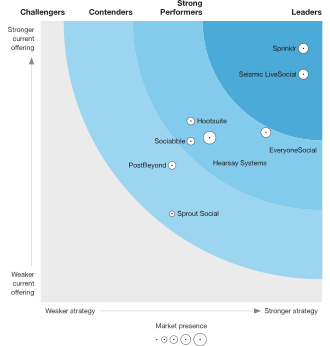
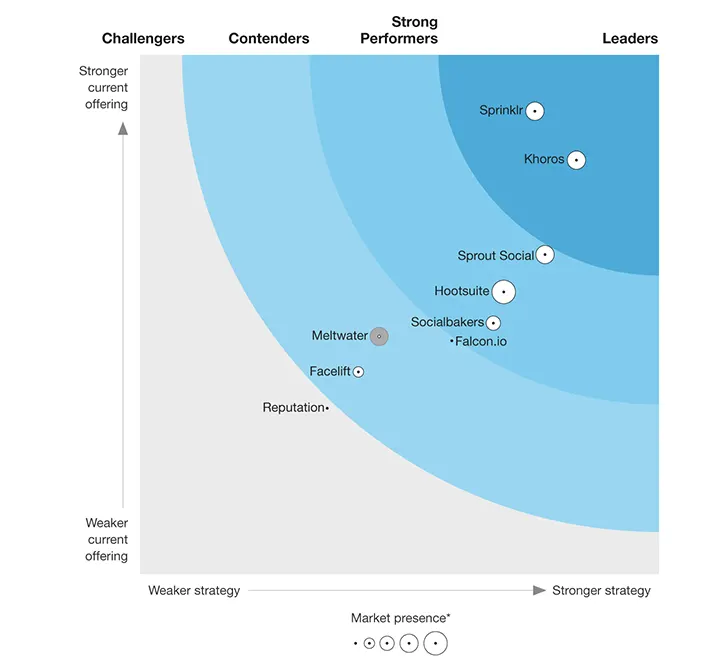
Yesterday, Forrester Research, Inc., published The Forrester Wave™: Social Relationship Platforms (SRP), Q2 2013.
Here’s the news — Forrester cited Sprinklr “the most powerful technology in the market.”
We held off on our announcement out of respect for the tragedy at the Boston Marathon. We decided that it was not appropriate or in line with our core values to celebrate and promote while so many were in shock, suffering, and mourning.
We are greatly encouraged by Forrester’s decision and efforts to define the Social Relationship Platform market. In our view, it is a sign that they share Sprinklr’s long standing vision of Social as a strategic enabler for brands. Since our founding in 2009, our singular, consistent focus and aspiration has been on building the most comprehensive, integrated enterprise social infrastructure to enable large organizations to be social at scale across channels, functions, and business silos. Forrester also noted that “Sprinklr set out to build a potent technology, and it succeeded.”
We certainly appreciate this accolade, one which we believe reflects our core capability to innovate at the speed of social, but we humbly maintain that the journey has just begun. We are building the best Social Relationship Platform on the market. We know that the social needs of enterprises are complex and we continuously strive to rapidly expand the capabilities of the more than 250 household name brands we already serve as well as the thousands we will serve soon.
The fact that we have had 15 feature releases alone since the December review of our platform by Forrester provides evidence to this point. Fifteen months ago, we set a course to reimagine the user experience for enterprise social software. Forrester evaluated our platform in early December, prior to the unveiling of our new User Interface in Q1, 2013. It’s simply unfortunate that the report does not reflect the results of this effort because of timing.
We encourage you to get a platform tour and judge for yourself. You’ll see just how powerful the best Social Relationship Platform is.
But, don’t take it from us. We prefer to let our clients do the talking.
Nick Ayres is the Manager, Social Marketing for InterContinental Hotels Group (IHG). As Nick says, “I’ve been in Social at the enterprise level for many years and have watched the landscape evolve dramatically. At IHG, we’ve built a sophisticated global social operation and as a result, our needs are fairly complex. Having seen most of the significant vendors in the market, there’s no doubt in my mind that Sprinklr is a leader that has the horsepower to deliver for IHG as we continue on our social business journey.”
We believe that large organizations require an integrated enterprise social infrastructure that spans channels, functions, and business silos, built around a unified profile and message model. The pronouncement that Sprinklr has the highest overall score and the best technology in the Social Relationship Platform market represents a clear indication that we are on the path to achieving our own very high standards in terms of both platform technology and comprehensive vision.
We look forward to sharing our solution and world-class technology with you. We also are excited to collaborate with executives and practitioners who share our vision of Social as a strategic imperative and opportunity for global brands. If you are one of these people, you’re welcome to join our movement. You can start by adding a comment below or connecting with us on Twitter, LinkedIn, Facebook, or Google+.
If you are interested in obtaining a platform tour of the “most powerful technology” in the Social Relationship Platform market or learning more about Sprinklr’s vision for enterprise social, please let us know.
--

This year marks his final season and, like many greats before him, he is doing a farewell tour.
What differentiates this tour from all the others before it is how the Yankees have evolved the tour to benefit from the rise of the mobile/social/network-empowered consumer.
Traditionally, a player of Rivera’s magnitude goes out to home plate (or center court, etc.) and there’s a big public ceremony; he gets some gifts, and the fans give him a standing ovation.
As the NY Times wrote:
Three years ago, when Rivera first considered retirement, he went to Jason Zillo, the Yankees’ director of communications, to discuss how he should commemorate his final year in baseball. This year, in spring training, he and Zillo devised a plan for Rivera to meet with different people in each city, whether team employees or fans.
In Cleveland, for example, Rivera met with some employees of the Indians organization and John Adams, a devoted fan who has been banging his bass drum at Indians games for 40 years, according to the article.
In every single city, then, Rivera and the Yankees are creating a new story and one that, by definition, is going to be retold.
At a minimum, by those 25 employees (or whomever) in the room, but more likely by an entire group of people surrounding the event, including friends, other fans, and online and MSM outlets.
Instead of “Oh, there was yet another big celebration for Rivera, but this time in our city,” now it’s “Rivera connected specifically with our fans, talking about his memories here, and making a new memory.”
While some say that the “big campaign” is dead, I’d disagree. The campaign is just fine, it’s the activities that make up the campaign that have changed drastically.
Instead of copy/paste marketing activities, social benefits most when the tactics are unique/customized to a smaller audience. And, counter-intuitively, those smaller events can (and — as we all get better at this — will) ultimately lead to greater reach, engagement, or whatever marketing objective you have, because of the power of the consumer to tell the story on your behalf.
The larger narrative — let’s celebrate Rivera’s accomplishments — used to be the one consistent theme. What the Yankees are doing is using that idea as the foundation upon which many small narratives (i.e. a dedicated fan who tries to distract the greatest reliever of all time by banging a drum) are built. Since each one is unique, it gets told more often, reinforcing the core narrative at the same time.
For the full story, you can read “Real-time Social at Scale: Oreos, Marco Rubio, and Unplanned Moments,” but the takeaways are these:
To do this, large organizations attempting to manage large volumes of messages require:
And that’s just the tip of the iceberg, since we haven’t even talked about security, governance, permissions, compliance, etc.
At least this is Sprinklr’s perspective and why we’ve built the platform in the way we have.
--
(Note: If you’d like to find out more about how Sprinklr can help your organization engage with the Chinese social market, please drop us a line. )
In Mary Meeker’s 2012 Internet Trends Year-End Update, the esteemed general partner at Kleiner Perkins Caufield & Byers made a number of critical observations about the future of the industry.
(Eric Markowitz did us all a service and summarized her report quite well in Inc. magazine.)
His number 1 takeaway?
As Eric wrote, “from 2008 to 2012, China added 282 million Internet users, bringing their total number of users close to double the population of the United States.”
It’s why we are extremely excited to share that Sprinklr now offers Sina Weibo, Tencent Weibo (RenRen), and QQ integration to our client partners.
In fact, two of our clients, Samsung and GM International are already engaging with the Chinese market via these social networks and using Sprinklr to do so.
Global organizations like Samsung and GMIO have come to expect and demand that their social infrastructure will allow them to monitor, engage, collaborate, and measure across teams, functions, divisions, and geographies. For them to effectively be social and at scale (Social@Scale™), ALL of their social audience-facing groups must be on the same secure, comprehensive platform, including those in China.
Sprinklr is solely and uniquely focused on large organizations and their needs. We understand their challenges and opportunities.
Now that 1 billion social media profiles can be engaged with through Sprinklr, we believe we have taken the next step to helping the brands we serve — and the brands we will serve — really be Social@Scale.
China, Welcome to Sprinklr
欢迎中国到 Sprinklr