






Erhalten Sie Echtzeit-Einblicke in Verbraucher, Wettbewerber und das Marktumfeld mit einer Genauigkeit von 90 %
Vereinheitlichen Sie Daten aus über 30 Kanälen. Gewinnen Sie umsetzbare Erkenntnisse und unterstützen Sie wichtige Geschäftsentscheidungen mit der KI-gestützten Consumer Intelligence Suite von Sprinklr.



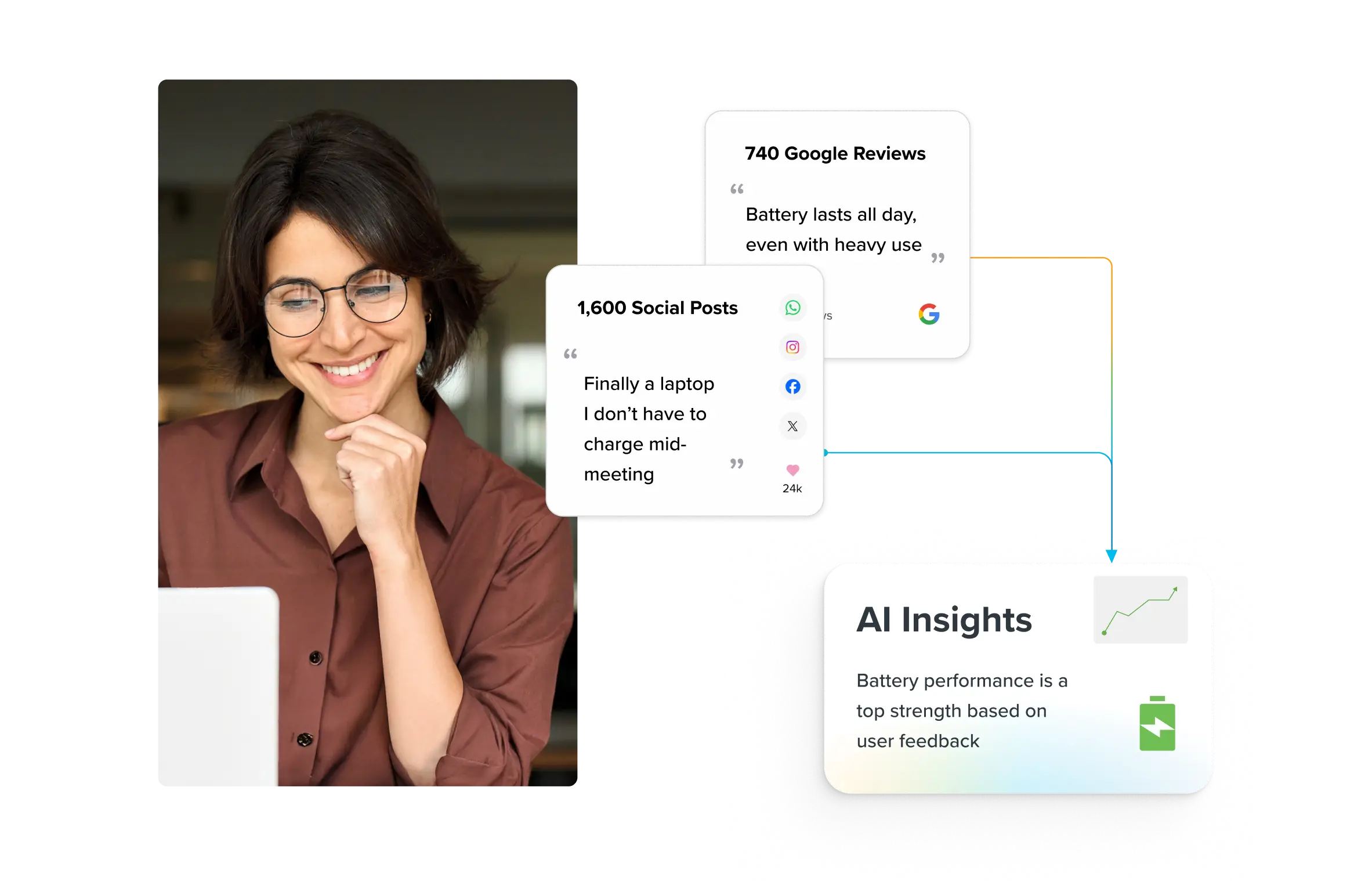
What is Customer Feedback Management and How to Do It
Issac Thomas is a content marketing professional with around eight years of experience across SaaS, fintech and B2B technology. During his three years at Sprinklr as a senior content writer, he authored long-form blogs, product pages and knowledge content across customer service and contact-centre topics, from call-centre technology and automation to conversational AI, NPS and customer feedback management.
Aksheeta Tyagi is an experienced content marketer specializing in customer service, customer experience, contact center technology and AI-powered customer support. She writes in-depth guides on customer feedback management, conversational AI, agentic AI and enterprise service transformation to help businesses deliver better customer experiences at scale.
Key takeaways
- Customer Feedback Management (CFM) turns scattered customer opinions into structured insight. Teams collect signals from surveys, reviews, support interactions and social conversations to understand what customers experience.
- Effective CFM runs on a three-step cycle: collect, analyze and act. Businesses capture feedback across touchpoints, use analytics to uncover patterns and implement changes that improve products, service and operations.
- Enterprises rely on CFM to prevent churn, guide product decisions and protect brand trust. Detect recurring complaints early, resolve friction points and use customer input to prioritize meaningful improvements.
- Strong feedback programs follow a clear workflow and remove barriers to action. Ask for feedback, categorize it, analyze trends, assign fixes to teams and follow up with customers to close the loop.
Every business claims to value and manage customer feedback — but let’s be honest, how much of it actually gets used? Feedback forms pile up, polite nods replace honest conversations and the “feedback loop” becomes a broken circle.
Customers often hold back, unsure if their opinions will matter, while businesses stick to templates that ask for input but rarely act on it. The result? A process that feels hollow on both sides. More than just collecting, you need a customer feedback management system that helps you change raw input into real practical findings with thoughtful collation, analysis and follow-through. The question is: are you ready to rethink the approach?
What is customer feedback management (CFM)?
Customer Feedback Management (CFM) is the systematic process of gathering, analyzing and acting on customer feedback to improve products, services and customer experience.
But more than just collecting opinions, customer feedback management is about building a framework that turns feedback into concrete action. For enterprises, CFM plays a dual role:
👉 Addressing immediate customer concerns
👉 Informing long-term strategies that shape growth
By integrating structured and unstructured insights from channels like customer surveys, social media, reviews and support tickets, you can catch patterns, prioritize fixes and deliver results that matter. When done right, customer feedback management is how you can stay relevant, trusted and truly customer-driven.
The 3 core components of CFM are...
1. Collection
Businesses collect feedback and opinions through various customer touchpoints, where customers naturally express opinions — whether it’s a quick post on social media or a detailed response to a follow-up email. Tools like automated surveys or social listening help ensure nothing is overlooked. Enterprises often use such tools to collect feedback in real-time, ensuring they catch insights at critical moments, like after a service interaction or a product purchase.
2. Analysis
Once collected, feedback needs to be unpacked. Tools like AI, sentiment analysis and categorization help break down what customers are saying, tracing common themes or sticking points. For example, if feedback repeatedly mentions delays or confusion in the process, those insights can be flagged for immediate review. The goal here is clarity — getting to the heart of what customers are actually saying, without getting lost in the noise.
3. Action
This is where feedback drives change. Whether it’s improving a flawed feature, closing gaps in customer service or upgrading internal workflows, action ensures feedback has a tangible impact. For enterprises, this step also ensures leadership uses feedback data to steer strategy, not just react to immediate issues.
These three elements work as a cycle, helping you stay in tune with your customers and build better experiences at every step.
Customer feedback management vs. Review management
Aspect | Customer feedback management | Review management |
Primary Purpose | Collects, analyzes and acts on feedback to improve products, services and CX effectively. | Manages customer reviews on third-party platforms and ensures efficient public responses. |
Scope of Feedback | Covers direct feedback, surveys, reviews, support tickets and social media. | Primarily reviews posted on platforms like Google, Yelp and social media. |
Touchpoints Covered | Includes public and private feedback channels across the entire customer journey. | Limited to public review sites and forums. |
Actionability | Leads strategic decisions, operational improvements and long-term CX upgrades. | Focuses on addressing individual complaints or praise publicly. |
Focus Area | Comprehensive improvement of customer experience and business operations. | Reputation management and improving online perception. |
Data Depth | Detailed insights with trend analysis, categorization and actionable data. | Surface-level insights, mainly sentiment and star ratings. |
System Integration | Highly integrated with CRM, product management and analytics platforms. | Standalone system with minimal integration into broader business processes. |
What’s the difference between customer feedback management and Voice of the Customer (VoC)?
Customer feedback management is the working system. It collects feedback, organizes it, analyzes it, and routes it to the teams that need to act. Voice of the Customer is broader. It’s the bigger discipline of understanding what customers are saying, feeling, and expecting across the full journey. In simple terms, VoC is the strategy; customer feedback management is the machinery that helps run it. Enterprises need both: one to hear the customer clearly, and the other to make sure that insight actually goes somewhere useful.
Why is a customer feedback management system crucial to enterprises
It’s interesting — over half of Americans read reviews for things they already know they need before deciding which brand to go with and more than three in 10 still check after they’ve picked one. Not only does feedback nudge preferences, but it also shapes purchase decisions and trust at every stage. Here’s why it’s important for enterprises to have a customer feedback management system.
❤️ Giving customers no reason to leave
Large enterprises often juggle thousands — if not millions — of customers. So, customer retention hinges on addressing frustrations before they escalate. A strong CFM system identifies recurring issues and fixes gaps, helping you strengthen trust and reducing customer churn.
🎯 Evolving your product with purpose
Customers are the most honest source of product feedback. Listening to their suggestions and pain points can help you spot opportunities for innovation, prioritize features customers truly want and stay ahead of the competition. It’s a built-in research engine that scales with your business.
✨ Making customer service frictionless
Delivering consistent service at scale is a balancing act — what works for a hundred customers can crumble when stretched to thousands. Feedback reveals where and why cracks start to form, whether it’s sluggish customer response times or recurring issues that aren’t fully resolved. Acting on this data empowers you to target the root causes of problems and ensure customers feel heard and supported — not just managed.
Know the real impact of customer feedback management for large companies?
Customer feedback is your safety net. Especially in an era where social media amplifies everything, the stakes are even higher for enterprises. One unresolved issue can trigger a ripple effect of public backlash turning into tomorrow’s viral headline. Managing feedback means listening closely, detecting the warning signs and fixing issues quietly before they turn into a PR storm. When feedback is managed well, it protects the trust you’ve built.
With Sprinklr’s Crisis Management Solution, you can respond to potential crisis three times faster. Using intuitive generative AI, you can scan 30+ social and digital channels, 400K+ media sources, 1B+ websites and review sites to detect anomalies and deploy your plan of action from a unified source of information.
See how this comes to life with a free demo today.
How to manage customer feedback [Detailed process]
Managing customer feedback involves several key steps to ensure that feedback is collected, categorized, analyzed and actioned effectively. Here is a detailed process with best practices and pro-tips for each stage:
Step 1: Ask for feedback
When you ask for customer feedback, follow these key steps.
- Clearly define your objectives and goals to guide the survey design.
- Consider using event-triggered surveys to capture responses based on specific user actions or events.
- When crafting questions, strike a balance between close-ended (quantifiable) and open-ended (expressive) formats.
- Ensure your survey is mobile-friendly with a responsive design. This will help assess the mobile experience of your customers.
- To prevent survey fatigue, limit the number of surveys you send out, keep them concise and skip logic.
- Additionally, supplement surveys with non-survey methods like observational research, diaries, interviews and biometric measures for a comprehensive understanding.
Last but not least, gather feedback from all the channels your customers use to interact with you. Utilize omnichannel tools that can integrate feedback from multiple sources into a centralized system for easier management.
💪 One omnichannel survey is enough
Creating a survey for every one of your channels is a daunting task, no doubt. That’s why you need an omnichannel survey solution that creates one survey to seamlessly deploy across multiple channels.
Be it social media, website or any other customer service channel, a unified survey adapts with ease as per your brand taste making customer feedback collection easier.
Curious?
Sprinklr’s Omnichannel Survey Solution supports 30+ modern and digital channels with plug-and-play surveys that are super scalable yet customizable. Book a demo today.
Step 2: Categorize the feedback
Use a feedback management system to organize feedback into categories like: -
- Product performance
- User experience
- Feature request
- Technical issues
- Customer support
- Pricing and billing
- General feedback
Tag and label feedback with metadata (e.g., customer demographics, feedback source) to enhance organization and analysis. Prioritize the feedback using techniques like the Urgent vs. Important matrix or feature prioritization frameworks. Assess the impact and feasibility of addressing each piece of feedback to ensure the most critical and actionable items are addressed first.
Step 3: Analyze the feedback
Use dedicated dashboards and AI-powered analytics to streamline the analysis process.
- Feedback analysis can be done based on customer service metrics like:
o Customer Satisfaction (CSAT)
- Generate reports on common issues, feature requests and sentiment trends to identify key areas for improvement.
- Utilize visualizations such as heatmaps to find frequent pain points, sentiment analysis charts to understand the emotional context of feedback and trend graphs to track changes over time.
These tools provide actionable insights by showing critical areas needing attention, enabling you to prioritize responses and optimize your strategies.
Be a step ahead, at all times
Using generative AI and verticalized models, you can transform scattered customer feedback into clear insights — what happened, why it happened and what you need to fix. Spot emerging trends and hidden customer frustrations early, without drowning in noise. AI-powered spam filters can even help you keep bots, ads and junk out, so you focus only on what matters. With sentiment analysis, intent detection, emotional cues and even visual associations, you’re actually making sense of the feedback you collect.
Sprinklr’s AI-first feedback management gets straight to the point. Take a stroll?
Step 4: Action the feedback
Turning feedback into action is where real change happens. Start by breaking it down —assign specific issues to the teams best equipped to resolve them, whether it’s product, customer support or operations.
- Create clear action plans that outline who’s responsible, what needs to be done and when it’ll be completed.
- Fix accountability, set realistic timelines and ensure progress doesn’t stall by using automated reminders and manager alerts for follow-ups.
- For critical feedback, especially negative input, treat it with urgency. Automatically create cases to track resolution and keep customers updated along the way.
A simple, “We’re working on fixing this and here’s where we are” builds transparency and reassures customers their concerns are being prioritized.
Step 5: Follow up
Following up is where you show customers their feedback wasn’t ignored. Be clear, direct and human. Reach out personally — through email, a call or a quick update — and tell them exactly what you’ve done to address their concerns. For example, “We’ve fixed the billing error you flagged and updated our process to prevent it from happening again.” carries more weight than something vague. Specificity builds trust.
Let them know their input didn’t just fix a problem for them — it helped improve the experience for everyone. If appropriate, invite them to share their updated experience on reviews or social platforms. Read More: 11 Ways to Thank Your Customers
Top 4 ways to overcome barriers in client feedback management
Large companies face predictable roadblocks when trying to act on customer feedback: disengaged employees, resistance to change and feedback that feels like noise instead of insight. But the real failure? Treating feedback as a task instead of a lifeline. Here’s how enterprises can rethink these barriers:
1. Employees are not engaged in the feedback process
If employees see feedback as a performance review, the interaction becomes transactional. They focus on earning high scores instead of looking for actual learning. For example, a contact center agent might deliver great service only to awkwardly beg for a “5-star” review at the end — ruining the experience altogether.
Solution: Redefine the role of feedback. Teach teams to ask better questions like, “What’s one thing I could have done to make your experience better?” This shifts the focus from scoring to learning. Pair this with regular customer service coaching on how to dig deeper into customer responses — sometimes the second or third question brings the real issue to light. Make improvement — not ratings — the goal.
2. Teams resist change because feedback feels disruptive
It’s easy to dismiss feedback when it challenges the way things have always been done. Teams assume change will mean added work or unintended chaos.
Solution: Start small and prove the value. Instead of rolling out massive process changes across the board, experiment in smaller areas of the business. For example, test a new feature update with a small customer segment and collect direct feedback on it. When changes work, celebrate them visibly. Teams are more open to feedback-driven improvements when they see tangible wins — and when leadership frames it as progress, not disruption.
3. Feedback is collected but rarely turns into action
Collecting feedback without follow-up is the equivalent of asking for advice and ignoring it. Many companies get stuck in this loop because feedback data is scattered across systems, making it hard to act.
Solution: Make feedback actionable and visible using Unified Customer Experience Management (Unified-CXM). Set up systems where feedback can’t be ignored — use omnichannel routing to assign cases to the right teams and assign clear ownership. For frontline teams, empower employees to flag recurring issues (like a product flaw or broken process) and send those insights upstream. Pair behavioral data — like abandoned carts or repeated purchases — with direct feedback. For example, if customers are leaving half-eaten plates at a restaurant, that’s silent feedback. Observing what customers do often speaks louder than what they say.
This is why unsolicited feedback from customers is such a goldmine. What might feel like a random opinion floating around online can actually help you connect the cause of an issue with the effect it renders. Check out how capturing it looks like with Sprinklr' Feedback Management and book a demo to see it come to life on your screen.
4. Feedback is treated as a “check-the-box” task
A quarterly survey might look good on paper, but it won’t catch issues before they explode. Customers don’t wait three months to leave — you just won’t know why they left.
Solution: Make feedback continuous and responsive. Integrate quick feedback mechanisms throughout the customer journey: a post-service text, a follow-up email after a product launch, or tools that capture real-time behavior. Beyond gathering data, pair it with micro-experiments — test small changes and ask for input right away: “We updated this process; did it improve your experience?” Feedback becomes part of the culture when it’s seen as a tool for constant iteration, not a periodic burden.
Listening Loud and Clear: Vi’s Real-Life Win with Google Reviews
For Vodafone Idea (Vi), India’s telecom giant serving over 230 million customers, Google reviews became a turning point. With 450+ retail stores and 2,000 small outlets, Vi knew it had to dial it in and start listening to them.
But the challenge was that its Google reviews were slipping through the cracks. Customers shared frustrations online, but responses were impersonal — asking them to email for help. The result: frustrated customers, confused agents and lost chances to fix in-store experiences.
Partnering with Sprinklr, Vi flipped the script. Agents now respond to reviews with a simple, secure link to collect customer details privately. From there, it’s personal. A follow-up call, real solutions and sometimes, a customer so satisfied they update their review.
The results speak for themselves: faster responses, happier customers and a spike in positive reviews. Vi even doubled down by rolling out QR codes across 400 stores, encouraging feedback and making reviews a two-way conversation. Read the whole story here!
Stop chasing feedback. Start understanding it.
Managing customer feedback is a mindset shift. Large enterprises can’t afford to treat feedback as routine data. It’s the difference between catching problems early or watching them explode, between small tweaks and massive PR crises. Closing the loop, acting with intention and embedding feedback into daily operations separates brands that evolve from those that stagnate.
Sprinklr’s Feedback Management System makes the process effortless and intelligent:
- AI-powered insights: Go beyond surface-level surveys — validate results with social listening, reviews and service conversations to see the full picture.
- Unified reporting: Capture feedback across channels and unify it into one actionable report.
- Conversational surveys: Use AI-powered, engaging surveys to combat low response rates and pull up rich insights.
- Real-time crisis detection: Implement an enterprise-grade Early Warning System to spot and defuse issues before they snowball.
- Actionable market insights: Identify themes and trends from industry conversations to guide wiser decisions.
- Streamlined workflows: Automate survey creation, eliminate manual analysis and surface root causes instantly.
Turn scattered feedback into clear direction, silent signals into solutions and customer voices into your brand’s competitive edge with Sprinklr.

Frequently Asked Questions
Large companies collect feedback through surveys (email, in-app, post-interaction), support tickets, social media comments, product reviews, live chats, and direct conversations. They also use social listening tools to capture insights, ensuring every customer voice, spoken or unspoken, is heard.
AI helps sort through massive volumes of feedback by finding patterns, analyzing sentiment and categorizing data automatically. It detects trends, flags urgent issues and even predicts impending problems. AI-driven tools also power conversational surveys and provide actionable insights, replacing guesswork with clear, data-backed decisions.
Customer feedback pinpoints exactly where products and services fall short or shine. By listening to recurring customer pain points and suggestions, businesses can prioritize updates, develop features customers actually want and deliver targeted customer service.
Businesses should centralize feedback collection while localizing responses. Assign local teams to act on insights specific to their market and close the loop in a way that feels personal and relevant. With Sprinklr’s Survey Translations, you can support customers who speak multiple languages and absorb cultural contexts to interpret regional sentiment accurately.
Absolutely. Feedback reveals why customers leave before they actually do. Addressing frustrations early — whether it’s a product flaw or poor service — builds trust and prevents churn. Customers stay loyal when they see their input driving meaningful improvements and know their concerns matter.
Issac Thomas is a content marketing professional with around eight years of experience across SaaS, fintech and B2B technology. During his three years at Sprinklr as a senior content writer, he authored long-form blogs, product pages and knowledge content across customer service and contact-centre topics, from call-centre technology and automation to conversational AI, NPS and customer feedback management.
Aksheeta Tyagi is an experienced content marketer specializing in customer service, customer experience, contact center technology and AI-powered customer support. She writes in-depth guides on customer feedback management, conversational AI, agentic AI and enterprise service transformation to help businesses deliver better customer experiences at scale.
Explore Customer Feedback Management