




Elevate CX with unified, enterprise-grade listening
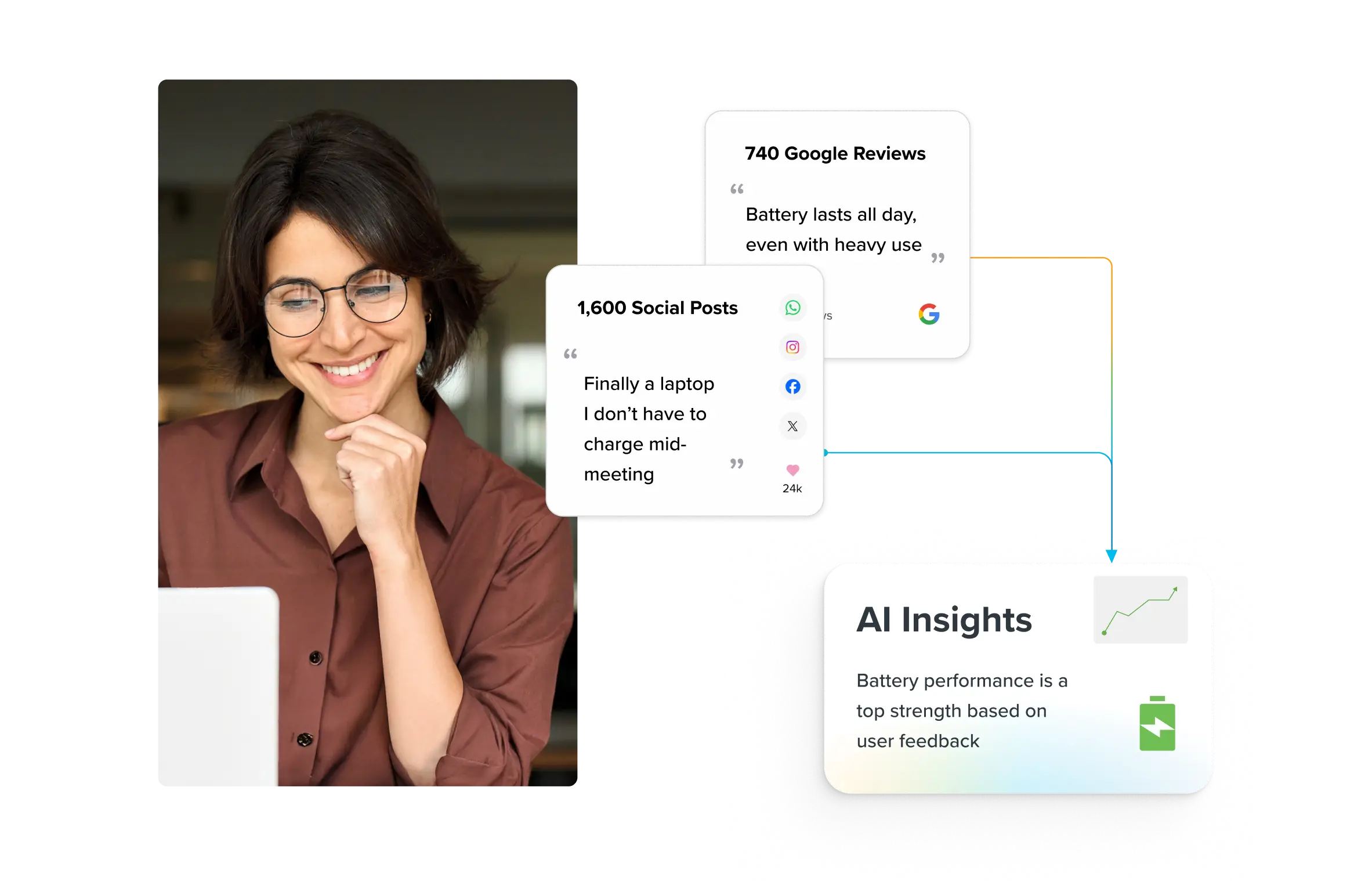
Sprinklr Insights gives you real-time consumer, competitor and market intelligence from 30+ channels without the noise. Make smarter decisions, strengthen your brand, and stay relentlessly customer-led.



13 Best Voice of the Customer (VoC) Tools for 2026
Jayadeep Subhashis is a senior B2B content specialist and editor with over a decade of experience creating content across blogs, whitepapers, eBooks, case studies, sales enablement assets and account-based marketing campaigns. During his time at Sprinklr, he led editorial strategy for Sprinklr Service, shaping content around customer experience, contact centres, Voice of the Customer and enterprise AI.
Aksheeta Tyagi is an experienced content marketer specializing in customer service, customer experience, contact center technology and AI-powered customer support. She writes in-depth guides on customer feedback management, conversational AI, agentic AI and enterprise service transformation to help businesses deliver better customer experiences at scale.
- The best Voice of the Customer tool depends on how your organization captures, analyzes and acts on customer feedback.
- Platforms like Sprinklr Insights, Qualtrics, or Medallia are the best if you need to unify customer feedback across surveys, social channels, reviews, contact centers and digital touchpoints.
- Tools like SurveyMonkey, Alchemer, Sprinklr Survey and PG Forsta work well for collecting structured feedback through NPS, CSAT, CES and customer satisfaction surveys.
Voice of the customer (VoC) is the practice of capturing, centralizing, and analyzing customer feedback across touchpoints such as surveys, support tickets, call transcripts, reviews, and social media to generate insights that inform business decisions.
For enterprise teams, the complexity lies in interpreting this feedback at scale. Customer interactions span multiple channels, and most data is unstructured and continuously evolving. Without the right systems in place, important signals are often missed or misinterpreted, leading to churn, delayed product decisions, and declining customer satisfaction.
A modern VoC platform brings structure to this fragmented data and enables teams across CX, product, marketing, and customer success to act on consistent, reliable insights.
This guide compares seven leading VoC tools across enterprise criteria, including AI capability, integration depth, analytics quality, and pricing models, to help CX leaders make an informed purchase decision.
What is a Voice of the Customer (VoC) tool?
A voice of the Customer (VoC) tool enables you to collect and analyze feedback across channels such as surveys, email, live chat, call transcripts, social media, and app reviews. Their primary function is to convert unstructured customer input into structured insights that product, marketing, and customer success teams can act on with clarity.
These tools play a distinct role within the broader CX ecosystem. While CX platforms focus on delivering and managing experiences, VoC tools focus on capturing customer signals and translating them into direction for teams responsible for product, service, and experience decisions.
Key benefits of VoC tools
- Unified feedback visibility: Aggregates signals across channels into a centralized system, reducing gaps caused by fragmented data sources.
- Faster time to insight: Uses automated tagging, categorization, and sentiment analysis to reduce the time between feedback collection and decision-making.
- Proactive issue detection: Identifies emerging patterns and themes early, allowing teams to address potential churn drivers before they escalate.
- Cross-functional alignment: Converts customer feedback into insights that can be consumed consistently across product, marketing, support, and leadership teams.
- Closed-loop accountability: Tracks follow-up actions on feedback and measures whether those actions led to measurable outcomes.
Common VoC use cases in enterprises
Most enterprise VoC programs are built around a primary operational need. The choice of tool depends on which of the following contexts is most relevant:
- Enterprise CX and feedback centralization
Brands managing high volumes of feedback across channels, teams, and geographies require a unified system to consolidate data and maintain consistency in insights. - Survey-driven insights and closed-loop feedback
Enterprises running NPS, CSAT, or CES programs require workflows that connect feedback to action, ensuring ownership and resolution for each signal. - AI-driven text and conversation analytics
Brands that handle large volumes of unstructured data from support interactions and conversations rely on AI to detect patterns that are not visible to manual analysis. - Real-time social listening
Organizations that monitor public customer sentiment need systems that can detect shifts in perception early and provide visibility into emerging risks or opportunities.
Top 13 voice of the customer (VoC) tools for 2026
Enterprise CX programs operate across multiple channels, teams, and geographies. The primary requirement in this context is not feedback collection alone, but the ability to unify signals, analyze them in real-time, and connect insights to operational workflows.
This category includes platforms designed to act as a central system for customer feedback, combining data ingestion, analytics, and action frameworks into a single layer.
Important note for readers
The following tools are in no particular order of ranking or popularity. Still, they are independent picks by Sprinklr’s editorial team based on our research and publicly available information on the review sites. It is crucial to note that software or platforms may evolve over time and the company may address some of these concerns in newer updates or versions.
Sprinklr Insights
Sprinklr Insights enables enterprises to build a comprehensive customer feedback management system that aggregates feedback and insights across multiple sources and methodologies. Through its integrated suite of tools—surveys, social listening, product insights, and customer interaction analysis—Sprinklr Insights captures what customers are saying, thinking, and feeling across all touchpoints.
Sprinklr Insights enables comprehensive VoC programs for brands that require a unified view of customer experience across digital, social, and contact center interactions. Its strength lies in consolidating large volumes of structured and unstructured feedback into a single system and connecting that intelligence to downstream workflows.
Sprinklr's voice of the customer platform benefits from its broader ecosystem across social media management, conversational AI, and contact center solutions, which allows VoC insights to extend beyond reporting into execution.
Top features
- 30+ channel coverage
Captures feedback across social media, messaging platforms, email, chat, voice, and review sites, enabling a unified view of customer signals across digital and conversational touchpoints. - AI-powered sentiment detection
Uses AI models to analyze unstructured feedback at scale, identifying sentiment, intent, and emerging themes across conversations. - CRM integrations
Connects VoC insights with systems such as Salesforce and Microsoft Dynamics 365, allowing teams to link feedback directly to customer records and workflows.
✅ Best suited for: Large enterprises looking to centralize CX data across channels and operationalize insights across multiple teams Pros: Strong integration across digital and social channels, a unified data model, and the ability to connect consumer insights directly to CX operations and workflows
Cons: The interface can require onboarding time, particularly for teams new to unified CXM platforms or managing multiple modules.
Qualtrics
Qualtrics is primarily adopted in organizations that rely on structured feedback to drive experience improvements. It combines survey-based data, digital experience signals, and operational metrics into a centralized experience management platform. The platform is known for its depth in survey design, advanced analytics, and role-based reporting, which allows different teams to access insights relevant to their function.
Top features
- Advanced survey engine
Supports complex survey logic, distribution, and customization for programs such as NPS, CSAT, and CES. - Predictive analytics and driver analysis
Identifies key factors influencing customer experience metrics and helps prioritize areas of improvement. - Role-based dashboards and workflows
Delivers tailored insights to different teams and automates follow-up actions based on feedback.
✅ Best suited for: Brands running mature, survey-led CX programs that require structured feedback and deep analytics
Pros: Robust survey design, mature analytics capabilities, and strong governance for enterprise-wide feedback programs.
Cons: Less flexible when handling large volumes of unstructured, multi-channel feedback outside survey-driven programs.
Getting started: Visit website
Medallia
Medallia is designed for enterprises that need visibility across end-to-end customer journeys and the ability to act on feedback within operational workflows. It brings together signals from multiple touchpoints and connects them to specific moments in the customer lifecycle. The platform is strong in routing insights to frontline teams, enabling you to respond to feedback in context and track the impact of those actions over time. This makes it well-suited for environments where experience management is closely tied to day-to-day operations. Top features
- Journey analytics and mapping
Connects feedback to specific stages in the customer journey, helping teams understand where experience breakdowns occur. - Closed-loop workflow management
Routes feedback to the right teams and tracks follow-up actions to ensure accountability. - Omnichannel feedback collection
Captures signals across digital, in-store, and service interactions to provide a comprehensive view of experience.
✅ Best suited for: Enterprises managing complex customer journeys across multiple business units or regions
Pros: Effective at linking feedback to customer journeys, strong action management workflows, and proven scalability in large enterprises.
Cons: Configuration and ongoing management can require dedicated resources, particularly in large or highly customized deployments
Getting started: Visit website
Verint
Verint approaches VoC as part of a broader customer engagement and contact center strategy. It focuses on capturing and analyzing feedback from service interactions, including calls, chats, and agent workflows, and linking those insights to operational performance. Verint’s strength lies in turning service conversations into structured insights that can improve both customer outcomes and workforce efficiency.
Top features
- Speech and text analytics
Analyzes call recordings, chat transcripts, and digital conversations to extract sentiment, intent, and recurring themes. - Contact center integration
Connects VoC insights directly with agent performance, quality management, and workforce optimization systems. - Interaction analytics at scale
Processes large volumes of service interactions to identify patterns that impact customer satisfaction and operational efficiency.
✅ Best suited for: Enterprises with large contact center operations where service interactions are a primary source of customer feedback.
Where it stands out: Deep integration with contact center workflows, strong speech analytics capabilities, and alignment with workforce performance.
Pros: Strong in service interaction analytics, tightly integrated with contact center operations, and effective for improving agent-level performance.
Cons: Less comprehensive in capturing feedback from digital and social channels outside the contact center ecosystem.
Getting started: Visit website
PG Forsta
PG Forsta brings together the voice of customer capabilities with deep roots in market research and analytics. The platform is often used in industries where research accuracy, compliance, and methodological rigor are critical. In addition to VoC data, it supports broader research programs, enabling teams to combine customer feedback with market and brand insights.
Top features
- Advanced survey and research capabilities
Supports complex research methodologies, sampling, and survey design for both CX and market research programs. - Predictive and prescriptive analytics
Uses statistical models to forecast trends and recommend actions based on feedback data. - Industry-specific solutions
Offers tailored frameworks for sectors such as healthcare, financial services, and public sector organizations.
✅ Best suited for: Brands that require a combination of VoC and market research, particularly in regulated or research-intensive industries
Pros: High analytical rigor, strong support for research-driven programs, and suitability for regulated environments.
Cons: May require specialized expertise to fully leverage advanced research and analytics capabilities.
Getting started: Visit website
Brandwatch
Brandwatch is built for brands that need deep, research-grade insight from social and digital conversations. Its audience segmentation, demographic analysis, and data visualization layer (Vizia) make it a strong fit for market research and consumer intelligence teams who treat social data as a primary research input.
Top features
- Advanced querying & segmentation
Builds complex Boolean queries and uses machine-learning classifiers to segment mentions by topic, sentiment, demographics and custom tags. Lets you drill into specific issues or audiences in large conversation streams. - AI-powered emotion clustering
Moves beyond polarity-based sentiment to identify specific emotional states, such as frustration over a product issue or excitement around a launch. - Demographic and geolocation analysis
Segments conversation data by audience profile and geography, supporting both global and regional brand analysis.
✅ Best suited for: Market research and consumer intelligence teams that use social data as a primary research source and have the analyst resources to work at depth
Pros: Research-grade data depth, strong historical coverage, advanced audience segmentation, and robust visualization through Vizia.
Cons: Primarily an analytics engine; it lacks built-in case management or CRM workflows. Also, it may cause “data silos" as sometimes it can be difficult to integrate its raw data back into a standard CRM (like Salesforce) without a high-tier API plan.
Getting started: Visit website
Talkwalker
Talkwalker focuses on social and digital listening with an emphasis on AI-driven analysis and visual data interpretation. It captures conversations across social platforms, news sites, blogs, forums, and review channels, and applies AI to detect patterns, sentiment shifts, and emerging topics in near real-time.
Top features
- AI-powered trend detection
Identifies emerging themes, spikes in conversation, and sentiment shifts using machine learning models trained on large datasets. - Image and video recognition
Analyzes visual content such as logos, scenes, and objects across social and digital media to capture brand mentions beyond text. - Pre-built dashboards and alerts
Provides ready-to-use dashboards and automated alerts for tracking brand health, campaigns, and potential risks.
✅ Best suited for: Brands that need fast, AI-driven insights from social and digital conversations, especially for brand monitoring and communications.
Pros: Effective at identifying emerging trends quickly, strong visual recognition capabilities, and accessible dashboards for non-technical teams.
Cons: Less flexible in deep custom analysis compared to tools built for advanced querying and research workflows.
Getting started: Visit website
Meltwater
Meltwater monitors social media networks alongside online and print media sources, making it a natural choice for brands where PR, communications, and CX teams need to operate from shared intelligence. The platform's Explore module is designed for enterprise teams requiring unlimited search volume with advanced analytics.
Top features
- Integrated media and social monitoring
Covers news, print, broadcast, and social channels on a single platform, supporting cross-functional use by PR, communications, and CX teams. - Mira Studio AI agents
Purpose-built agents for industry roundups, news briefings, and coverage reports, reducing manual effort in routine reporting workflows. - GenAI Lens for LLM tracking
Monitors how a brand appears in AI-generated responses across major LLMs, providing a new layer of brand visibility beyond traditional digital channels.
✅ Best suited for: Brands where communications, PR, and CX functions need a shared media intelligence layer, particularly those in regulated industries or operating across global markets.
Pros: Comprehensive media monitoring, good social listening capabilities, and useful benchmarking for brand and PR teams.
Cons: Less depth in advanced analytics and workflow integration compared to platforms focused purely on enterprise VoC or CX operations. Also, some niche and regional media sources fall outside the platform's coverage, which can matter for brands operating in specific markets.
Getting started: Visit website
Sprout Social
Sprout Social combines social media management with listening capabilities, enabling you to monitor conversations, engage with audiences, and measure performance within a single platform. It captures data across major social networks and presents it through accessible dashboards designed for day-to-day use. The platform is often used by social and digital teams that require both listening and publishing capabilities, with a focus on execution and responsiveness rather than deep analysis.
Top features
- Social listening and keyword tracking
Monitors brand mentions, hashtags, and keywords across social platforms to track conversations and sentiment. - Integrated publishing and engagement
Allows teams to respond to messages, manage conversations, and publish content directly from the same interface. - Performance reporting and analytics
Provides reports on engagement, audience growth, and campaign performance across social channels.
✅ Best suited for: Social media and CX teams that need high-quality, AI-accelerated listening insights and want those insights connected to publishing, engagement, and customer care workflows within a single platform.
Pros: Sprout Social’s proprietary AI agent Trellis significantly reduces the time required to surface actionable insights; strong integration between listening, engagement, and content workflows.
Cons: Social listening is a paid add-on, not included in standard plans, which affects total cost of ownership calculations at the enterprise level. Trellis is currently scoped to listening data only, so teams expecting broader VoC data coverage across surveys, reviews, or support interactions will need to evaluate whether the platform's current architecture meets those requirements.
Getting started: Visit website
SurveyMonkey
SurveyMonkey supports NPS, CSAT, CES, and custom survey formats, with a template library and AI-assisted creation layer that reduces time to deployment. The AI layer helps with question optimization, theme detection, and response analysis across open-ended fields.
Top features
- SurveyMonkey AI for response analysis
Automatically identifies themes, sentiment shifts, and patterns across open-ended responses, reducing the manual work of synthesizing large volumes of qualitative feedback. - Multilingual survey distribution
Supports survey deployment and email distribution across multiple languages from a single survey build, improving response rates in global programs. - Role-based reporting and data segmentation
Enables teams to filter and compare responses by demographic, source, and time period, supporting both tactical analysis and longitudinal tracking.
✅ Best suited for: CX and market research teams that need a fast, familiar, and cost-effective survey platform for structured feedback programs without complex enterprise configuration requirements
Pros: High brand familiarity accelerates adoption; strong template library and AI-assisted creation reduce setup time; accessible pricing relative to enterprise-tier competitors.
Cons: Less suited if you need deep closed-loop workflow automation, advanced journey-level analysis, or integration of survey data with broader unstructured feedback sources.
Getting started: Visit website
Alchemer
Alchemer’s core value proposition is configurability. It allows you to build feedback programs that fit your existing workflows rather than reshaping workflows to fit the platform. Alchemer Workflow triggers real-time surveys based on key events that affect your business, with closed-loop actions that push data into existing software systems. For teams that want structured feedback to feed directly into CRM, support, or product systems without manual export steps, that workflow layer is a practical differentiator.
Top features
- Alchemer workflow for event-triggered feedback
Launches surveys automatically based on business events and pushes responses into connected systems, enabling closed-loop feedback without manual intervention. - Flexible survey logic and customization
Supports advanced branching, piping, and custom scripting, giving research and CX teams precise control over survey structure and respondent experience. - Reputation management and location intelligence
Extends structured feedback with review site monitoring and local search data, giving multi-location enterprises a broader view of customer sentiment.
✅ Best suited for: CX, market research, and product teams that need a highly configurable feedback platform with strong workflow automation and the flexibility to scale programs without heavy IT dependency.
Pros: Strong customization depth; fast implementation; event-triggered workflows reduce manual effort in closed-loop processes.
Cons: Some users report that AI capabilities trail behind newer entrants in the category. Platform breadth can create a learning curve for teams managing complex reporting setups across multiple feedback programs simultaneously.
Getting started: Visit website
Chattermill
Chattermill occupies a distinct position in this category. Rather than positioning itself as a data collection tool, the platform focuses on applying deep AI-powered analysis to customer feedback that already exists, revealing the reasoning behind the numbers across surveys, reviews, support conversations, and social media interactions.
Top features
- Lyra AI for deep theme and sentiment detection
Goes beyond keyword matching and polarity scoring to identify multiple concepts, emotional states, and sentiment nuances within a single piece of feedback, producing more granular insight than standard NLP models. - Impact scoring linked to business metrics
Automatically surfaces which feedback themes are having the greatest impact on business outcomes. - Unified feedback hub across channels
Consolidates surveys, reviews, support tickets, social media, and voice call data into a single analysis layer.
✅ Best suited for: CX, VoC, and product teams at mid-market to enterprise brands that need to make sense of large volumes of existing unstructured feedback and connect those insights directly to customer retention and satisfaction metrics
Pros: Lyra AI delivers strong accuracy on theme and sentiment detection; impact scoring makes prioritization defensible.
Cons: Chattermill focuses on analysis rather than survey creation, which means it requires existing feedback collection tools to feed the platform. Teams without a mature multi-channel data collection setup may find the platform's value harder to realize.
Getting started: Visit website
Thematic
Thematic helps you analyze large volumes of customer feedback across surveys, support tickets, and product channels using AI-driven theme detection. It focuses on identifying patterns in customer language and organizing feedback into structured themes that can inform product and CX decisions.
Top features
- AI-driven theme extraction
Automatically groups feedback into themes and sub-themes based on customer language, reducing the need for manual tagging. - Unified feedback analysis
Combines data from surveys, support systems, and product feedback into a single analytical view. - Insight prioritization and reporting
Highlights the most impactful themes and trends to support decision-making across teams.
✅ Best suited for: Product, CX, and insights teams that need fast, AI-driven analysis of feedback across multiple sources
Pros: Fast time to insight, minimal setup for feedback analysis, and strong alignment with product and CX workflows.
Cons: Less depth in speech analytics and enterprise contact center integrations compared to specialized platforms.
Getting started: Visit website
Which voice of the customer tool is the right fit for your business?
Choosing the right VoC tool depends on how your brand collects, analyzes, and acts on customer feedback. The table below maps common business needs to the most relevant tools based on real-world use cases.
Business requirement | Primary need | Ideal VoC tools |
Managing feedback across multiple channels and teams Running NPS, CSAT, and structured feedback programs | Centralized visibility and operational alignment Survey design, distribution, and closed-loop workflows | Sprinklr Insights, Medallia, Qualtrics Sprinklr Surveys, SurveyMonkey, Alchemer |
Monitoring brand perception across social and digital channels | Real-time sentiment tracking and trend detection | Sprinklr Insights, Brandwatch, Meltwater |
Analyzing large volumes of customer conversations | Theme & text detection, sentiment analysis, and root cause identification | Sprinklr Insights, Thematic, Chattermill |
Final thoughts
Voice of the customer programs have evolved beyond feedback collection into a core capability for decision-making across CX, product, and marketing teams. The challenge is no longer access to feedback, but the ability to interpret it consistently and act on it at the right moment.
The tools covered in this guide reflect different approaches to solving that problem. Some are designed for structured feedback and governance. Others focus on real-time listening or deep analysis of conversational data. Each category addresses a specific layer of the VoC lifecycle, and the right choice depends on how your organization captures and uses customer input.
For most enterprises, the decision is not about selecting a single tool. It is about building a system that can connect feedback from multiple sources, translate it into clear insights, and enable teams to respond with speed and accountability.
As VoC programs mature, the emphasis shifts toward integration, consistency, and actionability. Tools that can unify signals across channels and align insights with business workflows become increasingly valuable.
Selecting a VoC platform should therefore be approached as a long-term capability decision, not just a feature comparison. The goal is to ensure that customer feedback does not remain fragmented but becomes a reliable input into how your business operates and grows.
If you are evaluating how to bring these capabilities together, exploring platforms such as Sprinklr can provide a practical view of how unified VoC programs operate in real-world environments. All you need to do is hit the button below!
Jayadeep Subhashis is a senior B2B content specialist and editor with over a decade of experience creating content across blogs, whitepapers, eBooks, case studies, sales enablement assets and account-based marketing campaigns. During his time at Sprinklr, he led editorial strategy for Sprinklr Service, shaping content around customer experience, contact centres, Voice of the Customer and enterprise AI.
Aksheeta Tyagi is an experienced content marketer specializing in customer service, customer experience, contact center technology and AI-powered customer support. She writes in-depth guides on customer feedback management, conversational AI, agentic AI and enterprise service transformation to help businesses deliver better customer experiences at scale.