How is Customer Sentiment Detected?
Updated
Sentiment Calculation Process
The sentiment calculation for each message within a live conversation is carried out by considering the latest up to 10 messages from both the customer and the agent. This approach aims to capture context, and based on this context, the sentiment of the current message is predicted. The sentiment can be classified as positive, negative, or neutral.
Importantly, this process is executed in real-time as the conversation unfolds, not after the case has been closed. After the case is closed, a final sentiment is predicted for the entire case.
This sentiment analysis is an automated and continuous process that runs for every case. No additional configuration is required, making it a seamlessly integrated component of the overall conversation monitoring workflow.
Considerations
Greetings and Expressions of Gratitude
Messages such as greetings and thank yous, as well as introductory messages, are identified as neutral since they typically do not significantly impact the sentiment of the conversation.
Repetition of Issues by Customer
If the customer has to repeat their issue, the sentiment associated with that particular message is categorized as negative. This accounts for potential frustration or dissatisfaction arising from a lack of resolution in earlier interactions.
Agent's Troubleshooting and Resolution
Positive sentiment is assigned when the agent successfully troubleshoots the issue, and the conversation progresses smoothly. Additionally, if the issue is ultimately resolved, it contributes to a positive sentiment score.
View Sentiment in Case Analytics View
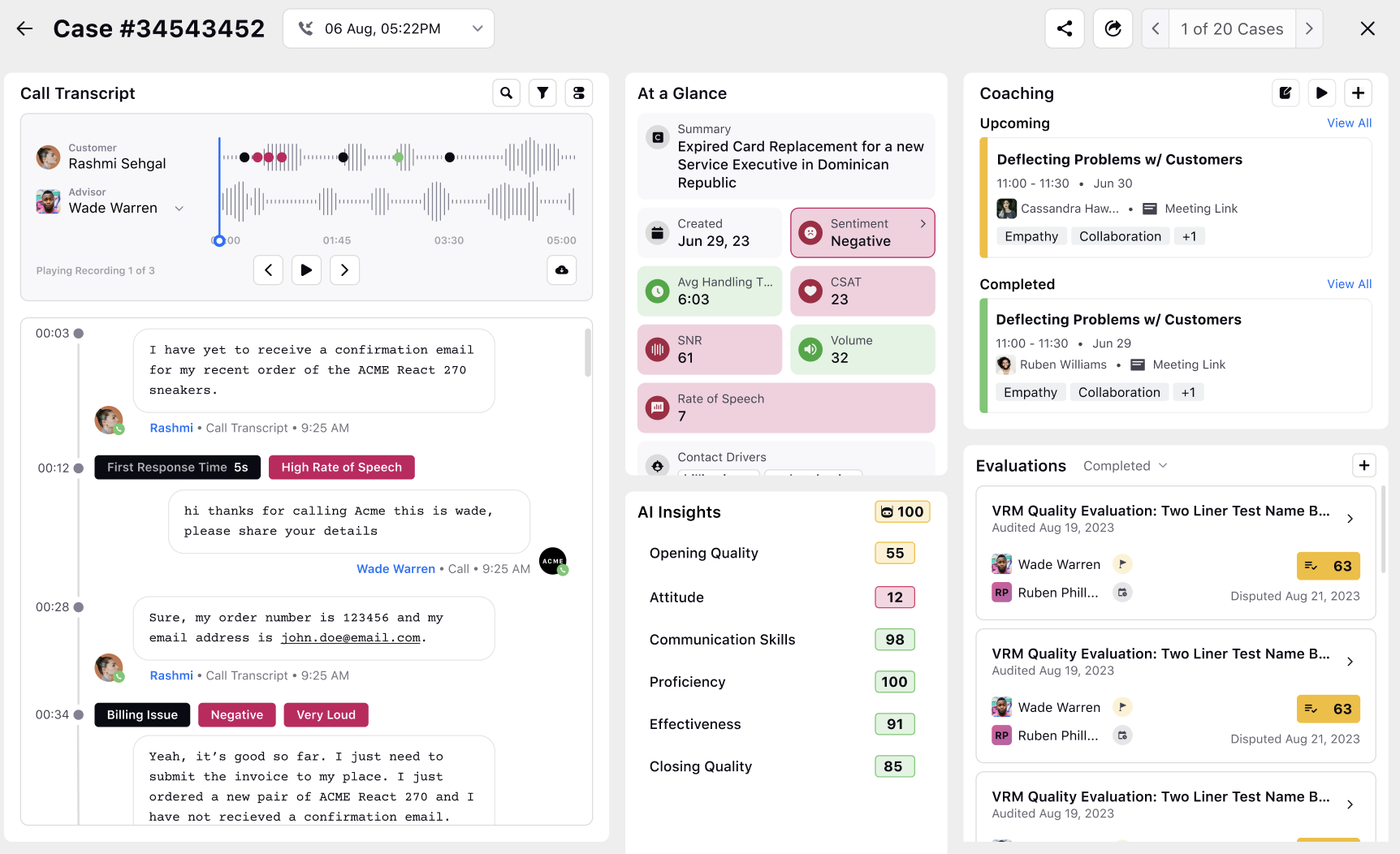
Access the final sentiment for the case within the At a Glance widget. Click on the sentiment score to explore and navigate to the related messages.
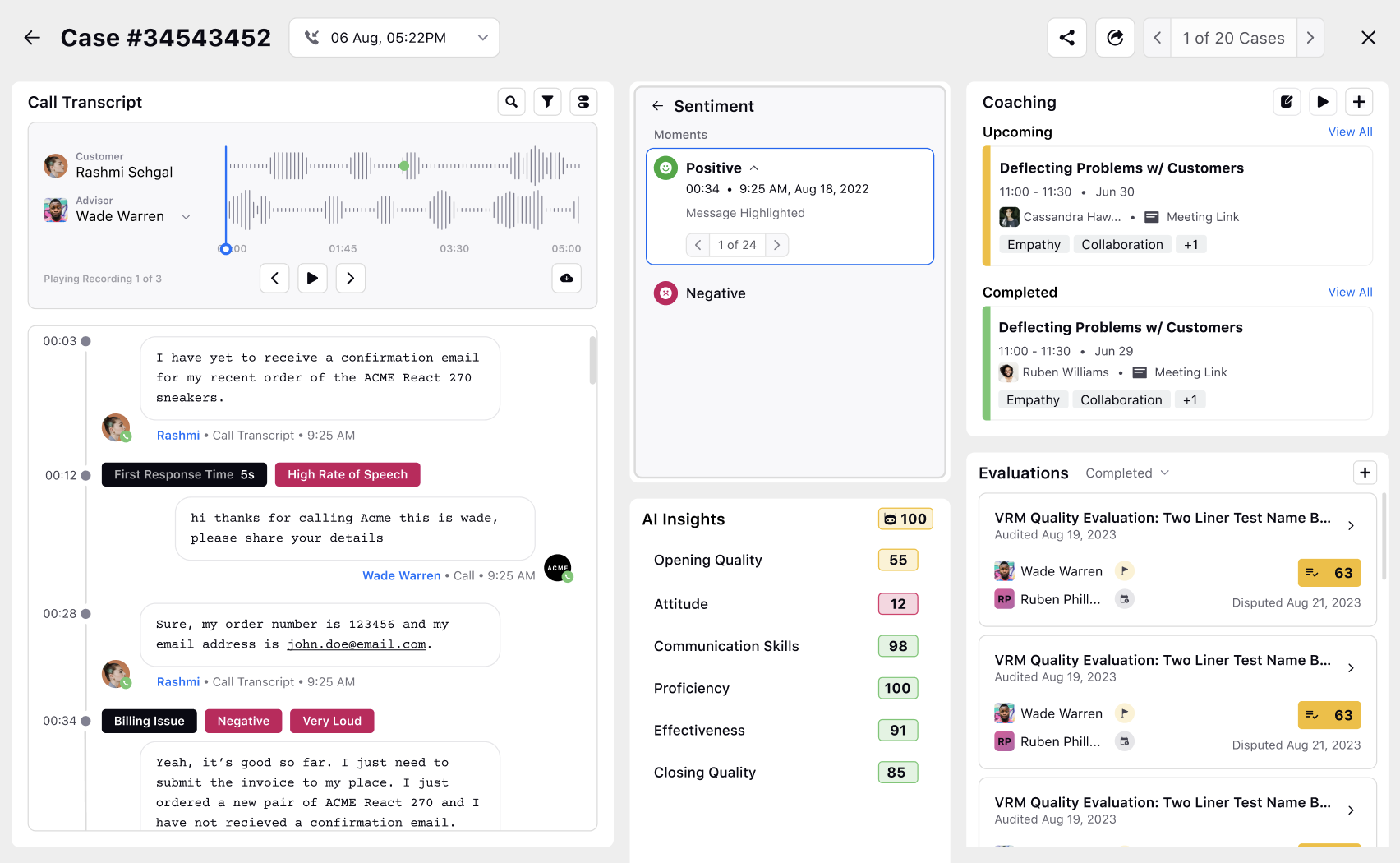
Locate the specific message corresponding to the sentiment in the transcript.
Sentiment Aggregation at Multiple Levels
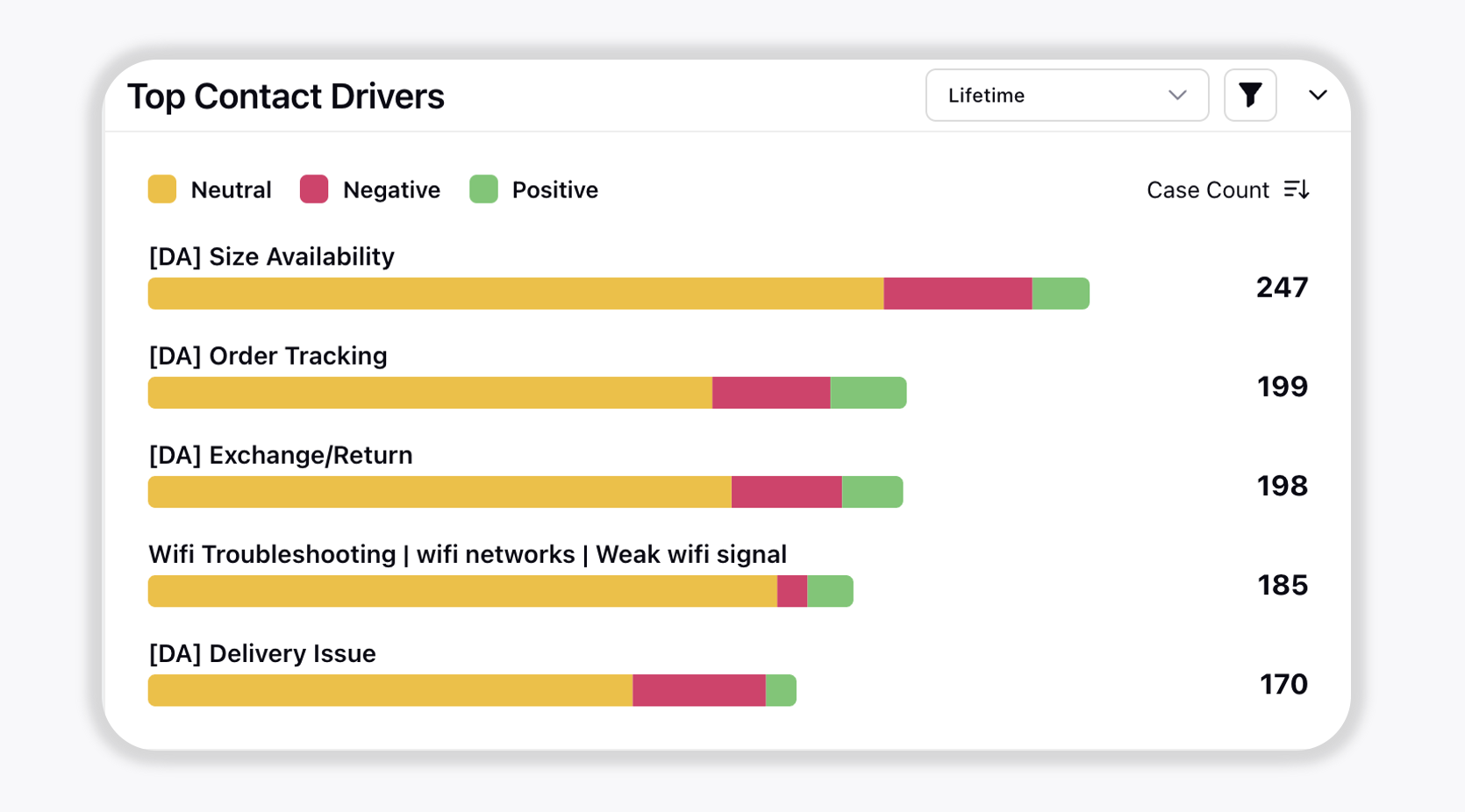
Sentiments can be aggregated at various levels and displayed on the homepage. This includes the aggregation of overall case sentiment, along with breakdowns for specific contact drivers, agents, and more.
Voice Tonality for Customer Satisfaction Analysis
Voice conversations often carry emotional intent that is not fully captured in text.
Customer Satisfaction Analysis now delivers more accurate Sentiment and CSAT insights for voice interactions by incorporating voice tonality alongside call transcripts.
Instead of relying only on what is said, the system also evaluates how it is said by both the customer and the agent. This combined approach provides a more precise understanding of customer emotion and satisfaction during voice conversations.
 Note: Access to this feature is controlled by a dynamic property (DP). To enable this feature in your environment, reach out to your Success Manager. Alternatively, you can submit a request at tickets@sprinklr.com.
How Voice Tonality Enhances CSAT and Sentiment
Text transcripts alone may miss emotional cues such as frustration, confidence, or reassurance that are often conveyed through tone. By analyzing voice tonality, the system captures these nuances to improve overall accuracy.
The analysis considers:
Customer tone to assess emotional state and satisfaction
Agent tone to evaluate empathy, engagement, and response quality
Transcript context to support and validate tonal signals
This multi-signal approach produces sentiment and CSAT scores that better reflect the actual customer experience.
Using voice tonality in Customer Satisfaction Analysis helps you:
Generate more accurate sentiment and CSAT signals for voice calls
Reduce over‑reliance on text‑based interpretation
Identify emotional patterns that influence customer satisfaction
Gain deeper insight into voice interactions across the customer journey