


The global leader in enterprise social media management
For over a decade, Sprinklr Social has helped the world’s biggest brands reimagine social media as a growth driver with a unified platform, industry-leading AI and enterprise-grade scale.



Social Media Crisis Management: Complete Guide
Aishwarya Suresh is an experienced content writer specializing in social media management, social listening, social analytics, Voice of the Customer (VoC) and customer experience. She writes practical, research-backed guides that help brands understand customer conversations, measure social media performance and turn insights into meaningful business decisions.
Key Takeaways:
- Social media crises don't wait, and neither should your response plan. A viral post, deepfake, or mishandled complaint can escalate into a global reputational threat within minutes, long before an unprepared team can react.
- AI is both the accelerant and the antidote. AI-generated content speeds up how crises spread, but AI-powered listening, smart alerts, and automated workflows give brands the early warning needed to stay ahead.
- Crisis management is cross-functional, not just a PR function. Effective response requires marketing, legal, customer support, and technology teams aligned in a single command center with pre-approved messaging and clear escalation tiers.
- Transparency and consistency are your strongest crisis tools. Brands that acknowledge issues early and communicate with empathy retain customer trust far more effectively than those that go silent or respond generically.
Effective social media crisis management starts before a crisis hits. A single viral post, a mishandled complaint, or an AI-generated deepfake can spiral into a full-blown reputational threat before your team has had a chance to react. Yet most brands still lack the processes and tools to respond with the speed and coordination these moments demand.
This guide breaks down six proven strategies for managing social media crises — covering real-time response, AI-powered listening, cross-functional coordination, and more, with real-world brand examples and actionable steps your team can implement today.
- What is social media crisis management?
- Why is social media crisis management crucial?
- 6 proven strategies for social media crisis management and response
- Real-world examples of social media crisis management
- Best practices for social media crisis management
- Bonus: Enterprise crisis reports in the digital age
- Final thoughts
What is social media crisis management?
Social media crisis management is the disciplined practice of preparing for, identifying, and quickly resolving brand-threatening issues on social platforms before they spiral.
A social media crisis can take many forms:
- Public backlash over an insensitive campaign
- Misinformation spreading rapidly online
- Data breaches exposing customer information
- Product safety concerns going viral
- Controversial actions or statements by company leaders
With over 5 billion people on social media, even a single post can escalate into a global reputational crisis within minutes. Unlike traditional PR, social media spreads across diverse audiences in real time — making a proactive crisis plan a core pillar of business resilience.
A strong social media crisis management plan goes beyond reactive fixes. It includes clear escalation tiers, pre-approved messaging, AI-powered social listening, and cross-functional teams trained to respond with speed and empathy.
As Siena Siekman, VP of Analytics & Optimization at Athena Global Advisors, puts it:
“Even after a decade in this industry, I’m still amazed at how many people share their opinions online and the range of niche topics that gain traction. Sprinklr allows us to quickly identify these conversations, add context and escalate emerging issues to the right teams within our clients’ organizations, be it PR, security or customer service.”

Curious how they turned the crisis around, and what measurable impact it had? Read the full story here!
When executed well, crisis management on social media not only contains damage; it protects your brand, strengthens trust, and even sharpens your competitive edge.
Suggested Read: How to Manage a Social Media Crisis Efficiently
Why is social media crisis management crucial?
Because today’s crises erupt faster, and cost more than ever.
A stray tweet or an AI-fueled deepfake can spark a global firestorm in minutes, forcing enterprises into the spotlight before they’ve had a chance to react. This erosion is fueled by misinformation, toxic discourse, bots, and now, the looming impact of generative AI.
That matters because:
- Your customers’ trust is already fragile. If they’re stepping back from social, they’ll have zero tolerance for brands that mishandle a crisis; they’ll simply leave.
- Public scrutiny is immediate and global. Even a minor issue can escalate into investor concern, legal scrutiny, and long-term reputational damage across every region you operate in.
- Recovery is costly. Rebuilding brand equity after a viral backlash can take years and millions in spend. Every unmanaged crisis eats into loyalty, stock value, and future growth.
- Your competitors won’t wait. A crisis that slows down your team is an opportunity for others to win customers, talent, and market share.
And all of this plays out in real time.
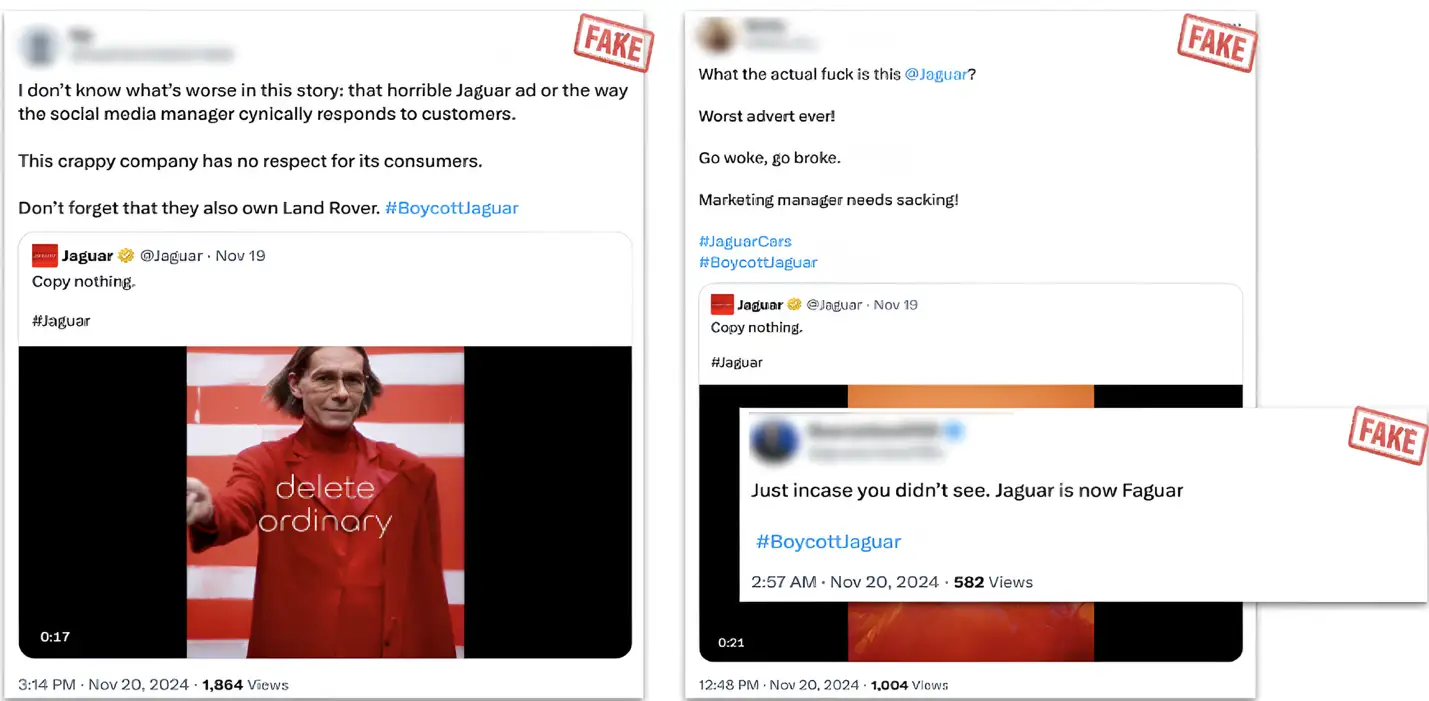
Jaguar’s crisis shows the risk. Following misinformation about its advertising, hashtags like #BoycottJaguar and #Faguar exploded across social channels. Fake profiles, accounting for up to 20% of those engaging, fanned the flames, generating thousands of posts and nearly 500,000 views. Negative articles spiked to 3,788 in a single week, and fake accounts even revived old articles that had lost traction, bringing them back into public view.
Jaguar’s generic, automated responses only amplified the anger, allowing a single tweet from an influencer to rack up 3.4 million views and drive even more engagement.
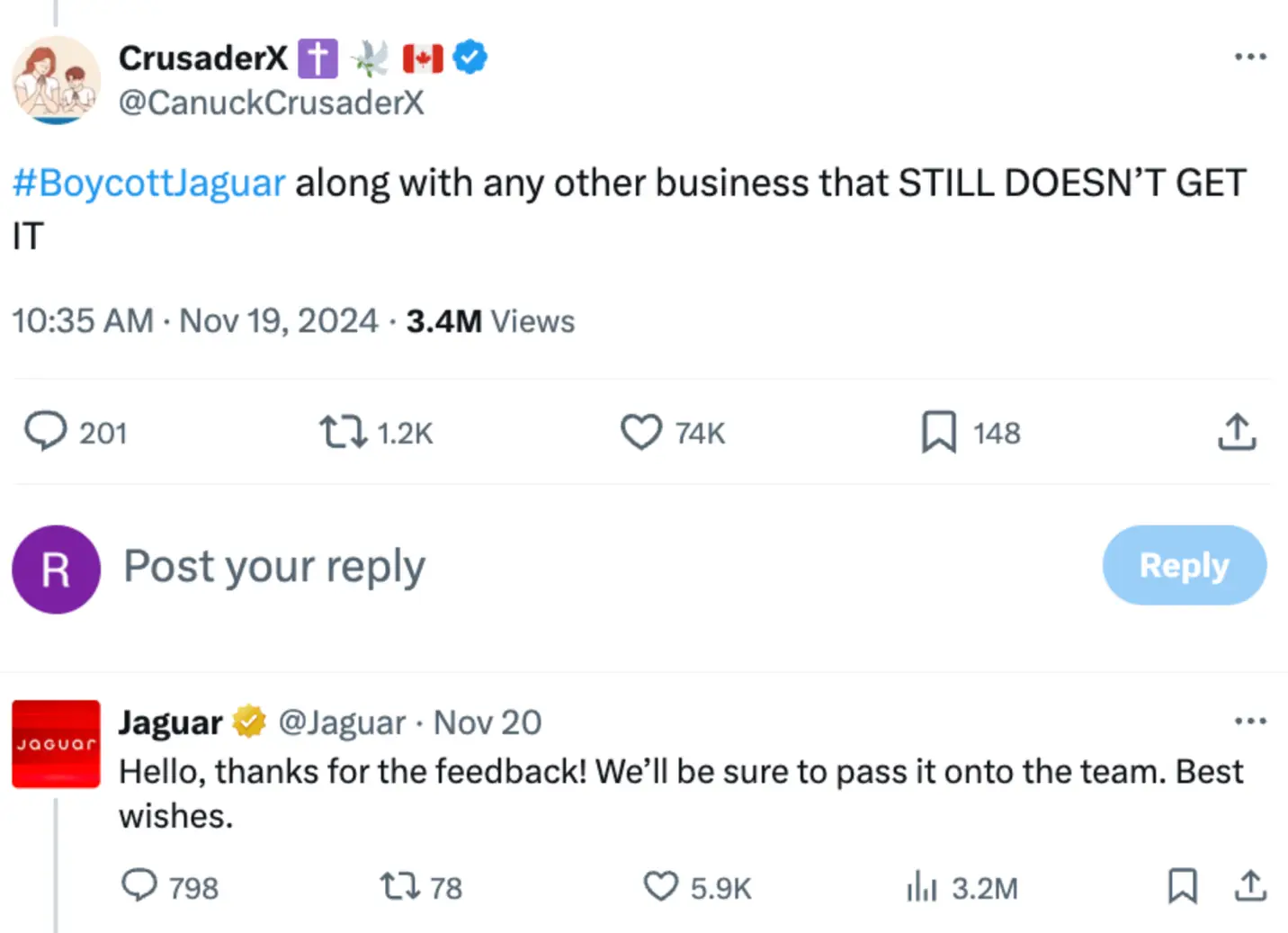
The incident highlights a simple reality: without strong monitoring and coordinated response workflows, brands can lose control of the narrative quickly.
In a volatile digital environment, social media crisis management is not just about reacting to problems. With real-time monitoring, clear escalation processes and coordinated teams, brands can detect risks earlier and respond before issues escalate further.
Learn More: How Generative AI Is Transforming Crisis Management
How do you know when a social media issue becomes a crisis?
Not every negative comment qualifies as a crisis. A useful framework is to monitor three signals simultaneously: volume (spike in mentions), sentiment (sharp drop in positive or rise in negative), and source authority (influencers, media, or verified accounts joining the conversation). Set specific triggers, for example, a 3x mention spike with a 20% sentiment drop within an hour to automatically escalate for review. This prevents alarm fatigue while ensuring genuine threats get immediate attention.
6 proven strategies for social media crisis management and response
When a crisis erupts on social media, every second matters. A slow or fragmented response can erode trust, damage your reputation, and impact the bottom line. These six proven strategies help you act quickly, align your teams, and protect your brand:
1. Set up a real-time command center
Your team needs a cross-functional digital war room; one centralized space where marketing, PR, legal, and customer support can align instantly. Tools like Sprinklr Insights make this easy — offering a single interface to monitor social channels, triage issues, and publish responses instantly.
- Define roles and workflows: Pre-assign responsibilities — who drafts responses, who escalates to legal, and who handles approvals.
- Unify communications: Use shared dashboards and live alerts so all team members see evolving conversations as they happen.
- Respond decisively: Enable one-click escalation paths, so critical issues are surfaced and handled immediately.
Why this matters:
- Crisis intensity on social is real: Customers often take complaints directly to public platforms and expect brands to respond just as quickly. When responses are slow or absent, frustration spreads fast and the issue escalates. A command center helps teams respond in minutes, not hours.
- Expert-backed approach: FGS Global recommends real-time “Operations Rooms” to track evolving crises and coordinate a swift, unified response.
Example: When American Airlines faced a critical incident in January 2025, it activated its social crisis protocol within an hour — posting updates, deploying support resources, and sharing a video message from its CEO. That clarity and speed helped protect its reputation when every moment counted.
The result? Greater control of the narrative, reduced misinformation, and a quicker path to rebuilding public trust; all made possible by one unified response team and a single source of truth.
More to read: Social Media Crisis Communication: Strategy, Examples and Resolution
2. Define crisis tiers and response playbooks
Not every trending hashtag is a full-blown crisis, but every issue needs the right level of response, especially at scale. A tiered system paired with pre-approved playbooks helps your team act fast and stay aligned when social media scrutiny hits.
How to set it up:
Define Low, Medium, and High tiers with clear response protocols:
Tier | Social Scenario | Key Actions | Stakeholders | Approval Workflow |
Low | Misinformation, isolated complaint posts | Correct false info with fact-based messaging | Social, PR | Comms lead review |
Medium | Widespread service complaints, local outages | Acknowledge publicly, update regularly, and provide a resolution timeline | IT, Support, Social, Comms | Cross-functional review |
High | Viral boycott hashtag, legal/ethical issues | Executive video or statement, public apology, legal involvement | Executive leadership, Legal, PR | Legal + C-suite approval |
Social media crises don’t follow linear paths. A local complaint at 9 AM, like a delayed delivery shared by one customer, can escalate into a viral post by noon if ignored. With clear tiers and pre-approved playbooks, your team can move fast before a minor issue snowballs into a reputation-damaging incident.
Situational Crisis Communication Theory (SCCT) backs this: your response strategy must match your crisis’s nature and severity.
Pro tip: Set specific escalation triggers, like a 3x spike in mentions or a 20% drop in sentiment within an hour — then pair them with AI-driven tools like Sprinklr Social that do the heavy lifting for you.
Sprinklr’s automated Engagement Intuition model scans all incoming messages across owned and earned channels in real time and classifies them as engageable or non-engageable based on message content, user profile, and past interactions. That way, your team stays focused on the most relevant conversations, not manual message triage, and can jump in before issues gain public traction.
3. Leverage AI-powered social listening
Platform monitoring isn’t enough. Brands need predictive tools that surface signals before they escalate into full-scale crises. AI-powered listening combines scale, context, and speed to give your team the edge.
The faster you spot an issue, the more control you have over how it unfolds. AI-powered social listening gives brands a head start before news breaks or negative sentiment hits critical mass.
What it looks like in action:
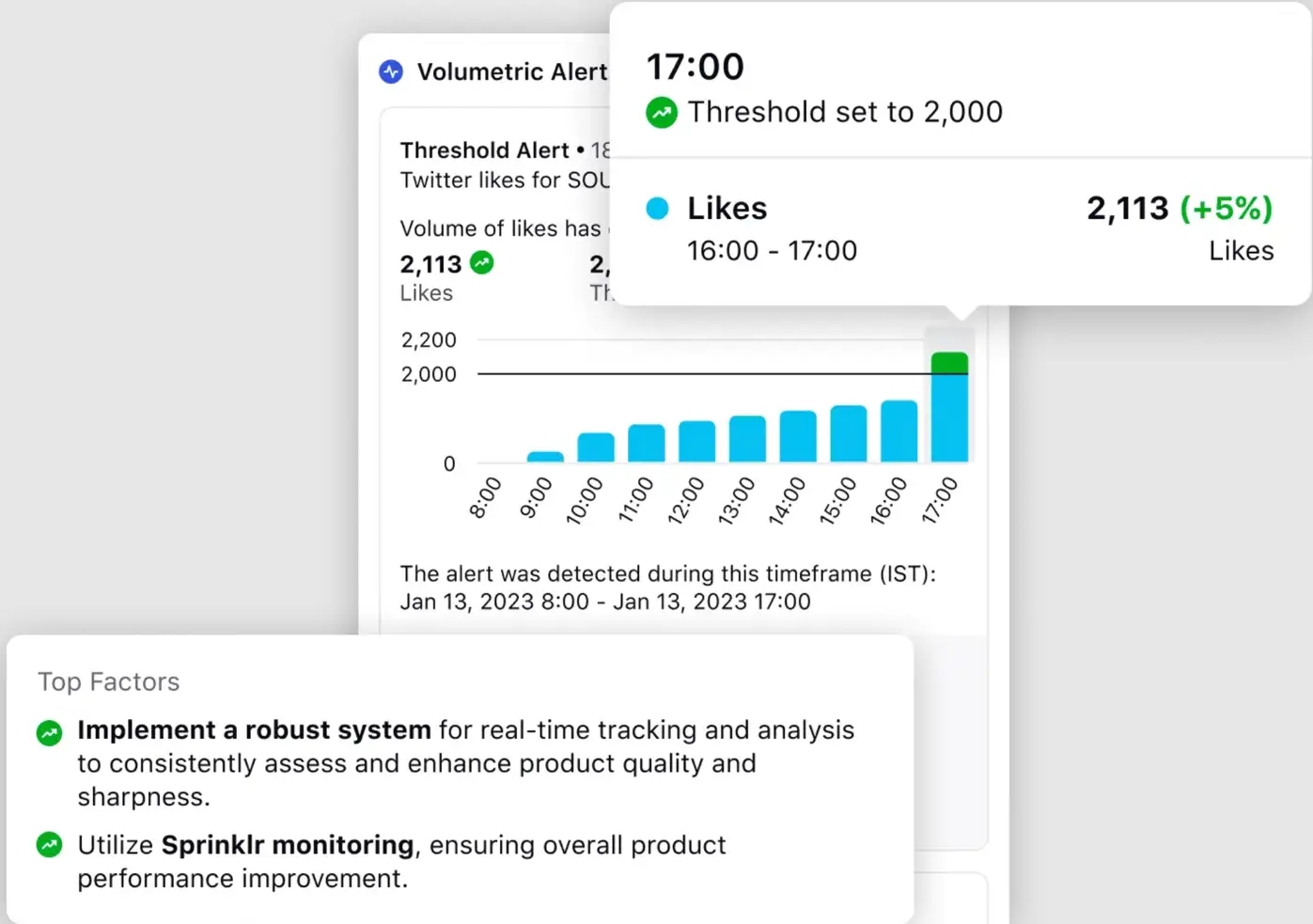
- Real-time alerts: For example, Sprinklr Smart Alerts flag sudden drops in sentiment or spikes in social media engagement tied to key terms, whether it’s #BrandFail or a viral influencer mention.
- Root cause detection: AI analyzes text clusters to surface the underlying issue — product concerns, misinformation, or campaign backlash, allowing targeted and informed responses.

💡 Pro Tip: Once you've identified the root cause, dig deeper into the specific themes driving the conversation. Look at which words, topics, and sentiments are clustering together, and click into each theme to understand what's actually fueling the narrative. That level of detail is what separates a targeted response from a generic one. Sprinklr's Topic Analysis widget makes this easy — plotted directly in any custom reporting dashboard, it gives your team an instant, visual read on what's trending across your social channels.
- Regional prioritization: Filter alerts by geography, platform, or volume so your team can prioritize what matters most globally.
- Automated workflows: Trigger internal comms, task assignments, or deploy pre-approved responses directly from the alert.
Why this matters:
- Speed matters: Detecting a brewing crisis even 30 minutes faster can mean the difference between stopping a rumor and facing viral brand damage.
- Accuracy matters: Fewer false alarms mean your team can trust alerts and act decisively, without wasting time.
- Coverage matters: Today’s conversations aren’t just text-based. Social listening must include voice, video, and visuals to fully track sentiment.
What you can implement:
→ Set alert parameters for your brand, product, campaign names, sentiment levels, and key phrases.
→ Connect listening to social media workflows so that when alerts fire, your command center is automatically engaged.
→ Refine models continuously as language evolves — sarcasm, slang, and new platforms all require constant updates to AI filters.
Key Takeaway: During a crisis, the real challenge isn’t just seeing the spike in mentions; it’s understanding why it’s happening. For example, Sprinklr’s Social Listening platform helps teams cut through the noise by clustering conversations across 30+ social and digital channels and surface trends, themes, anomalies, and visual mentions (like logos) before crises spread.
4. Maintain a consistent brand voice
In a crisis, your voice is your signature. When posts go viral on social platforms, your tone needs to remain distinctly you, not generic or panicked.
Here’s how to do it right:
1. Codify your tone:
→ Define your brand voice, whether it's empathetic, professional, or candid
→ Translate that into adaptable message templates and pre-approved “holding” statements for when facts are still emerging
2. Build flexible templates: Create response frameworks for common scenarios (outages, product issues, executive responses), that can be localized by region or channel.
3. Use holding statements effectively: If you don’t have all the facts, post an early, empathetic acknowledgment. A simple message like, “We’re looking into this and will update you shortly,” shows responsiveness and reduces speculation.
4. Align all teams:
→ Ensure social, PR, CX, legal, and leadership all follow the same voice and message templates.
→ Consistency reduces the risk of off-brand or tone-deaf responses.
A consistent voice doesn’t just sound better; it performs better. When messaging frameworks and escalation plans are already in place, brands respond faster and more coherently during high-pressure moments. In fact, research shows that 82% of marketers say having pre-prepared crisis content significantly reduces response delays, allowing teams to communicate with clarity instead of scrambling to craft messages under pressure.
When templates and tone guidelines are already in place, teams don’t waste time wordsmithing under pressure. They communicate with clarity, speed, and confidence.
In a crisis, don’t reinvent your voice; reinforce it. It’s what customers count on when everything else feels uncertain. Studies also show that about 65% of consumers remain loyal to brands that respond transparently during a crisis, proving that honest and timely communication can preserve trust even when things go wrong.
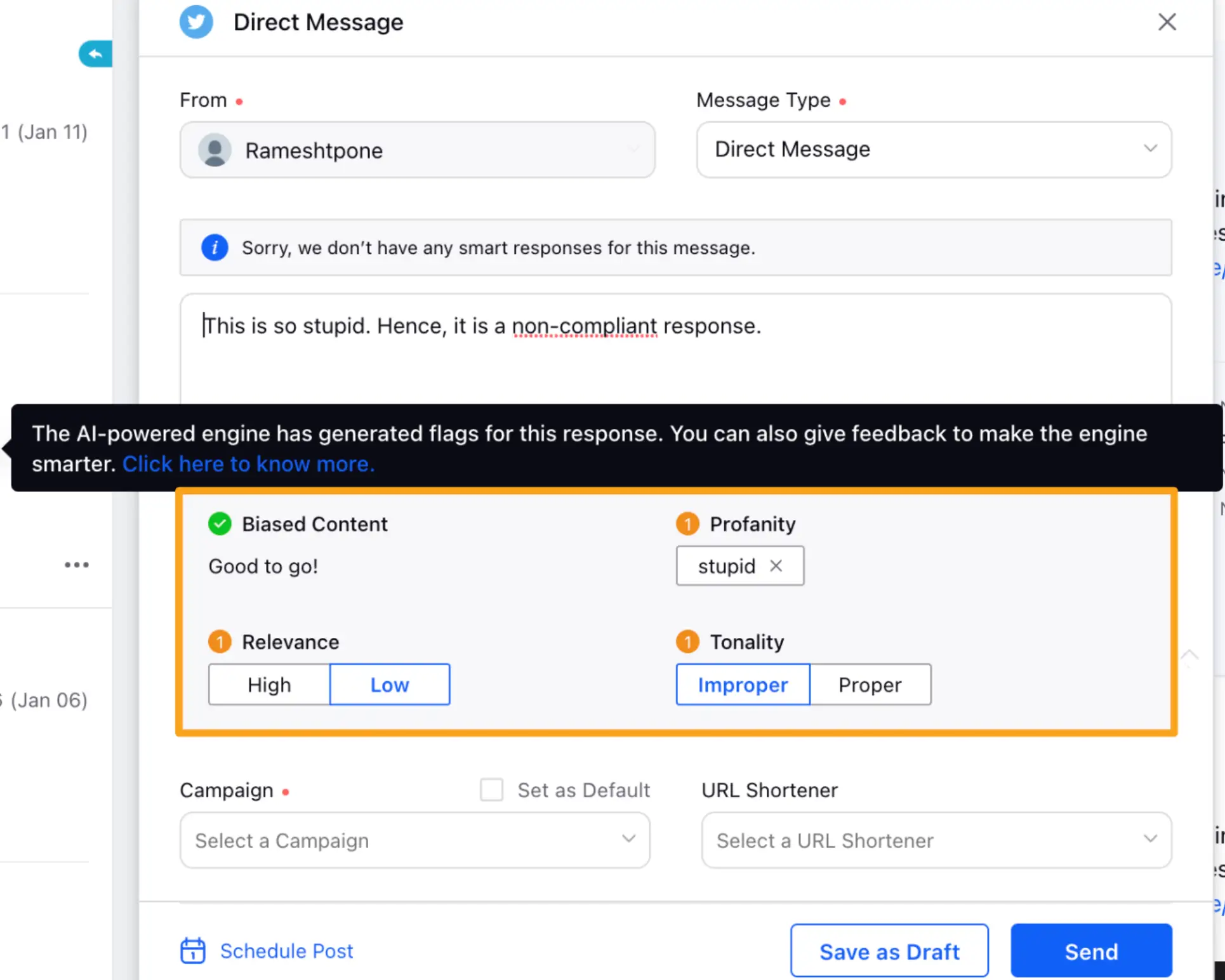
💡 Pro Tip: During a crisis, consistency in tone and language matters as much as speed. AI-powered response checks can help teams review outgoing messages for biased language, profanity or off-tone phrasing before they’re published, reducing the risk of replies that escalate the situation.
Capabilities like Sprinklr’s Smart Response Compliance apply AI to scan responses across social channels and flag potential issues in real time. This helps teams maintain an empathetic, brand-safe voice while responding quickly to customers and public conversations.
5. Train teams in AI-assisted crisis responses
You can’t improvise under fire. A crisis-ready team needs more than occasional media training — they need real-time practice powered by AI, realistic simulations, and data-driven insight. This prepares them to respond with clarity and speed when social media crises strike.
What this looks like:
- Real-time AI alerts and insights: Set up instant alerts in Sprinklr’s Social Listening when sentiment drops or a viral hashtag spikes. Check insights in the tool that AI filters out, so your team sees only the most impactful conversations, allowing you to act before issues escalate.
- Smart routing and response: Once an alert is triggered, AI can automatically route issues by severity to the appropriate teams (PR, legal, customer support), so the right people jump in immediately. Many tools also offer tone and message suggestions tailored to each situation, cutting drafting time and ensuring consistency. Infact, AI-generated response suggestions can reduce average reply times by up to 30%, helping teams respond faster while keeping messaging consistent and on-brand.
- Simulate crises for rapid learning: Crisis simulations using real-world social data, now standard with tools like Prevency and Social Simulator help teams practice under pressure. Participants respond to simulated viral posts and escalating threads, testing coordination, speed, and empathy before they ever face a real incident.
- Align teams and decision-makers: AI-assisted workflows keep everyone on the same page. Shared dashboards, role-specific notifications, and pre-approved templates mean you can scale decisions faster without endless back-and-forth.
AI-assisted crisis management isn’t about removing the human touch. It’s about making your human response faster, smarter, and less risky.
- Reduced response time = less viral spread
- Fewer legal/PR missteps = stronger brand protection
- Consistent tone and messaging = better customer trust
- Faster internal coordination = lower operational stress
In a high-stakes situation, you fall to the level of your training and tools. Make sure both are AI-ready.
Interesting Read: The Importance of Empathy in Crisis Response
How quickly should you respond to a social media crisis?
The first response should ideally go out within 30 to 60 minutes of identifying the issue, even if it's just an acknowledgment that you're aware and investigating. Delayed responses create a narrative vacuum that misinformation and speculation will quickly fill.
6. Prioritize transparency and empathy
Silence or spin? Neither works in 2026. Audiences expect clear, human responses, and fast. But to manage this at scale, brands need both automation and authenticity.
- Acknowledge early: Even when details are limited, post a timely acknowledgement: “We know there’s been concern around this, and we’re actively investigating.” This early transparency builds credibility and prevents rumor gaps from growing.
- Speak human: Drop the legalese. Use empathetic, plain language that reflects your brand values. For example: “We understand your concern and are sorry for the worry this has caused.”
- Show the fix: Be clear about what you're doing, when they can expect the next update, and how you’ll communicate. Even simple timelines — “We will share an update by 3PM ET today”, help calm audiences.
- Build trust in the moment: Customers remember authenticity. Being straightforward in real time strengthens trust, even if the crisis isn’t over.
- Prepare responses in advance: Predictive AI tools can help you identify trending concerns early and suggest empathetic messaging before a crisis peaks.
- Use AI thoughtfully: AI tools can assist by drafting empathetic messages based on your tone guidelines. These drafts still require human review, ensuring sincerity without slowing down the response.
🤖 Pro Tip: If you want to send the replies quickly, Sprinklr AI+ helps you respond with heart and precision. It can suggest empathetic, on-brand replies, summarize complex cases, and pull accurate answers from your knowledge base — all while optimizing for tone and relevance.
Worried about AI going off-script? Sprinklr AI+ includes built-in guardrails to minimize risks like hallucinations, so your messages stay trustworthy and human. Only the content you actively enter is shared with third-party AI, keeping your data secure and your voice authentic.
Ignoring or downplaying a threat on social media only makes it worse. In 2026 and beyond, preparedness means combining speed, empathy, and transparency, backed by AI-enabled tools and real human oversight.
Real-world examples of social media crisis management
Crisis doesn’t play favorites. But how you respond can define your brand for years. Here are some real-world examples to learn from:
1. e.l.f. Cosmetics
Crisis: Viral TikTok videos falsely claimed harmful ingredients in e.l.f. products, leading to boycott threats and a growing credibility gap.
Response:
- Launched an Ingredient Safety and Transparency Policy, spotlighting its use of RSPO-certified palm ingredients and clean beauty commitments
- Instead of deflecting, the brand engaged directly on TikTok, where the narrative had emerged, using factual responses, short-form videos, and creator partnerships to clarify misconceptions
Outcome & learnings:
- Reversed negative sentiment across platforms
- Strengthened trust with Gen Z
What worked: Platform-native transparency and influencer-led truth-sharing. What didn’t: Initial delay allowed misinformation to gain traction, highlighting the need for early detection.
2. Majid Al Futtaim
Crisis: The sudden surge in online interactions during COVID-19 created an unpredictable volume of customer queries and complaints. Rapidly shifting social customer behavior meant Majid Al Futtaim had to scale its response across multiple markets and channels overnight.
Response:
- Deployed Sprinklr’s social listening platform to capture earned and owned mentions across all digital touchpoints
- Introduced COVID-specific keyword filters to surface actionable cases faster
- Deployed automated rule engines to triage incoming posts
Outcome & learnings:
- Maintained mostly positive sentiment during the pandemic
- Accelerated cross-functional decision-making and customer responsiveness
What worked:
- Real-time monitoring and escalation across all markets kept customer trust high
- Rapid routing to the right team ensured specialized responses that met customers’ evolving expectations
What didn’t: Initially, scattered data sources created blind spots, underlining the need for early centralization and automation.
3. Chick-fil-A
Crisis: 2016 backlash after replacing Original BBQ sauce — 73% negative sentiment and a viral boycott hashtag (#BringBackTheBBQ).
Response:
- Used Sprinklr dashboards to monitor social sentiment
- Built a custom engagement dashboard to respond personally to customers across platforms
- Relaunched the Original BBQ sauce with a high-touch campaign, including fan outreach kits and personalized messages
Outcome & learnings:
- 92% positive sentiment after relaunch
- 188x spike in mentions on launch day
- 5,000+ interactions within 72 hours and over 1,000 organic hashtag mentions
What worked: Personal outreach and using social listening to guide action. What didn’t: Initial silence stalled engagement, demonstrating the cost of ignoring real-time sentiment.
How long does it take for a brand to recover from a social media crisis?
Recovery time depends on the severity of the crisis, the speed of the initial response, and the transparency of communication throughout. A well-handled crisis with a fast, empathetic response can see sentiment recover within days. A poorly managed one marked by silence, deflection, or generic responses can take months to years to fully repair, with lasting impact on customer loyalty and brand equity.
Read more: Social media crisis management examples
Best practices for social media crisis management
If you can't afford learning-by-failure, here are six best practices to help your brand stay prepared and resilient:
- Keep your crisis plan current: Platforms, audiences, and threats evolve constantly. Audit response workflows at least quarterly — update messaging templates, escalation paths, and approvals to reflect new teams, tools, and channels like Threads or Bluesky.
- Let AI do the early warning: Manual social media monitoring can’t keep pace with today’s fast-moving conversations. AI-powered social listening tools detect sentiment drops, viral spikes, and untagged threats — giving you the lead time to act before issues escalate. Sync approved messaging instantly across channels using AI to contain backlash with speed and consistency.
- Prepare before a crisis hits: Don’t wait for a crisis to hit. Run regular simulations using real-world data, stress test your processes and have a ready-to-activate crisis playbook. The faster you can move when an issue surfaces, the more control you have over the narrative.
- Be transparent and timely: Silence creates space for speculation. Acknowledge issues early, even if all the facts aren’t known. Use a human, empathetic tone and outline next steps and timelines to reassure your audience and maintain trust.
- Run crises from a unified command center: Fragmented monitoring and communication slow everything down. A centralized hub that integrates real-time monitoring, AI alerts, escalation tools, and cross-functional collaboration ensures a streamlined, coordinated response.
- Measure performance and iterate: After a crisis, review metrics like sentiment recovery, resolution times, and engagement rates. Learn what worked (and what didn’t) and feed those insights into your next audit to continuously improve your crisis readiness.
What should you post during a crisis if you don't have all the facts yet?
Silence is the worst option. Post an early acknowledgment even with limited information. A simple statement like, "We're aware of the situation and actively investigating. We'll share updates as soon as we have more information," serves multiple purposes: it shows you're responsive, prevents rumor gaps from filling with speculation, and buys your team time to gather facts. Update regularly, even if only to say you're still investigating, to maintain trust throughout the process.
Bonus: Enterprise crisis reports in the digital age
An enterprise social media crisis report is a living document that captures the full story of a crisis, from the first alert to final resolution. Typically, it includes:
✓ Incident timeline — when each milestone occurred
✓ Impacted channels — social platforms, communities, digital ecosystems
✓ Actions taken — who did what, when, and under which approval
✓ Sentiment shifts — tracked before, during, and after the crisis
✓ Resolution time & customer impact — how quickly issues were addressed and how customers responded
But a truly effective report goes further: it connects the dots between what happened, how your teams responded, and what can be improved next time.
For large organizations, these reports are essential because they:
→ Provide cross-team visibility, keeping Marketing, PR, Legal, and Support on the same page
→ Give executives the insights they need to make fast, informed decisions; summarizing not just what happened, but why and how it was handled
→ Surface learnings that sharpen future response playbooks, so the organization gets stronger with every incident
A great crisis report is timely, visual, and actionable. It pulls in real-time data from all relevant platforms, highlights sentiment shifts, and engagement spikes and clearly records who did what and when. Most importantly, it centers on customer impact and lessons learned, making it a practical tool for both immediate response and long-term improvement.
Manual reporting can slow teams down and leave gaps. That’s where Sprinklr comes in:
- Customizable dashboards let you track crisis metrics across 30+ channels in real time
- AI-powered alerts surface sentiment changes and potential threats before they escalate
- Crisis cards and summary reports make it easy to share key findings with leadership and stakeholders, keeping everyone aligned and ready to act
Final thoughts
Social media crises today can happen faster and hit harder than ever before. The difference between losing trust and earning it back lies in how prepared you are. Brands that handle these moments well don’t do it by chance; they do it by putting the right processes, tools, and teams in place before they need them.
Take time to review your current crisis plans, identify any gaps, and pressure-test your workflows across teams. Consider rolling out AI-powered listening tools, automated response templates, and clear escalation paths that help your teams work together quickly and consistently. Solutions like Sprinklr Social can help you get there — starting small, proving value, and scaling up as you go.
When the next issue hits, be ready. Request a demo and see how Sprinklr can help your team stay prepared, responsive, and in control when it matters most.
Aishwarya Suresh is an experienced content writer specializing in social media management, social listening, social analytics, Voice of the Customer (VoC) and customer experience. She writes practical, research-backed guides that help brands understand customer conversations, measure social media performance and turn insights into meaningful business decisions.