




The global leader in enterprise social media management
For over a decade, Sprinklr Social has helped the world’s biggest brands reimagine social media as a growth driver with a unified platform, industry-leading AI and enterprise-grade scale.



Social Media Management: A Complete Guide for Brands
Aishwarya Suresh is an experienced content writer specializing in social media management, social listening, social analytics, Voice of the Customer (VoC) and customer experience. She writes practical, research-backed guides that help brands understand customer conversations, measure social media performance and turn insights into meaningful business decisions.
Key Takeaways:
- Social media management drives results when every post ties back to a business goal, not when it simply keeps the feed active.
- Strong management rests on five connected pillars: content, scheduling, community, listening and analytics, working as a system.
- AI now handles the operational layer, freeing managers to focus on brand judgment and voice.
- Social has become a discovery channel, so content built to be found and understood matters as much as content built to engage, not just to reach.
- Consolidating publishing, listening and analytics on one governed platform helps teams move faster and stay on-brand, not stitch point tools together.
Social media management is what turns a scattered set of accounts into a brand people follow, trust and buy from. It's how you plan, publish, engage and measure across every platform, and at today's scale, that coordination is the whole challenge. Social media managers now spend over six hours a week just switching between tools before a single post goes out, and audiences are spread across more platforms and formats than any team can handle by hand. Without a system to manage it, effort leaks everywhere: posts go out inconsistently, conversations get missed, and the brand slowly loses the thread of its own presence.
That's why the brands winning on social aren't posting more. They've built a system, one where every post has an owner, a purpose, and a tie back to a business result.
This guide breaks down what social media management really means, the five pillars that hold it together, the tools worth your budget, and the trends redefining the job in 2026.
- What is social media management?
- Key skills of a social media manager
- Benefits of social media management
- 5 core pillars of social media management
- Tools for overall social media management
- How to grow your social media engagement?
- Latest trends in social media management
- Case studies: Social media management in action
- Final thoughts
What is social media management?
Social media management is the process of strategically overseeing and optimizing a brand’s presence across various social media platforms — from creating and scheduling content to engaging with audiences and analyzing performance. It’s about having a strategy that drives real business impact by strengthening brand awareness, building relationships, and ensuring consistency across platforms.
Social media management vs social media marketing
While often used interchangeably, social media marketing and social media management serve distinct but interconnected roles.
Social media marketing focuses on the strategy — defining objectives, targeting the right audience, crafting campaigns, and using content to drive brand awareness, engagement, and conversions. It answers the why and who: Why are we on social media? Who are we trying to reach?
Social media management, on the other hand, is the upkeep, ensuring the strategy comes to life through daily execution. It involves the day-to-day operations — scheduling content, monitoring engagements across the platforms, engaging with audience, and analyzing performance.
While marketing sets the vision, management brings it to life!
The overlap? A well-defined marketing strategy is ineffective without strong management to implement it effectively. Together, they ensure a structured, data-driven approach that maximizes social media’s impact on business growth.
Key skills of a social media manager
Being a social media manager isn’t just about posting content — it’s about strategy, engagement and staying ahead of the game. From crafting viral posts to analyzing performance, they wear many hats.
Here are the key skills that make a great one:
- Content creation & curation: Crafting engaging text, images and videos that align with the brand’s voice.
- Community engagement: Responding to comments, messages, and trends to build meaningful relationships.
- Analytics & performance tracking: Measuring reach, engagement and conversions to optimize strategies.
- Social listening & trend spotting: Monitoring brand mentions and industry shifts to stay ahead.
- Paid social & ad management: Running targeted social media ads to expand reach and drive results.
- Strategic planning & execution: Aligning social efforts with business goals for measurable impact.
- Platform expertise: Understanding the nuances, algorithms, and best practices of different social media channels.
- Crisis management: Handling negative feedback, PR crises and brand reputation challenges with tact and speed.
- AI fluency: Using AI tools and agents to scale output and speed without losing authenticity or brand control.
- Social search optimization: Structuring content so it surfaces in social search and AI-generated answers, not just traditional feeds.
→ An added skill is adaptability: Pivoting quickly when algorithms or audience preferences change.
Benefits of social media management
Being on social media isn’t enough — how you manage it is what makes or breaks your brand. A scattered, inconsistent approach leads to missed opportunities, while a well-managed strategy drives real business impact.
Here’s why it’s non-negotiable:
· Consistency builds credibility: Social media moves fast. If you’re not managing posts, responses, and campaigns in a structured way, you risk fading into irrelevance. Effective social media management ensures your brand stays top-of-mind without last-minute scrambling.
· Conversations need control: Customers expect instant responses, and every comment, tag and mention is an opportunity — or a crisis waiting to happen. Managing social media well means actively monitoring conversations, addressing concerns before they escalate, and ensuring a consistent brand voice across platforms.
· Data drives smarter decisions: Every post, reaction and click on a social media post tells a story. Without proper social media management, valuable insights get lost in the noise. A structured approach helps businesses track what’s working, refine strategies and allocate social budgets effectively — so you’re not just posting for the sake of it.
· Efficiency saves time (and money): Managing multiple platforms manually is a time drain. Smart management through automation, scheduling, and streamlined workflows cuts effort while maximizing impact, so your team focuses on strategy.
· From presence to performance: A presence on social media isn’t enough; performance is what counts. Good management ensures every action ties back to business goals — whether it’s lead generation, sales or brand awareness — instead of just “being active” online.
👀 How much does social media management cost?
It depends on how you resource it. Doing it in-house with a scheduling tool can run from a low monthly software fee to a full salaried manager, while agencies and freelancers typically charge a monthly retainer that scales with the number of platforms, content volume, and paid campaigns involved. The bigger cost question is the hidden cost of fragmentation: separate tools for publishing, listening, and reporting, plus the hours lost switching between them. Consolidating onto one platform usually lowers total cost while improving output.
5 core pillars of social media management
Business social media management is a system of interconnected actions that drive results. Here’s are 5 pillars to get it right:
1. Content creation and curation
What it is: Creating high-quality, engaging content that resonates with your audience — whether it’s videos, infographics or user-generated posts.
Why it matters: Content is the backbone of your social presence. It’s how you tell your story, showcase your value, and build trust.
Action tip: Focus on creating content that solves problems, sparks conversations, and aligns with your audience’s preferences.
The hardest part of content creation is the volume. Most teams burn hours rewording captions for each platform, resizing visuals, and keeping tone consistent across dozens of posts a week. That's where AI earns its place: handling the repetitive drafting, so your team spends its energy on the story.
Inside Sprinklr Social, AI+ Writing Assistant does this in the Quick Publisher, generating post, reel and carousel copy, then rewording, retoning and translating it, with hashtags and variations built in.

The AI+ Image Editor does the same for visuals, so you can swap backgrounds or objects from a plain-language prompt.

2. Scheduling and publishing
What it is: Strategically planning and posting content at optimal times to maximize visibility and engagement.
Why it matters: Consistency keeps your brand top-of-mind, while timing ensures your content reaches the right people at the right moment.
Action tip: Use analytics to identify peak activity times and automate posting with social media scheduling tools to maintain a steady flow of content.
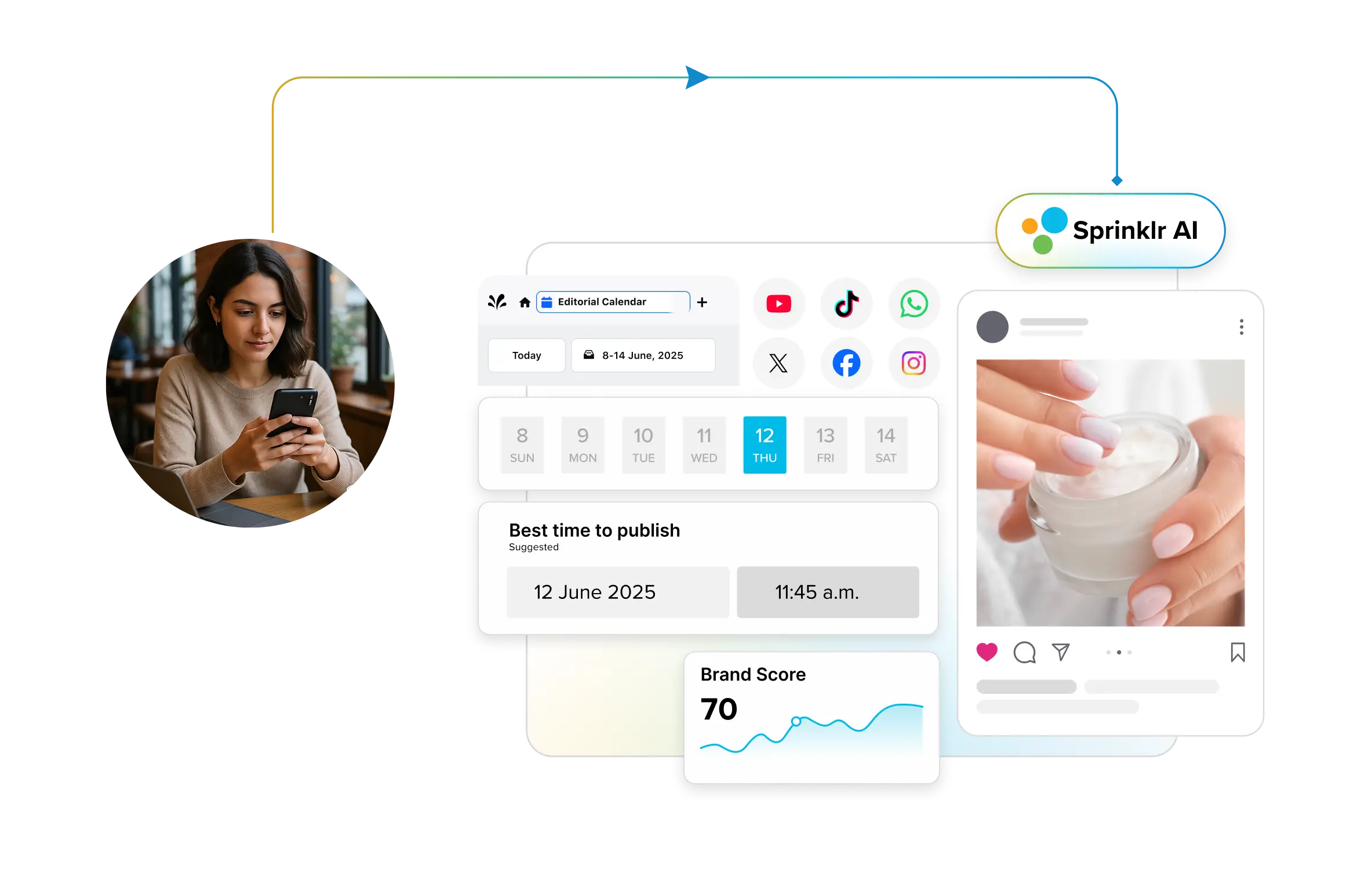
💡Pro Tip: If you want to make finding the right posting times easier, let Sprinklr’s AI-driven Smart Scheduling worry about getting your posts out at the highest traffic times for each social account.

Optimize your publishing strategy and maximize engagement with Sprinklr Social today.
3. Community management
What it is: Actively engaging with your audience — responding to comments, messages and mentions to foster relationships.
Why it matters: Brands that listen, respond and engage in real time build stronger relationships, trust and brand loyalty.
Action tip: Prioritize timely, authentic responses. Turn customer feedback into opportunities to strengthen your brand’s reputation.
4. Social listening and monitoring
What it is: Tracking brand mentions, industry trends and customer sentiment in real-time.
Why it matters: Social listening helps you stay ahead of social media trends, manage your reputation and identify opportunities to connect with your audience.
Action tip: Set up alerts for brand mentions and use insights to refine your strategy.
Want to go deeper? Platforms like Sprinklr’s Social Listening analyzes millions of conversations across networks, forums, and news sources. Its newer AI Topics feature uses generative AI to filter out irrelevant mentions and surface only the conversations that genuinely matter to your brand, cutting the noise most listening tools leave in

🎥 Live Demo: AI Topics: Turn Social Listening Noise Into Trusted Insights
5. Analytics and reporting
What it is: Measuring performance metrics like engagement rates, click-through rates and ROI to evaluate success.
Why it matters: Tracking key social media metrics helps you optimize content, refine strategies and make smarter marketing decisions.
Action tip: Regularly review performance reports to identify what’s working, what’s not and where to double down.
💡Good to Know: Sprinklr's new Copilot brings conversational reporting to social and paid teams. Ask it to explain a performance change, summarize engagement, or build an analytics widget, and it does the digging for you, so insight-to-action takes minutes instead of a manual pull.

Tools for overall social media management
Managing social manually, logging into each platform, posting, and replying one by one, is possible but painfully inefficient. Brands that use the right tools turn that fragmented process into a streamlined operation, lifting both social media productivity and performance.
Here's a breakdown of the key tools that make it easier:
Social media management tools
· Sprinklr Social – Best for all-in-one social media management by combining publishing, engagement, and analytics in one platform.
· Hootsuite – Ideal for centralized post scheduling and team collaboration.
· Agorapulse – Excellent for social inbox consolidation and community engagement.
Not sure which tool fits your needs? We broke it down — explore top Social Media Management Tools.
👀 What is a social media management platform, and do I actually need one?
Social media management is the practice: planning, publishing, engaging, and measuring. A social media management platform is the software that runs all of it in one place, replacing separate tools for scheduling, inbox, listening, and reporting. You need one the moment social becomes a team sport: multiple people, multiple brands or regions, and approval steps that can't live in spreadsheets and DMs. For a solo creator, native apps plus a scheduler may be enough. For an enterprise, a unified platform is what keeps messaging on-brand and reporting sane at scale.
Content creation tools
· Canva – Easy-to-use design platform for creating high-quality graphics and visuals.
· Adobe Express – Advanced tool for editing social media images, videos, and animations.
· CapCut – AI-powered video editing for engaging short-form content.
· Narrato AI Content Genie – Ideal for automating content creation, generating weekly posts based on themes or URLs.
Check out our handpicked list of The Best AI Tools for Social Media Content Creation.
Monitoring & social listening tools
· Sprinklr Insights – AI-powered, enterprise-grade platform, providing real-time sentiment analysis, trend detection, and competitive intelligence across millions of conversations.
· Brandwatch – AI-driven insights to track brand sentiment and industry trends.
· Talkwalker – Deep social listening and analytics for brand reputation management.
Choosing the right radar for your brand? Check out the list below to track conversations in real-time!
Analytics & reporting tools
· Google Analytics – Tracks website traffic from social media efforts.
· Sprinklr Social – Provides in-depth performance metrics across platforms, along with customizable dashboards, giving complete control of your social performance.
· Quintly – Benchmarking tool for tracking competitors’ social media performance.
Scheduling & publishing tools
· Meta Business Suite – Native scheduling for Facebook and Instagram, ensuring platform-specific optimization.
· Sprinklr Social – AI-powered scheduling and publishing platform, automating posting across multiple platforms + analytics with brand-safe workflows.
· Later – Best for visually planning and scheduling Instagram, TikTok and Pinterest content.
Team collaboration tools
· Slack – Streamlines communication for social media teams.
· Asana – Helps manage social media content calendars and workflows.
· Trello – Visual task management for planning and executing campaigns.
Using these tools saves time, improves efficiency and enhances decision-making — whether through automated scheduling, unified messaging, AI-driven insights or streamlined collaboration. The right stack transforms social media from a time-consuming task into a strategic business advantage.
How to grow your social media engagement?
Want to turn passive followers into active participants? Here’s how to spark real social media engagement:
✔️ Talk with your audience, not at them: Respond to comments, ask questions and join conversations — make it two-way dialogue
✔️ Post consistently, not constantly: Maintain a steady rhythm (quality over quantity) using a content calendar
✔️ Leverage trends strategically: Jump on relevant viral moments, but only if they align with your brand voice
✔️ Use video to stop the scroll: Short-form video (Reels, TikTok) drives 2-8 times more engagement than static posts
✔️ Run targeted engagement campaigns: Polls, Q&As, live sessions, stories with engagement stickers and user-generated content prompts keep audiences involved
✔️ Collaborate with influencers and partners: Cross-promotions and partnerships expand reach and drive credibility
✔️ Analyze and iterate: Double down on what works — if carousels perform best, create more of them
Engagement isn’t vanity metrics — it’s the pulse of your community. Measure replies, saves and shares, not just likes.
How does social media management affect how my brand shows up in AI search?
AI answer engines like ChatGPT, Perplexity, and Google's AI Overviews pull from the same public conversations and content your social team already manages. What you publish, and how people talk about you, shapes what these tools surface when someone asks about your category. Clear, consistent, well-structured posts give AI more context to connect your brand to the right topics. This is why social search optimization is becoming part of the job and why tracking how you appear in AI-generated answers now belongs in your measurement mix. Sprinklr's LLM Insights was built for exactly this, helping brands see and improve how they show up across AI-powered search.
Latest trends in social media management
Social is reshaping how people discover, decide, and buy. The teams pulling ahead aren't chasing every trend; they're reading where attention and technology are actually moving.
Here's what's separating leaders from laggards right now:
1. Agentic AI takes over the operational layer
The conversation has moved past AI writing captions. The shift now is toward AI agents that handle multi-step work end to end: drafting a post, routing it for approval, scanning it for compliance, scheduling it, then flagging the replies that need a human. The winning approach is still augmentation, using AI to remove the busywork, so your team spends its time on judgment, voice, and strategy.
💡Pro Move: Put AI on the operational layer (scheduling, tagging, routing, first-draft copy, reporting) and keep humans on the calls that carry brand risk. Fact-check, refine, and add personality before anything goes live.
Here are 10 Ways to Use AI in Social Media, wisely!
2. Social has become a search engine
Discovery is moving off traditional search. With 46% of Gen Z now preferring social platforms over search engines to find information, and product discovery increasingly starting on TikTok, Instagram, and YouTube — social content is no longer only about engagement; it's about being findable, both inside platform search and inside the AI answers people now rely on.
💡Pro Move: Write posts the way people actually search, with clear language and real answers, not just clever hooks. Structure content so a platform (or an AI engine) can understand what it's about and who it's for.
3. Authenticity beats polish
As AI-generated content floods every feed, audiences have gotten sharp at spotting it, and they're tuning it out. The content winning trust in this cycle is raw, human, and specific: behind-the-scenes moments, first-person perspective, real people talking to camera. Overproduced, templated content is quietly losing ground. The brands doing well use AI for speed and volume, then let a human voice carry the point of view.
💡 Pro Move: Pair AI-assisted production with a genuine human layer. Show the process, not just the polished result, and keep community replies coming from a real person.
4. Short-form leads, long-form returns
Short-form video is still the default language of social and the fastest route to reach. But long-form is staging a quiet comeback as platforms extend their limits, and audiences reward depth on the topics that deserve it. The smartest teams aren't choosing between the two. They're using short clips to earn attention and longer formats to build authority, with the short piece often teeing up the long one.
5. Governance becomes non-negotiable
As AI does more and privacy rules tighten, brands can't afford loose social operations. Expect stricter compliance, role-based access, and audit trails that track who posted what, when, and where. This is especially critical for regulated industries and any enterprise running social across markets and teams.
💡 Pro Move: Use governance tools to control who can post, respond, and access social data, and set automated approval workflows so every asset clears brand and legal guardrails before it ships. Here's everything you need to know about social media compliance.
Benchmark before you plan: Before setting next quarter's goals, see where you actually stand. The 2026 Sprinklr Social Index scores 1,160 brands across five industries on two dimensions: how visible you are (Brand Index) and how people feel about you (Audience Experience Index). Fewer than 5% of brands score well on both, so it's a fast way to spot whether you're loud but not loved, beloved but invisible, or genuinely leading. Use it to pick the one gap worth fixing first.
Case studies: Social media management in action
1. Capital University
Capital University ditched scattered social tools for Sprinklr’s AI-powered platform, transforming their strategy from guesswork to data-driven wins. By unifying publishing, listening and analytics, it:
· Spotted trending campus moments through social listening
· Scheduled posts at scientifically perfect times
· Turned parent nostalgia into viral content
Result? TikTok engagement exploded by 163%, while Instagram became a "warm fuzzy" showcase of campus life.
2. HP
When HP launched its anti-screen addiction “Get Real” campaign, Sprinklr became its crisis radar and optimization engine. The team:
· Detected negative sentiment shifts within minutes
· Adjusted ad targeting live during World Series commercials
· Pulled dark post comments into their response strategy
Outcome? It transformed controversy into conversation, with real-time tweaks that saved the campaign’s impact.
Final thoughts
Let’s crystallize what matters. Social stopped being a nice-to-have and became the heartbeat of modern business. But here’s what nobody’s telling you: The game changed. It’s not about posting more, it’s about working smarter.
Your advantage: While competitors drown in busywork, you now know:
· AI and agents can take over the routine layer
· Data can guide strategy instead of gut feel
· Social search optimization shapes how you're found, including inside AI answers
· The right platform is what makes all of it scale
This isn't theory, it's execution. Picture logging off knowing your posts are scheduled, your customers are happy, and your analytics are already crunched. That's what happens with the right approach and the right tools.
You don’t have to take our word for it. See how Sprinklr can wipe out social media chaos! ⬇️
Frequently Asked Questions
Start by auditing your existing profiles, choosing 1-2 key platforms where your audience is active and planning consistent, goal-aligned content. Tools like content calendars and scheduling apps help maintain regularity.
It can vary widely based on the size of your business and the number of platforms you manage. On average, businesses may spend anywhere from 1 to 3 hours per day on tasks such as content creation, posting, engagement, and analytics review.
Consider hiring if:
- Social media directly impacts revenue
- Engagement and content demands exceed your capacity
- Strategy requires specialized expertise (ads, analytics, etc.)
For small businesses, starting with tools + limited hours can work.
✖️ Ignoring engagement – Responding builds trust
✖️ No strategy – Random posting leads to low ROI
✖️ Focusing on vanity metrics – Conversions matter more
✖️ Not optimizing for platforms – Content should be tailored
✖️ Over-automating – Keep a human touch
AI-driven tools now assist with content, engagement and insights. Social search optimization (SSO) is rising, private communities are growing, and short-form video dominates.
Track engagement rates (likes, shares, comments), follower growth, website traffic from social channels, conversion rates and overall brand sentiment. A platform like Sprinklr provides real-time insights for data-driven decisions.
Aishwarya Suresh is an experienced content writer specializing in social media management, social listening, social analytics, Voice of the Customer (VoC) and customer experience. She writes practical, research-backed guides that help brands understand customer conversations, measure social media performance and turn insights into meaningful business decisions.
Explore Social Media Management