



The global leader in enterprise social media management
For over a decade, Sprinklr Social has helped the world’s biggest brands reimagine social media as a growth driver with a unified platform, industry-leading AI and enterprise-grade scale.



The Moment is the New Channel

There's a question most marketing leaders can't honestly answer: “Is everything we're doing on social actually working?”
Not "Are we posting consistently?" Not "Did our last campaign hit its reach target?" But genuinely — “Are we building something? Is the brand stronger, more trusted, more loved than it was six months ago?”
For most brands, the honest answer is: “We don't really know. And that uncertainty is expensive.”
Here's what we do know: The old mental model — brand presence as a function of social media strategy — is quietly failing i.e., every customer-facing team in the organization operating in silos, optimizing for its own metrics, while the customer experiences all of it (or none of it) as a single, continuous impression of your brand.
Customers have never thought in terms of channels. They think in terms of moments.
A quick product comparison at lunch. A creator tagging your brand in a post that reaches a million people. A service issue that ignites a public thread on a Friday night. A cultural spike that puts your category on everyone's feed for 48 hours. These aren't touchpoints in a funnel. They're moments — fast-moving, emotionally charged, and outcome-defining.
The brands that are doing well aren't the ones with the biggest budgets or the most sophisticated tech stacks. They're the ones that have figured out how to show up in these moments with the right signal, the right sentiment, and the right speed.
These three elements — signals, customer sentiment, and speed — are the anatomy of every marketing moment that matters.
1. Signals are what spark a moment. Most brands are trained to watch for direct mentions and branded hashtags. But the moments that actually shape perception often start somewhere else entirely: a creator thread your brand isn't tagged in, a cultural conversation adjacent to your category, a surge in search interest that precedes a spike in social volume. The brands that win are the ones that sense the shift before it peaks and have the infrastructure to act on it.
In this video, Kelsey Chickering, principal analyst, Forrester, discusses the power creator economy wields in the current social verse:
2. Sentiment is how people feel inside the moment and it decides what happens next. This is where the data gets interesting. Across industries, businesses that take a human approach to content see a considerable uptick in public sentiment toward their brand. Businesses that let their public feeds fill up with service complaints watch their sentiment plummet. And in an industry such as telecommunications, the gap between how people feel in private DMs versus public mentions can exceed 100 points — meaning a brand can look perfectly healthy in its support dashboards while its public reputation is actively eroding.
3. Speed is what determines whether a moment tips toward trust or tension. In financial services, for example, the most-loved brands aren't the fastest to respond — they're the ones that acknowledge instantly and resolve thoughtfully. In telecom, however, cutting response time by just 23 minutes during a service disruption is the difference between a PR crisis and a visible proof of accountability. While in CPG, a slow response to a misinformation spiral can turn a manageable moment into a reputational one. Speed isn't about racing the clock. It's about showing up before the narrative unfolds without you.
Here's the uncomfortable reality for most brands: the cost of doing nothing isn't a flat line. It's a slow erosion of their online brand reputation.
Right now, if your content is consistently underperforming, you're likely wasting close to half your potential reach — swallowed by social media algorithms that are explicitly trained to bury content that doesn't earn engagement. Your public feed, if it's absorbing service volume, is functioning as an unmanaged help desk — signaling dysfunction to every prospective customer scrolling past it. And if your team is focused entirely on owned content, you're paying a discovery premium for every new customer while competitors benefit from earned brand advocacy you're not generating.
Perhaps most dangerously: if your reporting is built on DM sentiment and owned post performance, you may be completely blind to what's actually being said about your brand in the public conversations that shape real perception. The reality gap isn’t a myth and by the time it shows up in your brand health tracker, the moment has already passed.
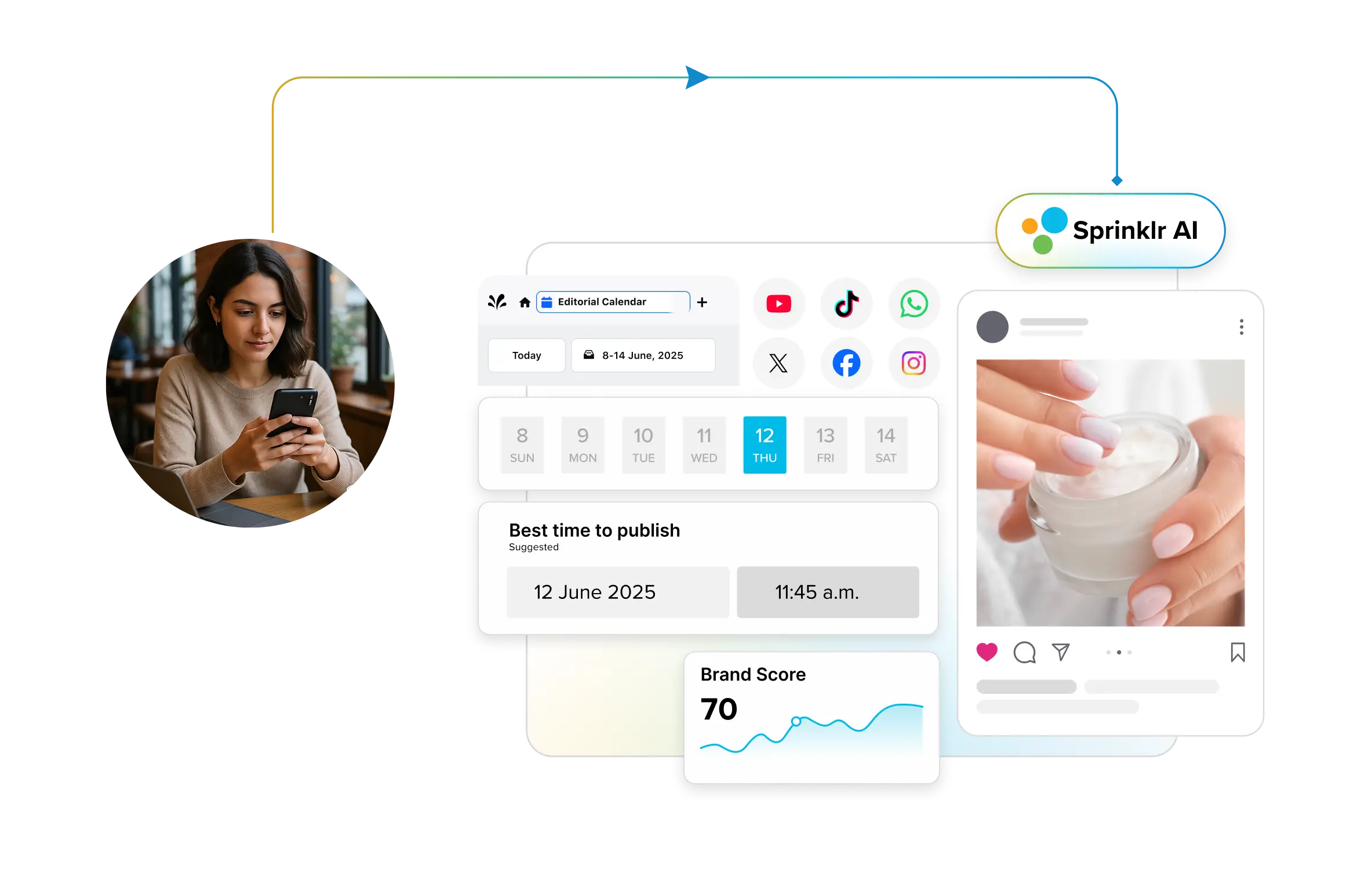
Check out how Engagement Dashboards help you stay on top of inbound messages across social channels.
The path forward doesn't require a wholesale transformation. It requires a shift in operating model — from channel-first to moment-first.
That means moving from episodic campaigns to sustained presence: showing up consistently enough that your brand becomes familiar, not just visible. It means acknowledging issues publicly to show you're awake, then moving resolution to DMs to protect the narrative space of your feed. It means reallocating attention from inbox management to the public conversations happening in creator threads and cultural feeds, where discovery actually happens.
Lastly, it also means preparing for a crisis before it arrives — having pre-approved context, FAQ frameworks, and response templates ready for the moments you can predict, so that when attention spikes, your brand signals competence rather than chaos.
Watch this video to find out how to manage a crisis should you ever face one:
Moments move faster than channels. The brands that win them aren't just responsive, they're ready. How ready is your brand?
This blog is the first in a series of blog posts about the relevance of moments and how brands can dominate social media by winning key moments. The next blog in the series will be about the telecom industry.