




The global leader in enterprise social media management
For over a decade, Sprinklr Social has helped the world’s biggest brands reimagine social media as a growth driver with a unified platform, industry-leading AI and enterprise-grade scale.



How to Create a Social Media Strategy? A Practical Guide
Aishwarya Suresh is an experienced content writer specializing in social media management, social listening, social analytics, Voice of the Customer (VoC) and customer experience. She writes practical, research-backed guides that help brands understand customer conversations, measure social media performance and turn insights into meaningful business decisions.
Key Takeaways:
- A modern social media strategy keeps clear goals, audience insight, strong content, and measurement. Additionally, AI now runs the execution, turning a static plan into a real-time system.
- AI's biggest shift is from backward-looking to predictive: it helps teams forecast outcomes, choose channels from data, and act on live signals, not last quarter's reports.
- Generative AI speeds up ideation, drafting and optimization, while brand voice, creativity and the final call stay human, not automated.
- Continuous listening and analytics let strategy adapt as the market moves, including how your brand shows up in AI-generated answers, the newest discovery frontier.
- The payoff is measurable business impact, pipeline, retention and ROI, when teams unify insight, action and governance on one platform instead of stitching point tools together.
A successful social media strategy remains built on timeless foundations: clear goals, audience insight, compelling content, and measurable metrics. What has fundamentally changed is how we execute each of these components. And the shift is already mainstream, with 89.7% of social media marketers now using AI daily or several times a week. Artificial Intelligence now provides the capability to plan with foresight, create with context, and optimize in real time. Insights that once took weeks to uncover are surfaced in seconds, allowing you to anticipate audience shifts before they impact engagement.
The modern social media roadmap is now a dynamic, AI-powered system. It leverages predictive analytics, automated insights, and generative creation to move faster, resonate deeper, and deliver tangible business outcomes.
Let’s explore how the core steps of social media strategy transform when powered by AI.
What is a social media strategy?
A social media strategy is a documented plan that outlines a brand's goals, target audience, content themes, chosen platforms, and success metrics across social channels. It connects every action, from publishing to engagement to reporting, to measurable business outcomes like demand generation, customer experience, retention, and brand equity.
AI now sits at the center of modern social media planning. It extends that framework by automating data interpretation, forecasting outcomes, and personalizing engagement at scale. It can surface audience patterns from millions of interactions — revealing sentiment shifts, emerging topics and platform behavior that used to take teams weeks to uncover. AI doesn’t replace strategic thinking; it accelerates it. Teams are freed from data collection bottlenecks and equipped with a continuous intelligence loop, allowing strategy to be refined not on hunches, but on live market signals.
Let’s examine how to build this AI-powered social media strategy.
Read More: 10 Ways to Use AI in Social Media
How to create a social media strategy?
Yes, the core objectives of social strategy are constant, but AI introduces a new paradigm for achieving them. The following framework details how to build a strategy where AI acts as a force multiplier at every stage.
1. Define goals and KPIs with predictive precision
Defining goals and KPIs used to be backward-looking — “what did we do last quarter?” Now AI projections factor in audience dynamics, content performance trends and platform shifts to estimate outcomes before you execute.
Use AI models to simulate scenarios such as:
- Predicting engagement lifts from different content formats.
- Forecasting reach based on posting cadence and historical patterns.
- Stress-testing strategy choices (e.g., video vs carousel content in specific regions).
This turns goal setting from best guess to evidence-backed projections, helping allocate budgets and resources where they matter most.
2. Understand your audience with AI-driven insights
Audience segmentation used to be based on simple demographics. Today, AI clusters behavior, sentiment and intent across millions of data points to uncover latent segments and interests. It isn’t about knowing that a group is active — it’s about why they engage and how that changes over time. AI tools ingest social signals, cross-reference behavioral data and expose:
- Emerging interests before they peak.
- Shifts in sentiment tied to product or cultural events.
- Audience affinity groups that aren’t obvious from surface metrics.
Use AI-first tools like Sprinklr’s Audience Insights analyzes billions of digital signals to surface affinities and create custom segments you can act on. Your brand can use these insights to target specific audience tribes, tailor content to interests and engage at the right time, turning raw social data into actionable strategies that drive conversions.
Once you start seeing audience signals at that depth, another challenge emerges — How can I adapt my social media strategy to meet evolving customer expectations?
Their expectations shift as fast as the platforms they use. The key is agility. Real-time listening and AI-driven analytics help you understand what customers value today, not last quarter. By monitoring live conversations and sentiment, you can spot when interests evolve or pain points surface, and adapt messaging, tone, or campaign formats before relevance slips. When every decision is grounded in live audience intelligence, your strategy stays aligned with what people want, not what you think they want.
3. Choose channels based on data
Choosing channels used to be about assumptions and industry norms. AI changes that by analyzing where your exact audience is most active and which content types drive conversions on those platforms.
Analyze cross-platform behavior to:
- Prioritize channels that show measurable social media ROI for your segments.
- Avoid platforms with low conversion potential despite high traffic.
- Tailor content forms to each channel’s unique engagement patterns. (e.g., LinkedIn favors expertise & conversation; Instagram increasingly rewards original content, saves, and shares).
This keeps spend efficient and audit ready.
4. Craft smarter content with generative AI
Content still wins, but now the processes behind ideation, refinement and optimization are AI-assisted. Generative AI accelerates brainstorming and drafting, while analytics layer on what works with specific audiences.
Human creativity combined with AI means:
- Generating multiple headline and caption variants.
- Testing tone and messaging against predicted engagement.
- Fine-tuning visuals to platform norms before publishing.
This reduces time from idea to execution without sacrificing quality.
Here’s how Sprinklr AI+ helps craft smarter content. It helps generate captions/headlines, reword, elongate, shorten, or even translate your messaging – all while maintaining the essence of your brand's voice. 👇
This fusion of creative and analytical power brings up a common concern for teams investing in content: How can I predict when my social media strategy needs to evolve as engagement algorithms change?
Social media algorithms change constantly, which can impact how far your content reaches and how audiences engage. You can determine when it’s time to adjust your strategy by keeping a close eye on engagement metrics, audience behavior, and content performance over time.
Sudden drops in likes, shares, comments or reach, even on posts that normally perform well, can signal shifts in audience preferences or changes in platform algorithms. Monitoring trends, testing new formats, and analyzing what resonates allows you to adapt before performance declines.
5. Optimize posting and engagement with AI scheduling
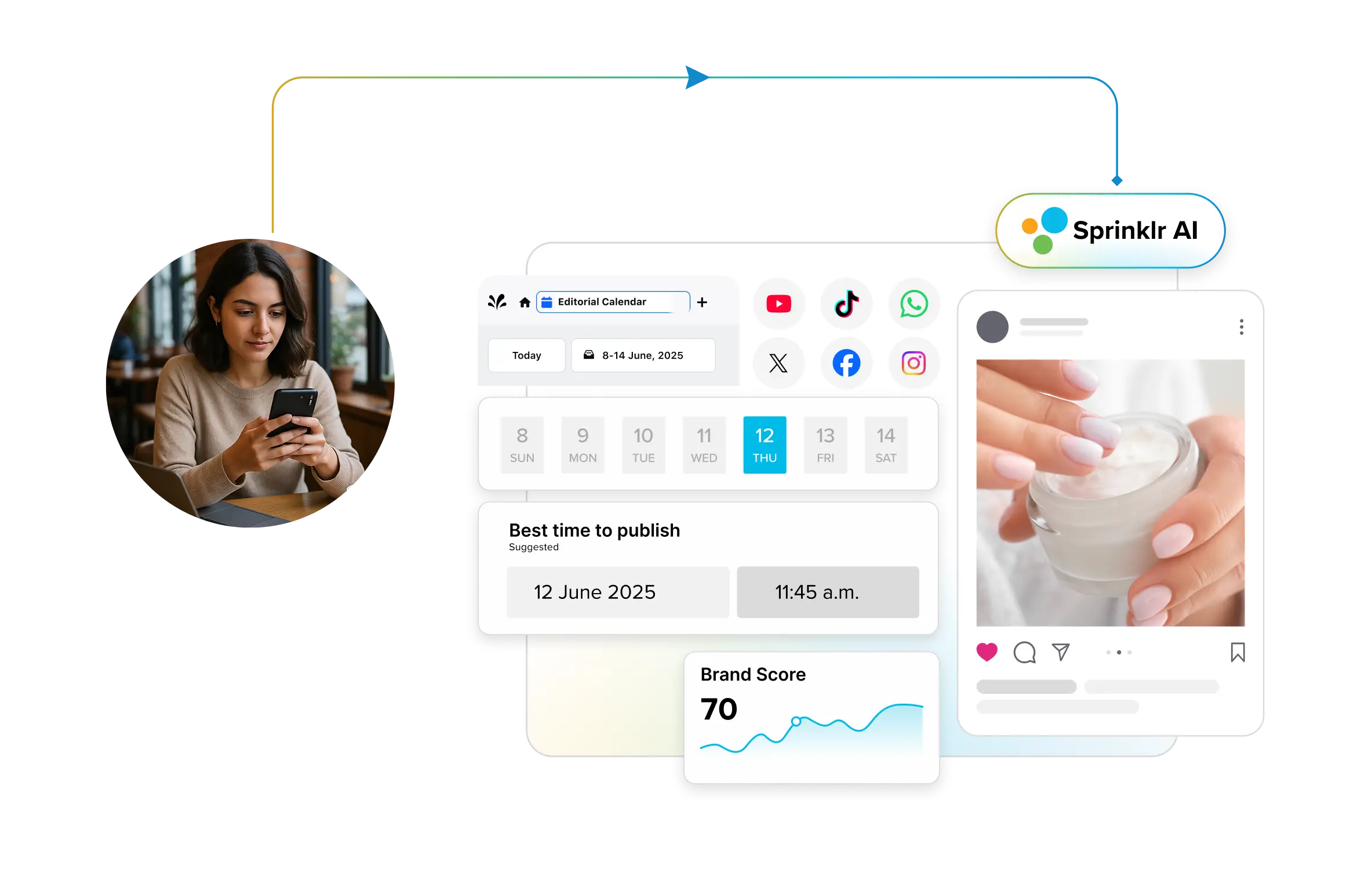
Even the best content can underperform if it isn’t published at the right time or in the right format. AI analyzes audience activity, engagement patterns and platform trends to recommend optimal posting times, ideal frequency and the formats most likely to resonate.
Smart social media scheduling tools factor in:
- Audience online presence rhythms.
- Content type performance across days and times.
- Engagement peaks for target demographics.
This means fewer manual guesses and better engagement outcomes.
Here’s how Sprinklr’s Smart Scheduler helps achieve just that! 👇
6. Monitor, measure and adapt in real time
Social media trends shift rapidly and static reports don’t keep pace with social dynamics. AI gives you a living dashboard — spotting content underperformance, flagging sentiment shifts and suggesting strategy tweaks in real time.
Leverage:
- Automated alerts when key metrics deviate.
- Trend signals that inform content pivots (e.g., “double down on carousels,” “retire low retention video styles”).
- Sentiment analysis that flags risk or opportunity early.
This becomes a feedback loop where strategy learns as the market moves. The catch is that a loop only helps if you can actually question it, and for most teams, understanding why a number moved still means digging through dashboards by hand. This is where conversational reporting is starting to help: with Sprinklr Copilot for social, you can simply ask why engagement shifted, get a plain-language summary, or spin up an analytics widget, and it surfaces the answer from your own data. It's less about replacing analysis and more about getting to the "so what" faster.
A real-time feedback loop reveals more than just performance dips; it highlights a critical strategic question: "How do I identify content gaps in my social media strategy to improve organic reach and engagement?”
Identifying content gaps is about mapping your actual output against the total landscape of audience interest and competitor coverage. AI analysis does this at scale, comparing your published themes and formats against trending industry conversations, competitor messaging, and unmet audience queries detected through social listening. It surfaces clear, actionable whitespace: perhaps you're under-indexing on how-to video content in a sector obsessed with tutorials, or missing the chance to lead on an emerging topic your competitors have yet to own.
Filling these specific, data-identified gaps is what transforms organic reach from a hopeful broadcast into a targeted magnet for engagement.
7. Show up where discovery is moving: AI search
Discovery is no longer just Google and social feeds. A growing share of buyers now start with AI answer engines like ChatGPT, Gemini, and Perplexity, and 80% of consumers rely on "zero-click" AI search results at least 40% of the time. That makes a new question part of every strategy: what is AI telling people about your brand before you get to?
Answer Engine Optimization (AEO) is how you influence it, structuring content and signals so AI engines mention, recommend, and accurately represent you. Sprinklr's LLM Insights tracks how your brand (and your competitors) show up across AI answers, measuring AI mention rate, share of voice, sentiment, and the sources shaping those responses, then turns the gaps into action plans, all built from real customer conversations rather than guessed-at prompts.
💡 Pro Tip: New to answer engine optimization? Sprinklr's LLM Insights: Your Guide to AEO breaks down how AI search decides which brands to surface, and gives you a 30-day framework to diagnose visibility gaps and start showing up in AI answers.
How do I know if my brand is showing up in AI-generated search results?
Start by tracking how often AI engines like ChatGPT, Gemini, and Perplexity mention your brand for the queries your buyers actually ask, and whether that mention is accurate and positive. This is becoming a core strategy metric because a growing share of discovery now happens inside AI answers rather than traditional search, often before someone visits your site. Platforms like Sprinklr's LLM Insights measure this visibility and flag where competitors are being surfaced instead of you.
5 mistakes to avoid in your social media strategy
Even the most well-planned strategy for social media can stumble if common pitfalls are overlooked. For enterprise teams managing multiple channels, campaigns and audiences, mistakes can cost engagement and dilute ROI. Understanding where brands often go wrong and how to course-correct helps ensure that every campaign contributes meaningfully to business objectives.
1. Chasing trends without data: Jumping on every viral trend can spread resources thin and dilute brand messaging. Not every viral format fits your audience or objectives.
✅ Do this: Use listening benchmarks to validate trend‑fit before investing; run 2–3 controlled tests and scale only on repeated lift.
2. Ignoring audience signals: Brands that fail to listen to their audience risk misalignment and lost engagement. Monitoring sentiment and engagement patterns is critical.
✅ Do this: Review top themes weekly; update copy and formats to reflect emerging motivations and frustrations.
3. Focusing on vanity metrics: Metrics like likes, shares or follower counts are easy to track but don’t reveal business value. It rarely correlates to pipeline or retention.
✅ Do this: Instrument lead quality, assisted conversions, and retention signals alongside social KPIs; review quarterly.
4. Over-automating without oversight: Automation accelerates content scheduling, engagement and reporting, but removing human judgment entirely can result in tone-deaf or off-brand messaging.
✅ Do this: Keep human approvals for messaging, compliance, and crisis workflows; use AI to triage and suggest.
5. Neglecting continuous optimization: Social media is dynamic, and a static strategy quickly becomes outdated.
✅ Do this: Move to real-time dashboards with anomaly detection and action prompts; reallocate efforts monthly.
Final thoughts
Social media strategy today isn’t about choosing between data and creativity. It’s about fusing them, where predictive intelligence sharpens human insight, and human creativity gives data its soul. That’s how you move from counting likes to driving pipeline, from monitoring sentiment to forecasting demand. And that’s the equation that matters now: AI’s foresight plus your team’s creativity equals ROI you can measure and momentum you can sustain.
Looking ahead, one thing is clear: campaigns that listen first, act with insight, and speak to people will win. Reactive posting is fading. What’s rising is strategy that’s proactive, rooted in real-time signals, and built around the audience’s world, not your brand’s calendar.
If you’re ready to move your strategy from manual guesswork to intelligent execution, the platform built for that shift is Sprinklr Social. It brings together the AI, the analytics, and the governance enterprises need, not to replace your team, but to equip them.
To see what that looks like for your organization, let’s start a conversation. 👇
Frequently Asked Questions
A strong social media marketing strategy aligns business outcomes to goals and KPIs, uses audience intelligence to inform channel selection and content planning, and runs on disciplined governance, workflows, and measurement. AI enhances each step by forecasting outcomes, segmenting audiences, and optimizing creative, timing, and frequency, then flagging anomalies so teams can adapt quickly.
Prioritize the few channels where your audience is active and your formats perform (quality > quantity). Use AI to rank channels by return on effort/ROI for each segment, keep 2–4 primary platforms, and review quarterly to scale up winners and sunset underperformers.
Continuously. Set a simple operating cadence: weekly performance checks (alerts/anomalies), monthly optimization (format, timing, audience pivots), and quarterly strategy reviews (goals, budgets, channels). AI‑driven analytics make this feasible by surfacing shifts in engagement, trends, and behavior in real time.
Connect social metrics to business outcomes — assisted conversions, lead quality/pipeline, retention/CSAT, revenue influence. Use AI to translate reach, engagement, and sentiment into actionable indicators (e.g., content/segment‑level ROI), and report both leading signals (engagement quality, saves/shares, watch time) and lagging outcomes (MQLs, opportunities, renewal uplift).
No. Strategies should reflect goals, audience, industry, and resourcing. AI enables customization at scale — tailored segments, localized messaging, and format choices with brand voice, compliance, and approvals as guardrails, so you avoid one‑size‑fits‑all tactics.
Aishwarya Suresh is an experienced content writer specializing in social media management, social listening, social analytics, Voice of the Customer (VoC) and customer experience. She writes practical, research-backed guides that help brands understand customer conversations, measure social media performance and turn insights into meaningful business decisions.
Explore Social Media Marketing