Setting Up the In-App distribution with Trigger Conditions
Updated
You can use In-App Surveys to collect solicited feedback from your customers during key interactions in your mobile app. You can choose from predesigned formats such as micro-surveys or customize pop-ups to match your brand. You can also embed surveys in any section of the app.
For each distribution, you configure a single intercept that includes the creative, trigger conditions, translations, and schedule in one place.
You can trigger creatives using predefined conditions, such as browsing behavior or session duration, or use custom events to capture specific feedback. You can also refer to the In-Apps article for use cases and value additions.
Prerequisites
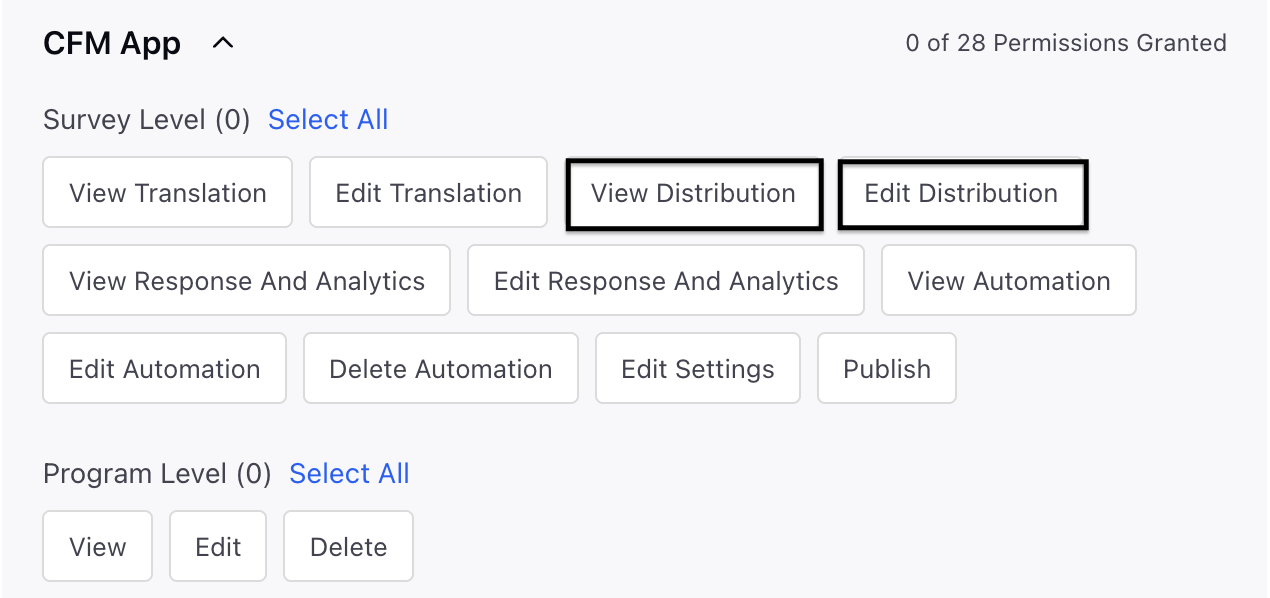
You would need access to the Survey Level View and Edit Distribution in order to access In-Apps distribution.
Setting up the In-App distribution with Trigger Conditions
Select a Survey and go to Distribution section.
Click on More Actions click Create Distribution and select In-App distribution.

Go to Details section and fill in the details:

Distribution Name: Enter a meaningful name to the distribution.
Expiration Date: Enter an expiry date.
Live Chat Application: You can select an existing LiveChat application or create a new one. Any proactive prompts related to the chosen LiveChat will be displayed in the dropdown menu. If you select an existing LiveChat, you will also be able to see all other distributions tied to that particular LiveChat instance. You can view all Website or In-App distributions associated with LiveChat in the dropdown.
 Note: Selecting a LiveChat here does not immediately display a live chat on the Mobile App. Instead, it links the proactive prompts to the appropriate code required to render the creative within the app.
The LiveChat ID is utilized during the SDK installation process.
Click Next and Go to Intercept Setup section and fill in the details:

Select Creative: Select a creative from the drop-down or create a new one. The following creative types are supported:
Pop-up: A full-screen or modal survey overlay.
PopOver Rating: A lightweight rating prompt that appears as a popover.
Embedded Rating: A rating component embedded directly into a section of the app.
Select Trigger: Go to select trigger section and set up trigger conditions and select the value. You can add multiple trigger conditions by clicking + Add Condition.
Note: You can add multiple condition by clicking + Add Condition Group. Conditions can be incorporated by utilizing a mix of AND and OR operators, or a combination of both. Furthermore, groups of conditions can be established using the same mix of operators to refine targeting criteria more accurately.Deactivate the Auto Trigger for the Variant to halt the automatic display of the creative when the variant is evaluated and the criteria are met, allowing the client application to control when to show the creative. Activate this feature to stop the creative from appearing automatically once the intercept conditions are fulfilled.
By turning off the auto trigger, you can utilize the displayByInterceptId method within the SDK to manually initiate the creative at the preferred time. You can obtain the Intercept ID from the post-save pop-up or via the Copy Embed Details option found in the 3-dot menu of the Distribution Record Manager.
For SDK method details, refer to this article.
Go to Translation section where you can configure multilingual support for your In-App survey, with this setting enabled by default and controlled through the SDK. The SDK determines the language displayed based on the user’s locale, which you set using the updateLocale method.
If a translation is available in the creative for the selected language, the survey displays in that language.
If a translation is not available, the survey falls back to the base language.
Note: Ensure that you add translations to the creative in the Builder module beforehand. The distribution step only controls how the language is applied at runtime.

Go to Scheduling section and fill in the details:

Go to Intercept Activation Details, where you can plan the timing for sending your survey to the recipients.
Start Date and Time: You can select the start date and time to schedule the survey.
End Date: You can select the end date the distribution.
Business Hours: Optionally restrict distribution to specific business hours.
Time Zone: Select the time zone for the schedule.
Navigate to the Distribution Sampling option and switch it on to determine what percentage of all eligible recipients will receive this intercept. Additionally, Sampling is not applicable to custom programmatic triggers.
Go to the Distribution Tagging section where you can configure custom tags for reporting associated with this distribution by selecting a response custom field and value, then click Update. At this stage, you can assign static values to response custom fields, which will be automatically applied to each survey response collected from this distribution.
This enables you to classify responses by distribution. For example, you can label a distribution with values such as:
source = "checkout_flow"
campaign = "Q3_NPS"
Response Custom Field Enrichment
Response custom fields allow you to attach contextual metadata to each survey response — either statically (at the distribution level) or dynamically (via the SDK at runtime).
Static Tagging (Distribution Level)
Set up in Step 4: Planning the distribution form
The tagged values apply to all responses from this distribution
Example: campaign = "Summer_2026", channel = "mobile_app
Dynamic Tagging (SDK)
Set at runtime using the SDK's updateSurveyResponseContext and clearSurveyResponseContext methods
Allows passing real-time context such as screen name, user tier, session ID, or cart value
Dynamic values override static values for the same custom field
Usage of Response Custom Fields
Survey Question Personalization: Insert response custom field values as placeholders within survey questions and special pages to create a more contextual survey experience.
Display and Skip Logic: Use response custom field values to control survey flow through display conditions and skip logic.
Custom Reporting and Analytics
- Plot response custom fields as dimensions in Custom Reports and Distribution Reports for deeper analysis and segmentation.
Click Save and deploy to save the distribution, after saving, a popup appears displaying:
LiveChat ID: Used during SDK installation and configuration.
Intercept ID: Used for manually triggering surveys through displayByInterceptId.
Replaces the legacy Variant ID.
Environment: Specifies the environment in which the intercept is configured.
Available options: Production or QA.
This will open into a pop for Copy Embedded Details, where you can copy the Livechat ID, Intercept ID, Product Environment details. This popup is available at any time through the Vertical Ellipsis (⋮) in the Distribution Record Manager by selecting "Copy Embed Details."
Click Done and install SDK. Follow this article for more details on installing SDK.

Analyze Distribution Report
Once the surveys have been distributed, you can examine the metrics in the Distribution Record Manager. Click on the summary metrics to view detailed reports that include the following widgets:
Widget | Metrics / Dimension | Description |
Informational Widget | Metric | Displays distribution details, including Distribution Name, Description, LiveChat Application, and Creative. |
Key Metrics Widget | Metric | Provides a summary of core performance metrics, including Intercept Triggered Count, Engagement Count, Abandonment Count, Completed Count, Abandonment Rate, Engagement Rate, and Completion Rate. |
Funnel Widget (Absolute Values) | Metric | Visualizes the survey journey using absolute counts across stages: Triggered → Engaged → Completed. |
Funnel Widget (Conversion Rates) | Metric | Shows conversion rates across key stages, including Engagement Rate and Completion Rate. |
Trend Widget (Absolute Values) | Metric | Tracks Triggered, Engaged, and Completed counts over time to monitor survey performance trends. |
Trend Widget (Rates) | Metric | Tracks Abandonment Rate, Engagement Rate, and Completion Rate over time to identify changes in user behavior and survey effectiveness. |
Intercept ID | Dimension | Support for plotting with response metadata and intercept performance metrics. |
Time Spent in Session | Metric | Time spent within a session at the time of the response. |
Total Page views in Session | Metric | Total number of pages viewed within a session at the time of the response. |
Unique page views in Session | Metric | Total number of pages viewed within a session at the time of response. |
Testing an In-App Survey Distribution
Create a Creative
- Navigate to the Creative Library and create a Pop-up creative.
- Add translations if you want to test multilingual survey support.
- You can also use the system-provided PopOver Rating or Embedded Rating creatives.
Create a Distribution
- Configure the distribution using the four-step setup process.
- For testing purposes, use simple trigger conditions, such as Session Duration > 0 seconds, to ensure the survey is triggered easily.
Copy the Embed Details
- After saving the distribution, copy the LiveChat ID and Intercept ID from the confirmation popup.
Install the SDK
- Integrate the SDK into your test application using the LiveChat ID.
- Refer to the Installing the SDK documentation for setup instructions.
Configure Profile Authentication (Optional)
- If you are testing authenticated surveys, configure HMAC-based profile authentication through the SDK.
- Refer to SDK Support for In-App Surveys for more details.
Set the Locale (Optional)
If you are testing translated content, call
with the required language code before triggering the survey.
- Refer to the SDK localization documentation for supported languages and configuration details.
Trigger the Survey
- Launch the application and perform the action that satisfies the configured trigger conditions.
If automatic triggering is disabled, manually trigger the survey using
with the corresponding
Intercept ID
Complete the Survey
- Submit a test response and verify that all response custom fields, including both static and dynamic values, are captured correctly.
Validate Reporting
- Navigate to Distribution Record Manager and open the distribution.
- Verify that the report widgets display the expected survey metrics and response data.
Key points to note
Each distribution supports only one intercept. Multi-variant distributions are no longer supported for new distributions.
Translation language selection is controlled exclusively via the SDK, there is no server-side or distribution-level language override.
Sampling (showing the survey to only a percentage of qualifying users) is not currently supported.
Response custom fields set via SDK (updateSurveyResponseContext) will override any static values configured at the distribution level for the same field.
The "App Usage Over Time" conditions (Daily, Weekly, Monthly) are not enabled by default and require product team assistance to activate.