




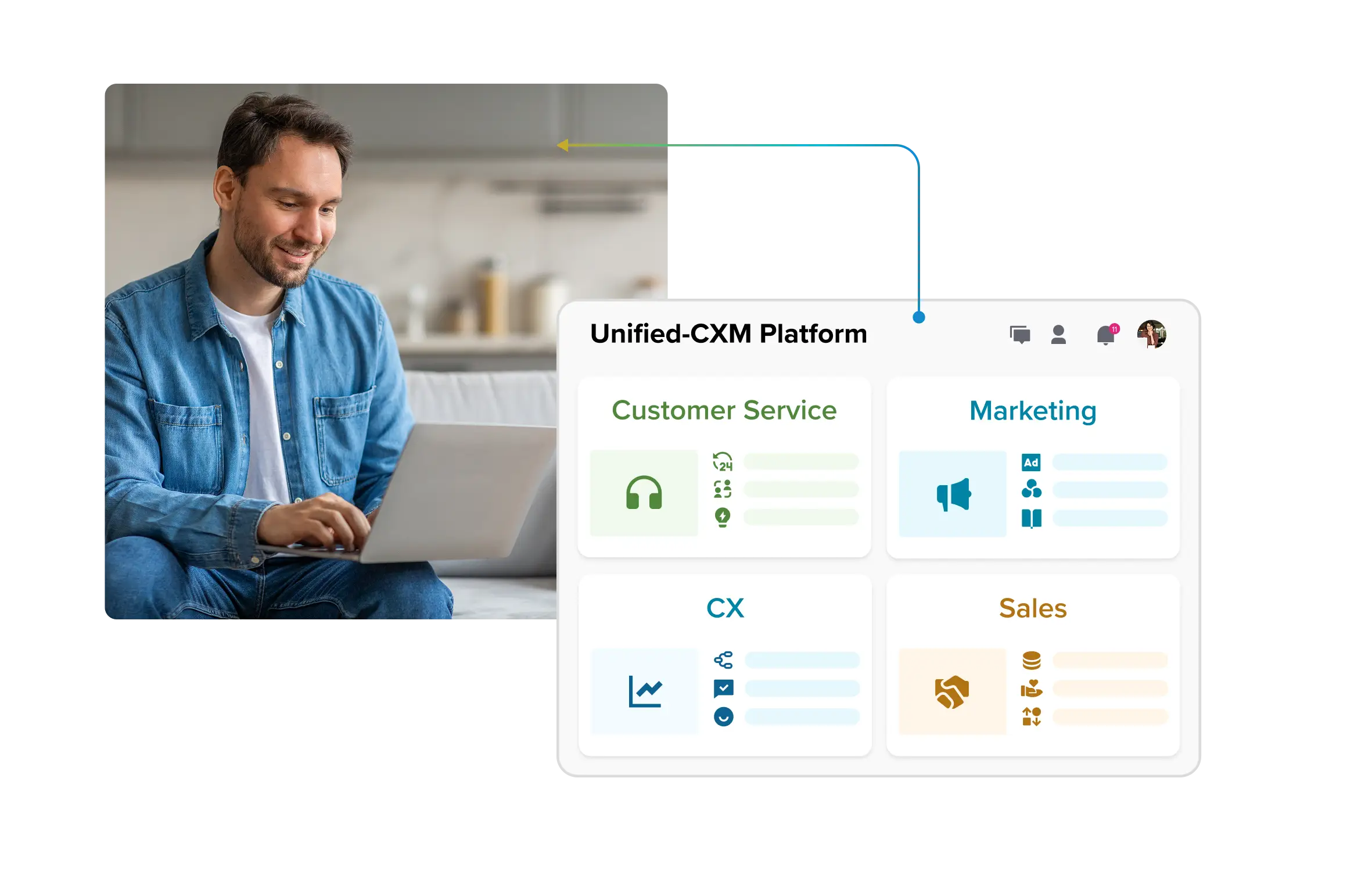
The strategic AI-native platform for customer experience management
Unify your customer-facing functions — from marketing and sales to customer experience and service — on a customizable, scalable, and fully extensible AI-native platform.




Agentic AI vs MCP: Competing with or Completing Each Other?
Aksheeta Tyagi is an experienced content marketer specializing in customer service, customer experience, contact center technology and AI-powered customer support. She writes in-depth guides on customer feedback management, conversational AI, agentic AI and enterprise service transformation to help businesses deliver better customer experiences at scale.
Key takeaways
- Agentic AI and MCP solve different problems at different layers. Agentic AI decides what should happen next, while MCP defines how systems access data, tools and permissions safely.
- Agentic AI drives behavior; MCP enables reliable execution. Agents plan, reason and act toward goals, but MCP ensures those actions run through structured, governed interfaces instead of fragile integrations.
- You need both when AI moves from responses to real-world actions. Agentic systems can make decisions, but without MCP they struggle to execute safely or scale across systems.
- The future points toward MCP as the shared foundation for agent ecosystems. As multiple agents coordinate across tools and workflows, standardized context, permissions and interoperability become essential for control and trust.
Agentic AI and the Model Context Protocol often get spoken about in the same breath, sometimes even used interchangeably. They are not the same thing. They also are not rivals in the way many assume.
Agentic AI sits at the behavior layer. It defines how an AI system reasons, plans, decides, and takes action toward a goal. MCP sits underneath, quietly handling how models receive context, tools, and data in a consistent, structured way.
One shapes intent and autonomy. The other shapes execution and connectivity.
When these layers blur, teams make architectural choices that look right on paper but struggle in real systems. Developers feel it in brittle integrations. Enterprise leaders feel it when pilots stall after early promise.
This piece breaks the two apart with clarity. We’ll explain what Agentic AI actually governs, what MCP truly enables, where they intersect, and how to think about using them together or separately.
- What is agentic AI?
- What is MCP (Model Context Protocol)?
- Agentic AI vs. MCP: The core difference explained
- How agentic AI and MCP work together in a modern AI stack
- 4 use cases of agentic AI vs MCP in action
- How to decide: When to use Agentic AI vs MCP (or Both)
- From agentic AI to MCP-native ecosystems
What is agentic AI?
Agentic AI refers to AI systems capable of setting goals, planning multi-step actions, and executing them autonomously — adapting based on feedback until an objective is met. Instead of responding once and stopping, these systems operate in cycles. They decide what to do next, take action, observe outcomes, and adjust until the objective is met.
Four core components make this possible.
- Goal planning sits at the top. The system starts with an outcome and deconstructs it into steps, deciding what needs to happen and in what order.
- A reasoning loop keeps the system grounded. After each action, the agent evaluates progress, checks assumptions, and determines the next move.
- Memory allows continuity across steps. The agent can retain past actions, intermediate results, constraints, and context that influence future decisions.
- Tool use is where action happens. Agentic systems interact with APIs, databases, internal services, and external software. They operate beyond text and can trigger real work in real systems.
This is the key distinction from standard LLM usage. A traditional LLM generates responses to prompts. An agentic system executes tasks. It reads documents, calls services, updates records, and coordinates workflows based on what it learns along the way.
This is also where MCP begins to matter, even though it is not what makes a system agentic. Agentic AI defines behavior and decision-making. MCP governs how context, tools, and data are supplied to the model in a consistent way. Without that underlying structure, agentic systems tend to become fragile as they scale.
We need a simple way to explain agentic AI vs MCP to execs. Where does each fit in our roadmap?
Agentic AI and MCP answer two different questions on the roadmap, and both matter for different reasons.
Agentic AI represents what the business ultimately wants: systems that can plan, decide, and act toward outcomes with less manual effort. MCP represents what the organization needs underneath: a reliable way to pass context, tools, and data to models without fragile custom work.
For executives, the framing is simple. MCP creates confidence and control early on. Agentic AI delivers business impact once that foundation is in place. Together, they turn experimentation into systems leaders can trust.
What is MCP (Model Context Protocol)?
MCP, or Model Context Protocol, is a shared standard for connecting AI models to external tools, data sources, and actions in a safe and consistent way. Instead of every team inventing its own custom wiring between models and systems, MCP defines a common language for how that connection should work.
The purpose is simple but important. As AI systems begin to act, they need reliable access to context. That includes data, permissions, and available actions. MCP standardizes how agents request that context, how tools are exposed to them, and what they are allowed to do.
Three ideas sit at the center of MCP.
- Context provides shared state across tools and interactions, so models are not guessing or starting fresh every step.
- A registry declares which tools exist and what they can do, making capabilities explicit rather than implicit.
- A secure protocol governs access and permissions, ensuring models only see and use what they are allowed to.
Pioneered by Anthropic and subsequently adopted by OpenAI and Google DeepMind, we see MCP in practice through secure, structured tool integrations. For enterprise leaders, this is the quiet layer that turns powerful AI behavior into something dependable. It is what allows agentic systems to exist without becoming brittle or risky.
In customer journeys, where does agentic AI vs MCP make the bigger impact first?
In customer journeys, MCP tends to matter first, even if it feels less visible. Before any AI system can act across touchpoints, it needs clean, reliable access to customer data, systems, and actions. MCP brings order there by standardizing how context and tools are shared.
Agentic AI delivers the more visible leap later. It plans next best actions, resolves issues, and coordinates steps across the journey.
Without MCP, those agents struggle to scale safely. With MCP in place, agentic AI can operate with confidence across channels, moments, and teams.
Agentic AI vs. MCP: The core difference explained
This is where most of the confusion clears.
Agentic AI and MCP solve two different problems, at two different layers of the system. One governs behavior. The other governs connection. When they get mixed up, teams expect the wrong outcomes from the wrong investments.
Here’s the cleanest way to separate them.
Aspect | Agentic AI | MCP |
Primary responsibility | Decides what actions to take to achieve a goal | Defines how models access data, tools, and actions |
What it controls | Planning, reasoning, prioritization, and decision flow | Context sharing, tool definitions, and permissions |
Core building blocks | Goal planner, reasoning loop, memory, tool execution | Context store, tool registry, secure access rules |
System layer | Cognitive and behavioral logic | Integration and communication foundation |
What it produces | Concrete actions, multi-step plans, coordinated workflows | Consistent, governed interfaces between models and systems |
Failure without the other | Smart decisions that cannot execute safely or reliably | Clean integrations with no autonomous decision-making |
Mental model | Brain that decides what to do next | Nervous system that carries signals safely and consistently |
Agentic AI answers the question: what should happen next? It plans steps, evaluates outcomes, and decides how to move closer to a goal. That decision-making can span multiple tools, systems, and moments in time.
MCP answers a quieter but more fundamental question: how does the system safely know what it can see and do? It defines how context is passed, how tools are declared, and how permissions are enforced so models act within clear boundaries.
This is why the two are not competing ideas. MCP does not make systems intelligent. Agentic AI does not solve integration chaos. MCP powers agentic behavior by giving it stable ground to stand on. Together, they form a complete system that can think, act, and connect without breaking trust or control.
From a risk view, how do we think about agentic AI vs MCP when agents can act and MCP connects to tools?
From a risk view, agentic AI and MCP address different failure points. Agentic AI introduces decision risk. The system may choose the wrong action, sequence steps poorly, or pursue a goal too aggressively. MCP introduces control and access risk. It governs what data and tools an agent can see and use. That separation matters. You reduce behavioral risk through constraints, review loops, and oversight. You reduce integration risk through standardized permissions and clear boundaries. Treating them together allows agents to act while keeping visibility, accountability, and trust intact.
How agentic AI and MCP work together in a modern AI stack
Once AI systems move beyond answering questions and begin taking action, the structure underneath them starts to matter. This is where agentic AI and MCP come together, each playing a clearly defined role in the same stack.
At the center of this stack sits the language model. It provides the raw capability to understand instructions, reason through problems, and generate structured output. On its own, the model remains reactive. It waits for input and responds once.
The agentic layer is what turns that capability into behavior. It defines the goal, breaks it into steps, decides what should happen next, and keeps track of progress over time. The agentic layer repeatedly invokes the language model to reason through decisions, then evaluates those responses before choosing whether to act, pause, or escalate. In this sense, the agent does not replace the model. It directs it.
When a decision requires interaction with real systems, MCP becomes essential. MCP provides a standardized interface between the agent and the tools it needs to use. It declares which tools are available, what data can be accessed, and what permissions apply. This allows the agent to act without hard-coding integrations or bypassing governance.
Here is the flow, described exactly as it happens in real systems.
- A goal enters the system. This might be a customer request, a task, or an internal trigger.
- The agentic layer takes ownership of the goal. It decides what needs to happen, in what order, and what success looks like.
- To think through the next step, the agent invokes the language model. The model reasons, evaluates options, and proposes an action.
- The agent reviews that reasoning and decides whether to act. This decision logic lives in the agent, not the model.
- When action is required, the agent uses MCP. MCP exposes which tools exist, what data can be accessed, and under what permissions.
- The selected tool executes and returns results. MCP ensures the interaction is structured, consistent, and governed.
- The agent updates memory, reassesses progress, and decides the next move. The loop continues until the goal is completed or human input is needed.
Why this structure matters
This separation is what allows agentic systems to exist safely.
- Agentic AI introduces autonomy and intent.
- Language models provide reasoning power.
- MCP provides trust, control, and consistency.
Without this structure, systems either stay stuck in conversation mode or become fragile automation. With it, AI can think, act, and connect in ways enterprises can rely on.
4 use cases of agentic AI vs MCP in action
1. Customer support agent that can actually finish the job
A customer opens chat with a familiar sentence: “I was charged twice.” A basic model can apologize, explain next steps, and ask for details. It sounds helpful, but it cannot close the loop. An agentic system behaves differently. It treats the message as a goal, then starts working the problem. It asks for only the missing detail it truly needs. It decides whether this looks like a duplicate authorization, a split shipment, or a real double capture. It chooses the next step based on the answer, then checks whether the resolution meets policy.
The agent’s decision to “verify the charge” and “issue a refund if eligible” needs tool access, but tool access must be constrained. MCP provides a structured way for the system to discover the allowed tools, pass the relevant context, and enforce permissions. So when the agent requests order history or payment status, it does so through governed interfaces rather than improvised integrations. When it updates the ticket or triggers a refund action, those actions stay inside approved boundaries.
2. DevOps automation that knows when not to ship
A deployment window opens. The pipeline is green, but production is noisy. Latency is creeping up. A few error budgets look thin. This is where teams usually rely on brittle rules or humans watching dashboards at midnight.
An agentic system changes the shape of that decision. It treats “ship safely” as the goal and weighs signals that rarely fit neat thresholds. It asks, in effect, “Are we stable enough to proceed, or is this a bad moment?” It can decide to pause, request more evidence, run a targeted verification, or proceed with a controlled rollout.
But deciding is only half the story. The “pause rollout,” “trigger canary,” or “roll back” actions must be executed through infrastructure APIs that are sensitive by design. MCP’s role is to make those tool calls consistent and permissioned. It prevents a clever agent from becoming an overly powerful operator by ensuring the system can only invoke approved actions, in approved ways.
3. E-commerce personalization that stays accurate in the moment
A shopper browses, hesitates, returns, and finally adds to cart. Timing matters. Inventory matters. Pricing rules matter. While a model can generate product suggestions, a real personalization system needs to predict.
Now an agentic system treats “help the shopper choose” as a goal. It reasons about intent, context, and next best action. It may decide to recommend a substitute because stock is low, to highlight a bundle because value is the blocker, or to delay a prompt because the shopper is still exploring.
That plan collapses if the system cannot trust the facts underneath it. MCP is how the agent gets reliable product feeds, price rules, promotion eligibility, and availability, without ad hoc integrations scattered across the stack. MCP keeps the interface consistent so the agent always knows how to request the information it needs, and governance remains clear when actions involve coupons, cart changes, or order updates.
4. Incident management that turns triage into coordinated response
An alert fires. Then another. Then ten more. The hardest part of incident response is not spotting that something is wrong. It is deciding what matters first, what is related, and what to do now. An agentic system can treat “stabilize service” as the goal. It groups alerts into a narrative, assesses severity, proposes a response sequence, and keeps checking whether actions improve the situation. It can also decide when uncertainty is too high and escalation is needed.
But response actions like rollback, patch application, status page updates, and ticket creation are exactly where control must be strict. MCP provides the standardized way to execute those actions through approved tools with clear permissions. It helps ensure that the agent can coordinate a response without taking shortcuts through raw system access.
How to decide: When to use Agentic AI vs MCP (or Both)
This is the decision most teams get stuck on because the options sound like alternatives. They are not. The clean way to choose is to start with one question:
Do we need the system to decide, or do we need the system to connect?
If you need both, design for both.
Here’s a simple matrix you can use in planning conversations.
Scenario | Go with Agentic AI | Go with MCP | Use Both |
Complex reasoning required | ✅ | ✅ | |
Simple API orchestration | ✅ | ||
Regulated or high-risk actions | ✅ | ✅ | |
Multi-model environments | ✅ | ✅ | |
Customer-facing automation | ✅ | ✅ | ✅ |
How to read this without overthinking it:
- Choose Agentic AI when the work is decision-heavy.
If the problem involves ambiguity, tradeoffs, or multi-step judgment, you want an agentic layer that can plan, evaluate outcomes, and adapt. This is where “next best action” becomes real rather than scripted.
- Choose MCP when the work is connection-heavy.
If the main challenge is getting reliable, governed access to tools and data, MCP is the foundation. It reduces one-off integrations and makes tool access explicit.
- Use both when decisions must execute in real systems.
The moment an AI system can change state, the stakes rise. Agentic AI can decide what should happen. MCP ensures those actions happen through approved tools with clear permissions.
A helpful rule for roadmap conversations: MCP makes the system dependable. Agentic AI makes the system capable. When you pair them intentionally, you get autonomy that leaders can trust.
From agentic AI to MCP-native ecosystems
What we’re seeing now is not a fork in the road. It’s a layering of responsibilities that is slowly settling into place.
MCP is moving toward becoming the default interoperability layer for AI systems. As more agents need access to tools, data, and actions, teams are realizing that bespoke integrations do not scale. A shared protocol for context, permissions, and tool discovery creates a common baseline that different agents can rely on without constant rewiring.
That direction became harder to dismiss in December 2025, when Anthropic donated MCP to the Agentic AI Foundation, a Linux Foundation directed fund co-founded by Anthropic, Block, and OpenAI, with MCP joining Block’s goose and OpenAI’s AGENTS.md as founding projects. That move matters because it places a core interoperability layer under neutral, open governance rather than leaving it tied too tightly to a single vendor.
At the same time, agentic AI is moving beyond single-task execution. The next phase is coordination. Multiple agents working toward related goals, negotiating priorities, handing off work, and resolving conflicts along the way. That level of autonomy only works when the connective layer underneath is predictable and governed.
This is why standardization efforts from players like OpenAI and Anthropic matter. They signal where the ecosystem is heading, not toward one dominant approach, but toward shared foundations that enterprises can build on with confidence.
Platforms like Sprinklr AI Agents fit naturally into this direction. They focus on orchestrating agent behavior across real customer and operational systems, while respecting the controls enterprises already rely on.
In the end, MCP doesn’t compete with agentic AI. It completes it.
Frequently Asked Questions
MCP solves the mess that appears when AI systems need to interact with real tools and data. Without a standard, every integration becomes custom, fragile, and hard to govern. MCP creates a consistent way for models and agents to discover tools, pass context, and operate within clear permissions. This reduces integration sprawl, limits accidental overreach, and gives teams confidence that AI actions stay within approved boundaries as systems grow more complex.
Yes, because MCP removes guesswork from how tools are accessed. Instead of agents calling APIs in ad-hoc ways, MCP defines what tools exist, how they should be called, and what data they can touch. This consistency reduces breakage, mismatched inputs, and unsafe actions. As a result, agent behavior becomes more predictable, easier to test, and easier to audit, even as workflows span many systems.
They scale in different directions. Agentic AI scales decision-making by handling complex goals and adapting across situations. MCP scales operations by standardizing access, permissions, and integrations across teams and tools. Enterprises usually need both. MCP provides the stable foundation that lets agentic systems grow without creating security or maintenance debt. Without MCP, scale increases risk. Without agentic AI, scale limits impact.
MCP gives agentic systems a safe way to act on their decisions. When an agent decides to fetch data, update a record, or trigger a workflow, MCP defines how that action happens and what boundaries apply. It supplies structured context, declared tools, and access rules. This allows agentic AI to focus on reasoning and planning, while MCP handles execution discipline. Together, they turn intent into controlled action.
Aksheeta Tyagi is an experienced content marketer specializing in customer service, customer experience, contact center technology and AI-powered customer support. She writes in-depth guides on customer feedback management, conversational AI, agentic AI and enterprise service transformation to help businesses deliver better customer experiences at scale.
Explore Agentic AI