





Elevate CX with unified, enterprise-grade listening
Sprinklr Insights gives you real-time consumer, competitor and market intelligence from 30+ channels without the noise. Make smarter decisions, strengthen your brand, and stay relentlessly customer-led.



What is Enterprise Feedback Management [+Why it Wins]
Key Takeaways
- EFM is an organizational change, not a software purchase. Most enterprises fail at implementation because they treat it as a tech rollout.
- Retained ARR, upsell conversion, and operational cost savings are directly traceable to feedback-driven actions, making EFM a financial argument, not just a customer experience one.
- EFM consolidates what point solutions silo, giving leaders a complete picture instead of competing scorecards.
Every interaction your business has — a customer survey, a support call, an online review — carries valuable feedback. Yet in most enterprises, that feedback sits scattered across disconnected systems, leaving leaders with incomplete data and delayed decisions. Enterprise feedback management (EFM) solves this by centralizing feedback across departments, applying AI to interpret it in real time, and routing insights to the teams that can act on them.
Here's how EFM works, why it's become essential infrastructure for modern enterprises, and what measurable results it actually delivers.
What is enterprise feedback management (EFM)?
Enterprise feedback management is a centralized system that unifies input from customers, employees, partners, and vendors into a single, actionable view. Rather than giving you a snapshot from one channel, EFM integrates multiple data sources, applies AI to analyze both structured and unstructured data, and routes insights to the right teams in real time — so sentiment stops being a metric and starts driving decisions.
This is what separates EFM from a standalone NPS or CSAT tool. A single-channel tool captures one type of feedback at one point in time. EFM builds a continuous, organization-wide picture.
Common sources that feed an enterprise feedback management system include:
- Customer and employee surveys to capture structured responses on satisfaction, engagement, and preferences — giving teams a reliable baseline for tracking change over time.
- Social listening to surface unfiltered opinions across public channels before they escalate or go unnoticed.
- Call center transcripts to identify recurring pain points and shifts in customer sentiment across live interactions at scale.
- Support tickets and chat logs to pinpoint service gaps and resolution trends as they emerge, not weeks later in a report.
- In-app analytics and usage data to show how customers actually interact with your product, revealing friction that surveys alone won't catch.
💬 How is enterprise feedback management different from a CRM or survey tool?
CRMs and survey tools are built for specific jobs. A CRM tracks customer interactions, manages pipelines, and stores transactional data. A survey tool captures structured responses at a defined moment. Both do their jobs well — but neither is built to answer the question enterprises actually need answered: what do our stakeholders think, across every touchpoint, right now?
EFM is built for exactly that. The difference comes down to three things:
- Scope. A survey tool captures one channel. A CRM captures one relationship type. EFM unifies feedback from customers, employees, partners, and vendors across every channel — surveys, calls, reviews, tickets, social — into a single system.
- Depth. CRMs and survey tools handle structured data well. EFM goes further, applying AI to unstructured data — open-ended responses, call transcripts, social comments — to surface sentiment and themes that structured fields never capture.
- Action. A survey tool tells you a score. A CRM logs an interaction. EFM routes the insight to the team that can act on it, in time to matter.
Think of it this way: a CRM tells you what happened. A survey tool tells you how someone felt at one moment. EFM tells you why it's happening, across the entire organization, and who needs to know.
Why enterprise feedback management works?
Enterprise feedback management helps large organizations in multiple ways:
Builds a single source of truth for customer experience
When customer data is scattered, enterprises pay the price in lost revenue, inefficient fixes, and decisions made on partial views. Enterprise feedback management eliminates this fragmentation by consolidating feedback across touchpoints into unified customer profiles.
The impact is measurable. Pain points are identified before they escalate, teams coordinate improvements faster, and customers experience consistency across every interaction. Enterprises that achieve this level of customer centricity are likely to experience twice the revenue growth of those that fall behind.
Enables faster responses to issues
For an enterprise contact center handling thousands of interactions daily, even brief delays can translate into hundreds of unresolved cases, frustrated customers, and rising churn risk. For example, many customers abandon a call if it goes unanswered for 30 to 60 seconds.
Advanced EFM platforms utilize real-time sentiment analysis to detect customer frustration before it escalates into formal complaints or cancellation requests. This involves analyzing language patterns, interaction frequency, and sentiment trends to identify at-risk accounts. Proactive retention efforts are significantly more cost-effective than reactive customer recovery programs.
Must read: Ways to improve customer response time with AI
Reduced duplication and survey fatigue
In enterprises, different teams chase different definitions of success. Marketing focuses on brand perception, product focuses on feature adoption, and service tracks resolution times. EFM systems facilitate alignment through automated feedback distribution and shared dashboards. They also centralize surveys and consolidate inputs, so customers aren’t asked the same questions multiple times.
In practice, an EFM can reroute a customer’s product issue that potentially affects marketing messaging to both the product and marketing teams, along with contextual information about customer segments, business impact, and competitive implications.
Powers AI-driven predictive insights
Traditional feedback systems only explain how customers felt at a single point in time. Enterprise feedback management (EFM), however, uses AI to detect patterns in sentiment, behavior, and interaction history to predict what customers will do next. These predictive capabilities help enterprises identify churn risks before they emerge and pinpoint accounts poised for expansion.
In fact, 84% of customer service and support leaders cited customer data and analytics as “very or extremely important” for achieving their organizational goals. It allows leaders to act with precision, resolving issues for at-risk customers while directing positive sentiment into upsell opportunities that drive growth.
Strengthens regulatory compliance
Enterprises face mounting pressure to manage customer feedback within strict regulatory frameworks, such as GDPR and industry-specific mandates. Serious GDPR violations carry penalties of up to €20 million or 4% of global annual turnover, not to mention the reputational damage that follows.
Enterprise feedback management embeds compliance into the feedback process itself, reducing this risk. For compliance leaders, this means lower operational costs, stronger governance, and audit readiness without slowing down the pace of business.
💬 What does implementing an enterprise feedback management system actually involve?
Most enterprises fail at EFM implementation — because they treat it as a software rollout instead of an organizational change. Done right, implementing an enterprise feedback management system involves four stages:
- Audit your current feedback landscape: Before selecting a platform, map every touchpoint where feedback is currently collected — surveys, support tickets, call transcripts, reviews, in-app signals. Identify where data lives, who owns it, and where the gaps are. This audit tells you what the system needs to unify, not just what the vendor claims it can handle.
- Define what action looks like: EFM only delivers value when feedback triggers a response. Before implementation, define the workflows: which insights route to which teams, what thresholds trigger escalation, and who is accountable for closing the loop. Without this, even the best platform produces dashboards that nobody acts on.
- Integrate with existing systems: An EFM system doesn't replace your CRM, helpdesk, or analytics stack — it sits above them. The implementation work involves connecting these systems so feedback flows in automatically, enriches existing records, and surfaces in the tools your teams already use.
- Build for adoption, not just deployment: The most common implementation failure is a platform that goes live but doesn't get used. Cross-functional training, shared dashboards, and early wins — showing teams how EFM surfaces insights they couldn't see before — are what drive sustained adoption across the organization.
Implementation complexity scales with organization size, but the sequence stays the same whether you're a mid-market company or a global enterprise.
While these enterprise feedback management benefits demonstrate measurable impact, it’s also important to compare EFM systems with point solutions that many enterprises still use.
Enterprise feedback management vs point solutions
Point-solution tools, such as NPS trackers, CSAT apps, or survey plugins, are built for narrow use cases. While they work well for small teams, they create complexity when scaled up. Each generates its own data repository, requires separate vendor management, and increases integration challenges. This ‘point solution fatigue’ also leads to higher costs, as organizations incur hidden expenses through licensing fees, training, and IT maintenance.
The market shift toward consolidation underscores this reality. The EFM market, currently valued at USD 2.5 billion, is projected to reach $7.5 billion by 2033. Enterprises are consolidating structured and unstructured feedback into a single system, reducing vendor complexity, and providing leaders with a comprehensive view of the customer and employee experience. Integrated AI also supports predictive analytics, automated routing, and sentiment analysis.
The table below highlights how enterprise feedback management compares with NPS and CSAT tools across critical capabilities:
Capability | Enterprise feedback management | NPS tools | CSAT applications |
Data integration | Unified cross-channel data with real-time synchronization | Single metric focus with limited integration capabilities | Isolated satisfaction metrics without cross-channel connectivity |
Scale and governance | Enterprise-grade security frameworks, role-based access, and compliance-ready architecture | Varies by vendor; often lacks enterprise governance | Basic user management with limited compliance features |
AI and analytics | Advanced sentiment analysis, predictive modeling, and trend detection | Basic scoring algorithms with limited predictive capability | Simple rating aggregation without advanced analytics |
Automation and workflows | End-to-end workflow automation with intelligent routing and escalation management | Manual routing with basic email notifications | Minimal automation; primarily notification-based |
Cross-department use | Consolidated dashboards accessible to all stakeholders, aligning CX, product, and service teams | Department-specific insights with limited cross-functional applicability | Isolated departmental data that doesn’t integrate into enterprise-wide reporting |
Enterprise feedback management in action: Use cases
Discussing EFM in theory is useful, but its value comes to life when it is applied across various enterprise functions. Here are a few use cases that demonstrate its capabilities:
1. Efficiently closing the customer feedback loop
EFM turns negative feedback into opportunities for recovery. Instead of waiting days or weeks for reports to surface, enterprises can detect dissatisfaction in real time and trigger immediate follow-ups. It prevents escalation and restores trust at critical moments.
Best practice: Train teams to collect feedback and act on it. Closing the loop requires clear ownership, automated routing, and the ability to resolve issues within hours. When done consistently, it turns dissatisfied customers into loyal advocates and builds a culture of accountability across the enterprise.
Example: Vi, a telecom provider with hundreds of retail stores, utilized Sprinklr Service to respond efficiently to Google reviews about in-store experiences. The platform enabled agents to share individual case details across different departments on a unified dashboard, allowing service teams to follow up seamlessly.
Within months of launching the new review process, Vi achieved a 2.4 times faster response time to Google reviews, increased positive reviews for physical stores by 40%, and saw a 500% surge in overall review volume.
2. Using feedback to train and coach frontline teams
Analyzing surveys, transcripts, and chat logs helps enterprises identify recurring service gaps and translate them into targeted coaching opportunities. Managers can gain real-time insights into where agents struggle and where they excel.
Best practice: Secure C-suite sponsorship and clear KPIs for frontline coaching programs. When executives champion training initiatives and define measurable outcomes, feedback translates directly into performance improvements and enterprise-wide impact.
Example: TSB Bank analyzed customer interactions and identified responses that garnered positive reactions using Sprinklr's unified customer experience management platform. The bank also analyzed over 30,000 customer survey responses using Sprinklr Insights, turning feedback into actionable takeaways that were shared with the customer operations team.
The AI-driven approach enabled TSB to handle inquiry spikes with the same or fewer agents while improving first response SLA by 86%, from 2 hours 25 minutes to 20 minutes.
3. Turning product feedback into innovation roadmaps
An enterprise feedback management system centralizes product requests, tags them by theme or customer segment, and links them directly to KPIs. Instead of disappearing in disconnected spreadsheets or ad hoc notes, it shapes the roadmap in ways that drive adoption, retention, and upsell.
Best practice: Integrate EFM into existing CX, CRM, and BI tools so that product teams can connect feedback with adoption metrics, churn data, and customer value. It prioritizes features that deliver measurable outcomes and ensures roadmaps reflect enterprise-wide priorities.
Example: A global technology company deployed Sprinklr to analyze customer feedback across social channels and review sites for nearly 300 products. Cross-functional teams onboarded to the platform captured sentiment data, surfaced consumer suggestions, and shared actionable insights with product stakeholders to inform strategic decisions and product roadmaps. The analysis ensured product teams had real-time access to customer voices, shaping strategy and innovation priorities.
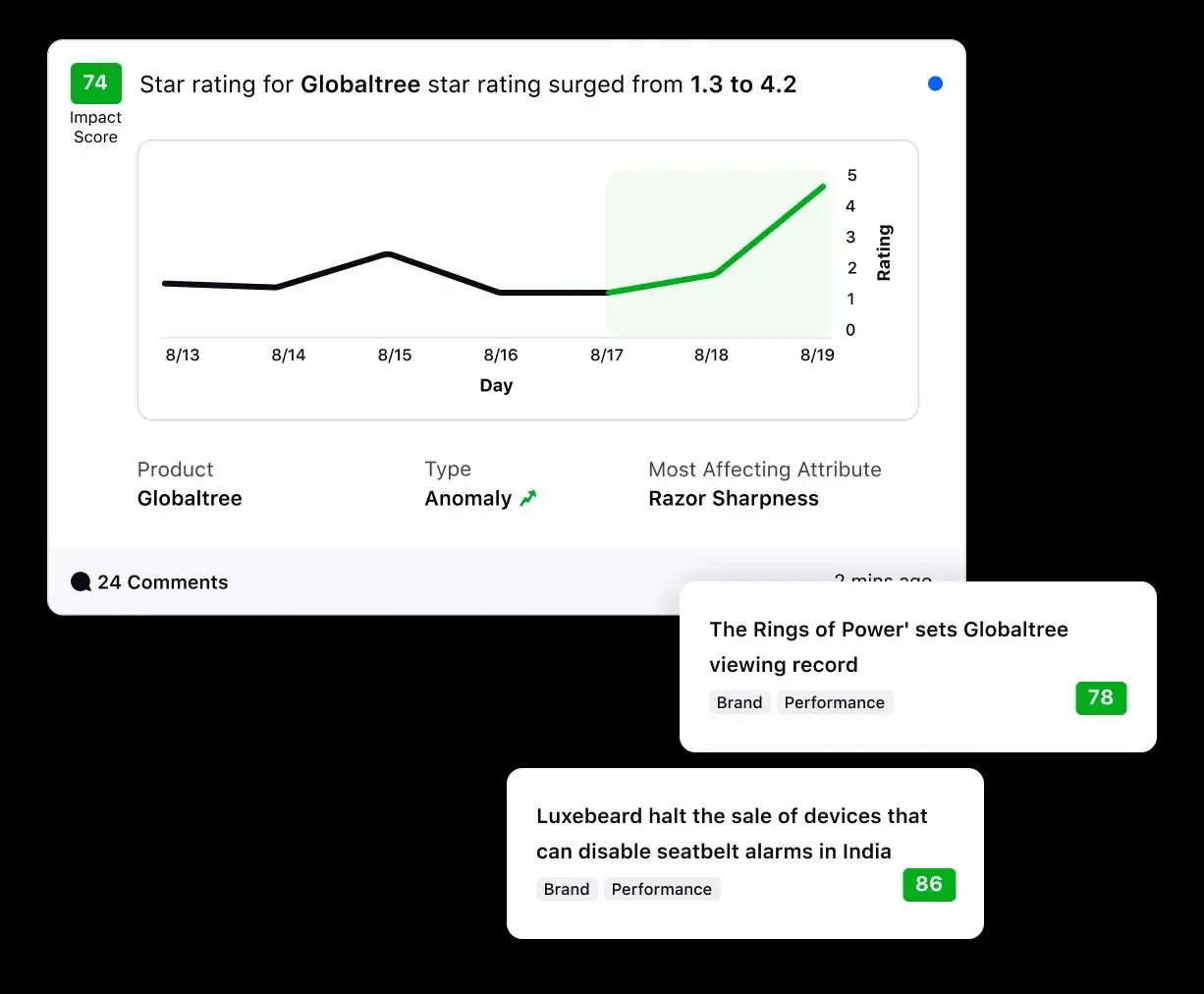
💡 Pro Tip: Invest in a market research tool offering a product insights capability that can capture and analyze customer feedback in real time. It consolidates reviews, social conversations, and support tickets into one view, then applies AI to uncover patterns and prioritize what matters most.
You can unify feedback from e-commerce sites, social platforms, and millions of media sources, applying industry-specific AI models to surface nuanced trends. It can enable product teams to move beyond gut feel, aligning roadmaps with measurable customer value and strengthening engagement.
Interested in learning more? Book a demo to explore all the features!
4. Identifying regional or channel-specific issues before they spread
In large enterprises, local issues can quickly snowball into organization-wide problems if left unchecked. EFM provides a continuous listening layer that captures employee and customer sentiment across regions, channels and teams in real-time. It can identify patterns early, allowing leaders to intervene before isolated concerns escalate into widespread challenges.
Best practice: Continuously measure the impact of EFM against business outcomes. Tracking how early interventions reduce churn, improve engagement or accelerate adoption validates the investment and ensures that insights lead to measurable improvements.
Example: Acer deployed the Sprinklr Platform across its offices in over 160 countries and across more than 250 social media accounts. Sprinklr’s unified visibility enabled Acer's teams to track conversations across all markets, rally resources quickly and mitigate potential brand issues before they escalated. Within six months, Acer increased customer care responses by 18%, demonstrating how continuous monitoring translates into improved customer engagement across diverse markets.
Feeding insights into marketing personalization engines
Modern marketing relies on relevance, but personalization often falls short when based on incomplete data. EFM bridges this gap by feeding feedback into personalization engines. It connects what customers say in surveys, chats, and reviews with how they behave across channels.
Best practice: Standardize data taxonomy to avoid two-dimensional insights. A consistent framework for categorizing feedback ensures marketing teams can reliably segment audiences, enrich profiles, and activate campaigns that reflect the real voice of the customer.
Example: Standard Chartered Bank utilized social listening and sentiment analysis to examine customer spending habits, financial needs and emotional reactions to content across digital channels. These insights enabled marketing teams to fine-tune strategies and retarget customers based on demonstrated behaviors and preferences. Within four years, the bank handled one million customer engagements with social care interactions growing tenfold year-over-year.
What is the real ROI of enterprise feedback management
Executives invest in managing enterprise feedback because it drives key metrics, including customer retention, satisfaction, revenue growth, and cost-to-serve. When feedback is unified and routed into action, the outcomes show up directly in business KPIs.
Here’s how the process connects:
- Raise satisfaction (NPS, CES, CSAT): Route negative survey responses in real time and close the loop within 24 hours. It will increase satisfaction scores, which directly correlate with repeat purchases and referrals.
- Reduce churn: Detect early warning signals, such as decreasing survey scores, repeated complaints, and negative sentiment in transcripts. Intervene proactively to prevent at-risk accounts from leaving.
- Increase upsell conversion: This involves identifying promoters and high-adoption accounts and targeting them with add-ons or premium tiers. This practice converts positive sentiment into revenue growth.
- Reduce operational costs: Automate manual tasks like ticket routing, text tagging, and reporting to save time. It lowers cost-to-serve and redirects resources to high-value work.
Retained ARR → connects to churn reduction (via NPS/CES/CSAT improvements).
Upsell ARR → connects to NPS promoters and upsell conversion.
Cost Savings → connects to operational efficiency (routing, ticket deflection, reduced analysis time).
By aggregating retained revenue, upsell growth, and cost savings, enterprises can calculate the total ROI of EFM programs. More importantly, these numbers demonstrate that customer and employee feedback are growth drivers directly tied to financial performance.
Additional read: Customer success metrics to track
How Sprinklr elevates enterprise feedback management
By consolidating feedback from over 30 channels into a unified view, Sprinklr Surveys turns traditional survey tools into an AI-powered feedback system. It eliminates silos, validates insights across touchpoints and accelerates the path from listening to action. Its capabilities include:
Generative AI and verticalized AI models: Detect emerging customer experience drivers and conversation themes automatically, with clear explanations of what happened and why.
Cross-channel validation: Combine customer survey results with data from social, digital and service channels to confirm accuracy and uncover deeper insights.
AI-powered conversational surveys: Increase response rates with adaptive, interactive surveys that tailor questions dynamically based on previous answers, uncovering more context.
AI-powered reporting and analytics: Analyze open-text responses with sentiment and statistical tools, surface trends and provide role-based dashboards tailored to business leaders.
Closed-loop automation: Create cases, trigger alerts and send reminders automatically from survey responses to ensure fast follow-up and measurable impact.
You can embed these surveys directly into the Sprinklr platform and collect feedback. They convert it into real-time insights that improve retention, loyalty and operational efficiency at scale.
From listening to action: Why EFM wins with Sprinklr
Enterprise feedback management systems have moved beyond collecting surveys or monitoring sentiment. It delivers business outcomes, including stronger retention, faster response times, better cross-departmental alignment and measurable gains in efficiency and growth. Sprinklr Insights unifies feedback from multiple channels, leveraging AI to identify risks and opportunities and automate closed-loop actions.
Book a Sprinklr demo to see how enterprises worldwide are turning feedback into outcomes that matter.
Frequently Asked Questions
EFM collects, analyzes and acts on feedback from multiple stakeholders across various touchpoints. In contrast, Voice of the Customer (VoC) programs focus specifically on gathering customer feedback to improve customer experience.
Yes. The EFM system connects with CRM platforms to enrich customer profiles with real-time feedback, providing teams with a 360° view of interactions and sentiment within their existing workflows.
Leaders must ensure data privacy compliance, define clear roles and stewardship and balance transparency with confidentiality. Managing enterprise feedback also involves access across teams, while maintaining accurate and secure data.
Yes. In B2C, EFM captures mass feedback across many channels. In B2B, it supports deeper, relationship-driven insights from fewer, high-value accounts. Both benefit from scalable analysis and action.
AI analyzes large volumes of data to detect patterns, sentiment and risks. It predicts churn, identifies upsell opportunities and routes feedback to the right teams, turning raw input into actionable intelligence.