




The global leader in enterprise social media management
For over a decade, Sprinklr Social has helped the world’s biggest brands reimagine social media as a growth driver with a unified platform, industry-leading AI and enterprise-grade scale.



Social Media Copywriting: How to Write Posts That Capture and Convert

Great social posts don’t go viral by accident. They are powered by sharp, intentional copy that earns attention in the first line and guides the reader all the way to action. Copy that works improves engagement, strengthens brand recall and drives conversions when the message connects quickly and clearly. The words you choose create the difference between a post people scroll past and one they click, save or share.
In this blog, you’ll learn how to structure high-performing social copy. You will learn how to use emotional triggers intentionally, write hooks that stop the scroll and adapt your messaging for each platform.
- What is social media copywriting, and why does it matter for brands?
- Understanding the psychology behind high-converting copy
- Key elements of effective social media copywriting
- Scroll-stopping copy that captures attention
- How to write copy that converts engagement into action
- Measuring the success of your social media copy
- Tips and tools to elevate your social copywriting game
- Be at the top of your social media copywriting game
What is social media copywriting, and why does it matter for brands?
Social media copywriting is the process of crafting short, strategic messages for platforms like Instagram, LinkedIn, X and Facebook. In a business and marketing context, it means writing captions, headlines, hooks, carousel text and scripts designed to stop the scroll, build relevance and drive a specific user action.
It’s different from general social media content writing because it’s immediate, platform-native and behavior-focused. Blogs and long-form content are built for depth and discovery. Advertising copy focuses on persuasion and conversion through carefully structured messaging. Social copy sits in the middle.
Effective social media copywriting plays three major roles:
- Engaging audiences: Sharp first lines, emotional relevance and platform-specific tone help capture attention fast.
- Building brand positioning: A consistent voice, phrasing and narrative shape how audiences perceive your brand over time.
- Driving conversions: Clear CTAs, benefit-led messaging and proof points can turn impressions into clicks, leads or sales.
For example, Invisalign created an interactive quiz called Smile Quiz within the TikTok app. They saw a 28% increase in the form submissions compared to standard web forms and an 11 percent lower cost per lead. The copy and interface were crafted to engage through a quiz format, convert through an instant form, and optimize cost per action, all while linking engagement directly to a lead generation metric that ultimately drives revenue.
Understanding the psychology behind high-converting copy
When a post reflects a user’s need or internal narrative, it earns attention. When it doesn’t, even well-written copy is ignored. This is why high-performing social content prioritizes emotional insight over sheer volume of text.
- The AIDA framework: Attention, Interest, Desire, Action (AIDA) is a framework to help your enterprise structure copy for fast-scrolling environments. Start with Attention using a sharp hook, build Interest by adding quick context, create Desire by tying the message to a clear benefit and end with Action through a direct prompt. It keeps your copy focused and easy to follow.
- Storytelling, relatability and curiosity: Small narrative cues, relatable lines or curiosity gaps keep readers engaged because they promise meaning or resolution without overwhelming them. These elements make users feel seen and that emotional connection is what drives them to read further or interact.
- Emotional triggers that work: Several emotional triggers consistently lift engagement. Humor makes posts feel lighter. Aspiration helps users imagine a better outcome. Urgency pushes timely action. Fear of Missing Out (FOMO) encourages audience participation as others have already found value. Reassurance reduces hesitation by calming doubts.
Emotional trigger | Example |
Humor | Proof that your day can instantly improve. |
Aspiration | Build the habits your future self will thank you for. |
Urgency | Last 24 hours to enroll. |
FOMO | 18,000 people saved this guide last week, did you? Everyone’s trying this trick right now. |
Reassurance | Takes under 60 seconds to get started. |
Key elements of effective social media copywriting
High-performing social media copy comes from a blend of consistency and audience awareness. Below are some of the key elements of effective social media copywriting and how you can apply them:
1. Brand voice and tone
Strong social copy begins with a brand voice that feels familiar to your audience. A consistent voice reduces friction because people immediately understand who’s speaking and what the message stands for.
How to apply this: Map your audience into segments (for example, awareness, consideration and loyal advocates). Early-stage audiences may need more straightforward explanations, while existing customers may expect insider language or faster context. Build a short voice checklist for every post.
How to align social media copywriting with your brand tone and audience segmentation?
Aligning copy starts with documenting a clear brand voice and matching it to the specific needs, motivations and behaviors of each audience segment. Once you map tone of voice to segment, adjust your hooks, phrasing and CTA strength so each group sees messaging that feels tailored rather than generic. Consistency in voice, combined with variation in emphasis, keeps posts on-brand and relevant.
2. Clarity and brevity
In today’s scrolling environment, attention spans are limited and cognitive load is high. Short sentences outperform dense, jargon-heavy lines because users understand the message faster.
How to do it: Start with your core message. Rewrite it in one sentence or a catchy phrase. Remove unnecessary qualifiers like “in order to,” “basically” or “what we’re trying to say.”
3. Pairing copy with visuals or emojis strategically
Copy and visuals should complement each other. Visuals carry context, emotion or explanation. Copy sharpens the takeaway.
How to apply this: Write captions that add meaning the visual cannot deliver on its own. If the visual shows what, let the copy explain why it matters.
4. Crafting CTAs that are direct and action-driven
A high-performing CTA is specific, simple and tied to a clear outcome. The more direct it is, the easier it becomes for users to act.
How to do it: Use verbs that signal the action expected: Download, Save, Try, Explore, Join. Make the CTA context-dependent, not generic.
5. Platform-specific nuances
Every platform serves a different role in the customer journey. Treating them as interchangeable distribution channels weakens performance. Effective copywriting adapts to platform psychology while supporting business objectives.
LinkedIn: LinkedIn is a credibility-building environment. It is ideal for thought leadership, demand creation, and trust development. Users expect clarity and professional relevance.
Content performs well when it breaks down a business problem and offers a structured solution.
Example: Most organizations do not lack ideas. They lack alignment. When we aligned our marketing and sales teams around three shared KPIs, pipeline velocity improved within one quarter. Here is how we structured it.
This reinforces authority and connects insight to business impact.
Instagram:
Instagram supports discovery and brand affinity. It is highly visual and attention sensitive. The hook must create curiosity, and the caption should convert attention into meaning.
Example: Still creating content without seeing traction? Growth is rarely about effort. It is about clarity of positioning. When we refined our messaging around one core promise, engagement doubled.
This reframes effort versus strategy and adds depth.
X (Twitter):
X thrives on opinion and real-time thinking. It is where positioning is sharpened and ideas are tested quickly.
Concise, direct statements that challenge common assumptions tend to perform best.
Example: Consistency is not your problem. Relevance is. You can post daily and still be ignored if your message does not solve a specific problem.
This introduces tension and reinforces specificity.
Facebook:
Facebook supports relationship building and community engagement. Users are comfortable with longer narratives when formatted clearly.
Example: We recently asked our audience what is holding them back from scaling content. The most common answer was limited internal resources. Here are three changes that reduced our workload without reducing output.
This balances relatability with practical value.
What types of social media copywriting generate the most saves, shares and comments?
Posts that deliver practical value (how-tos, checklists), evoke strong emotional resonance or offer apparent novelty tend to drive higher saves and shares. Community-oriented prompts, opinion questions and storytelling formats often generate more comments because they invite participation. Performance varies by platform and audience behavior, so testing remains essential.
Scroll-stopping copy that captures attention
The most effective hooks use statements that speak to a clear need or blind spot. Here is how social media marketing copywriting can capture attention right from the first line:
1. Lead with the hook
A hook works when it tells your reader right away that there’s something in the content for them. The goal isn’t shock value; it’s relevance. Bold claims, unexpected contrasts or pointed questions establish a reason to read on.
How to: Challenge a common assumption. Use a statistic only if it highlights a clear problem or payoff. Ask a question that’s specific enough to matter, not a generic one.
For example, Mike’s Hot Honey used the hook, “You’ll Love It With Mike’s,” which turns the hook into a promise. The promise-based structure functions as a scroll-stopping hook, especially in food content where enhancement is the emotional driver.
2. Snappy first lines encourage clicks
The first line determines whether your post gets read at all. It shouldn’t summarize. It should pique the user’s curiosity and leave them eager to learn more about your brand.
How to: Create an unresolved thought or open loop. Keep the line short enough to read in a single glance. Hint at the payoff without revealing it immediately.
For example, Apple’s every product carbon neutral by 2030 campaign used the line "Apple has a plan and a promise," which immediately nudges users to seek out more information about the campaign. This opening works because it introduces incomplete information. The plan is hinted at, but not explained. The phrasing creates a natural curiosity gap; readers want to know what the plan is, what the promise includes and how Apple intends to reach carbon neutrality.
3. Use pattern disruption to stand out in crowded feeds
Pattern disruption in social media content writing is about presenting something that looks or feels different from the posts around it. This could be an unexpected phrasing choice, a contradiction or a format shift.
How to: Start with a counterintuitive angle. Use rhythm changes, short sentences followed by a sharp contrast. Break predictable patterns your audience is used to seeing.
For example, The Economist used bold, copy-only OOH ads such as Make AI worried you’re going to take its job, which disrupted every visual norm on the street. In a landscape filled with glossy visuals, lifestyle scenes and AI-generated creatives, this minimalist, copy-first approach emerged as a disruption. The unexpected directness made people pause, read and think.
How to write copy that converts engagement into action
Social media marketing copywriting that converts is about guiding readers through a clear decision path. Your job is to make the value easy to understand and the next step effortless through the following process:
- Structure your message from awareness to action: Lead with a problem or desire, explain why it matters, introduce the benefit and close with a single next step. A linear flow keeps readers focused and reduces cognitive load. Draft in four beats: problem, relevance, benefit, action and remove anything that doesn’t support this progression.
- Align your social media content writing with the campaign goal: Lead generation needs clarity and value, awareness needs memorability, sales needs outcomes and retention needs familiarity. When the copy reflects the goal, the message becomes sharper and more purposeful. Define the campaign goal before writing and let it dictate the tone, detail level and CTA style.
- Reinforce credibility with simple proof elements: A short testimonial, a number or a reference to community engagement helps reduce hesitation. Proof signals that the benefit has been experienced, not just promised. Insert one proof point directly after your benefit statement to strengthen trust without overloading the copy.
- Use precise, purpose-led CTAs: CTA language should match the action required. Replace broad CTAs with verbs that state exactly what the user does or receives, keeping the action straightforward. Try to utilize concise statements such as “Explore for clicks,” “Get the guide for sign-ups,” “Shop now for purchases” or “Share your view for comments.” Specificity removes the need for your audience to guess.
Measuring the success of your social media copy
The strongest social copy reads well and performs consistently. Measuring performance helps you understand what resonates, what falls flat and where minor adjustments can unlock bigger results. Here is how you can measure if your copy is on the right track.
1. Track the right metrics: Metrics like click-through rate (CTR), engagement rate, conversion rate and sentiment each tell a different part of the story.
- One of the most actionable figures is the CTR, which is the number of clicks divided by the number of impressions or views. It tells you whether your copy and creative are compelling enough to prompt action.
- Engagement rate (likes, comments, shares relative to reach) signals how well your message resonates and is relevant to your audience.
- Conversion rate (desired actions such as sign-ups, purchases) links your copy to business goals; this is where copy converts beyond engagement. Sentiment (positive/negative discussion) helps you assess brand health.
How to: Set up dashboards that show these metrics for each post or campaign using social media management tools. Flag posts with below-benchmark results for review.
2. Use A/B testing to refine hooks, headlines and CTAs: A/B testing removes the guesswork from your creative decisions. When you compare variations of a hook, first line or CTA, you can see exactly which version reduces friction and improves clarity.
For example, Lazada Philippines ran a structured A/B test with the Show products feature. The variation with auto-generated formats and product displays saw a 13% lower cost per action, 41% higher ROAS and a 15% lift in conversion rate.
How to: Start by A/B testing your opening line; it has the most significant impact on CTR. Then test CTA phrasing once you’ve identified a high-performing hook.
3. Use analytics tools for continuous optimization: Enterprise analytics tools help you see how copy performs across channels, audiences and formats. With access to cross-platform sentiment, click trends and conversion data, you can identify which message frameworks consistently outperform and make optimization a repeatable process.
For example, using Sprinklr’s unified dashboards, HP gained visibility into paid, owned and earned conversations, including dark posts, allowing them to refine messaging based on sentiment patterns and user reactions across platforms.
How to: Set up automated weekly reports that break down copy performance by platform (Instagram vs. Facebook vs. TikTok) and by format (short vs. long, direct vs. narrative).
Tips and tools to elevate your social copywriting game
There’s a point in every workflow where even the best ideas need a little help. Tools won’t replace strategy or creativity, but they do make it easier. Let’s bring in some tips and tools to elevate your social media marketing copywriting game:
- Use AI to broaden your idea set: AI-driven tools like ChatGPT, Jasper and Copy.ai help you quickly generate alternate hooks, phrasing options or tone variations. Generate a few variations, pick the strongest angle and rewrite it manually to match your brand voice.
How will AI-driven tools transform social media copywriting in the next few years?
Based on current industry trends, AI tools will likely help teams scale variations of copy, test hooks more quickly and personalize messaging for smaller audience clusters. They will also help predict which tones or structures will perform best, making optimization a more data-led, continuous process. Human oversight will remain key for accuracy and brand alignment.
- Strengthen drafts with analyzers and readability tools: Headline analyzers, readability checkers and sentiment tools help you catch weak hooks, long sentences and phrases that unintentionally shift tone. Run your final draft through these tools to spot friction points you might miss on a first read.
- Work with design and analytics to improve clarity: Copy performs best when visuals and data support the message. Share early drafts with design and review insights using analytics to understand how readers respond.
- Keep up with platform shifts and tone trends: Social tone, features and behaviours change fast. Review platform updates weekly and scan top creator posts in your category to understand emerging tones.
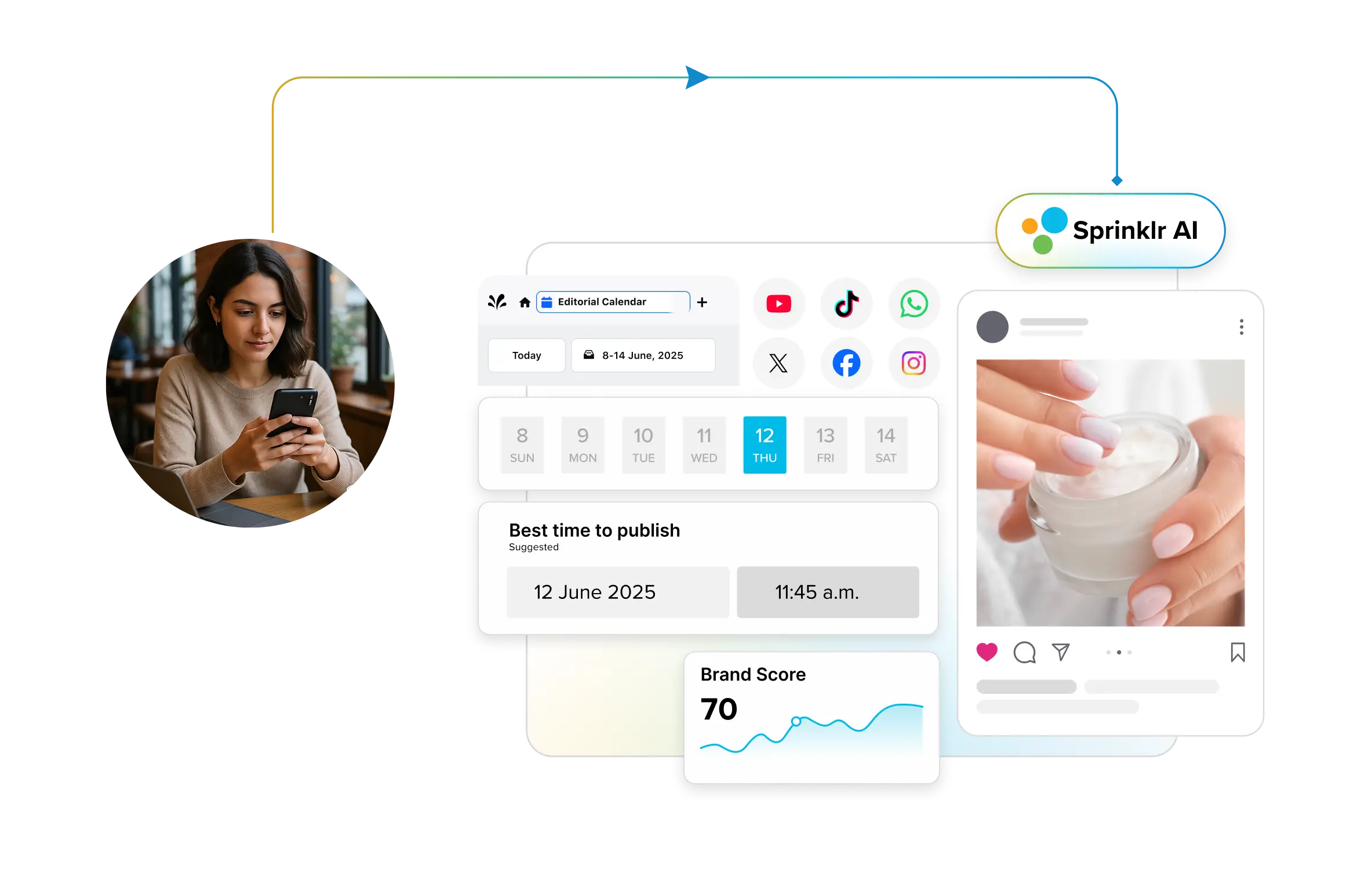
Pro tip: Stop guessing what will perform. Write more imaginative copies by pairing creativity with real audience signals and performance patterns. Social Publishing & Engagement make it easier for your content to be more deliberate, more relevant and easier to optimize. It brings publishing, previews and performance insights into one workflow and lets you review how your past pieces performed across channels.
- Channel-specific previews help you tailor hooks, length and tone for each platform.
- AI-recommended publishing times increase the odds your opening line gets seen.
- Engagement and sentiment dashboards show which message structures resonate, helping you refine the next draft.
The result is a writing process grounded in insight, not intuition, so every post feels more focused and more likely to perform.

Keen to learn more? Book a demo today!
Be at the top of your social media copywriting game
Social-focused copy works best when it’s clear and built around a genuine purpose. When you understand what your audience cares about and write with that intention, your message lands faster and feels more relevant. The trick is balancing creativity with conversion and letting the writing feel natural, while still guiding people toward the action you want them to take.
If you want a quick way to put all of this into practice, start by auditing your next five posts. Look at the hook, the flow, the emotional angle and the CTA. Ask yourself: Does each line earn its place? Is the message obvious? Would someone stop scrolling for this? That small exercise alone can immediately help you tighten up your content.
Sprinklr Social enables you to get deeper visibility into which copy styles actually perform, which hooks get attention, which tones drive clicks and which CTAs move people forward. It brings all your engagement, sentiment and performance insights into one place so you can refine your copy with real data.
Curious to see how it works? Book a demo and explore how to sharpen every post.
Frequently Asked Questions
Copywriting focuses on quick, action-driven messaging, such as the hook, headline, caption and CTA. Social media content writing focuses on depth and context, such as in blogs or long-form posts.
Shorter copies usually perform better—Instagram and TikTok reward punchy first lines. LinkedIn can go longer if you lead with a strong hook. X works best with tight, concise statements.
Use simple A/B tests to compare hooks, first lines or CTAs. Track CTR, engagement rate, conversion rate and sentiment. Look at your top and bottom performers.
AI idea generators (ChatGPT, Jasper, Copy.ai), headline analyzers, readability checkers and sentiment tools help you stress-test your drafts. Analytics platforms like Sprinklr Social show you how each copy style performs across channels.
Refresh whenever your performance dips or your audience behavior changes. As a rule of thumb, reassess your tone, hook formats and CTAs every quarter. But adjust earlier if your metrics show a drop in relevance or engagement.