




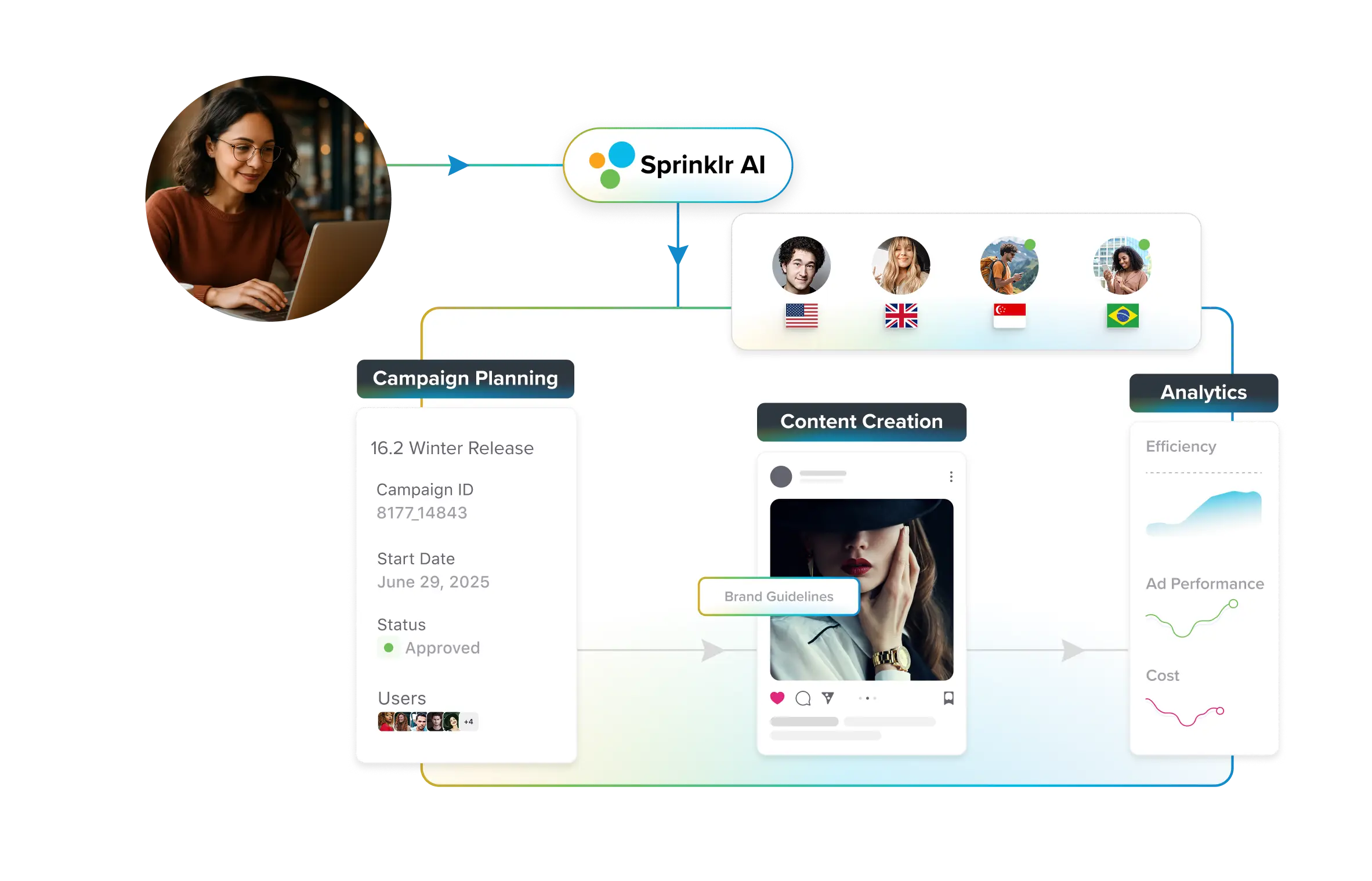
The AI-native platform for global campaign management
Sprinklr Marketing unifies campaign planning, content creation, publishing and analytics across global teams — all elevated by AI. Accelerate go-to-market, boost performance and enforce brand governance at scale.



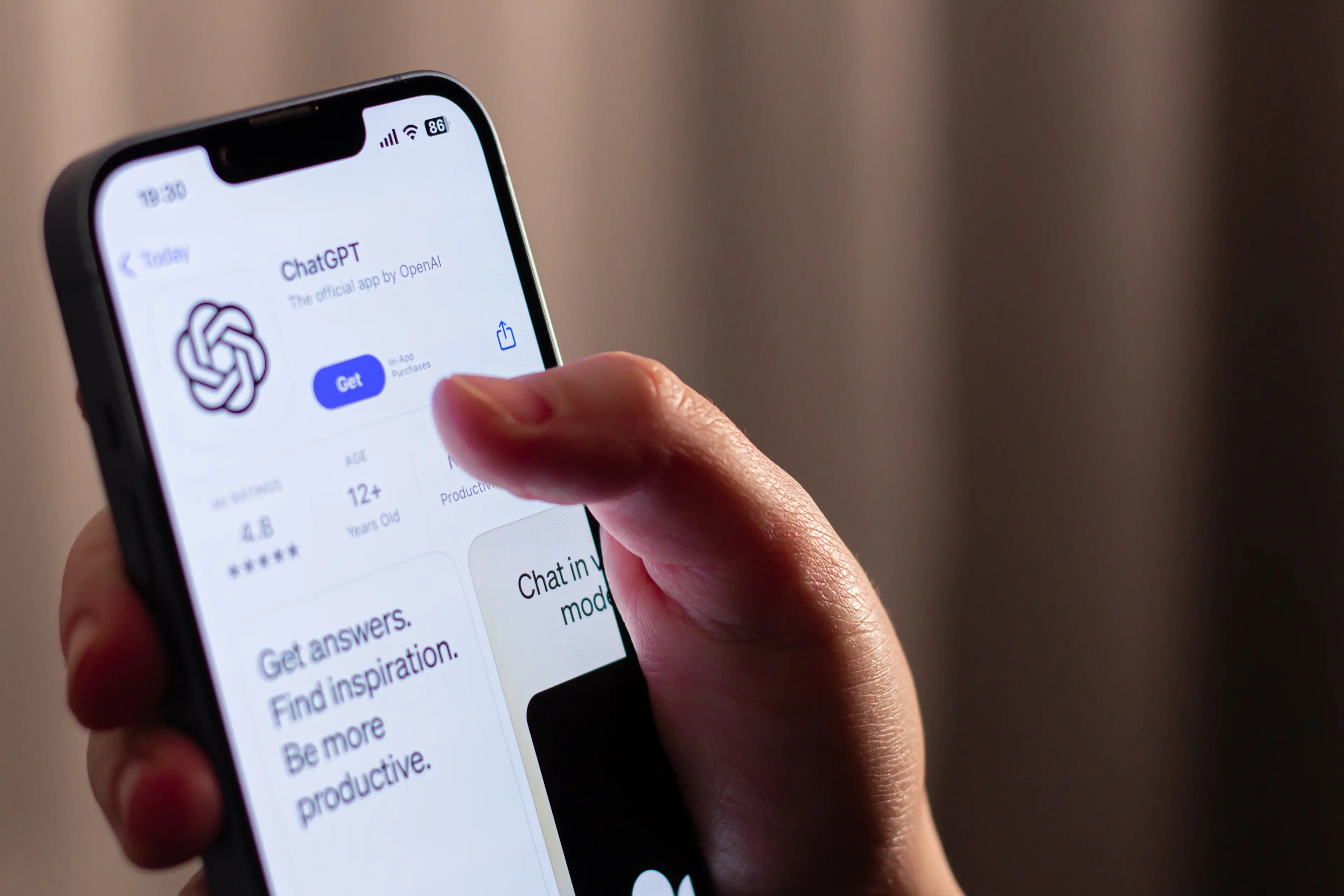
ChatGPT Advertising: How It Works and How to Prepare Your Team
Aishwarya Suresh is an experienced content writer specializing in social media management, social listening, social analytics, Voice of the Customer (VoC) and customer experience. She writes practical, research-backed guides that help brands understand customer conversations, measure social media performance and turn insights into meaningful business decisions.
Key Takeaways:
- ChatGPT advertising lets brands place clearly labeled ads below ChatGPT responses for logged-in adults on the Free and Go plans. As of October 21, 2026, it's available to advertisers in 89 countries.
- Targeting works through conversation context and short "context hints" rather than keywords or demographic profiles. That makes your understanding of customer questions the most valuable input.
- ChatGPT Ads supports contextual targeting, visual ad creatives and impression- or click-based buying. Advertisers can also configure conversion measurement.
- ChatGPT advertising complements search and social media advertising by introducing another opportunity to reach people during research and consideration. Its value depends on audience fit, campaign objectives, and measured results.
If your team manages paid media, you have probably been asked whether ChatGPT is the next channel to test. The short answer: ChatGPT advertising is a set of labeled ads that OpenAI shows to people on its Free and Go plans, placed below ChatGPT's conversations that match the advertiser's topic. OpenAI began testing it in the US on February 9, 2026, opened a self-serve Ads Manager in beta on May 5, 2026, and by October 21, 2026 had expanded availability to more than 100,000 advertisers running campaigns across 89 countries.
That pace raises practical questions for social media and marketing leaders to understand a new surface where a billion-plus weekly users are already exploring, comparing, and deciding. Where does a brand start? Who owns it? How do you know it worked? This guide covers what OpenAI has confirmed, what remains reported or unconfirmed, and what a sensible pilot looks like for a team that already runs search and social campaigns.
- What is ChatGPT advertising?
- How is ChatGPT advertising different from search and social ads?
- Should brands invest in ChatGPT advertising?
- How ChatGPT ads appear
- How brands can prepare for ChatGPT advertising
- What to measure in ChatGPT advertising
- Running ChatGPT ads without adding another silo
- Final thoughts
What is ChatGPT advertising?
ChatGPT advertising is a paid placement system inside OpenAI’s ChatGPT interface that shows sponsored content to users on the Free and Go tiers. Ads are matched to the topic of a user’s conversation and, when personalization is enabled, signals from past chats and ad interactions.
Here are few fundamentals:
· Placement: Ads appear below a ChatGPT response and are clearly labeled.
· Separation from answers: Ads run on systems separate from the chat model. Advertisers can't shape, rank, or change ChatGPT's responses.
· Audience: Only Free and Go users can see ads. Plus, Pro, Business, Enterprise and Edu accounts don't, and neither do accounts identified as belonging to people under 18.
· Privacy: OpenAI says it keeps conversations private from advertisers and doesn't sell user data.
· Buying: Brands can buy through technology partners or self-serve through OpenAI's Ads Manager.
⚠️ Availability and account eligibility can change, so check the OpenAI Ads Help Center before planning a campaign.
The key difference is the environment in which the ad appears. A person using ChatGPT might explain their budget, requirements, preferences and constraints in a single conversation. That context can help an advertising system identify relevant opportunities beyond the short keywords people typically enter into a search engine.
For example, someone comparing project management software might explain that their team works across multiple regions, needs enterprise permissions, and has a limited implementation window. A relevant software ad could appear alongside an eligible ChatGPT response, offering another route to the advertiser's website.
⬆️This is a hypothetical example, not a claim about a specific ad impression or guaranteed placement.
How is ChatGPT advertising different from search and social ads?
The unit of intent changes. In search, it's a keyword. In social, it's a profile and an interest. In ChatGPT, it's the whole conversation. In other words, ChatGPT advertising introduces a conversational context to paid media. Search ads typically respond to queries entered into a search engine, while social ads often reach people based on platform-specific targeting, content consumption, and campaign objectives.
When OpenAI picks an ad, it looks at several signals:
- What the person is asking about and why
- Your ad's title, copy and landing page
- Hints you provide about relevant conversations, plus your targeting selections
- When ad personalization is turned on, some signals from the person's wider ChatGPT use
Search ads | Social ads | ChatGPT ads | |
What triggers the ad | Search queries, keywords and other platform signals | Audience, content, behavioral and platform-specific signals | Conversation context, intent and advertiser-provided context hints |
User mindset | Looking for a link | Scrolling, discovering | Exploring, comparing, deciding |
Where it appears | Results page | Feed, stories, video | Below a ChatGPT response (visual and agent formats in testing) |
Targeting controls | Keywords, audiences, location | Demographics, interests, lookalikes | Contextual hints plus country targeting; platform targeting added in Sep 2026 |
Creative | Text headlines | Image, video, carousel | Compact card: image, title, short body, URL |
Measurement | Platform-specific traffic, conversion and cost metrics | Platform-specific reach, engagement, traffic and conversion metrics | Supported delivery, click, spend and conversion metrics |
Strategic role | Capture relevant search demand | Build awareness, engagement and demand while supporting conversions | An additional channel to test against defined objectives |
Two differences matter most for planning. First, topic relevance decides much of the outcome, so message and landing page need to match the question a person was asking. Second, because OpenAI controls delivery and shares aggregate data, teams cannot rely on the audience-level analysis they use in social.
What this means is that: your best input isn't a keyword list. It's a clear picture of the questions customers ask before they buy. Social listening, customer care transcripts and community threads are your new keyword research.
✅ Good to know: With Sprinklr’s Social Listening, you can monitor 30+ social and digital channels in real time and automatically surface themes, trends and anomalies with Sprinklr AI.
Can advertisers pay to influence what ChatGPT recommends?
No. OpenAI states that ads don't influence ChatGPT's answers. Advertisers can't shape, rank or alter responses, and an ad doesn't mean OpenAI endorses the brand. To appear inside answers, brands still need earned visibility: credible content, reviews and mentions that AI systems draw on. Paid placement and answer visibility are two separate jobs.
Why does conversational intent matter?
A traditional keyword may reveal what someone is searching for, but a longer conversation can reveal why they are searching and what constraints matter to them.
Consider two hypothetical prompts:
· Search query: enterprise customer service software
· ChatGPT conversation: We need customer service software for a global team, with multilingual support, integration with our existing CRM, and reporting that our regional managers can use.
The second example expresses a more detailed set of needs. Contextual advertising may use relevant conversation signals to select an ad that fits those needs, subject to OpenAI's delivery rules and the advertiser's targeting settings.
However, richer context does not automatically make ChatGPT Ads more profitable than search or social advertising. That depends on the advertiser's audience, the quality of the campaign, costs, conversion behavior, and business outcomes.
Should brands invest in ChatGPT advertising?
For most brands, the honest answer is: prepare, test small as a structured test funded from an experimentation budget, and do not reallocate. Don't pull money from proven channels to pay for it.
Reasons to test now:
· Reach is large. OpenAI says ChatGPT reaches 1.2 billion people each week.
· CNBC reported the ads business hit a $1 billion annualized revenue run rate in August 2026.
· Early results are encouraging but partner-reported. OpenAI cites DV Rockerbox finding that WeightWatchers' attributed cost per acquisition was 15.3% lower than its blended paid-search benchmark, and Triple Whale reporting that 93% of visitors to one brand were new.
· The channel is small enough that learning is cheap.
May be worth testing when:
· Your products or services are commonly researched through questions, comparisons, and recommendations.
· Buyers need to understand features, evaluate alternatives, or solve a specific problem before purchasing.
· You can create a landing page that directly addresses the needs expressed in relevant conversations.
· Your team can configure tracking and assess results against a clear business objective.
· You have enough budget and operational capacity to run a meaningful experiment without compromising proven campaigns.
Reasons to wait or limit scope:
· Regulated or sensitive categories: OpenAI doesn't serve ads next to personal health, mental health or political topics, and political ads aren't allowed.
· Thin reach: Your core audience mostly uses paid plans, which don't show ads.
· No measurement plan yet: You can't yet tell a click from a real business outcome. Incrementality testing is described by OpenAI as early-stage.
· Changing norms: Eligibility, country coverage, and pricing details are still shifting.
ChatGPT advertising may be a lower priority if your audience is unlikely to encounter relevant ad opportunities, your conversion tracking is incomplete, or your existing campaigns have unresolved performance issues.
It may also be premature to scale if you cannot distinguish meaningful business outcomes from inexpensive clicks or impressions.
An early campaign should answer specific questions. Does the channel attract relevant visitors? Do those visitors engage with the landing page? Are they converting? How does the cost compare with similar campaigns serving the same objective?
An independent practitioner assessment published by DAC also recommended treating ChatGPT Ads as an emerging consideration opportunity rather than an immediate replacement for established performance channels. That is a useful caution, although individual results will vary.
The practical approach is to preserve what already works while gathering evidence about what this new channel can contribute.
How much does it cost to advertise on ChatGPT?
OpenAI doesn't publish a fixed price. Ads are sold in an auction. Third-party advertisers and agencies report that:
· OpenAI recommends starting cost-per-click bids at $3 to $5.
· US campaigns have a minimum daily budget of $25.
The $200,000 minimum reported at launch no longer applies to self-serve buying. Treat any published CPM figure as a planning estimate, not a rate card. Your first few weeks of data are the real quote.
How ChatGPT ads appear
ChatGPT Ads can appear below ChatGPT responses, clearly labeled and visually separated from the answer. OpenAI has also announced a visual ad format intended to help people explore products and services through imagery. The available experience depends on the current product rollout and placement.
The following describes the main formats and delivery mechanisms documented by OpenAI.
1. Chat card ads
Chat Cards are a supported ad format built around an advertiser's message and destination. The documented ad unit includes:
· Advertiser name and logo or favicon
· Headline or title
· Descriptive ad copy
· Creative image
· Destination landing page
The creative should communicate a clear benefit and give the reader a relevant next step. A B2B software company, for example, might direct interested prospects to a page explaining a particular use case, integration or product capability.
See OpenAI's ChatGPT Ads documentation for current format specifications.
2. Visual advertising experiences
OpenAI announced a new visual ad format on October 5, 2026, to help people explore products and services through imagery. The announcement also covered expanded measurement and brand-suitability efforts.
This development gives advertisers another way to communicate product benefits visually. It also creates a practical requirement for marketing teams: creative assets need to fit the supported format and remain useful in the context where the ad appears.
Because ad products evolve quickly, teams should confirm which visual placements, creative specifications and campaign objectives are available in their accounts before producing assets.
3. Contextual targeting through context hints
Advertisers can provide Context Hints describing the conversations, topics or keywords where their products or services may be relevant. They can also use supported country targeting and exclusion settings.
Context Hints guide ad matching. They are not exact-match keywords and do not guarantee that an ad will appear in a specific conversation.
A useful hint should describe the problem, topic, or situation that makes the offering relevant. For example, a business selling analytics software could describe conversations involving reporting workflows, data consolidation or marketing performance measurement, where those topics fit its offering.
Marketers should avoid treating Context Hints as a direct equivalent of a traditional keyword list. The goal is to establish relevance, then evaluate delivery and performance through actual campaign data.
Where ads won't appear:
· Logged-out users may see ads, but only ones suitable for all audiences.
· Temporary Chats show no ads.
The direction is clear even if the timing isn't. The ad is gradually moving from a link to a conversation. That raises the bar for how well your brand can answer real questions, not just attract clicks.
Here’s where ChatGPT ads show up:
Can people turn off ads in ChatGPT?
Partly, depending on the plan. Reporting based on OpenAI's help documentation says:
- Free users can opt out of ads in exchange for fewer messages and some lost features.
- Go users can't opt out.
- Users on paid plans never see ads.
For advertisers, this means your reachable audience skews toward people who choose free or low-cost access. Factor that into who you expect to reach.
How brands can prepare for ChatGPT advertising
Start with ownership and measurement, then creative. A practical order:
· Assign one owner and a supporting team: Paid search knows auctions. Social knows the conversations. Content knows the answers. Name one accountable owner and give social and content a formal seat.
· Build a conversation map before you write ads: List the questions, constraints and comparisons customers raise before buying. Pull them from social listening, reviews, and care interactions. These become your context hints: short descriptions of the conversations where your ad fits, such as "planning a first marathon" or "choosing a CRM for a mid-size sales team." Context hints guide where ads are delivered, but they aren't exact-match targeting.
· Match landing pages to needs: A person who explained a specific problem expects a page that solves that problem. Generic homepages waste clicks.
· Set up tracking before launch: OpenAI supports a pixel and Conversions API. Integrations with Hightouch, Tealium and LiveRamp help send conversion data from systems you already use.
· Watch how competitors show up: Before spending, see which brands already appear as ads on the prompts that matter to you. The ChatGPT Ads tab in Sprinklr's LLM Insights helps you understand which brands are advertising against prompts relevant to your business. When prompts tracked in your report return advertisements in ChatGPT responses, it surfaces those ads along with details such as the advertiser or brand, the advertisement content and the prompt that triggered it.
Take the example of a mid-size outdoor retailer that finds through listening that shoppers often ask about "lightweight tents for rainy coastal trips." It writes a context hint for that exact situation. It sends clicks to a rain-rated tent comparison page instead of the tent category page. Then it compares results against its search campaign for the same product line.
Do you need an agency or partner to buy ChatGPT ads?
No. Self-serve buying through OpenAI's Ads Manager is available in all 89 launch countries, and partner routes also exist. Larger advertisers can also ask for sales support. The advertising business's legal entity must be in a supported country, so check OpenAI's current availability list before planning regional campaigns.
What to measure in ChatGPT advertising
Start with delivery metrics. Graduate to conversion and incrementality as your data matures. OpenAI itself describes its incrementality work as early-stage, so a clear measurement ladder protects you from overclaiming.
Track relevant outcomes such as qualified form submissions, demo requests, purchases or other supported conversion events. Use consistent UTM parameters and existing analytics tools to identify traffic originating from ChatGPT Ads. Where appropriate, compare results with similar campaigns while accounting for differences in audience, objective and measurement methodology.
Stage | What to track | Why it matters |
Delivery | Impressions, spend, CPM | Confirms your context hints reach real conversations |
Engagement | Clicks, CTR, CPC | Shows whether the ad matches what people are asking |
Outcome | Conversions via pixel or Conversions API, cost per conversion | Connects ads to leads, sign-ups and purchases |
Attribution | Results under 7-, 14- or 30-day click windows | Research-heavy journeys often convert later |
Incrementality | Geo-based tests with partners such as Haus, Measured or WorkMagic | Shows what the channel adds beyond demand you'd capture anyway |
Brand | Brand-lift studies (early testing with Kantar and Cint) | Useful where awareness is the goal |
Two practical tips:
· Compare on equal terms: Pick the same products and the same click window when you set ChatGPT next to search or social.
· Keep a log of your context hints: When performance shifts, you'll want to know which conversation descriptions drove it.
Because OpenAI describes incrementality as early-stage, set the pilot's success test before launch and agree how you will treat view-through conversions.
Running ChatGPT ads without adding another silo
Every new channel arrives with a hidden cost: another login, another naming convention, and another dashboard someone reconciles by hand. Sprinklr added ChatGPT Ads as a dedicated channel within its advertising platform. Teams can create, manage and measure ChatGPT Ads campaigns alongside other paid channels.
Here's what that covers:
· Create: Build campaigns in Ads Composer — set a Clicks or Reach objective, budget, country targeting, context hints and Chat Card creatives, then submit for review.
· Govern: Apply naming conventions and automated pre-publish QA checklists. Store and reuse approved Chat Card creatives in the Creative Library.
· Automate: Use Rule Engine for rule-based and performance-based actions. OpenAI's review statuses (In Review, Approved, Rejected) are available in reporting and automation workflows.
· Report: Analyze impressions, clicks, spend, CTR, CPC and CPM in the same reporting environment as your other channels.
⚠️ To connect, you need a ChatGPT Ads account and API key. For conversion and attribution data, keep using OpenAI's measurement tools and your existing partners.
Learn More: How Sprinklr Lets You Make the Most of ChatGPT Ads
Final thoughts
Over the past two years, shoppers have changed where they start researching. 46% of AI users now begin purchase research on a standalone AI platform such as ChatGPT, up from 25% in 2024. Over the same period, the share starting with traditional search fell from 43% to 24%.
Ads in ChatGPT aren't settling into one format, either. OpenAI is already testing Sponsored Agents, where people who click an ad can ask a brand's own agent follow-up questions before visiting its site. Once buyers can question an ad directly, it's only as convincing as the answers behind it. And they'll check those answers: the same research found 86% of shoppers verify an AI recommendation through another source before buying. That second look usually lands on your reviews, your social channels and how your care team handles questions in public.
Fidji Simo, OpenAI's CEO of Applications, has said that what people often dislike about ads is "not the ads themselves; it's the use of the data behind the ads". Without profiles to target, the brands that win in ChatGPT will be the ones that understand customer conversations best and can handle the paid and organic parts of those conversations together.
With Sprinklr’s Advertising tool, you can run ChatGPT Ads alongside your other paid channels and see which brands are advertising against prompts relevant to your business.
Book a personalized Sprinklr demo to see how ChatGPT Ads fit into your marketing workflow.👇
Frequently Asked Questions
Probably, but check first. As of October 21, 2026, ChatGPT Ads were available in 89 countries, including markets across North America, Latin America, Europe, the Middle East, Africa, and Asia. OpenAI notes that availability may keep changing as it expands.
No. Business, Enterprise, Edu, Plus and Pro accounts don't see ads. This matters for B2B advertisers, whose buyers may use company-provided plans at work.
No. OpenAI says conversations stay private from advertisers, and it doesn't sell user data. Advertisers get aggregated performance reporting.
Advertisers can buy on a cost-per-click or impression basis. In September 2026, OpenAI made conversion optimization with impression billing generally available and called it its recommended model. Options vary by buying route and may change.
Yes. Political ads aren't allowed. Ads don't appear next to personal health, mental health, or political conversations. Check OpenAI's current ad policies before you plan regulated-category campaigns.
At the time of writing, OpenAI's advertiser site offers $500 in ad credit when new advertisers spend $500. Promotions change, so confirm before you budget around it.
Use Ads Manager reporting with the OpenAI Pixel or Conversions API for post-click actions. OpenAI lists attribution partners including AppsFlyer, Adjust, Branch and Kochava, and notes that incrementality tools are in early stages.
Aishwarya Suresh is an experienced content writer specializing in social media management, social listening, social analytics, Voice of the Customer (VoC) and customer experience. She writes practical, research-backed guides that help brands understand customer conversations, measure social media performance and turn insights into meaningful business decisions.