




Elevate CX with unified, enterprise-grade listening
Sprinklr Insights gives you real-time consumer, competitor and market intelligence from 30+ channels without the noise. Make smarter decisions, strengthen your brand, and stay relentlessly customer-led.




How Predictive Models Make Feedback Actionable
Your enterprise is constantly collecting thousands of data points from surveys, reviews and call logs every week. However, often with more feedback comes less clarity. 93% of CX leaders are still relying on survey-based metrics like CSAT or CES to gauge performance, and only 15% say they’re satisfied with their measurement approach.
But what if every comment, score or ticket could help you predict the future of customer loyalty, product adoption or brand crises? That’s where customer feedback management and predictive analytics converge, turning feedback into real-time intelligence that drives action.
In this article, we’ll explore how predictive models make feedback actionable, why traditional tools fall short and how predictive systems work in practice.
- Why traditional feedback tools aren’t enough
- Why customer feedback management and predictive analytics belong together
- Feedback → Model → Action: The enterprise loop
- Use case: Predictive models as an early warning system
- Use case: Product innovation through predictive feedback
- Set up for success: Action cadence, ownership and alert hygiene
- How Sprinklr Insights powers predictive feedback
Why traditional feedback tools aren’t enough
Traditional analytics detect satisfaction dips or complaint spikes only after issues surface, by which time customers have already felt the negative impact or switched to a competitor. As organizations grow, this lag widens. Teams adopt separate and unsynchronized systems for surveys, sentiment tracking and reporting, none of which connect with gathering feedback. Insights stay trapped in isolated datasets and silos, making it hard to see the complete picture or act in time.
This reactive approach costs more than just time. Churn rises as at-risk customers go unnoticed. Growth opportunities vanish. Brand reputation erodes as negative experiences spread faster than teams can respond. Over time, organizations tend to spend more on damage control than on prevention.
To move forward, enterprises need feedback systems that record experiences and anticipate them. When customer feedback management works hand-in-hand with predictive analytics, data stops being a report of what happened and becomes a framework for what to do next.
Why customer feedback management and predictive analytics belong together
Customer feedback management helps you capture what customers say and feel through surveys, reviews or service interactions. Predictive analytics interprets those signals to show what’s likely to happen next. Each process has value on its own, but together, they transform feedback management and analysis from a reactive appraisal method into an actionable source of strategic insight.
The combination bridges two layers: Feedback explains the past, while predictive analytics prepares your brand for the future. Instead of waiting for scores to drop or tickets to pile up, enterprises can identify patterns, such as rising friction with a new product feature, ahead of time and take proactive measures to address the issues.
This approach works best when all data, whether structured or unstructured, is consolidated into a single system. A shared taxonomy allows predictive models to identify signals that would otherwise stay hidden, such as which customer segments are at risk or which experience themes consistently drive satisfaction.
Forrester’s recent research on CFM solutions notes that success depends less on the technology itself and more on how organizations operationalize it. Teams that embed predictive analytics into their daily workflows see improved customer service, as insights directly guide their decisions.
When that happens, feedback and predictive analytics form a closed loop: models flag issues before they surface, tasks are routed automatically and results are tracked.
Feedback → Model → Action: The enterprise loop
Predictive models turn feedback into a continuous learning system. They connect every customer signal to measurable outcomes, creating a loop that captures, predicts, acts and improves, all in real time. Let’s explore the mechanics of this process in greater detail:
Capture: Turning scattered data into structured intelligence
Enterprises collect feedback across hundreds of touchpoints, including surveys, support tickets, and chat transcripts. But when every channel speaks a different language, insights get lost in translation.
A shared taxonomy aligns themes and terminology, ensuring that “payment interruption,” “cart error” and “checkout failure” all map to the same root issue. This consistency turns scattered comments into structured signals that analytics can actually use.
Sprinklr’s Social Listening tool uses AI to automatically detect themes, sentiment shifts and brand mentions across channels, collating data into coherent reports. It also benchmarks your brand’s experience against competitors, tracking share of voice, sentiment and CSAT trends to reveal where your performance stands in context.
Related read: Customer feedback: How to collect and analyze
Model: Scaling predictive intelligence with governance and context
Once structured, the data feeds into predictive models that identify patterns long before they’re visible. These models classify recurring pain points, estimate customer satisfaction drops and detect trends worth attention. Over time, they learn which types of feedback precede churn, drive repeat contacts, and consistently improve the experience.
Sprinklr AI combines advanced natural language understanding (NLU), computer vision and speech analysis to extract deeper intent and emotion from every interaction.
Recent analysis in PwC’s CX in the Age of AI and Beyond underscores this shift: enterprises are now using AI to respond faster, anticipate needs and resolve issues before customers even report them.
Activate: Automating action through integrated workflows
When predefined thresholds are predicted to breach, such as when churn risk exceeds a set value, the system triggers an action and alerts the teams. Tickets are prioritized, owners are assigned and fixes are triggered automatically without requiring manual escalation.
This automation closes the gap between knowing and doing, turning predictive insights into tangible customer experience improvements.
Additional read: Customer churn: Top strategies to reduce and prevent
Pro Tip: Use an advanced product insights platform that collects customer feedback across e-commerce sites, social conversations and owned channels, then benchmarks performance against competitors. It helps translate customer feedback into concrete product improvements by identifying patterns. Real-time product intelligence helps CX and product teams see beyond individual reviews to understand recurring issues and hidden opportunities for innovation.
And because every improvement feeds fresh data back into the model, insights evolve with each cycle. The system learns what worked, what didn’t and how customer sentiment shifted, creating a self-improving loop where every action sharpens the next prediction.
Book a demo to measure Sprinklr Insights features against your use cases.
Learn: Closing the loop through continuous improvement
Every action feeds new data back into the system — what worked, what didn’t and how customer sentiment changed. Models retrain on these outcomes, improving accuracy and response speed.
Gradually, feedback stops being a record of past performance and becomes a running measure of how well the organization learns and adapts. At enterprise scale, this self-learning loop becomes the backbone of intelligent operations. Data is unified for clarity, predictions are governed for accuracy and actions are owned for accountability.
Customer feedback management and predictive analytics have the potential to replace lagging metrics with living intelligence. Here, every insight predicts, every prediction triggers action and every action strengthens the next prediction.
Q&A: We’re trying to connect day-to-day CX work with customer feedback management and predictive analytics. Where should we start so the team actually uses it?
It’s easy for predictive programs to stay theoretical if teams don’t see how they fit into everyday workflows. Here’s how you can enhance wider adoption:
Start small and specific: Choose one customer journey, such as post-purchase or onboarding, where the volume and impact of feedback are high.
Define a single prediction label: Focus on one measurable risk, like churn likelihood, to keep models focused and outcomes clear.
Tie action to results: Link each prediction to one action (e.g., knowledge base update) and track weekly improvement in metrics like FCR, AHT and repeat-contact rate.
Sprinklr’s Customer Feedback Management solution helps operationalize this loop by connecting every feedback source, from surveys to social comments, in a unified workspace. Teams can capture feedback across channels, analyze emerging drivers with AI and trigger automated workflows that assign owners and due dates.
As this feedback loop matures, predictive models evolve from reactive tools into early warning systems, spotting subtle shifts in customer behavior or sentiment before they become visible problems.
Use case: Predictive models as an early warning system
Customer issues evolve quietly through subtle shifts in behavior or sentiment. Predictive models detect these signals early, giving enterprises the time to intervene before small problems become costly ones.
They identify micro-patterns that human analysts miss: the slight uptick in negative sentiment around a specific product feature, the gradual decline in engagement from high-value customer segments or the early signs of dissatisfaction that surface weeks before formal complaints.
Forrester calls this the shift toward “invisible experiences” — brands that anticipate customer needs and act before being asked. Real-time interaction management (RTIM) enables this by analyzing live signals and triggering the next best action. In practice, that means a support workflow that schedules a follow-up before frustration escalates or a campaign engine that pauses before audiences tune out.
The same principles apply elsewhere:
- Churn prediction models combine satisfaction scores, contact frequency and sentiment changes to anticipate risk weeks before visible dissatisfaction.
- Campaign fatigue detection models monitor engagement velocity to prevent burnout.
- Product testing models use recurring complaints or confusion to highlight issues before launch.
Put simply, predictive models act like sensors across the customer journey, quietly scanning for change and triggering timely, preventive action. It helps enterprises deliver customer experiences that feel seamless, intuitive and reliable.
Must read: Bad customer service: Ways to identify and fix it
Use case: Product innovation through predictive feedback
Predictive feedback models make the biggest impact when they’re tied directly to business outcomes. One of the strongest examples is in product innovation, where customer signals guide development before launch, helping teams prioritize features, reduce time-to-market and design experiences that align with real demand.
1. Spot unmet needs early
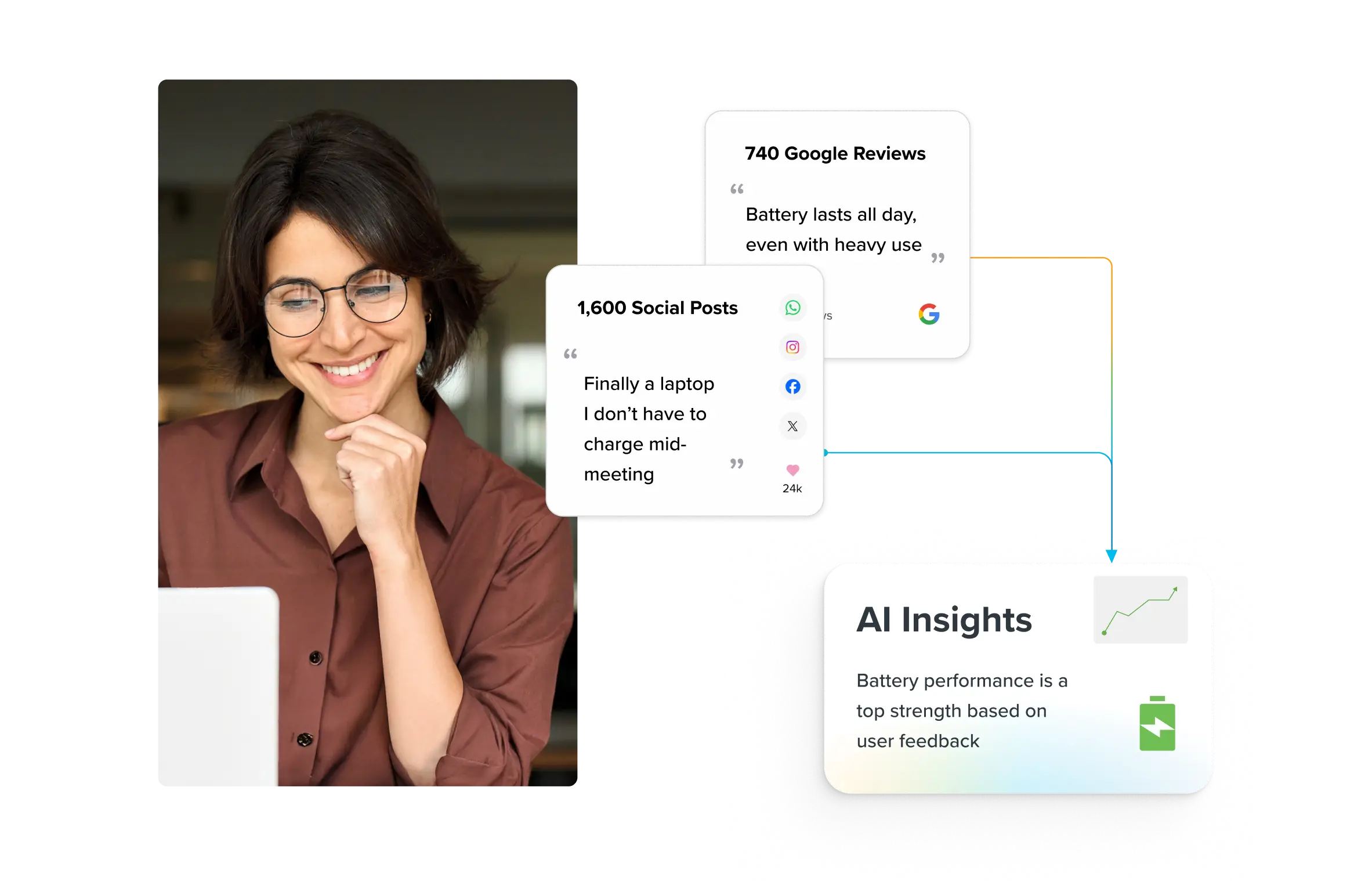
Innovation begins by listening to the right data. Predictive systems bring together feedback from surveys, app reviews, support logs, community forums and usage analytics. Once unified, they highlight patterns that point to unmet needs, like frequent mentions of “setup complexity” or “battery issues.” These are early indicators of where customers expect improvement, long before formal complaints arise.
2. Map trends to opportunities
After the data is organized, machine learning models identify where preferences are shifting. They track recurring requests, rising interest in new features and changes in sentiment across segments. Instead of waiting for quarterly research, product teams can see what’s gaining traction now and invest accordingly.
3. Forecast adoption and risk
Predictive models track customer needs and estimate how the market will respond. Forecasting models use early engagement signals to predict which ideas will succeed, when to launch and what improvements will yield the highest adoption. They also flag declining satisfaction for existing products, allowing teams to refine designs before their reputation or revenue suffers.
4. Scale the payoff across the portfolio
Once embedded, predictive innovation reshapes how enterprises make product decisions:
- Smarter investment allocation: Direct R&D toward the ideas with the strongest predicted impact.
- Revenue protection: Detect satisfaction decline early and act before losses compound.
- Customer loyalty: Deliver products that feel effortless because they reflect needs customers haven’t yet expressed.
Enterprises that embed predictive feedback into product development move faster and with more confidence. Each cycle makes the next smarter, turning feedback from a research tool into a growth framework.
In addition, real-time analysis of customer feedback data helps prevent churn by detecting early signs of disengagement, such as declining satisfaction, repetitive complaints, reduced product mentions and triggering timely action. When product and CX teams act on these signals together, they reduce attrition and continuously evolve offerings to match customer expectations before loyalty starts to decline.
Set up for success: Action cadence, ownership and alert hygiene
Predictive insights lose their value the moment they sit idle. Turn data into impact with clear ownership, steady action cycles and disciplined alerting to keep teams moving from insights to outcomes.
Assign ownership for every prediction
Every predictive insight should have a name and a deadline attached to it. Each “prediction card”, whether it flags churn risk, product friction or campaign fatigue, needs a responsible owner and a due date. Without that accountability, feedback stays theoretical.
You can also embed prediction cards directly into CRMs, service desks or project platforms. It helps teams track progress seamlessly from insight to resolution. Every prediction becomes a task with context, ownership and measurable closure.
Sprinklr’s Unified Agent Desktop can help organize customer interactions, feedback data and predictive alerts in one place. It lets teams act without switching systems, creating visibility where ownership happens.
Create a weekly action cadence
Predictive feedback works best in a regular rhythm. Leading teams hold quick weekly triage sessions to review top signals, share updates and plan fixes. The goal is to keep actions moving. Tracking customer service metrics like completion rate and average resolution time keeps focus on outcomes. Over time, this cadence turns predictive insight into habit.
Maintain alert hygiene to prevent fatigue
When everything triggers an alert, nothing gets noticed. Enterprises need smart guardrails to keep notifications meaningful:
- Thresholding: Trigger alerts only when confidence levels exceed set limits.
- Seasonal baselines: Account for expected variations (e.g., holidays).
- Duplicate suppression: Merge similar alerts to reduce clutter.
- Caps per owner: Limit daily alerts to preserve focus.
Clean alerting helps teams focus on signals that drive retention, satisfaction and revenue.
Close the loop with visible impact
Progress should be visible. Every completed action needs to tie back to a clear result, like fewer complaints, higher NPS or faster resolution times. The “You said → we did” model reinforces accountability and builds trust across teams and customers alike.
When insights have owners, follow a cadence and stay focused on relevance; predictive feedback stops being theoretical. It becomes an integral part of how the organization operates.
Q&A: Our VoC outputs don’t change behavior. How do we turn customer feedback management and predictive analytics into weekly actions that owners can’t ignore?
Many VoC programs fail because insights remain on dashboards instead of being integrated into daily workflows. The key is to make predictive insights impossible to overlook by tying them directly to ownership and outcomes.
When insights appear where people already work and progress is reviewed weekly, action becomes muscle memory. Start with one pilot team. Assign clear ownership, plug predictions directly into their workspace and make progress reviews part of the weekly routine.
Within a few cycles, you’ll see an increase in completion rates and a visible drop in recurring drivers, proof that the loop is working.
Sprinklr’s Guided Workflows make this operational discipline effortless. They let CX teams design step-by-step, no-code workflows that standardize how predictive actions are assigned, tracked and resolved. It also ensures that every prediction follows a clear, consistent path from detection to resolution with AI-powered intent analysis and seamless integration across chat, agent desktops and self-service channels.
How Sprinklr Insights powers predictive feedback
Sprinklr Insights transforms fragmented customer data into a real-time workflow for enterprises. It unifies feedback from 30+ digital, social and service channels and helps teams detect emerging risks, anticipate trends and act before issues escalate.
Built on an AI-native foundation, it delivers predictive visibility at scale while maintaining governance, accuracy and speed.
Key capabilities include:
- Unified feedback intelligence: Consolidate data from Sprinklr Surveys, reviews, tickets and social channels into a single governed platform for a complete, 360° view of customer sentiment and intent.
- AI models built for unstructured data: Analyze text, audio, video and images with verticalized AI agents that surface themes, emotions and root causes faster and more precisely.
- Real-time predictive insights: Detect sentiment shifts and early friction points as they develop, enabling proactive resolution and campaign optimization.
- Integrated action layer: Route predictive insights to the right teams across CX, marketing and product workflows, closing the loop between feedback and action.
- Enterprise-grade governance and scale: Ensure consistent taxonomy, compliance and performance across teams with centralized model management and audit-ready reporting.
Unlike standalone analytics tools, Sprinklr Insights acts as an always-on intelligence engine that connects listening, prediction and action across the enterprise. This includes detecting a brewing reputation risk before it trends, spotting a shift in buyer sentiment before it affects revenue and benchmarking brand performance against competitors in real time.
Make predictive CX your competitive advantage with Sprinklr
Predictive models redefine feedback as more than a performance metric. They turn it into a roadmap for the future. By pairing customer feedback management with predictive analytics, enterprises gain the foresight to anticipate change.
Every survey, review and service interaction becomes a signal for smarter decisions and measurable growth. If you’re still reacting to yesterday’s sentiment while tomorrow’s risks are already forming, then that stops now. Sprinklr Insights gives you the foresight to act early by spotting emerging friction and aligning every team around what customers will need next. Book a demo to see how leading enterprises turn feedback into an actionable roadmap.
Frequently Asked Questions
Predictive insights shift CX from reactive reporting to strategic foresight. Leaders can see where satisfaction, loyalty and revenue risks are forming before they show up in quarterly results, helping the board align investments with future outcomes.
Enterprises need cross-functional ownership and a shared cadence for action. Predictive insights deliver value only when marketing, CX and operations teams align on response protocols and accountability, supported by a unified data infrastructure.
By analyzing early customer feedback and behavioral signals, predictive models flag adoption risks and market misalignment before launch. This allows teams to adjust positioning, messaging or product features early, reducing costly post-launch corrections.
Key performance indicators include churn reduction, time-to-resolution, driver volume decline and increase in satisfaction or loyalty scores. Tracking completion rates of predictive actions and their downstream impact helps quantify how foresight improves both efficiency and revenue retention.
Stream processing is ideal for high-velocity environments where feedback changes rapidly, such as in social or service interactions. Batch analysis, on the other hand, suits trend detection and long-term strategy. Platforms like Sprinklr Insights combine both, streamlining for alerts and batching for pattern discovery, ensuring that speed and scale coexist.