



The global leader in enterprise social media management
For over a decade, Sprinklr Social has helped the world’s biggest brands reimagine social media as a growth driver with a unified platform, industry-leading AI and enterprise-grade scale.




Facebook Competitive Analysis: How to Benchmark and Outperform Competitors

Sometimes, the difference between a brand that’s just present on Facebook and one that owns the conversation comes down to one thing: perspective.
Most teams look at their numbers — likes, reach, impressions, and stop there. The best teams? They study the field. They understand who’s winning, why they’re winning, and how to play a smarter game.
That’s what Facebook competitive analysis does. It turns social data into foresight; helping you see not just where your competitors stand today, but where they’re about to move next.
This guide breaks down how to benchmark your brand against the best, uncover hidden opportunities, and turn competitive intelligence into real business results.
- What is Facebook competitive analysis?
- How to conduct Facebook competitive analysis?
- Step 1: Identify true competitors and market context
- Step 2: Deep dive into competitor Facebook performance
- Step 3: Benchmark key metrics
- Step 4: Identify strategic gaps and opportunities
- Step 5: Implement, test and optimize
- Turning Facebook competitor insights into strategic action
- Gain the foresight your Facebook strategy needs
What is Facebook competitive analysis?
Facebook competitive analysis is a repeatable process for mapping competitors, benchmarking performance, and interpreting the drivers of audience response and campaign efficiency across Meta surfaces (e.g., Facebook, Instagram). It’s about reverse‑engineering decision patterns behind successful content, community tactics, and paid strategies.
Behind this analysis lies the ultimate goal of surfacing strategic insights that guide your go-to-market (GTM), content, audience and paid strategies.
In an enterprise setting, this becomes part of a continuous intelligence function that supports:
- Resource allocation: Scale or cut Facebook ad spend based on comparative efficiency (CPM/CPC/ROAS) and engagement quality.
- Cross‑channel alignment: Social signals often mirror macro initiatives (product launches, PR cycles) across the wider media mix.
- Early warning: Spot competitor experiments (messaging shifts, formats, regional spikes) before they scale.
- Executive reporting: Translate social data into actionable narratives for the CMO, product leaders, and finance.
Since Facebook blends paid distribution with community engagement, competitive insights often propagate across the stack, from content portfolio mix to service and PR.
How to conduct Facebook competitive analysis?
Conducting a Facebook competitive analysis helps you anticipate competitor moves and make smarter decisions for your brand.
Here’s how:
Step 1: Identify true competitors and market context
Before diving into metrics, start with the critical question — who are you really competing with?
An effective analysis maps out competitors across three layers:
1. Direct competitors: Brands offering the same products or services, targeting a similar audience. For example, Peloton vs. NordicTrack both target fitness enthusiasts with connected home workouts. Benchmarking NordicTrack’s Facebook engagement can reveal content types and timing that resonate with shared audiences for Peloton.
2. Adjacent competitors: Brands in related categories that compete for the same attention. For example, Echelon Fitness provides connected fitness experiences similar to Peloton but at a more accessible price point, highlighting trends in instructional videos or motivational content.
3. Aspirational competitors: Brands that set the bar high, even outside your category. TOMS Shoes, for instance, stands out with purpose-driven storytelling and social impact campaigns that could inspire new directions for Peloton’s brand voice.
Why include aspirational brands?
Because innovation rarely comes from your comfort zone. Observing how a lifestyle brand builds emotional connection or how a tech company uses micro-videos for engagement can spark ideas that set you apart in your own space. And that’s when you get your ideal customers.
How to do it? Use tools like Sprinklr Social Listening to discover current and emerging competitors, track audience overlaps, and see which brands are earning the most attention. Combine that with Meta’s Ad Library or Audience Insights to validate relevance.
Start by listing 5-10 brands in your category, then use social listening to find which share audiences with your page.
Tip: Factor in market context — seasonal trends, product launches, or algorithm changes can heavily influence engagement performance.
Pitfall to avoid: Outdated references to the old “Facebook Audience Insights” tool. Meta moved audience data into Business Suite/Insights starting July 1, 2021, and the modern Audience tab lives there. Some interfaces now expose “Audience Insights” as a section inside Insights within Business Manager. Plan your workflows accordingly.
Also read: 7 Competitive Insights to Give You an Unfair Advantage
Step 2: Deep dive into competitor Facebook performance
Once you’ve mapped your competitors, the goal is to understand why their Facebook strategy works.
Analyze performance at two levels:
- Macro (overall strategy): Overall consistency, creativity, and audience focus of their Facebook presence.
- Micro (content-level details): Which individual posts, visuals, and tones drive reactions and clicks
At a superficial level, you might see what works. But to make it work for you, you need to uncover why it works.
Key elements to analyze:
- Content resonance: Identify patterns in top-performing posts. Which formats (videos, polls, carousels, or short captions) spark the most engagement? Study posting cadence and its impact on reactions and shares.
- Audience segmentation: Who are they really talking to? Use demographic and behavioral insights to uncover hidden segments where your brand could gain ground.
- Paid campaigns: Explore the Facebook Ad Library to review active and past ads. Look for differences in tone, targeting, and creative variety — these reveal how paid and organic strategies connect.
- Community engagement: Evaluate how competitors interact with followers — their responsiveness, tone, and sentiment management. Sprinklr Social Publishing can monitor these engagement trends and sentiment shifts in real time.
Track what performs but focus on why it performs. That insight uncovers deeper patterns in audience motivation, timing, and brand authenticity.
How to do it: Pick a top competitor. Review their last 20–30 posts and log: format, time posted, engagement rate per reach, and comment sentiment; then compare findings to their ad creative patterns and frequency in Ad Library.
Suggested Read: The Ultimate Facebook Marketing Guide
Step 3: Benchmark key metrics
Likes and follower counts only tell part of the story. To truly understand your position, focus on key social media metrics that connect to business outcomes.
Metrics that matter:
- Engagement efficiency: Engagement per reach or per follower; crucial for multi-market enterprises optimizing visibility and ROI.
- Content ROI: How top-performing posts align with conversions or key goals. This connects creative execution to revenue impact.
- Share of voice: How often your brand appears in relevant conversations compared to competitors. A strong indicator of brand authority and campaign visibility.
- Sentiment analysis: Track audience tone over time. Positive or negative sentiment trends can predict loyalty shifts and guide proactive PR or customer care.
- Paid efficiency: Compare CPM, CPC, or estimated ROI across competitors to refine media mix modeling and optimize spend.
To make sense of the data, build a weighted scoring system. Assign higher weights to conversion‑linked KPIs (e.g., Content ROI, Paid efficiency), mid‑weights to Engagement efficiency and SOV, lower weights to surface metrics (follower count).
How to do it: Track engagement per 1,000 followers, link posts to leads or conversions, and calculate share of voice to identify areas for growth. Use your scoring sheet to spotlight high-impact focus areas.
Step 4: Identify strategic gaps and opportunities
Once you’ve benchmarked competitors, find the whitespace others have missed. This is where Facebook competitive analysis turns from observation into opportunity.
Look for four types of gaps:
- Content gaps: Themes or formats your competitors overlook such as customer stories or educational posts.
- Engagement whitespace: Underserved audience communities that show high responsiveness but low targeting.
- Paid strategy gaps: Overreliance on limited ad formats or seasonal bursts, leaving space for always-on or micro-targeted campaigns.
- Innovation signals: Early experiments like AR filters or employee-led storytelling that may reveal emerging audience preferences.
At the executive level, these insights help prioritize investments that maximize ROI. Instead of chasing every trend, focus on gaps that advance your specific business goals.
How to do it: After benchmarking, identify missing content types (e.g., tutorials) or overlooked audience segments (e.g., younger users).
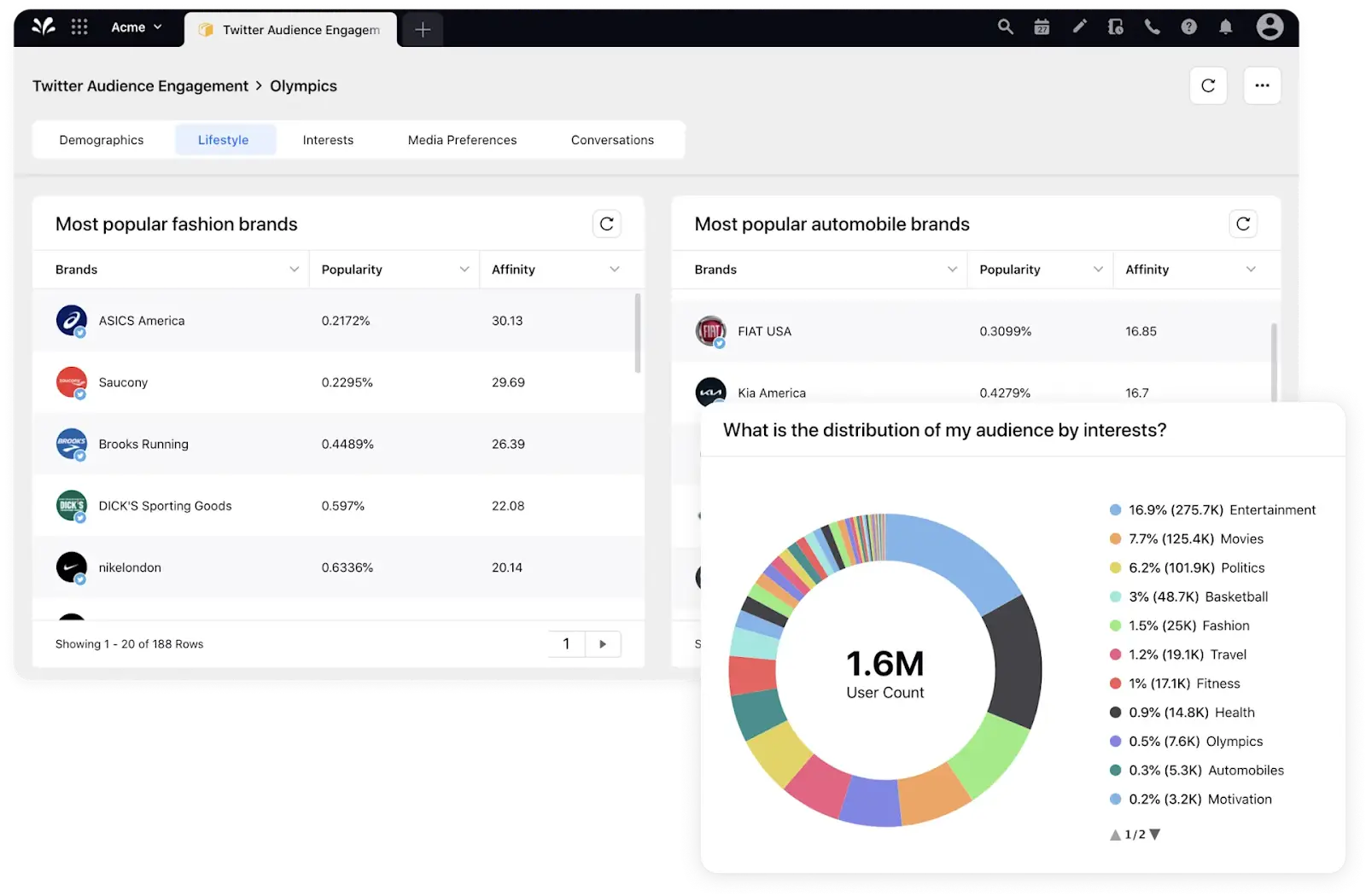
Pro Tip: Stop competing for the same attention. Use Sprinklr Insights to analyze competitor follower behavior and find highly engaged but under-served segments — where your message will stand out.
Keen to learn more? Book a demo to explore all Sprinklr features!
More to read: Top 12 Facebook Metrics to Track for Business Growth
Step 5: Implement, test and optimize
Competitive analysis only matters if it drives smarter execution. Once you’ve identified gaps and opportunities, turn insights into measurable improvements.
How to operationalize it:
- Apply insights: Refine posting cadence, content formats, and ad investments based on competitor benchmarking.
- A/B test constantly: Experiment with creative, copy, and timing to see what resonates with your specific audience.
- Track performance in real time: Use dashboards like Sprinklr provides, to monitor engagement quality, ROI, and audience growth alongside competitor data.
- Iterate continuously: Treat this process as an ongoing intelligence loop that evolves with market shifts.
Optimization creates an adaptive system where insights feed experiments, and experiments fuel consistent growth.
How to do it: Design a short-term campaign with varied post formats and timings. Test messaging, track engagement daily, compare against benchmarks, and adjust your next cycle accordingly.
Story Corner: How McDonald’s gained a competitive edge on social
McDonald’s manages 28,000+ social accounts and layered Sprinklr Insights Benchmarking on top of Listening to establish real‑time internal benchmarks and a unified view of competitor performance, so regional teams can compare formats, cadence, and engagement quality, then adjust messaging and publishing frequency accordingly.
The results speak for themselves:
- A real‑time, in‑depth view of top competitors via customized dashboards (e.g., comparing likes per post or post frequency to fine‑tune content strategy).
- Consistent digital experiences across multiple accounts by benchmarking performance and aligning best practices across regions.
Turning Facebook competitor insights into strategic action
The real payoff comes when you translate Facebook competitive insights into business impact.
Here’s how:
- Link social data to business goals: Treat reactions/comments as leading indicators; tie them to awareness, lead quality, and retention.
- Turn competitor strengths into differentiators: Decode rival strengths (e.g., humor cadence, series formats) and translate the principles into your own brand voice.
- Use insights for campaign planning: Apply benchmarks to inform formats, budgets, and launch timing.
- Build agility: Set alerts for spikes in competitor activity, sentiment shifts, or viral creatives, and pivot fast.
- Create cross-team alignment: Centralized insights let marketing, product, and CX teams act on shared intelligence, driving faster, unified decisions.
By turning intelligence into strategy, enterprises move from reactive monitoring to proactive growth.
Gain the foresight your Facebook strategy needs
For all the noise about new platforms, Facebook remains the world’s most complete marketing ecosystem — paid, organic, and community, all in one place. That’s why competitive analysis here matters more than ever.
When you understand how competitors earn attention, which audiences they miss, and what creative truly moves people, you gain more than an edge; you gain clarity.
Enterprises that use Facebook intelligence to guide investment decisions, refine content strategy, and align teams don’t just keep pace; they set it.
With Sprinklr Social, you can take advantage of AI-powered analytics to continuously monitor competitors, uncover sentiment trends and surface opportunities before they become mainstream, all within a single, unified dashboard. It brings you competitive intelligence that powers every decision you make.
Book a demo to see how your Facebook strategy stacks up and discover where competitive insights can fuel your next breakthrough. ⬇️
Frequently Asked Questions
Segment competitors into direct, adjacent, and aspirational categories. Use tools such as Sprinklr Social Listening to uncover emerging players, audience overlaps, and sentiment trends.
Focus on metrics that reflect impact rather than vanity numbers. These can be engagement efficiency, content ROI, share of voice, sentiment, and paid efficiency.
Look for patterns in what competitors ignore. These untapped themes, underserved audiences, or missed engagement opportunities can help you move ahead. Sprinklr Social helps visualize these gaps easily.
Use competitor data to understand why something works, then adapt the learning to your own brand’s tone and goals through A/B testing and data-driven adjustments.
Sprinklr Social centralizes competitive tracking, sentiment analysis and engagement benchmarking across Facebook, turning insights into real-time, actionable intelligence.