




The strategic AI-native platform for customer experience management
Unify your customer-facing functions — from marketing and sales to customer experience and service — on a customizable, scalable, and fully extensible AI-native platform.




Agentic AI vs. LLM: The Difference That Actually Matters for Customer Experience (CX)

If the difference between agentic AI and LLM had to be summed up in one word, it would be “autonomy.” Large language models (LLMs) have limited autonomy. They generate text, summaries, answers and code that help customer service teams work faster, but they do not act independently. Agentic AI, on the other hand, is built for complete autonomy. It plans, executes and manages the operational tasks so your human agents can focus on more critical CX priorities.
Both technologies have clear value and most leading brands now use them together across their customer service stack. So the decision is not between agentic AI vs. LLM. The real question is how to combine them to deliver meaningful improvements in speed, service quality and customer satisfaction. In the sections ahead, we break down what each technology does, how they differ and how enterprises are using them in real scenarios to improve CX outcomes.
Preliminary Read: Agentic AI vs. Traditional AI: Key Differences, Use Cases and Adoption Framework
Understanding LLMs and their limitations in customer service
Large language models (LLMs) are AI systems trained on vast amounts of text to understand and generate human-like responses. They understand patterns in language, and then use that understanding to generate answers, summaries, responses or content.
In customer service, they help agents by drafting replies, retrieving knowledge articles, summarizing long conversations and explaining policies or workflows in simple language. They're fast, scalable, and remarkably good at language comprehension. Think of them as highly sophisticated pattern-matching engines that power today's chatbots and virtual assistants.
But here's the catch: LLMs are reactive by design. They respond to what you ask, not what needs to happen next. Without explicit prompting, they may not know how to continue. And when they do respond, there's always the risk of hallucinations — confident-sounding answers that are factually incorrect or misaligned with your business logic.
Capability | Strength | Limitation |
Response generation | Drafts clear replies for agents | Cannot resolve issues or take action on its own |
Knowledge retrieval | Pulls answers from large knowledge bases | Needs human prompts to know what to pull |
Conversation summarization | Summarizes long chats or calls quickly | Cannot trigger workflows based on the summary |
Pattern recognition | Spots sentiment or intent in messages | May misinterpret complex or ambiguous inputs |
Output reliability | Helps reduce agent workload | Can produce inaccurate or fabricated responses |
What makes agentic AI different for customer service?
Agentic AI is built to go beyond conversation. It understands goals, plans the steps required to achieve those goals and executes the actions without requiring constant human oversight. It uses reasoning, context and live system data to operate with absolute independence. In customer service, this means the system does not just help customers with what to do; it also provides guidance on how to do it.
For instance, when addressing a customer ticket to "resolve this customer's billing dispute" — it breaks that down into actionable steps: pulling transaction history, identifying discrepancies, processing adjustments, updating the CRM, and notifying the customer. It doesn't stop at suggestions. Where LLMs provide intelligence, agentic AI provides execution.
Some ways agentic AI can autonomously handle customer service include:
- Automated ticket routing based on intent, customer sentiment, account value and business rules.
- Sending follow-up emails, confirmation messages or status updates without any agent involvement.
- Triggering workflow approvals across billing, refunds, subscriptions and service requests.
- Executing multi-step resolutions such as resetting a subscription, updating an address, issuing replacements or escalating unresolved issues to the right team.
With agentic AI, the focus shifts from “helping an agent respond faster” to “helping an customer resolve issues without requiring human intervention.”
Also Read: 5 Real-World Agentic AI Use Cases for Enterprises
Q: In service workflows, what’s the fundamental trade-off in agentic AI vs. LLM for handling end-to-end tasks?
A: LLMs excel at language tasks — drafting responses, summarizing conversations, retrieving knowledge — but can't execute actions autonomously. They're fast to deploy, predictable, and effective for scoped tasks. On the other hand, Agentic AI handles complete workflows independently. This means faster resolutions and scalable operations. The trade-off? Greater complexity.
Bottom line: If your goal is efficiency within bounded tasks, LLMs deliver quick wins. If you're solving for scalability, autonomy, and end-to-end resolution in complex, multi-system environments, agentic AI is the only viable path forward. Enterprises must strike a balance between autonomy and oversight to select the optimal mix.
Key differences between agentic AI and LLMs
You now have a broad sense of how LLMs and agentic AI differ. It is worth examining a sharper, operational view of these differences for practical customer service work.
Autonomy vs assistance: Agentic AI initiates actions, LLMs respond to prompts
LLMs are collaborative assistants — they wait for you to ask, then provide intelligent output, while Agentic AI operates with intent. For instance, an LLM can flag a customer at risk of churn based on sentiment analysis whereas Agentic AI goes further — it detects the risk, evaluates retention strategies, applies a targeted discount, updates the account, and schedules a personalized outreach. No prompt required.
Agentic AI vs. LLM in customer service: How each behaves in a live customer issue
LLM | Agentic AI |
Reacts to prompts. Example: It can draft a reply that explains the refund policy and suggest what the agent could do next, but waits for a human to confirm and take action. | Acts toward a goal. Example: It can validate refund eligibility, submit the refund to the billing system, updatesthe ticket and send a confirmation to the customer, while escalating only if something appears unusual. |
Did you know❓ Gartner predicts that by 2029, agentic AI will autonomously resolve 80% of common customer service issues without human intervention, shifting agents toward complex, judgment-heavy work.
Reliability and failure handling in CX operations
Reliability is about what happens when parts of the system fail, slow down or return low-quality responses. LLMs are dependable within guardrails — predictable, traceable, and lower-risk for customer-facing interactions. Their outputs can be reviewed before reaching customers, making them ideal for agent assist, knowledge retrieval, or draft generation. Agentic AI raises the stakes. Autonomous action means decisions happen in real time, often without human review. This demands mature governance: role-based access, audit trails, and fail-safes to prevent costly errors like incorrect refunds or misrouted escalations.
Agentic AI vs. LLM in customer service: How each behaves under system failure
LLM | Agentic AI |
Depends on a single model or endpoint. If the LLM is slow or down, the chatbot hangs, returns generic replies or forces agents to step in manually. Example: A billing bot may stop mid-conversation when the model times out. | Can orchestrate multiple models and tools. If one LLM or API fails, the agent detects the issue, retries or switches to a backup model and can route the case to a human when needed. Example: A refund workflow continues by using a secondary model while keeping the customer informed. |
Did you know❓ LLM systems experience outages at least one to two times per quarter, which can disrupt customer experiences if teams rely on a single model.
Agentic AI addresses this through intelligent failover. When the primary LLM goes down, the agent can switch to a backup provider within seconds and maintain near 99.99% uptime, preventing customers from encountering broken chatbots or failed requests.
Tool and system integration depth
Tool integration determines whether AI merely discusses work or actually drives work forward. In customer service, it is the difference between sitting on top of systems vs. being wired into CRM, billing, order management and ticketing tools. LLMs typically interact with systems through APIs or middleware — they query databases, retrieve information, or pass data to other tools, but rarely own the integration logic. Agentic AI, by contrast, orchestrates across your entire tech stack. It doesn't just pull data from your CRM, helpdesk, and billing platform — it coordinates between them.
Agentic AI vs. LLM in customer service: How each connects to CX systems
LLMs | Agentic AI |
Usually sits on top of the system. It reads the prompt's context and suggests replies or actions but cannot directly modify records. Example: It can draft an email to confirm an address change, while an agent must still update the CRM. | Connects directly to systems through APIs and workflow engines. It can read and write data, trigger actions and coordinate across tools. Example: It can update the address in CRM, log the change, send a confirmation, and close the ticket while maintaining a clear audit trail. |
Do you know❓ Recent research shows that many LLM and agentic APIs still suffer from unclear documentation and usability gaps, which, when integrated into existing systems, often lead to “hallucination errors” where agents misread instructions and generate invalid API calls.
In customer service, this can disrupt refund workflows, create duplicate tickets or push incorrect updates into CRM systems, which can misroute leads, distort forecasts and compromise quota planning for sales teams.
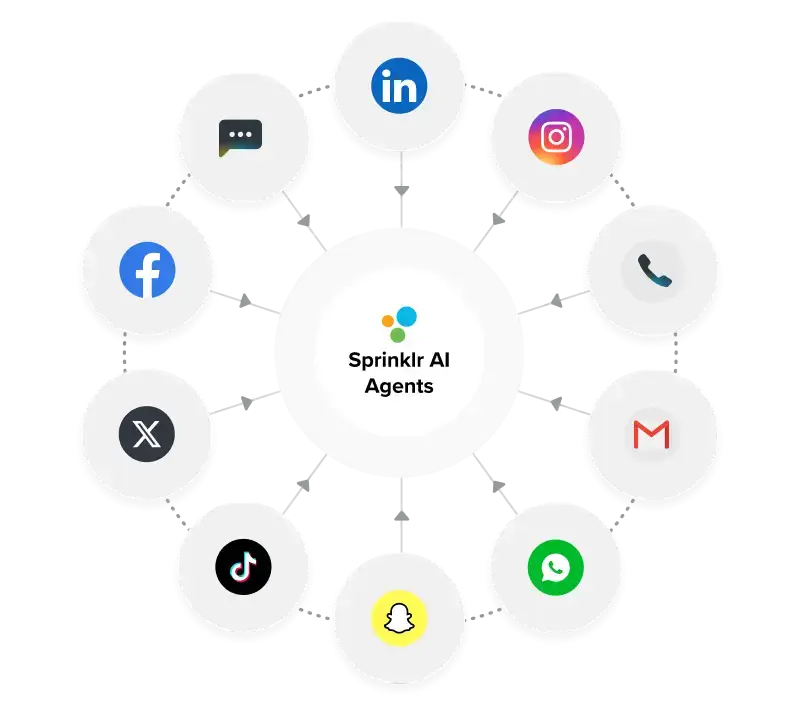
Pro Tip💡: Use a reliable AI system that seamlessly integrates AI agents into your workflows across chat, social, voice, CRM, messaging, analytics, and email, ensuring your customer experience remains consistent and predictable at scale.
Sprinklr’s Agentic AI executes tasks with guardrails, pulls real customer context from unified data, and applies governance policies so responses are compliant, auditable and aligned with your brand voice. In Sprinklr’s AI+ framework, agents don’t hallucinate instructions or create disconnected outputs because they operate on a governed knowledge layer, enterprise-grade routing logic and performance analytics that scale globally.
Governance, control and compliance in regulated CX
In customer service, governance is about who approves what, which actions AI can take and how every step is documented for audit purposes. Control and compliance determine whether AI operates within established policy guardrails or quietly creates risk in the background.
Agentic AI vs. LLM in customer service: How each enforces policy and compliance
LLM | Agentic AI |
Acts in accordance with whatever prompts and context it is given. It can mention policy, but it does not reliably enforce approval rules or limits. Example: It may suggest a refund above policy thresholds unless the prompt is written very carefully. | Works with explicit policies, roles and workflows. It checks limits, applies entitlements and triggers approvals when thresholds are crossed. Example: It can process refunds within policy on its own and route exceptions to supervisors with a complete audit trail. |
Did you know❓ JPMorgan’s deployment of autonomous anti-money laundering agents now triages millions of transactions daily and has reported a reduction of up to 95% in false positive alerts.
Investigators can focus on absolute risk while agents handle routine checks. This shows how agentic systems can operate at a massive scale under strict regulatory constraints while still maintaining traceability and audit compliance.
Memory, context and customer journey continuity
Memory and context determine whether AI treats every interaction as a new opportunity or as part of a longer relationship. LLMs operate within conversation windows — they understand what's happening now, but lack persistent memory across interactions.
Agentic AI maintains longitudinal memory. It can track customer history, remember past resolutions, and recognize patterns across touchpoints. CX leaders need to move beyond reactive support to predictive relationship management — where every touchpoint builds institutional knowledge that prevents issues before customers even raise them.
Agentic AI vs. LLM in customer service: How each handles ongoing customer journeys
LLM | Agentic AI |
Works on the context you pass in the prompt. It can summarize a chat or recall details within a single session, but it usually loses context across channels and long time gaps. Example: It may not recall that the customer has already attempted a fix in a previous email thread. | Maintains context and continuity in conversations. It tracks cases, prior steps, promises made and customer preferences across chat, email, voice and social. Example: It knows a replacement was shipped last week, checks the delivery status and adapts the next action instead of repeating earlier steps. |
Measurement, accountability and service quality
Measurement determines whether AI enhances CX or merely introduces noise. Accountability clarifies who is responsible for outcomes when an automated system makes a decision. Service quality ensures that automation aligns with enterprise KPIs, rather than prioritizing speed at the expense of accuracy.
Agentic AI vs. LLM in customer service: How each measures and owns outcomes
LLM | Agentic AI |
Produces responses but does not track whether the issue was resolved, how long it took or whether policy was followed. Example: It can draft a refund explanation but does not record the resolution's accuracy or compliance. | Tracks every step, action and outcome across systems. It measures resolution quality, SLA adherence, compliance checks and downstream impact. Example: It can log who approved what, when the issue was resolved and whether the workflow met enterprise standards. |
These were the core differences between LLMs and agentic AI at an operational level. The next question is where each excels and how you can utilize both together, rather than choosing one over the other.
Where each excels: Agentic AI vs. LLM in business use cases
Gartner’s 2024 survey found that 85% of customer service leaders will explore or pilot customer-facing conversational GenAI in 2025.
The momentum is undeniable. But momentum without clarity leads to expensive pilots that plateau. The teams extracting real value aren't the ones deploying AI everywhere — they're the ones deploying the right AI in the right place.
Customer service
In customer service, LLMs and agentic AI work best as a single system rather than as competing options. An agent copilot is a good example.
⭐ The agentic layer connects to CRM, ticketing and order systems. It checks entitlements and compliance rules, pulls past interactions and summarizes the customer’s journey, so the human agent is fully prepared before joining the conversation. It can also update records, set tasks and trigger follow-up workflows in the background.
⭐ On top of this, the LLM layer helps the agent communicate clearly and consistently. It drafts brand-compliant responses, explains complex policies in simple language and produces performance summaries or coaching notes for team leaders.
The result is a service environment where agentic AI quietly manages the work and LLMs make every interaction clearer, faster and easier for both customers and agents.
Deep Dive: Agentic AI in Customer Service: Your Next Advantage
Insurance
In insurance operations, LLMs and agentic AI complement each other even better because the work involves long policies, strict compliance and multi-step workflows that depend on accurate data movement across underwriting, claims, billing and risk systems.
⭐ Agentic AI handles the operational side. It verifies policy details, checks eligibility rules, pulls claim history and coordinates updates across core insurance platforms. It can pre-fill claim forms, validate documents, trigger FNOL workflows, route cases based on risk level and ensure every action stays within regulatory and underwriting guidelines. This provides adjusters and underwriters with a comprehensive, real-time view before they make a decision.
⭐ The LLM layer adds clarity and communication on top of that. It summarizes complex claim narratives, explains policy clauses in simple language, drafts settlement explanations and creates customer-ready messages that follow brand tone and compliance rules. It can also produce team-level insight summaries, supervisor notes and performance reports for claim reviews.
Together, agentic AI handles the operational workload, while LLMs enhance the quality and speed of communication. This enables insurance teams to close claims more quickly, reduce manual errors and deliver a smoother customer experience during high-stress moments.
Recommended Read: Role of Conversational AI in Insurance
Supply chain
Supply chain environments rely on speed, accuracy and coordination across procurement, logistics, warehouses, planning systems and distribution partners. This makes the combined use of agentic AI and LLMs more effective than relying on either alone.
⭐ Agentic AI manages the operational flow. It tracks live inventory levels, monitors supplier updates, reviews delivery schedules and adjusts plans when demand shifts or delays occur. It can reroute shipments, trigger replenishment orders, update ERP and WMS systems and coordinate multi-step workflows across procurement, logistics and distribution. It keeps the entire chain moving without requiring humans to push each step forward manually.
⭐ LLMs support the communication and intelligence layer. They summarize supplier contracts, explain exceptions, provide clear updates to planners and produce customer-facing messages about delays or revised delivery windows. They also transform operational data into simple narratives, allowing leaders to identify risk hotspots, supplier issues or forecast deviations without having to dig through reports.
Agentic AI is designed to keep the supply chain operating smoothly in real time, while LLMs provide clear, consistent and context-rich communication to every stakeholder.
Related Read: Agentic AI in Supply Chain
Deep Think: Code-wise, how does reasoning and tool use differ in agentic AI vs. LLM?
Think of it architecturally. An LLM is stateless — each query is self-contained. You feed it context, it returns output, then it forgets. Tool calls happen externally, orchestrated by your application logic.
Agentic AI introduces a control loop. It maintains state across interactions, evaluates outcomes against goals, and dynamically adjusts its next move. It uses a reasoning layer on top of the LLM - evaluates the goal, selects the proper function or API, executes it, checks the result and continues the workflow. So while the LLM handles language, he agent handles decisions, tools and actions.
Differences matter less when your strategy uses the best of both
For enterprise leaders, understanding the differences between LLMs and agentic AI is beneficial. However, the real advantage lies in knowing how to use both together to drive measurable CX outcomes.
The challenging part is finding a platform that combines the strengths of both technologies while still meeting stringent compliance, governance and data security standards.
Sprinklr, working with leading global brands, offers AI agents that can be customized from the ground up to meet your business needs. These agents adapt to your operations, integrate with your existing tech stack and deliver autonomous workflows while maintaining industry-standard controls and regulatory requirements. The goal is simple: autonomy with accuracy.
For clarity on where to start, book a free demo. Our specialists will guide you through a personalized roadmap tailored to your business goals.
Frequently Asked Questions
Not in a reliable, production-grade way. LLMs can suggest actions, draft responses and interpret context but they do not own workflows. They wait for prompts and cannot safely decide when to call systems, update records or complete refunds independently. You need an agentic layer around the LLM to handle goals, tools, error handling and approvals.
No. Agentic AI usually uses LLMs, but it is not “just a better model.” It adds planning, policy, tools, memory and control. The agent determines the necessary actions, invokes the correct systems, verifies the rules and closes the loop. The LLM is one component. The agent is the system that turns language ability into reliable action.
In most cases, no. It extends them. Agentic AI needs language understanding and generation to talk to customers and staff, so it often embeds one or more LLMs. What changes is the role. LLMs stop being the “whole solution” and become the language engine inside a larger agentic architecture that manages workflows, tools and governance.
A basic LLM system is typically prompt-in, answer-out and sometimes includes retrieval on top. An agentic AI system adds several layers. A planning layer that understands goals and breaks them into steps. A tools layer that connects to CRM, billing, ticketing and other APIs. A policy and guardrail layer that enforces rules and approvals. A memory layer that tracks state across sessions. The LLM sits inside this stack rather than at the edge.
You should move when “better replies” are no longer enough. Signs include agents still handling most of the clicks, unresolved backlogs and workflows spanning many systems and approvals. If you have stable processes, clear policies and decent data quality, it is the right time to pilot agentic AI on one or two high-impact workflows, then scale from there.