




The AI-native platform for global campaign management
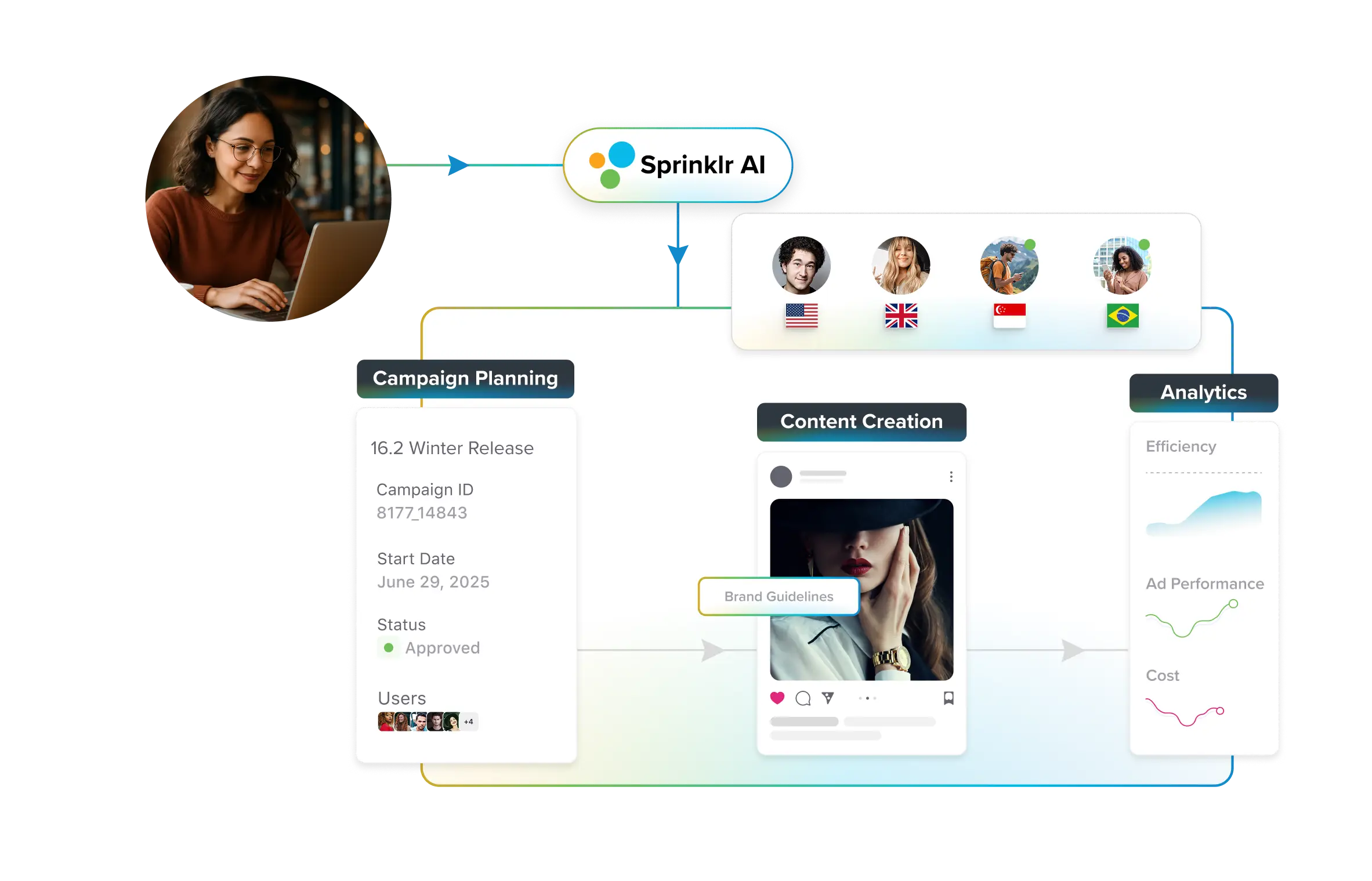
Sprinklr Marketing unifies campaign planning, content creation, publishing and analytics across global teams — all elevated by AI. Accelerate go-to-market, boost performance and enforce brand governance at scale.


What Goes into the Forbes Top 50 CMOs List
Sravani Gade is a Senior Content Marketing Manager at Sprinklr, bringing over eight years of content expertise with a specialism in long-form narratives for B2B SaaS. She combines creativity with insight across Voice of the Customer, customer feedback management, AI in customer experience and CX thought leadership, the kind of considered, editorial pieces that help leaders think differently about their work.
Every year, the Forbes World's Most Influential CMOs list drops and the marketing world stops to take notice: who made it, who moved up, and who got dropped. It's one of those lists people screenshot, share, and benchmark themselves against.
But most people engage with the list the same way they engage with award shows. They see the results and skip straight to reactions. But beyond the reactions is a deeper story: the work that goes into understanding influence at this scale. And that's the story we're here to tell.
Because behind the names and rankings is a massive, living dataset that captures how marketing influence really moves today: across conversations, channels, audiences and cultural moments that no brand fully controls. Sprinklr powers that view for the Forbes Top 50 CMOs list. The companion report we publish alongside the list is our way of opening the hood, showing you how Sprinklr's data, methodology and analysis helped make the ranking possible, what the data revealed, and which brand moments made influence visible in the real world.
So, how do you even score influence?
Good question. And the honest answer is: meticulously.
This year's ranking started with a universe of over 3,300 brands drawn from seven major global benchmarks and then narrowed to a competitive set of 419 CMOs and equivalent marketing leaders based on market presence, brand awareness, and confirmed leadership roles.
From there, the scoring looked at three dimensions of influence that together paint a pretty complete picture of how a CMO and their brand actually show up in the world:
1. The first – Attention for Marketing Work, captures how much attention a brand's marketing work earns in credible media and industry conversations.
2. The second – CMO Attention, Sentiment & Salience, looks at how visible and relevant the CMO themselves is as a leadership voice.
3. And the third – Brand Awareness & Sentiment, measures how the brand connects with its audience across engagement, sentiment, and reach.
None of these dimensions work in isolation. A great campaign means more when the CMO behind it has a strong public voice. A highly visible leader carries more weight when the brand's audience is actively engaged. The scoring reflects that interconnection, which is what makes the final list feel as credible as it does.
What 8.68 billion interactions tell you
We should talk about the scale for a second, because this is where the list starts to feel a little unreal. This year's rankings are powered by 8.68 billion social interactions tied to brand channels and over 6.19 million mentions of individual CMOs across news, blogs, forums, podcasts and social platforms.
That kind of volume matters because it lets you see things that smaller datasets simply miss. You can tell the difference between a campaign that performed well within its own channel and one that genuinely broke through into broader cultural and industry conversations. You can see which CMOs consistently show up in the discourse and which brands are quietly building momentum through sustained engagement rather than one-off spikes.
And when you layer this across industries, the patterns get really interesting.
i. Media and entertainment brands naturally generate massive conversation volumes, with median CMO mentions running into the thousands.
ii. Technology brands sustain elevated marketing attention through continuous product and platform innovation.
iii. Travel and hospitality brands tend to operate through fewer, more symbolic moments that punch above their weight across markets.
Same framework, completely different expressions of influence, which is exactly why the companion report matters. It gives you the deeper read on how Sprinklr's data helps compare influence fairly across industries, instead of flattening every brand into the same kind of score.
The moments that made it
Data gives you the structure. But the story of the companion report lives in the moments that show how Sprinklr's analysis translated signals into real-world examples of influence.
Every brand featured in the companion report is paired with a defining moment that captures where its influence was most clearly felt during. That's what the report adds to the Top 50 list: the context behind the ranking, powered by Sprinklr's ability to connect brand, audience and media signals at scale. And the range is genuinely fun to look at.
Pepsi turned the Super Bowl into a masterclass in creative engineering, building a spot around celebrity casting, AI-era cultural cues, and competitive energy that kept generating conversation long after the broadcast ended.
Source: Pepsi’s YouTube channel
Domino's went a completely different route, jumping into the viral KitKat heist news cycle with a fictional KitKat pizza that was so absurd, so well-timed, and so perfectly on-brand that it generated more visibility than most planned campaigns could dream of.
Source: Domino’s
Netflix expanded Tudum from a content showcase into a full-blown fan universe, connecting live performances, content reveals, and physical spaces like Netflix House into an experience that made the brand feel like a place you could walk into.
Source: Netflix
And Starbucks made one of the quietest but most strategic moves on the list by overhauling its loyalty program to make rewards feel earned and differentiated again, a structural decision that reshaped how millions of customers interact with the brand every week.
Source: Starbucks
What makes all of these interesting is how differently influence expresses itself. A Super Bowl spot, a meme-worthy pizza joke, an immersive fan event, and a loyalty redesign have almost nothing in common on the surface. But they all share the same underlying quality: they connected with audiences in ways that traveled, got talked about, and stuck around.
Why this needs a platform like Sprinklr
Here's where we'll be direct about Sprinklr's role, because this is the part the companion report helps make clear.
Tracking influence at this scale requires the ability to connect signals that are usually scattered across dozens of tools, teams, and dashboards. Social conversations live in one place. Media coverage lives in another. Competitive benchmarks sit somewhere else entirely. And most teams are left trying to piece the picture together manually, which means they're always working with an incomplete view.
Sprinklr brings social listening, competitive benchmarking and real-time analytics into a single unified platform that reflects how audiences actually experience brands. That unified view is what helped power the Forbes Top 50 CMOs methodology and gives the companion report its depth. It allows influence to be understood as it actually moves, across channels, moments and audiences, rather than freezing it into a single static snapshot.
And beyond the Forbes partnership, this is the same capability that helps marketing teams everywhere understand what their audiences are responding to, how their brand compares within their industry, and where the real opportunities for impact are hiding.
Why you should read the companion report
The Forbes list tells you who the most influential CMOs are right now. The companion report shows you how Sprinklr helped power that list: how influence is built, how it expresses itself differently across seven industries, and what the defining moments behind the rankings look like up close.
If you're a marketing leader trying to understand where your brand stands relative to the best in the world, or if you're just genuinely curious about what modern marketing influence looks like when you measure it properly, this is worth your time. It's the deeper story behind the Top 50 list, powered by billions of Sprinklr-analyzed signals, grounded in real moments. It’s designed to give you a view of marketing leadership you won't find anywhere else.
Sravani Gade is a Senior Content Marketing Manager at Sprinklr, bringing over eight years of content expertise with a specialism in long-form narratives for B2B SaaS. She combines creativity with insight across Voice of the Customer, customer feedback management, AI in customer experience and CX thought leadership, the kind of considered, editorial pieces that help leaders think differently about their work.