



The global leader in enterprise social media management
For over a decade, Sprinklr Social has helped the world’s biggest brands reimagine social media as a growth driver with a unified platform, industry-leading AI and enterprise-grade scale.



Generative AI in Social Media: A Complete Guide for Brands
Priyanka Malik is a content marketing professional with over nine years of experience creating content for global B2B SaaS brands. At Sprinklr she writes and strategizes across social media management, social listening, social media analytics and AI-driven social marketing, turning complex topics into clear, practical guidance for marketing and customer experience leaders.
Key Takeaways
- Generative AI does not replace social media teams. It eliminates the production bottlenecks that prevent them from doing strategic work.
- The highest-value use cases are content variation, repurposing, localization, and personalization at scale.
- Enterprise teams need governance and approval workflows for AI-generated content, not just the AI itself.
- The right platform embeds generative AI into publishing, engagement, and compliance workflows rather than running it as a separate tool.
Generative AI solved the hardest constraint in enterprise social media, producing content at the volume and speed that global brands demand. But it created a harder one. When every brand can generate a week of posts in a few hours, volume stops being an advantage and starts being noise. The feed fills with captions that sound interchangeable because they often came from the same models and nearly identical prompts.
That shift changes what social teams are actually competing on. The edge is no longer who can produce the most or the fastest, but who can use AI to move quickly on the repetitive work while keeping a voice that still sounds like them. This blog covers what generative AI in social media does, how it is reshaping the work, the highest-value use cases, best practices, and the tools that matter.
- What is generative AI in social media?
- How generative AI is changing social media marketing
- Generative AI use cases in social media
- What are the best practices for using generative AI in social media
- How enterprise teams can use generative AI safely
- Generative AI tools for social media
- Final Thoughts
What is generative AI in social media?
Generative AI in social media is the use of AI models to create new social content, such as captions, images, video, and copy, from a simple prompt or brief. Unlike traditional AI that analyzes or predicts from existing data, these models generate original outputs, letting teams produce content across formats and channels from a single input.
While generative AI can execute at scale, it is equally important to define what generative AI does not do. It does not replace brand judgment, editorial oversight, or strategic direction. It compresses the distance between idea and published content, while human editors retain control over accuracy, tone, and fit with campaign objectives.
How generative AI is changing social media marketing
Generative AI has moved social media work from manual production to direction and oversight. The old bottleneck was capacity, how fast a team could write, design, and adapt each post. That constraint is largely gone. The new bottleneck is judgment: how well a team can brief the AI, edit its output, and govern what reaches an audience. The table below shows where the work has shifted.
Social media tasks | Before generative AI | With generative AI |
Content creation | Each post written and designed from scratch | AI drafts captions and variations, humans refine |
Content volume | Limited by team capacity | Scales without adding headcount |
Repurposing | Manual rewriting for each platform | One asset adapted across formats in minutes |
Personalization | A few audience segments at most | Messaging tailored to many segments at scale |
Community management | Every reply written individually | AI drafts replies, humans approve and personalize |
The core skill | Production speed | Direction, editing, and governance |
Generative AI absorbs the repetitive, high-volume work, which moves the human role up the value chain toward creating social media strategy, brand perception, and quality control. For enterprise teams, that is the real change: the advantage no longer comes from how much a team can produce, but from how well it can direct and govern what AI produces at scale.
Generative AI use cases in social media
Generative AI in social media delivers the most value when each use case solves a specific problem. Below are six distinct ways enterprise teams put it to work, from creating content to understanding what audiences want next.
1. Content creation and creative variations
The production constraint is not one caption. It is fifty versions of it across multiple platforms, markets, and campaigns running simultaneously. Generative AI takes a single creative brief and produces format-specific, tone-adapted drafts for each channel, shifting the team's work from writing to editing.
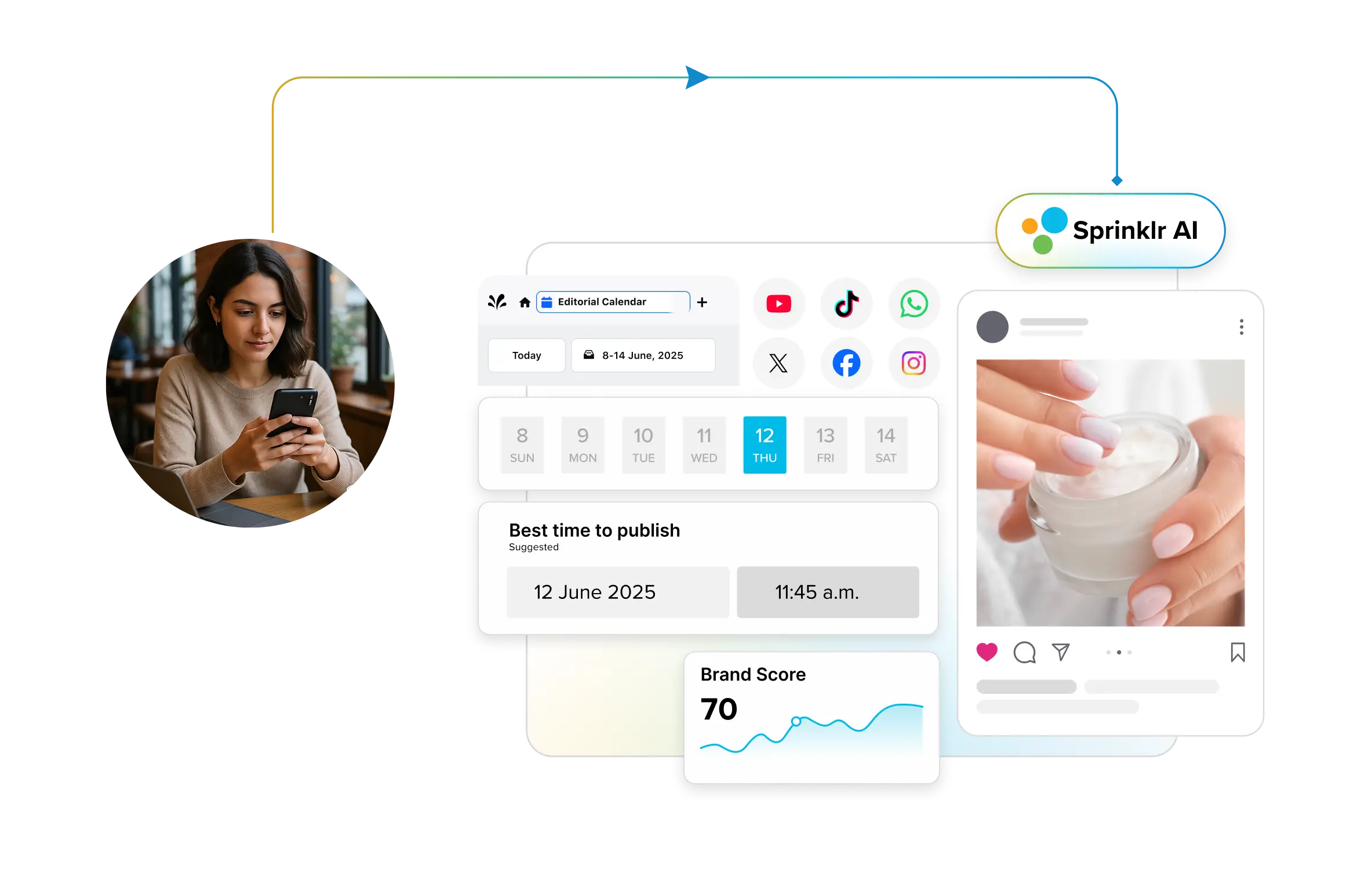
Sprinklr Social extends this further with AI recommendations on top-performing content formats, optimal publishing times, and tone, and the ability to automatically repurpose and personalize content by region, audience, and channel.
2. Repurposing long-form content into social posts
Every research report, webinar, and blog post contains social-ready insight that most teams never find time to adapt. Generative AI makes repurposing a routine workflow: one long-form asset becomes platform-specific posts, a carousel script, a video brief, and a thread, each formatted for its channel, in minutes. Unlike content creation, repurposing begins with existing thinking. AI speeds up the adaptation work, not the strategy behind it.
3. Generating campaign ideas and creative concepts
Most teams do not run out of creativity. They run out of time to explore it. Given a product, target audience, and objective, generative AI returns multiple campaign angles, content series ideas, and format options in the time it takes to schedule a creative meeting. The result is not AI replacing creative strategy, it is creative leads spending more time developing strong ideas and less time producing the first draft of them.
4. Personalizing and localizing content at scale
Content written for one audience rarely lands with another, and content translated for a new market rarely reads as locally written. Generative AI handles both: it adapts tone and benefit framing for different audience segments, language, and cultural context for different regions, going beyond word-for-word conversion to reposition how the message is expressed. Sprinklr AI enables one-click translations to create localized content derivatives across markets for higher efficiency and scalability.
5. Community engagement and conversation intelligence
Community teams cannot treat every comment, message, and mention as a one-off task. Generative AI helps them move faster without losing context. It drafts relevant replies, groups conversations into clear themes, and flags shifts in sentiment or intent. Sprinklr Copilot delivers AI summaries of inbound comments with sentiment and intent analysis across posts, campaigns, and accounts. Teams can see what needs attention, understand why it matters, and respond with more confidence.
What are the best practices for using generative AI in social media
Generative AI delivers value in proportion to the guardrails around it. These six practices are what separate brands that scale AI responsibly from those that create quality and compliance risk in the process.
1. Start with low-risk workflows first
Caption variations, content repurposing, and internal reporting summaries carry far less risk than customer-facing replies or regulated disclosures. Beginning where an AI error has limited consequences gives teams time to calibrate output quality before extending it to higher-stakes workflows. Sequence matters: build confidence on low-stakes work before scaling to high-stakes publishing.
2. Set brand voice and prompt guidelines before you scale
Without documented prompt standards, the same AI tool produces inconsistent, off brand output every time a different person uses it. Define your brand's tone, vocabulary, audience segmentation, and explicit exclusions, then build those into shared prompt templates the whole team uses. Standardizing inputs is the only reliable way to get consistent output at scale.
3. Use AI for drafting, not deciding
Generative AI belongs in the production step, not the approval step. Its job is to accelerate drafting enough that your team spends their time refining and approving rather than writing from scratch. The moment AI output is treated as default-publishable rather than a first draft, quality drift sets in without anyone noticing.
4. Review every AI output for accuracy, tone, and originality
Fluency is not accuracy. AI-generated content can read well while containing errors, misrepresenting facts, or sounding indistinguishable from a competitor's output. Before anything publishes, check three things: is the information correct, does the tone reflect the brand, and is the content specific enough that it could only have come from your brand. That third check is the most skipped and the most important.
5. Route AI content through your existing approval workflow
AI-generated content does not need a separate governance track. It needs to go through the same approval process as everything else your team publishes, with the same level of scrutiny and, in some channels, additional review steps. Define who reviews AI drafts, what triggers a compliance escalation, and which content types require a second check before going live.
6. Measure AI content performance against human-created content
AI output should be held to the same performance standards as everything else you publish. Track engagement, click-through, and sentiment for AI-generated content separately so you can see where it performs well and where more human input is still needed. Without that comparison, all you are growing is volume.
How enterprise teams can use generative AI safely
For enterprise teams, the governance risks specific to generative AI go beyond approval workflows. The three most overlooked are: sensitive data exposure in AI prompts, content that complies with one market's regulations but not another's, and output inconsistency when regional teams use the same tool with different, undocumented prompt approaches. None of this resolve through approval workflows alone.
- Prevent sensitive data from entering AI prompts. Social media teams frequently work with audience data, customer references, and internal research. When that information is included in prompts sent to third-party AI models, it creates data exposure risk that most standard publishing governance does not catch. Sprinklr enforces PII masking alongside role-based access controls and is compliant with major industry standards, with guardrails built directly into the platform architecture.
- Treat regulated content as a distinct category in your AI policy. Financial services, healthcare, and government teams face content restrictions that AI models will not observe without explicit guardrails. Sprinklr's AI-driven Smart Compliance monitors content while it is still in production and flags inconsistencies before any audience sees them, using brand guidelines, rules, and topic parameters to identify misaligned messaging. For regulated industries, this step belongs before the approval queue, not after it.
Generative AI tools for social media
The right generative AI tool depends on what you need it to do, from running social at enterprise scale to creating standalone content or visuals. Here are the leading options, what each does best, and how they compare at a glance.
1. Sprinklr Social
Sprinklr Social is the only social media management platform that embeds generative AI natively across the full social media workflow, from content creation and localization to compliance review and community engagement.
Unlike standalone AI writing tools, every capability sits inside the same publishing and governance environment, so AI-generated content passes through approval, compliance, and scheduling without switching platforms. It is the only solution that unifies social media management with consumer intelligence, marketing automation, and customer service on one AI-native platform.
Key Features:
- AI content generation: Creates platform-specific captions, post variations, and ad copy from a single brief, with brand voice and tone controls built into the prompt layer
- One-click localization: Dynamically translates content using Gen AI to adapt across regions and channels, enabling local teams to personalize assets within brand-approved templates
- Smart Compliance: Uses automated workflows and AI checks to enforce brand standards before content goes live, flagging off-brand or non-compliant messaging before it reaches an audience
- Sprinklr Copilot: AI assistant for social reporting that generates insights, understands audience behavior, and diagnoses performance shifts using natural language, including root-cause analysis for KPI spikes and drops
- Comment Summarizer: Instantly summarizes social comments to reveal sentiment, intent, and audience engagement trends across posts, campaigns, and accounts
- AI-powered engagement: Categorizes inbound messages by sentiment and intent in real time and surfaces contextually relevant reply suggestions for community managers
2. ChatGPT
ChatGPT is a general-purpose large language model from OpenAI that generates, edits, and adapts written content across any format or tone from a natural language prompt.
Key Features:
- Multi-format content drafting: Generates captions, threads, ad copy, campaign briefs, and content concepts from a single prompt with no template required
- Tone and style adaptation: Adjusts output for different tones, audience segments, and platform styles based on explicit prompt instructions
- Long-form repurposing: Breaks down blog posts, reports, and transcripts into social-ready formats including posts, threads, and short-form summaries
- Custom instructions: Allows teams to set persistent brand voice parameters that apply across all interactions in a session or workspace
- GPT Store integrations: Connects with third-party tools for image generation, web search, and workflow automation via the plugin ecosystem
3. Jasper AI
Jasper AI is a marketing-focused AI writing platform built specifically for teams producing high volumes of campaign and social copy at scale. It combines brand voice training, pre-built marketing templates, and multi-language support to produce consistent output across campaigns without starting from scratch each time. It is most effective for teams that need structured, brand-trained copy generation rather than open-ended ideation.
Key Features:
- Brand voice training: Learns and applies a brand's documented tone, vocabulary, and style to all AI-generated output across the team
- Marketing templates: Pre-built frameworks for social captions, ad copy, email, blog posts, and content briefs covering most campaign content types
- Campaigns workflow: Multi-step AI workflow that takes a brief from concept through to finished copy across multiple content formats in one session
- Multi-language generation: Produces marketing copy in multiple languages for teams managing global campaigns from a central function
- Team workspaces: Shared projects, brand knowledge bases, and prompt libraries for consistent AI-assisted output across large marketing teams
- Plagiarism detection: Scans generated output to check for originality before content enters the publishing or approval pipeline
4. Canva
Canva is a visual creation platform with built-in generative AI for both copy and image creation, enabling social teams to produce creative without design expertise or a separate writing tool. Its Magic Write, Magic Media, and brand template features allow teams to generate social visuals and accompanying captions within a single design workflow. It is widely used for fast-turnaround social content where visual and copy production need to happen together.
Key Features:
- Magic Write: Generates captions, social copy, and text variations directly within the design canvas based on a short prompt or topic
- Magic Media (AI image generation): Creates original images and short video clips from text prompts without leaving the Canva environment
- Magic Resize: Automatically adapts a design for different platform formats and aspect ratios with one click, covering Instagram, LinkedIn, X, and TikTok sizes
- Brand Kit: Central brand asset library that keeps fonts, colors, and logos locked across all AI-assisted designs to enforce visual consistency
- Background Remover and AI editing: AI-powered tools for product shot cleanup, background replacement, and creative asset refinement
- Branded templates: Platform-specific social templates with locked design elements for distributed team governance
5. Adobe Firefly
Adobe Firefly is Adobe's enterprise AI image generation model, trained exclusively on licensed Adobe Stock and public domain content, which makes it the most commercially safe option for brands that need to avoid copyright risk in AI-generated visuals. It is integrated directly into Creative Cloud applications including Photoshop, Illustrator, and Adobe Express, eliminating the need to export between tools. Enterprise creative teams use it to produce original visual assets for paid and organic social at scale without IP risk.
Key Features:
- Commercially safe generation: Trained on licensed content only, meaning outputs carry no copyright exposure risk for commercial use, a critical differentiator for enterprise brands
- Text-to-image: Creates high-quality photorealistic and artistic images from detailed prompts with consistent style and composition control
- Generative Fill (Photoshop): Replaces, extends, or removes elements within existing images using AI, with natural results that match lighting and perspective
- Creative Cloud integration: Works natively within Photoshop, Illustrator, InDesign, and Adobe Express, so creative teams never leave their standard production environment
- Vector and pattern generation: Produces scalable graphics and design patterns from text prompts for use across web, print, and social formats
- Content Credentials: Attaches metadata to AI-generated assets to support disclosure tracking and provenance verification
6. Hootsuite with OwlyWriter AI
Hootsuite's Wisdom is a generative AI assistant built natively into the Hootsuite social media management and scheduling workflow, removing the need to draft content in a separate tool before publishing. It generates captions, repurposes existing content into social posts, and surfaces content ideas without leaving the publishing environment. It is most effective for mid-market social teams that already use Hootsuite for scheduling and want AI assistance within that existing workflow.
Key Features:
- Native caption generation: Writes platform-specific captions directly inside the Hootsuite composer from a topic, URL, or existing piece of content
- Content repurposing: Transforms articles, blog posts, and web content into ready-to-schedule social posts within the publishing workflow
- Post idea generation: Suggests content themes, trending topics, and campaign angles based on the channel and audience context
- Hashtag recommendations: Surfaces relevant hashtags based on content and platform best practices to improve discoverability
- Best-time-to-post suggestions: Recommends optimal publishing windows based on historical audience engagement data per account
- Multi-platform scheduling: Publishes AI-generated content across multiple social channels from one interface with a unified calendar view
7. Copy.ai
Copy.ai is a GTM AI platform built for marketing and sales content that has expanded from simple copy generation into workflow automation for content-heavy teams. Social media teams use it for high-volume caption generation, multiple ad copy variations, and structured long-form content repurposing, with team collaboration features designed for enterprise use. It is strongest for teams that need repeatable, process-driven AI content workflows rather than open-ended ideation.
Key Features:
- Social caption generation: Produces platform-specific captions and post copy from a brief, product description, or URL at volume, with tone controls
- Ad copy variations: Generates multiple headlines, body copy, and CTA combinations for paid social creative, covering A/B testing requirements in one pass
- Repurposing workflows: Transforms blog posts, webinars, and whitepapers into social-ready content across multiple formats in a structured, automated sequence
- Team workspaces: Shared projects, brand voice templates, and reusable prompt libraries for consistent AI-assisted output across large teams
- Workflow automation: Connects content generation steps into automated pipelines with conditional logic, triggers, and approval gates
- Multi-language output: Generates marketing copy in 25-plus languages for teams managing global content from a central function
8. Midjourney
Midjourney is an AI image generation tool known for producing high-quality, stylistically distinctive visuals from text prompts, used by social creative teams to generate original campaign imagery and visual assets where photography or illustration would otherwise be required. It offers granular style and aesthetic control that makes it suitable for producing visually cohesive campaigns. It operates via a web interface and is most effective as a concept and visual development tool rather than an enterprise production pipeline.
Key Features:
- High-fidelity image generation: Produces photorealistic and artistic images with exceptional visual quality, detail, and stylistic consistency from text prompts
- Style and aesthetic control: Applies specific art styles, photographic references, lighting conditions, and compositional approaches using prompt parameters
- Aspect ratio flexibility: Generates images in custom dimensions optimized for social platforms including 1:1, 9:16, and 16:9 formats
- Variation generation: Creates multiple iterations of a single concept so creative teams have options before committing to a direction
- Image upscaling: Increases output resolution for use in paid media placements where higher quality assets are required
- Style reference prompting: Uses existing images as visual references to generate new assets that match a campaign's established aesthetic
Tool | Best for | What it does |
Sprinklr Social | Social media management | Generates captions and content variations, then connects that AI creation to publishing, engagement, and governance across every channel on one platform |
Jasper | High-volume content teams | Produces captions and repurposes long-form content at scale, with brand voice training to keep output on tone |
ChatGPT | Flexible, general-purpose creation | Drafts captions, brainstorms campaign ideas, and reshapes content across formats through conversational prompts |
Canva Magic Studio | Non-designers creating visuals | Creates on-brand graphics, text-to-image visuals, and templates with built-in AI writing tools |
Adobe Firefly | Professional visual production | Generates images and creative variations with commercially safe, enterprise-ready text-to-image and generative fill |
Final Thoughts
Generative AI has made creating social content the easy part. The real work now happens after the draft, in the judgment calls about whether a post is accurate, on-brand, and ready for an audience. And the faster AI generates, the harder those calls become, because more content is moving toward publish than any team can carefully check.
The risk is that most tools generate content in one place and leave approval and publishing to another, so the weakest posts slip through the gap between them. Sprinklr Social closes that gap. It brings AI creation, brand approval, publishing, and governance into one connected flow, so every AI-assisted post earns its place before it reaches your audience. That is how the strongest brands use generative AI: not to post more, but to post with confidence at a speed their competitors cannot match.
Frequently Asked Questions
Common examples include generating caption and ad copy variations, repurposing blogs into social posts, creating image and video variations for campaigns, drafting replies to comments and messages, summarizing social conversations and trends, and localizing content across languages and markets.
The main benefits are speed, scale, and consistency. Teams produce more content in less time, repurpose assets across platforms quickly, and maintain a steady presence, which frees people to focus on strategy, creativity, and the brand voice that sets them apart.
The key risks are factual errors, unintentional copyright issues, loss of a distinctive brand voice, and exposure of sensitive brand data. Since accountability sits with the brand as publisher, accuracy checks, originality review, and clear governance are essential before content goes live.
No. Generative AI handles drafting, variation, and repetitive scale work, but it cannot set strategy, protect brand voice, or apply human judgment. The strongest results come from people and AI working together, with humans directing and approving what AI produces.
Priyanka Malik is a content marketing professional with over nine years of experience creating content for global B2B SaaS brands. At Sprinklr she writes and strategizes across social media management, social listening, social media analytics and AI-driven social marketing, turning complex topics into clear, practical guidance for marketing and customer experience leaders.