




The global leader in enterprise social media management
For over a decade, Sprinklr Social has helped the world’s biggest brands reimagine social media as a growth driver with a unified platform, industry-leading AI and enterprise-grade scale.



Social Media Management in the Age of Fragmentation
Ayushi is a seasoned B2B writer with over five years of experience in creating high-impact content for companies across industries. She specializes in writing that drives engagement, builds authority, and supports business goals. Her work has helped startups and established brands alike connect with their audience through thought leadership pieces.
Priyanka Malik is a content marketing professional with over nine years of experience creating content for global B2B SaaS brands. At Sprinklr she writes and strategizes across social media management, social listening, social media analytics and AI-driven social marketing, turning complex topics into clear, practical guidance for marketing and customer experience leaders.
Social media is no longer concentrated on a few major platforms. Audiences, conversations, and signals are now spread across many networks and formats, each with different norms, risks, and expectations. For enterprise teams, this has turned social media management into a coordination and governance problem, not just a publishing task.
Fragmentation makes it harder to stay consistent, respond quickly, and understand what matters across channels. Insights are often trapped at the platform level, while brand, legal, and business teams operate on different timelines. The result is slower decisions, higher risk, and missed opportunities.
This blog explains how enterprises can regain control through better visibility, unified social media management, and clear governance. It focuses on how to bring structure to fragmented social channels so teams can act faster, stay aligned, and make decisions based on signal rather than noise.
- The fractured state of social media today
- The hidden cost of fragmentation
- How leading enterprises are regaining control
- 1. Centralizing workflows
- 2. Standardizing governance
- 3. Leveraging AI insights
- 4. Ensuring real-time monitoring and response
- 5. Implementing a unified analytics platform
- 6. Building complete customer profiles
- The way forward: One platform, many possibilities
The fractured state of social media today
Target audiences are scattered across different social media platforms, formats and communities, each with distinct expectations. In fact, the average person now spreads their digital footprint across 8.4 social media accounts, according to Forbes Advisor.
The core challenge for enterprise teams is maintaining a coherent brand identity and building a sustained dialogue with customers who interact across dozens of media, each with distinct expectations. A post that performs well on one platform may fall flat on another, and disconnected teams or tools also compound content customization issues.
For instance, TikTok demands short, viral videos that capture attention instantly, making it ideal for Gen Z and millennial engagement, but the same content posted on LinkedIn can seem out of place and unprofessional. The Threads platform thrives on fast, conversational updates that spark real-time dialogue, while Bluesky encourages niche, peer-driven discussions where overproduced viral content can feel shallow. LinkedIn, by contrast, rewards professional storytelling and thought leadership.
Brands that fail to tailor content to each platform risk wasted reach, weaker engagement, and diluted authority. This highlights the need for platform-specific strategies rather than one-size-fits-all campaigns for social media lead generation.
For enterprise teams, this is more than just a numbers problem. Fragmentation creates operational complexity that impacts both efficiency and brand perception:
- Multiple teams, multiple tools: Content creation, approvals and publishing often happen in silos, slowing collaboration and increasing the risk of errors
- Disjointed calendars: Overlapping campaigns or inconsistent messaging confuse audiences, reduce impact and can damage brand coherence
- Untracked performance: Without centralized insights, it’s impossible to know which content is working, where, or why, leaving teams reactive rather than strategic
Fragmentation is not just a management headache; it is a brand risk. This makes it essential for your enterprise to find a solution that unifies workflows, standardizes governance and leverages AI insights to transform complexity into a competitive advantage. By connecting teams, streamlining processes and gaining real-time visibility across channels, your brand can maintain consistent messaging, optimize performance and protect its reputation in a crowded social landscape.
Pro tip: Analyze your audience behavior across your platforms every month. Identify top-performing content and repurpose it in native formats for other channels. This keeps messaging consistent and reduces duplicated effort. Over time, it turns fragmentation into cross-platform reach.
Sprinklr’s social media publishing tool can make this process even easier. It helps brands deliver content, engage customers and drive revenue across over 30 social and messaging channels.

Organizations with multiple brands, geographies, or business units rely on Sprinklr for its governance, automations and customizable workflows. You can add new channels in a matter of weeks and use AI models with 90%+ accuracy. Granular access controls and custom approval workflows keep your brand safe. And highly configurable solutions ensure enterprise teams can solve unique social challenges at scale.
The hidden cost of fragmentation
When social media management is fractured, the business impact goes far beyond operational inconvenience. Here are some of the core pain points that cost enterprise brands real time, money and brand equity:
- Siloed workflows: Different teams (marketing, customer care, community, paid) work in disconnected tools. That means duplicated work, slow approvals and wasted effort. For example, Forrester’s TEI study on Sprinklr Social’s economic impact found that customers who didn’t consolidate their social media strategy said their content creation, publishing and approval processes spanned multiple point solutions, draining bandwidth. This inefficiency not only slowed campaigns but also increased the risk of errors, miscommunication and missed deadlines.
- Brand inconsistency: Without a single platform and unified governance, social media messaging and tone can vary wildly across channels. This weakens brand identity and confuses audiences. Over time, fragmented messaging can erode trust, reduce engagement and make it harder for campaigns to achieve impact at scale.
- Delayed responses: When you have separate tools for engagement and care, it's hard to triage social issues in real time. Slower replies risk unhappy customers and missed moments to join the conversation. This delay can turn small issues into bigger crises, while competitors respond faster and capture attention.
- No unified reporting: Many enterprises lack a single source of truth for social performance. Data is spread across platforms, tools, and teams, making it difficult for leaders to assess what is working or to identify where optimization is needed. Fragmented reporting slows insight generation and creates gaps in visibility. Without a unified view, decision-makers are often forced to rely on incomplete data or instinct, which limits the strategic value of social media efforts.
In addition, fragmentation creates data blind spots. Without a unified customer profile, you lose visibility into and insights from analyzing cross-channel behavior and sentiment. This gap undermines your ability to make informed decisions and personalize customer experiences.
Ferrara Candy faced a similar challenge. Here is an overview of how they turned fragmentation into an advantage:
Ferrara Candy boosted efficiency and consistency across 40-plus accounts
Ferrara Candy, which owns more than 25 candy brands, including Nerds and SweeTARTS, struggled to manage customer conversations and content across their 40-odd social media accounts. Their initial setup made it difficult to maintain a consistent brand voice for each product, respond to customer inquiries efficiently and connect social interactions to broader business goals.

Ferrara implemented Sprinklr Service, Sprinklr Insights and Sprinklr Social to unify all social management functions on a single platform. This allowed their teams to centralize workflows, monitor real-time conversations and streamline engagement across all accounts while maintaining each brand’s distinct voice. Benefits included:
- Managed 40+ social accounts efficiently with a single platform
- Improved customer service response times and team efficiency
- Gained real-time visibility into performance against engagement goals
- Connected social interactions to business outcomes, including sales opportunities
The future does not lie in adding more tools or juggling multiple platforms. Instead, success comes from adopting a single, more innovative platform that consolidates workflows, insights and engagement. This will provide your teams the clarity and control they need to deliver consistent, effective social experiences across every brand and channel.
How leading enterprises are regaining control
Leading brands are turning to integrated solutions that unify monitoring, analytics and content management, enabling teams to deliver tailored experiences across multiple channels without losing brand voice consistency. consistency.
To stay ahead in this shift, your enterprise must adopt intelligent workflows, leverage AI-driven insights and prioritize proactive engagement strategies that anticipate audience behavior rather than simply reacting. Here are some measures that can help:
1. Centralizing workflows
Consolidating content creation, approvals, publishing and engagement on a single platform reduces silos, duplication and bottlenecks. This allows teams to act faster, respond to trends in real time and maintain consistency across multiple regions and campaigns. Centralized workflows also free up creative bandwidth, letting teams focus on strategy and innovation rather than manual coordination.
Social Spotlight: Glossier built its growth on a digital‑first model, using its blog “IntoTheGloss” as both a content hub and community platform. By integrating community feedback directly into social media content creation and product development, Glossier eliminated redundant processes and accelerated campaign execution. and accelerated campaign execution.
2. Standardizing governance
Applying consistent messaging, tone and approval processes across channels strengthens brand identity and audience trust. Governance frameworks reduce errors, misalignment and conflicting messages, ensuring campaigns reflect your brand’s values and positioning. Standardization also streamlines cross-team collaboration, making it easier to scale content globally while staying locally relevant.
Social Spotlight: Allbirds turned transparency into a core brand pillar. Every product shows its carbon footprint and all marketing teams follow clear messaging and approval guidelines. This governance ensures consistent storytelling across social, email and product communications, reinforcing credibility and customer trust.
3. Leveraging AI insights
AI and analytics allow brands to track trends, monitor competitor activity and identify emerging opportunities before they become mainstream. Automating repetitive tasks, like social listening, tagging or sentiment analysis, saves hours while surfacing actionable insights that inform content strategy, campaign targeting and community engagement.
Social Spotlight: Gymshark uses analytics to understand fitness community trends and optimize creator-led content. By analyzing engagement patterns, Gymshark can launch campaigns that resonate with its audience, scale high-performing content globally and maintain agility in a fast-moving market.
4. Ensuring real-time monitoring and response
Immediate engagement allows your brand to protect its reputation, address customer concerns and participate in trending conversations. Real-time responsiveness builds customer loyalty, prevents small issues from escalating and increases visibility in social feeds through timely interactions.
Social Spotlight: When a customer’s cat went missing after a Lyft ride, the story blew up on Twitter, amassing millions of impressions. Lyft’s team picked up on the spike quickly, engaged publicly, coordinated with their customer and helped bring the cat home.
By responding in real time, Lyft managed both the emotional aspect of the incident and the reputational risk, thereby transforming what could have been a PR crisis into a human and community‑driven story.
5. Implementing a unified analytics platform
A single source of truth for cross-channel performance enables informed decision-making, timely optimizations and ROI tracking. Consolidated analytics allow marketing leaders to identify top-performing campaigns, measure sentiment and allocate social media budgets more strategically. Unified insights also help connect social activity to revenue impact, not just engagement metrics.
Social Spotlight: Outdoor Voices combines UGC, community feedback and social metrics in one dashboard. This integrated view informs product launches, content creation and campaign timing, ensuring each initiative is backed by data-driven insights.
6. Building complete customer profiles
Integrating cross-channel data will enable your brand to understand behavior, sentiment and preferences comprehensively. This will help deliver personalized customer experiences, predict customer needs and optimize engagement at every touchpoint. Complete profiles also enable more intelligent segmentation, targeted messaging and loyalty initiatives that drive long-term retention.
Social Spotlight: Rothy’s uses its direct-to-consumer model to consolidate online interactions, purchase data and brand values. This holistic approach creates a unified customer view that supports personalized messaging and strengthens brand loyalty around sustainability and style.
What your brand can do | Getting started |
Audit current workflows and identify disconnected tools or duplicate processes | Map all social channels, teams and workflows to pinpoint gaps and inefficiencies |
Implement unified governance rules for messaging, tone and approvals | Define governance rules, approval workflows and access controls for consistent messaging |
Leverage AI-driven platforms to surface insights, automate repetitive tasks and monitor conversations in real time | Select and configure an AI-powered platform that supports publishing, engagement and automation |
Consolidate reporting to create a single view of performance across all channels | Set up unified analytics dashboards to track performance across channels |
Build centralized customer profiles to personalize engagement and optimize campaigns | Integrate cross-channel data to create complete customer profiles for personalized interactions |
Optimize continuously based on social media insights | Start small with key channels, then measure, iterate and scale across the organization |
Sprinklr’s social media management tool plays a key role in this transformation by providing teams with a framework to regain control of their social footprint. Its capabilities are built around five strategic pillars:
- Unified publishing & scheduling: Plan, create and publish content across 30+ digital channels from a single scheduling dashboard, eliminating duplicated workflows and ensuring campaigns run smoothly.
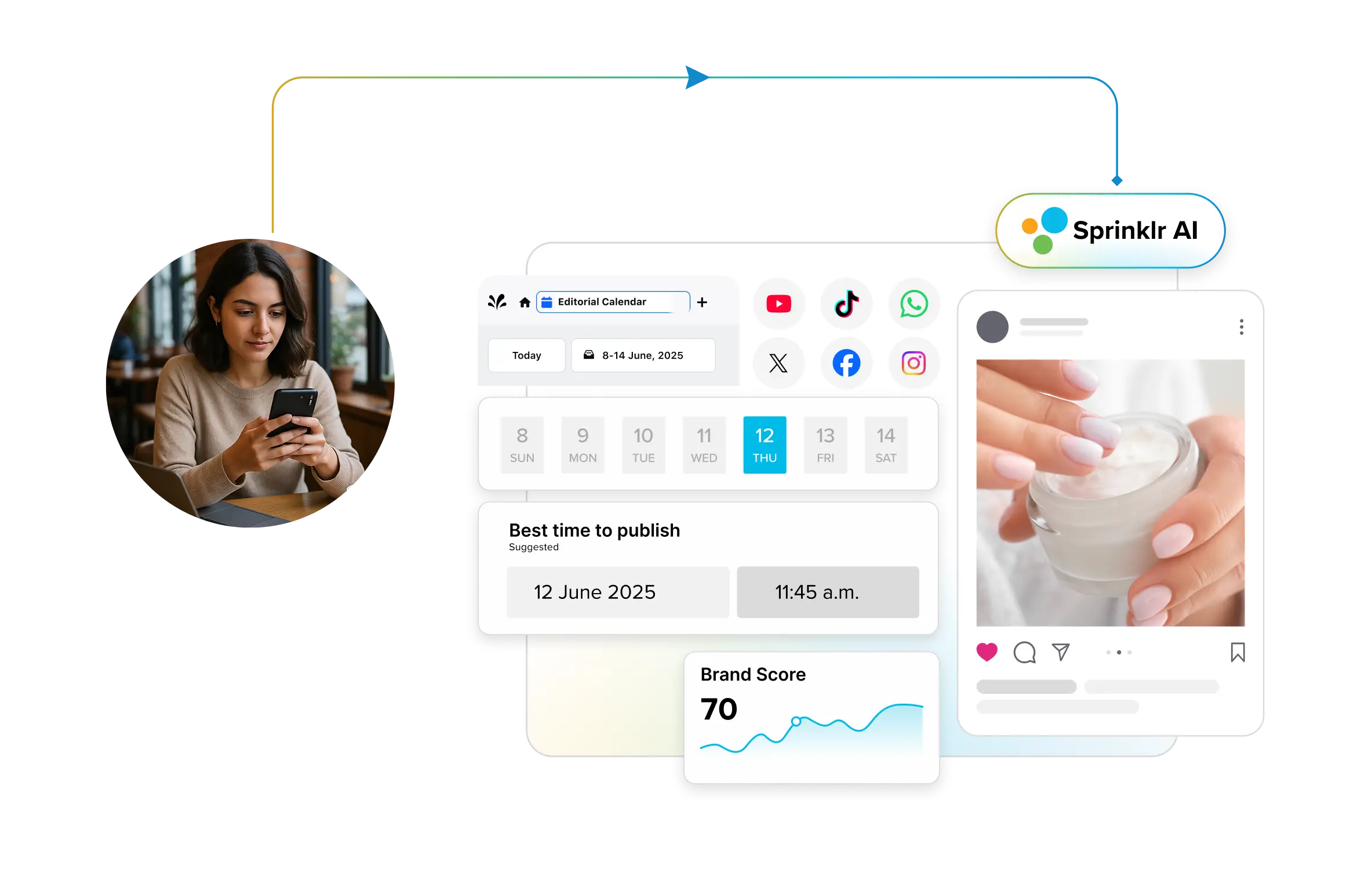
- AI-powered optimization: Sprinklr’s AI analyzes your audience and content to recommend the best timing, tone and format, helping every post achieve maximum engagement.
- Global collaboration with governance: Role-based permissions, approval workflows and brand guidelines keep teams aligned, ensuring a consistent voice across geographies and multiple brands.
- Cross-channel insights: Measure performance holistically across all channels, connecting social metrics to brand presence and business goals to ensure a single source of truth.
- Smart automation: Auto-tagging, language detection and predictive engagement suggestions reduce manual work, freeing teams to focus on higher-value interactions and strategy.
Enterprise teams that have adopted this approach consistently highlight the impact on global coordination and engagement. As SAP’s Gail Moody-Byrd, VP of Web Marketing, explains:
"There was an appetite from our customers and partners to have more authentic conversations with us. We developed our presence on social to feed that need. The more we engaged our customers through social, the more teams wanted to establish new accounts to have more relevant, useful conversations about their products and services."
A unified, intelligent approach to social media not only drives engagement but also empowers teams across regions to collaborate, respond faster and maintain a consistent brand voice.
See how global brands simplify social media management with Sprinklr Social. Get a personalized demo to learn more.
The way forward: One platform, many possibilities
Social media is becoming increasingly complex, with new platforms, formats and audiences emerging every day. For enterprise teams, this creates both opportunities and challenges. The brands that succeed are those that turn complexity into clarity by uniting data, people and strategy on a single platform.
With consolidated workflows, insights and engagement, teams can act quickly, respond effectively and maintain a consistent brand voice across all channels. They gain real-time visibility into performance, make smarter decisions and scale social programs globally without losing control. In a fragmented social landscape, the brands that succeed are those that unify every team, channel and insight to drive consistent impact.
Explore how Sprinklr helps enterprises bring every social channel, team and insight together in one unified workspace.
Frequently Asked Questions
Social media managers face fragmentation challenges because audiences spread across multiple platforms. Fragmentation increases workload, requires platform specific content formats, complicates analytics tracking and reduces organic reach consistency.
Inconsistent messaging and delayed responses weaken audience connection and dilute the overall brand voice. Fragmentation can also reduce the effectiveness of campaigns, as content may perform differently across platforms, making it difficult to measure impact and adjust strategies in real time.
AI in social media helps teams analyze audience behavior, identify trends and optimize posting schedules to maximize reach and engagement. It also recommends content strategies, automates repetitive tasks and enables data-driven decisions that improve efficiency and campaign effectiveness.
Sprinklr Social consolidates publishing, engagement, analytics and governance on a single platform, giving teams a unified view of all channels. This allows brands to maintain consistent messaging, respond faster to customers and scale global social programs without losing control or oversight.
Key metrics include engagement, reach, sentiment, response time and ROI, which together provide a comprehensive view of social performance. Monitoring these metrics across all channels enables teams to optimize campaigns, allocate resources effectively and demonstrate tangible business impact.
Ayushi is a seasoned B2B writer with over five years of experience in creating high-impact content for companies across industries. She specializes in writing that drives engagement, builds authority, and supports business goals. Her work has helped startups and established brands alike connect with their audience through thought leadership pieces.
Priyanka Malik is a content marketing professional with over nine years of experience creating content for global B2B SaaS brands. At Sprinklr she writes and strategizes across social media management, social listening, social media analytics and AI-driven social marketing, turning complex topics into clear, practical guidance for marketing and customer experience leaders.