






Elevate CX with unified, enterprise-grade listening
Sprinklr Insights gives you real-time consumer, competitor and market intelligence from 30+ channels without the noise. Make smarter decisions, strengthen your brand, and stay relentlessly customer-led.



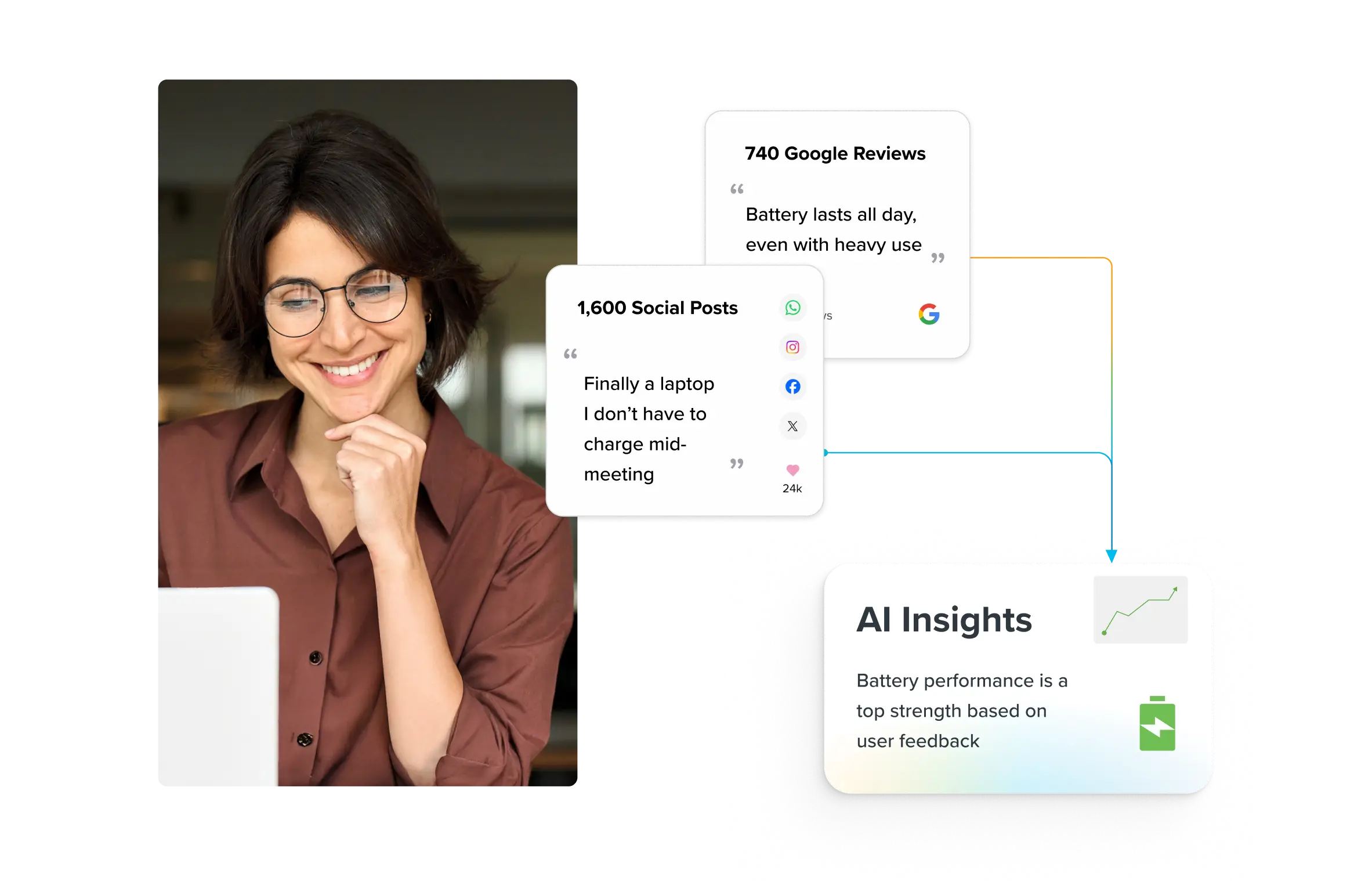
How Real-Time Alerts from VOC Signals for Churn Prevention
Every customer who leaves takes your potential revenue and growth with them. Replacing that customer costs roughly five times more than keeping one. Yet, many enterprises discover churn only after it has occurred.
The root cause is delay. Feedback from surveys, support logs and social channels arrives in fragments and by the time customer experience teams piece it together, frustration has already escalated into loss.
However, real-time alerts from voice of the customer signals can change that equation. They turn live feedback into instant early warnings, detecting risk as it emerges and routing context-rich tasks to the right owners for immediate action.
In this article, you’ll see how enterprises use real-time VoC alerts to prevent churn, and how an integrated, AI-driven approach helps teams act before a customer walks away.
- How do businesses prevent churn using real-time alerts from VoC signals?
- Designing real-time VoC Alert Cards for churn prevention
- How real-time alerts transform customer retention
- Key features to look for in a VoC alert system
- Measuring the impact on customer retention
- Common pitfalls and how to avoid them
How do businesses prevent churn using real-time alerts from VoC signals?
Real-time voice of the customer (VoC) alerting replaces delayed reporting with live, automated action. These systems continuously scan customer touchpoints to detect dissatisfaction as it happens.
When a machine-readable signal exceeds a predefined risk threshold, the system, powered by AI or automation, immediately converts it into structured work. A task is created with a clear SLA, a recommended action plan and a recorded audit trail so the right owner can respond without delay or confusion.
If a customer contacts support twice within a week and expresses negative intent in chat, the platform interprets that as a churn risk. It automatically opens a customer save task with a 60-minute SLA, prefilled with context from recent interactions and recommended next steps. The account manager receives the alert instantly, well before the issue becomes visible in the churn metrics.
In churn prevention, timing beats volume. The ability to detect risk during the customer journey turns reactive service models into proactive retention engines, helping enterprises prevent losses before they occur.
Companies implementing AI systems report 15–20% higher customer satisfaction, 5–8% increased revenue and up to 30% lower service costs.
Designing real-time VoC Alert Cards for churn prevention
Enterprises managing millions of customer interactions daily require a consistent method to identify risks and respond quickly. Alert Cards help with this. These provide a reusable framework that standardizes how churn risk is prioritized and routed across teams.
Each Alert Card functions like a blueprint, presenting a single view that combines the signal that triggered it, its confidence level, and the next steps required to protect the relationship. When applied across journeys, these cards provide CX leaders with a shared language for identifying risks and coordinating responses before churn occurs.
There are nine elements in an Alert Card that transform scattered customer feedback into structured, explainable action:
1. Trigger (signal + threshold + time window)
Defines when an event turns into a risk.
Alerts fire when a monitored signal, such as negative chat sentiment or a drop in product usage, exceeds a predefined threshold within a specified time window. Systems often run multiple windows: shorter ones for service disruptions, longer ones for churn trends.
For instance, sustained negative survey feedback over three days could trigger a churn alert.
2. Confidence
Determines credibility and evaluates how strongly the system believes a customer is at risk.
The system first identifies the topic (e.g., billing, delivery) and validates it through sentiment analysis. Priority 1 (P1) alerts require two independent signals, for example, a support chat expressing frustration, plus a negative social mention. Machine learning continuously refines these correlations to distinguish between short-term dissatisfaction and real churn intent.
Also read: 3 customer-experience risks challenging financial services
3. Priority & SLA
Specifies the response time required for each alert.
- P1 (critical): Represent clear churn intent, service breakdowns or multiple negative signals in a short span. These require acknowledgment within 60 minutes.
- P2 (moderate): Represent early risks like friction or product dissatisfaction. They follow a 24-hour SLA to allow deeper context gathering.
AI models automatically assign these based on issue type, account value, and engagement history.
4. Owner & Route
Ensures accountability: Ownership determines who acts on an alert, and routing defines how it gets there.
Systems route alerts dynamically based on customer segment, geography, or issue type. A churn-risk signal from a strategic account may reach a retention desk, while a usability issue is routed to product support.
Fallback rules keep the process resilient. If a primary queue is full or offline, alerts automatically reroute to secondary teams or on-call managers, maintaining SLAs under pressure.
5. Playbook
Outlines the next move after an alert fires.
It balances personalization with process control so every team responds consistently. For instance, a playbook could include:
- A tailored offer or incentive to recover goodwill
- Guided prompts for agents to resolve the issue
- Follow-up messaging reinforcing product value
This ensures churn prevention actions are guided, repeatable and measurable.
6. Cooldown & frequency caps
A cooldown period pauses repeat triggers for the same customer or issue until the initial alert is handled. It stops duplication and helps agents focus.
Frequency caps limit the total number of alerts sent to a customer within a specified time frame, ensuring outreach remains strategic and credible. Together, they protect response quality and maintain a healthy engagement cadence.
7. PII policy and data privacy
Safeguards personal data within alert workflows.
Personally identifiable information (PII) is masked in alert payloads. Teams act on context, while full records remain in secure, access-controlled sources, ensuring compliance without slowing response.
8. Explainability
Makes automation transparent.
Each alert contains a short “why fired” summary describing which conditions were met and which factors contributed most.
Top signals and confidence scores are ranked for clarity. This visibility helps teams verify accuracy, refine triggers, and trust AI decisions. It also builds a feedback loop where human insight strengthens machine logic.
9. Rollback
Ensures system credibility.
When alert volumes surge abnormally, the system automatically pauses that rule set or alerts. Admins investigate model drift or data anomalies before reactivation, preserving confidence in alert accuracy. Rollback ensures operations stay stable and teams act only on verified risk, not noise.
Examples of Alert Cards in Action:
Alert type | Response workflow |
Repeat-contact + negative intent | Route to the retention desk → offer concierge callback → apply a seven-day cooldown to suppress duplicate alerts. |
Renewal-at-risk | Assign to customer success manager → send plan-fit and benefit reminder → schedule personalized check-in. |
Release regression | Open problem ticket → message known fix to affected users → suppress generic promos for the impacted cohort. |
Shipping delay anger | Issue priority apology and store credit → send proactive tracking link → escalate VIP accounts for review. |
Must read: Customer care in the age of AI: Why it matters (+best practices)
How real-time alerts transform customer retention
Think of real-time alerts as an intelligent early-warning network. Machine learning models continuously analyze sentiment trends, message tone and engagement metrics to generate composite risk scores.
When sentiment dips, complaint volume spikes or the Net Promoter Score (NPS) declines sharply, the system activates in real-time, prompting teams to engage before dissatisfaction turns into departure.
Common use cases include:
- Social media complaint escalations that route instantly to service teams for response before negative sentiment spreads.
- NPS dips are automatically flagged to customer success managers, prompting targeted outreach and an experience review.
- Repeated support tickets from the same customer triggering an account health alert, enabling proactive issue resolution.
How Chick-fil-A turned negative sentiment into a viral success
Chick-fil-A, a leading quick-service restaurant brand, needed to address a sudden surge in negative sentiment and social media backlash following a change to its Original BBQ sauce. It used Sprinklr’s social listening and community management platform to turn a potential crisis into one of its most positive fan engagement moments ever.
By monitoring real-time sentiment, managing responses at scale and personally engaging fans across channels, the brand transformed backlash into advocacy. The impact was impressive:
- 92% positive fan sentiment after the relaunch
- 188× increase in Chick-fil-A & BBQ sauce mentions on launch day
- 5,000+ messages responded to or reviewed within the first 3 days
The campaign shifted sentiment from 73% negative to 92% positive, demonstrating that when brands act quickly and listen attentively, loyalty follows.
Key features to look for in a VoC alert system
For CX leaders, the right VoC alert system determines how fast teams detect dissatisfaction, how accurately they act and how clearly results translate to ROI.
Let’s look at the features in detail:
- Automated sentiment analysis across channels: Detect emotion and intent across calls, chats, emails and social mentions in real time, so teams act the moment sentiment dips.
- Integrate feedback from every customer touchpoint: Combine social, survey, chat and support data in a single view to eliminate blind spots and reveal the complete customer journey.
- Customize alert rules for high-impact scenarios: Set triggers, thresholds and escalation paths by customer value or product line to focus effort where it matters most.
- Visualize insights with real-time dashboards: Track sentiment, alert volume and resolution speed, and tie CX performance directly to ROI.
Pro Tip: Run a monthly audit of your feedback sources to ensure high-risk signals don’t go unnoticed. Over time, new review platforms, e-commerce listings or product forums can emerge outside your existing monitoring setup.
Sprinklr’s Product Insights help cross-check whether all relevant data streams are feeding into your VoC system. This simple habit helps CX leaders maintain visibility into customer sentiment and catch emerging risks before they escalate.
Measuring the impact on customer retention
Real-time VoC alerts prove their worth when faster responses lead to measurable outcomes. CX leaders should track key metrics linking operations to financial results.
- Churn rate: Measures the percentage of customers who discontinue their relationship with your organization during a specific period.
- First-response time: Tracks how quickly your team acknowledges customer concerns after an alert triggers. Customers expect responses within 60 minutes on social media, making this metric critical to retention success.
- Resolution time: Gauges how quickly alerts are resolved from activation to closure, reflecting team efficiency and system effectiveness.
- CSAT (Customer Satisfaction Score): Captures how customers rate their experience immediately after resolution, validating whether interventions work.
- NPS: Indicates long-term loyalty and advocacy, often improving as real-time alerting reduces friction across the journey.
Tracking before and after implementation reveals ROI clearly.
Here’s an example:
Metric | Before Alerts | After Alerts |
Churn Rate | 8% | 5% |
Average Response Time | 6 hours | 45 minutes |
CSAT | 78 | 91 |
NPS | 42 | 58 |
Reducing churn from 8% to 5% in a 10,000-customer subscription business means retaining 300 additional customers every month. At an average lifetime value of $2,400, that’s roughly $720,000 in monthly retained revenue, or $8.6 million annually —a direct measure of how timely alerts protect revenue.
Beyond churn reduction, real-time VoC programs create operational leverage. Faster intervention reduces support costs and prevents dissatisfaction from escalating into costly resolution cycles. Over time, the financial value compounds: retained customers buy more, stay longer and cost less to serve.
Also read: Customer service metrics to track [+ How to use them]
Pro tip: To continue improving, revisit the data quarterly and compare historical churn data before and after implementing alerts. Use a six- to twelve-month baseline to identify which triggers and thresholds have the strongest impact on retention.
With Sprinklr’s Competitive Insights and Benchmarking, you can track how these improvements compare to those of your industry peers and pinpoint which alert strategies are delivering the best results.
Common pitfalls and how to avoid them
Even the best-designed VoC alert systems can fail to deliver their intended value if not managed with precision. Here are a few recurring challenges that quietly undermine impact and their solutions:
Alert fatigue
When teams are inundated with notifications, they become desensitized, which slows response times and undermines the program’s credibility. Over-alerting often happens when thresholds are set too broadly or when every sentiment fluctuation triggers escalation.
How to fix alert fatigue:
- Refine thresholds to prioritize high-value signals.
- Implement cooldown periods or frequency caps so only urgent alerts reach agents.
- Review alert performance.
- Retire redundant triggers to keep attention focused on what truly matters.
Excessive false positives
Alerts triggered by isolated complaints or minor sentiment dips waste resources and erode trust in the system. When teams spend time chasing non-issues, genuine problems risk being ignored.
How to fix excessive false positives:
- Use multi-signal validation, combining topic relevance and sustained sentiment changes, to confirm genuine risk before escalation.
- Adjust thresholds monthly based on accuracy reports to maintain precision while avoiding missed churn indicators.
Ignoring qualitative nuance
Quantitative metrics alone rarely present the complete picture. A customer may sound neutral in tone yet hint at deep dissatisfaction through word choice or context. Without qualitative inputs, systems overlook these softer signals and fail to evolve in response to emerging customer concerns.
How to not ignore qualitative nuance:
- Blend qualitative feedback into your process.
- Encourage front-line teams to annotate alerts with contextual notes or emerging patterns.
- Convert the recurring themes into new automated triggers over time.
Pro tip: Looking for a tool that addresses all these challengesat once? A unified platform like Sprinklr Insights filters noise, surfaces true risk and lets teams tag context directly into the system.
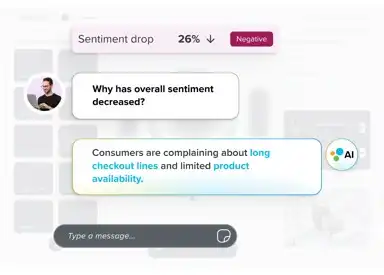
When noise is reduced, teams stop chasing every complaint and start spotting the patterns behind them, such as recurring frustrations hidden across chat, social media, and surveys.
And because qualitative feedback can’t always be automated, Sprinklr lets front-line teams tag context, annotate alerts and feed those insights back into the system. Over time, the platform learns what “real risk” looks like for your business.
In practice, this means fewer irrelevant pings, more actionable context and a tighter loop between human judgment and AI intelligence.
Prevent churn before it starts with Sprinklr
Real-time VoC alerts are the operational change that keeps small problems from becoming lost customers. By detecting sentiment shifts, complaint spikes and usage drops as they happen, alerts give teams the time and context to intervene when it still matters.
Strategically, that means proactive retention: faster responses, clearer ownership and repeatable playbooks that protect revenue and strengthen customer relationships. When alerts are well-designed, they pay for themselves in lower churn and higher satisfaction.
See how real-time alerts from voice of the customer signals for churn prevention can transform your retention strategy. Book a demo to explore a customized plan tailored to your enterprise.
Frequently Asked Questions
Real-time VoC alerts detect early signs of dissatisfaction, like repeated complaints or negative sentiment, before they escalate into cancellations. By surfacing these signals instantly and routing them to the right teams, enterprises can act quickly to resolve issues and prevent customer loss.
Multiple feedback types, including survey responses, support tickets, chat transcripts, social media mentions, app reviews and usage patterns, can trigger alerts. The system continuously monitors these channels for risk signals, such as frustration, negative sentiment or a decline in engagement.
Yes. Most VoC platforms integrate seamlessly with CRM, ticketing, and customer service tools, automatically creating tasks or cases when alerts are triggered. This ensures that context, ownership and next steps are immediately available for fast, coordinated responses.
Traditional reports summarize customer sentiment after the fact, often too late to prevent churn. Real-time alerts, on the other hand, identify risk as it happens, turning feedback into instant action and enabling proactive retention rather than reactive analysis.
“Real-time” typically means alerts are generated within seconds or minutes of detecting risk indicators across monitored channels. This immediacy allows teams to respond while the customer is still engaged, turning potential churn moments into recovery opportunities.