






The AI-native platform for global campaign management
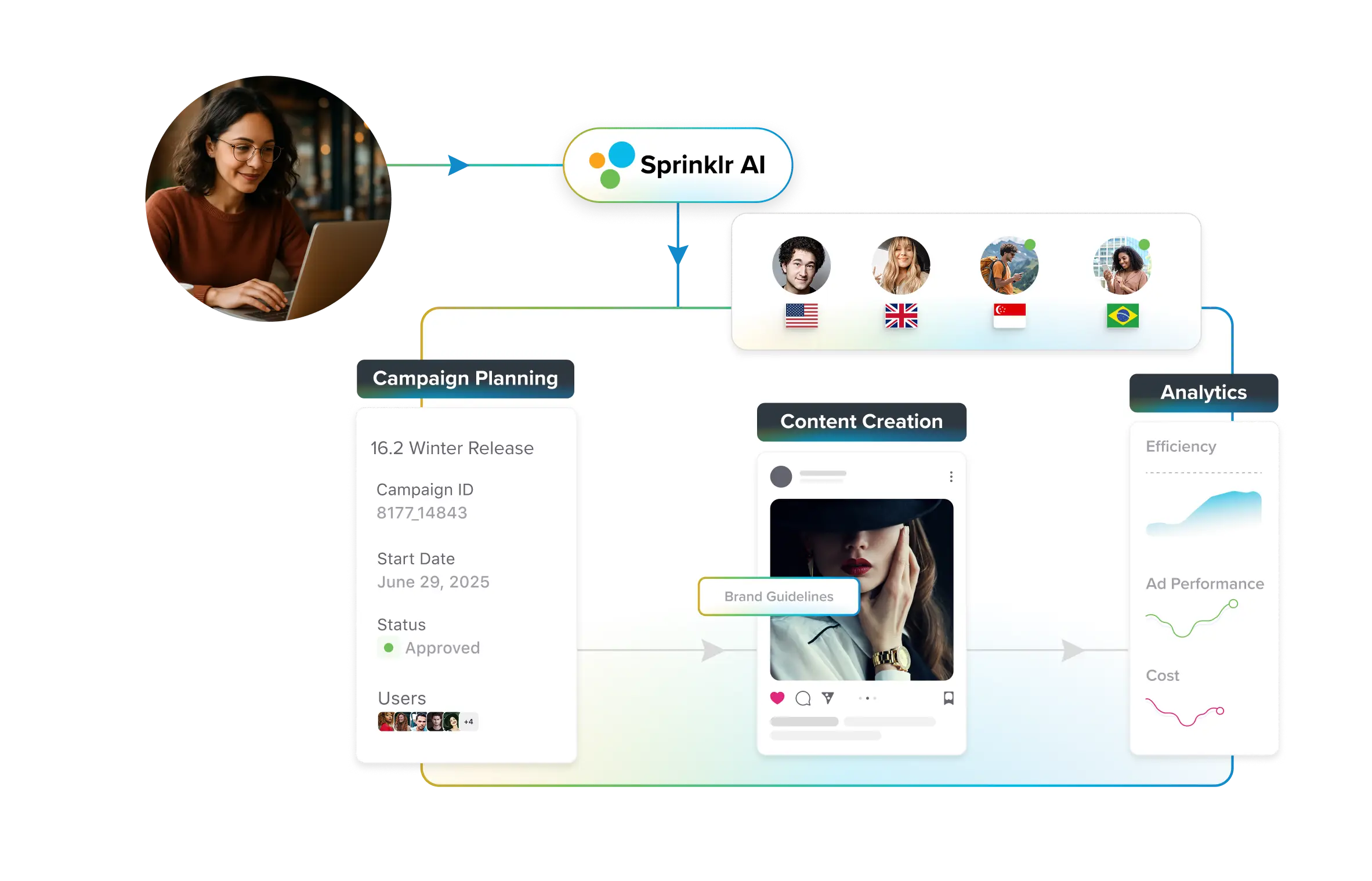
Sprinklr Marketing unifies campaign planning, content creation, publishing and analytics across global teams — all elevated by AI. Accelerate go-to-market, boost performance and enforce brand governance at scale.


The AI Paradox in Marketing
Naveen Mahadevan is a content strategist, writer and editor with experience spanning journalism, photography and B2B SaaS marketing. At Sprinklr, he writes about customer experience, social media, AI and modern marketing, turning complex business ideas into stories that are accessible and thought-provoking. His work blends research, empathy and storytelling to help leaders see beyond the technology and focus on the people behind it.
Ask any marketing team what AI has changed in the last two years, and you’ll hear some version of the same answer: everything’s become faster.
The campaign that took a week to plan now takes an hour. One hero asset becomes forty variants before lunch, and performance reports summarize themselves.
But speed was never the whole promise. As Karthik Suri, Chief Product and Corporate Strategy Officer at Sprinklr, puts it, “AI augments humans to do their job better, get more creative, and push the boundaries and the envelope.”
So, ask the same team a different question: can you quantify the impact AI had on your marketing outcomes?
You’ll probably hear a pin drop.
The AI paradox: faster tasks, same bottlenecks
Marketers didn't adopt AI on a whim. They adopted it because the job outgrew them. Consumers now move across more channels, more formats and are spread across more geographies than any team can track by hand, and every one of those touchpoints throws off signals you're expected to read and act on.
So AI went where the pain was sharpest. It sped up research. It drafted campaign ideas and media mixes. It generated copy, images, and video from a prompt. It turned dashboards into readable summaries.
Each of those wins is real. The problem is where they sit: inside individual steps of a workflow that is still stitched together by people, handoffs, and inboxes.
Look closer at what didn't change. The AI that writes your copy doesn't know your brand, your audience, your competitors, or this quarter's goal, so someone still has to fix what it gets wrong. Reviews still happen at the end, in rounds, often after the risk has already been baked in. Activation still depends on someone configuring audiences, schedules, and placements by hand. And when performance shifts mid-campaign, AI can tell you what happened, but a human still has to interpret it, decide, and move the budget.
Faster tasks, it turns out, don't add up to faster marketing. They just deliver work to the next queue sooner.
The more-content trap
There's a quiet equation running through most marketing AI conversations right now:
more AI = more content = better marketing
It's an easy equation to believe. Content was the bottleneck for years. Every channel, audience, market, and format multiplied the number of assets you needed, and production budgets never kept pace. So when AI arrived with the promise of volume, the industry went all in on producing more, producing faster, and publishing at greater scale.
And volume is achievable. Organizations using GenAI tools have reported up to a 3x increase in content production.
But here's the uncomfortable question. If you could produce ten times the content tomorrow, would you know which tenth of it actually mattered?
Most teams wouldn't. Because today's marketers don't struggle with a shortage of content. They struggle with a shortage of clarity: which opportunity to act on, which audience to target, which channel to prioritize, and which creative angle will actually resonate.
Pour more content into a system that can't answer those questions and you don't get better marketing. You get more noise, more variants to review, more approvals stuck in the queue, and more spend spread thinly across bets nobody chose deliberately.
Recommended Read: Content Marketing — The Latest Playbook
The real bottleneck: deciding, then acting
So if content isn't the constraint anymore, what is?
It’s the time lag between receiving a signal and making a decision, followed by the delay between making that decision and executing it.
Every marketing opportunity has a half-life. By the time teams identify an opportunity, plan, create, get it approved, and activate a campaign, the moment may have already passed.
A conversation starts trending in your category. A competitor's launch lands badly. A paid placement starts quietly outperforming everything else in your mix. Each of these is worth acting on, but only for a while.
Now trace what happens to that signal inside a typical team. Someone spots it on a listening dashboard. Someone else pulls performance data to check whether it's real. A brief gets written. Creative gets produced, then adapted for each channel and market. Legal and brand review it, sometimes twice. Someone configures the publishing and the paid setup. By the time it's live, the conversation has moved on.
Notice that AI has sped up almost every individual box in that chain. What it hasn't touched is the chain itself: the handoffs, the waiting and the context lost every time work changes hands.
That's why the competitive question is shifting. It's no longer "How much can we produce?" It's "How quickly can we turn the right signal into the right action?"
The brands that win the next phase won't be the ones creating the most content. They'll be the ones that can identify the right opportunities and act on them first.
Related Read: Getting Started with Social Media Automation
From task automation to orchestration
If the bottleneck is the chain, then the next evolution of AI in marketing isn't a smarter tool for each link. It's orchestration: specialized AI agents that each own a stage of the lifecycle and work together as one connected system.
So what actually changes when marketing is orchestrated rather than automated?
Decisions come before production. Instead of starting with "make more," the system starts with "what's worth making?" Agents continuously read listening insights, social performance, competitor activity, and audience behavior to surface data-backed campaign ideas and budget priorities. Production follows the decision, not the other way around.
Execution turns into a continuous feedback loop. Brand and channel checks run the moment an asset is created, not three review rounds later. Organic and paid channels move together, budget shifts toward what's working, and the results feed straight into the next round of ideas.
Put simply, AI agents don’t just generate ideas or create content; they orchestrate the entire campaign lifecycle – telling you what’s trending, what you should do, building the creatives and activating it across channels. And the marketer? They don't disappear. They move up: setting strategy, defining the guardrails and giving final approval before anything goes live, while agents absorb the coordination and the waiting.
If the projections hold, agentic systems could accelerate the creation and execution of campaigns by 10 to 15 times. Notice that the number isn't about volume. It's about speed to the right outcome. And speed only counts if the campaign stays on-brand. When agents work within your existing brand guidelines, permissions and approval workflows, consistency stops being something you police at the end. It’s built into every asset from the start.
The race worth running
The first wave of AI in marketing was a productivity story. It made individual marketers faster, and that mattered. But the brands pulling ahead next will measure themselves differently. Less by assets produced. More by how long it takes to go from signal to live campaign, how much spend reaches the bets that work, and how consistently every touchpoint sounds like the same brand.
It's the shift we're building Sprinklr Marketing AI Agents around.
The future of marketing won't belong to the brands that say the most. It will belong to the ones that hear the right signal first and answer before anyone else does. But answering first only counts if you still sound like yourself. And that's one problem no amount of speed can solve.
Next in this series: why context is the missing ingredient in enterprise AI.
Naveen Mahadevan is a content strategist, writer and editor with experience spanning journalism, photography and B2B SaaS marketing. At Sprinklr, he writes about customer experience, social media, AI and modern marketing, turning complex business ideas into stories that are accessible and thought-provoking. His work blends research, empathy and storytelling to help leaders see beyond the technology and focus on the people behind it.