





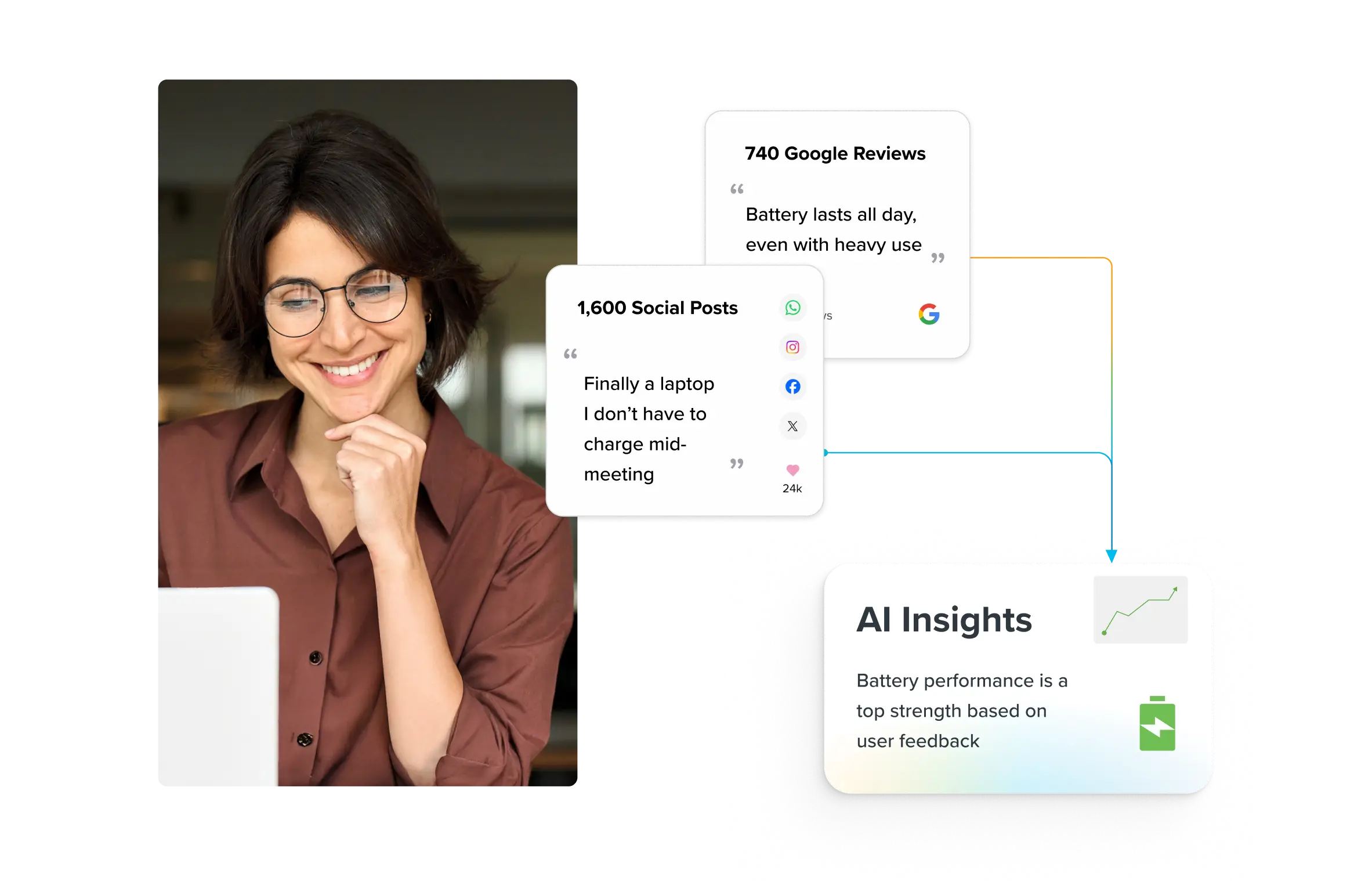
Elevate CX with unified, enterprise-grade listening
Sprinklr Insights gives you real-time consumer, competitor and market intelligence from 30+ channels without the noise. Make smarter decisions, strengthen your brand, and stay relentlessly customer-led.



Voice of Customer Analytics: The Expert Guide
Aishwarya Suresh is an experienced content writer specializing in social media management, social listening, social analytics, Voice of the Customer (VoC) and customer experience. She writes practical, research-backed guides that help brands understand customer conversations, measure social media performance and turn insights into meaningful business decisions.
Key Takeaways:
- Voice of customer (VoC) analytics is the systematic interpretation of customer signals from surveys, reviews, social conversations, support tickets, and behavioral data to guide business decisions.
- A credible VoC analytics process follows seven steps: setting objectives, identifying sources, unifying data, applying AI for theme and sentiment detection, layering business context, distributing insights, and closing the loop.
- The biggest benefits show up in retention, faster issue detection, sharper product roadmaps, and reduced research cost. ROI shows up across four lines: revenue retained, cost avoided, speed gained, and risk reduced.
- AI has shifted VoC analytics from periodic reporting to continuous, predictive intelligence that flags friction before it shows up in scores.
Voice of customer analytics is how enterprises convert unstructured customer signals into structured business decisions. It pulls data from surveys, social conversations, reviews, calls, chats, and support tickets, then uses AI to identify what customers feel, what's driving those feelings, and what to do about it. The global customer analytics market reached $16.97 billion in 2024 and is projected to hit $48.63 billion by 2030 at a 19.6% CAGR, with the AI-powered VoC analytics segment alone expected to cross $8.3 billion by 2028.
The pressure now is not on collection. AI has commoditized that part. As CMSWire put it in its May 2026 analysis of the VoC market, the category is being repriced because buyers are asking what changes inside the business as a result of the insight, not how much insight gets generated.
This guide covers what VoC analytics is, why it matters, how to run it well, the benefits worth measuring, and the ROI areas leadership cares about.
What is voice of customer analytics?
Voice of customer (VoC) analytics is the structured process of collecting customer feedback from multiple channels, applying AI and statistical methods to interpret it, and turning the resulting insights into business action. It covers both solicited feedback (NPS, CSAT, and CES surveys, interviews, focus groups) and unsolicited feedback (social posts, reviews, support transcripts, chat logs, community discussions).
While VoC analysis often refers to the broader practice, VoC analytics specifically describes the measurement and interpretation layer that turns raw feedback into patterns, drivers, and predictions.
Is voice of customer analytics the same as customer feedback analysis?
Not quite. Customer feedback analysis typically examines feedback from a single source, such as surveys or online reviews. Voice of customer analytics takes a broader approach by combining feedback from multiple channels, identifying recurring themes, and connecting customer sentiment to business outcomes.
What is the main purpose of voice of customer analysis?
The purpose of VoC analysis is to give every customer-facing team a shared, evidence-based view of what customers think, feel, and need so they can make better decisions faster.
In practice, that breaks down into five jobs:
- Identify friction early. Surface emerging issues before they affect retention, ratings, or revenue.
- Prioritize product and CX investments. Replace internal opinion with weighted customer evidence when deciding what to fix next.
- Align teams around the same customer truth. Marketing, product, support, and operations work from one signal set instead of competing dashboards.
- Inform pricing, positioning, and messaging. Understand the language customers use and the value they perceive, then mirror it back in go-to-market work.
- Measure the impact of changes. Quantify how product updates, campaigns, or process fixes shift sentiment, satisfaction, and behavior.
The strategic shift is from periodic reporting to continuous intelligence. As CX Today framed it in their 2026 customer analytics outlook, the question is no longer "how did we do" but "what should we do next, and how fast can we act on it."
Why is voice of customer analytics important in 2026?
Customer feedback now arrives faster and from more sources than any internal team can read manually. VoC analytics matters because it compresses thousands of daily signals into a clear, ranked view of what's helping or hurting the customer experience, so teams can act on it in days instead of quarters.
How to conduct a voice of customer analysis
A credible VoC analysis follows seven steps. The order matters because most programs fail at integration and action, not at collection.
Step 1: Define the business questions you want answered
Start with the decision, not the data. A useful brief sounds like: "We want to reduce churn in our mid-market segment by 15% in the next two quarters. What's driving cancellations, and where should we intervene first?” Vague goals lead to vague dashboards.
Step 2: Map your feedback sources
Identify where customers already talk about you. Typical sources include:
- Post-interaction and relationship surveys (NPS, CSAT, CES)
- Support tickets, chat logs, and call transcripts
- Public reviews on Google, G2, Trustpilot, Yelp, and app stores
- Social media mentions, comments, and DMs
- Community forums and product feedback boards
- Sales call recordings and CRM notes
- Product usage and behavioral signals
- AI-generated answers about your brand on ChatGPT, Gemini, Perplexity, and Google AI Overviews
A mature program blends solicited and unsolicited feedback, so you capture both what customers tell you when asked and what they say when they aren't.
💡 That last source is new and underused. Sprinklr’s LLM Insights, currently in beta, lets brands track how they're represented in AI-generated answers, which is becoming a meaningful slice of customer perception as generative search reshapes discovery.
Step 3: Set up unified data collection
Pull every source into a single environment. This is where most programs stall. Feedback in five tools means five taxonomies, five reports, and five versions of the truth. Standardize at the point of capture using consistent tags, customer IDs, channel labels, and timestamps.
This is also where survey design quality starts to compound. Conversational survey formats, which present questions in a chat-like flow and adapt based on prior answers, consistently produce higher completion rates and richer text responses than traditional forms. Sprinklr Surveys, built on the Customer Feedback Management module, uses an AI-assisted builder that lets teams draft conversational surveys in plain language and probe vague answers with intelligent follow-up questions, which is one of the cleanest ways to fight survey fatigue at scale.
Step 4: Apply AI for sentiment, theme, and root-cause analysis
Manual coding cannot keep pace with modern feedback volume. According to Forrester research cited in 2026 industry benchmarks, AI-powered text analytics reduces manual coding time by up to 70%, freeing analysts to focus on interpretation. Look for analytics that go beyond keyword counts to identify:
- Sentiment (positive, negative, neutral) and emotional intensity
- Emerging themes and topic clusters
- Root-cause drivers behind score movement
- Anomalies that indicate brewing issues
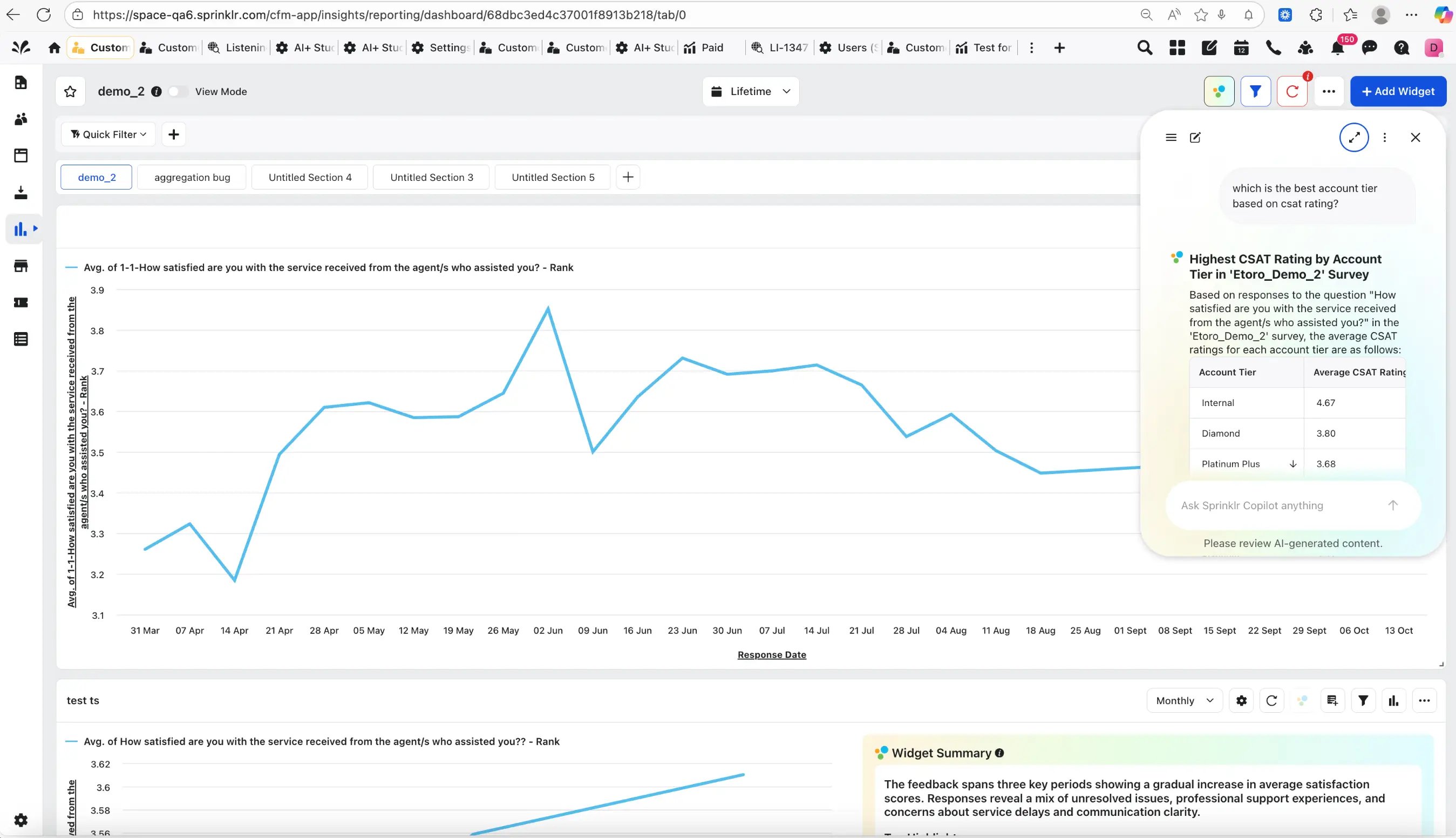
💡 This is where AI quality matters more than vendor marketing. Sprinklr's Customer Feedback Copilot takes solicited and unsolicited feedback and returns accurate insights, visual trends, comparisons, and multi-level drilldowns through natural language prompts, with citation-backed sources for every answer.
Step 5: Layer in business context
A 3-star review from a high-value enterprise customer is not the same as a 3-star review from a lapsed user. Join feedback data with customer attributes such as segment, lifetime value, tenure, product mix, and tier. This is where VoC analytics shifts from interesting to actionable.
Step 6: Distribute insights where decisions get made
Reports nobody reads change nothing. Push insights into the workflows where teams already work. That means routing service-related themes to support leads, product complaints to PMs, and reputational risks to brand and PR. Set up alerts for sentiment drops, spikes in specific themes, or new emerging issues so teams can move within hours.
What is the first step in voice of customer analytics?
Start by defining the business decision the analysis should inform, not the data you want to collect. A clear question (for example, "what's driving churn in our enterprise segment?") shapes which sources to listen to, which signals matter, and how success will be measured.
Step 7: Close the loop and measure impact
Track the actions taken in response to each insight and the change those actions produce. Did the product fix reduce support volume? Did the messaging update lift conversion? Without this closing step, a VoC program looks busy but never proves value.
📖 Story Corner: A global tech giant detects issues 60 days earlier
The clearest example of what happens when these steps connect comes from a global technology company that runs its VoC program on Sprinklr. The company sells a vast product portfolio with customers discussing those products in dozens of languages across Reddit, X, its own forums, and major review sites. Before, a single buggy product update could trigger 75,000 support contacts before the team understood the root cause.
The team implemented Social Listening, Product Insights, and Smart Alerts through Sprinklr Insights. Sprinklr's AI now filters the conversation stream, surfaces relevant themes, customer needs, and product complaints, and pings the team when it detects anomalies.
The result: the company detects product issues up to 60 days earlier, reduces contact center volume, and feeds the same signal stream back into product engineering for faster fixes. That is what closed-loop VoC looks like at enterprise scale.
Benefits of analyzing voice of customer data
The benefits of VoC analytics show up across the business, not just in CX. The most measurable ones are:
1. Earlier detection of customer problems
Sentiment shifts and theme spikes surface emerging issues days or weeks before they hit your support queue or your NPS. That early warning shrinks the window between problem and fix, as the global tech company case above demonstrates.
2. Higher retention and lifetime value
Companies that act on VoC signals quickly tend to retain more revenue. Customer-centric companies are 60% more profitable than those that don't prioritize the customer's perspective. Industry research on AI-powered VoC programs reports NPS improvements of 12 to 18 points within 12 months when teams close the insight-to-action loop within 48 hours.
3. Sharper product and roadmap decisions
When PMs can see which themes correlate with churn, expansion, or low adoption, prioritization stops being a debate and starts being a decision.
4. Less wasted research spend
Continuous VoC analytics replaces a chunk of one-off survey work and focus groups. You still run targeted research for specific questions, but you stop spending on what unsolicited feedback already tells you.
5. Aligned cross-functional action
When marketing, product, support, and CX read from the same insight layer, you get fewer conflicting narratives and faster decisions. This alignment is often the largest non-obvious benefit.
6. Stronger brand and reputation management
VoC analytics with social and review monitoring lets brand teams catch crises early and respond before they spread.
How does voice of customer analytics improve retention?
It surfaces the friction points causing customers to disengage before they show up in cancellation data. Acting on those early signals (fixing the broken onboarding step, the unclear billing email, the slow support response) directly reduces churn and protects revenue you would otherwise spend more to win back.
Measuring ROI from voice of customer analysis
ROI from VoC analytics is real, but it spreads across four lines that finance teams recognize. Track all four to build a defensible business case.
1. Revenue retained and grown
This is the largest line. Lower churn, higher cross-sell, and expansion driven by customer-led product decisions all map back to VoC insights. Tie specific actions taken from VoC findings to retention rates, expansion revenue, and CLV movement.
2. Cost avoided
Every prevented support ticket, escalation, or refund is money saved. Measure call deflection and ticket volume reduction tied to fixes that came from VoC insights. Self-service improvements informed by feedback are usually the cleanest line to attribute.
3. Operational efficiency
This includes time saved by analysts, faster reporting cycles, and consolidation of point tools. AI-driven analysis can match or exceed human accuracy on sentiment and theme classification at 87 to 92% according to Gartner benchmarks, which is what unlocks the productivity gains.
4. Risk reduced
Early detection of reputational issues, compliance flags, or crisis-level conversations has hard financial value, even when it's harder to quantify. Track time-to-detect and time-to-respond as proxies. Forrester also warns that one-third of brands risk eroding trust in 2026 through poorly executed AI self-service, which makes proactive VoC monitoring of AI-touched journeys a frontline risk control.
A mature program with clear closed-loop metrics typically reports payback in 6-12 months and ongoing returns scaling with feedback volume.
Final Thoughts
The companies that win customer experience are not the ones collecting the most feedback. They are the ones interpreting it fastest and acting on it most consistently. VoC analytics is what turns thousands of daily signals into the small number of decisions that actually move the business. Done well, it changes the operating cadence of CX from quarterly review to continuous response.
The tooling has caught up to the ambition. AI-native VoC platforms can now unify structured and unstructured feedback, apply industry-tuned models for sentiment and theme detection, and surface prioritized actions across teams. Sprinklr Insights, recognized as a Leader in the 2026 Gartner Magic Quadrant for Voice of the Customer Platforms, is one option enterprises evaluate when they want this in a single workspace rather than across stitched-together tools. Whichever platform you choose, the bar is the same: unified data, accurate AI, fast distribution, and a closed loop on action.
Frequently Asked Questions
VoC analytics improves CX by identifying the specific friction points hurting customers, the themes driving low scores, and the segments most affected, so teams can fix the right issues first. Because the analysis runs continuously, problems get caught and resolved before they affect retention or reputation.
Customer feedback analysis usually focuses on interpreting solicited feedback like surveys and reviews. VoC analysis is broader. It includes solicited feedback plus unsolicited signals from social media, support conversations, sales calls, and behavioral data, giving a fuller picture of customer perception.
AI processes unstructured feedback at a scale and speed humans cannot match. It tags sentiment, clusters themes, identifies root causes, detects anomalies, and surfaces predictive signals like churn risk. Industry benchmarks place AI sentiment accuracy at 87 to 92%, on par with human analysts, while cutting manual coding time by up to 70%.
Core sources include surveys (NPS, CSAT, CES), support tickets and call transcripts, chat logs, public reviews, social media mentions, community forums, sales call notes, and product usage data. A strong program blends solicited and unsolicited feedback, so the picture isn't skewed by who chose to respond.
Aishwarya Suresh is an experienced content writer specializing in social media management, social listening, social analytics, Voice of the Customer (VoC) and customer experience. She writes practical, research-backed guides that help brands understand customer conversations, measure social media performance and turn insights into meaningful business decisions.
Explore Voice of the Customer