




Elevate CX with unified, enterprise-grade listening
Sprinklr Insights gives you real-time consumer, competitor and market intelligence from 30+ channels without the noise. Make smarter decisions, strengthen your brand, and stay relentlessly customer-led.



8 Voice of the Customer Methodologies to Drive Business Impact
Debayan Paul is a content marketing leader specializing in product-led B2B SaaS content, with a background in journalism that still shapes how he writes. During his time at Sprinklr, he created content on Voice of the Customer, customer feedback and intelligence, social media and contact-centre topics, helping enterprises understand how to serve their customers better with unified CXM and AI.
Aishwarya Suresh is an experienced content writer specializing in social media management, social listening, social analytics, Voice of the Customer (VoC) and customer experience. She writes practical, research-backed guides that help brands understand customer conversations, measure social media performance and turn insights into meaningful business decisions.
Key Takeaways:
- VoC methodologies like social listening, NPS, behavioral analytics, and in-person surveys each capture a different layer of customer feedback — the strongest programs combine two or three to cover both breadth and depth, not rely on one.
- The biggest gap in most VoC programs is the speed and structure of acting on it. Closing the feedback loop with clear owners, timelines, and customer-facing updates is what separates insight from impact.
- Dark social, in-store interactions, and support transcripts are some of the richest VoC sources, yet most brands over-index on surveys and public social while ignoring where customers are most honest.
- VoC data drives measurable outcomes only when it's connected to decisions — product roadmaps, retention strategies, personalization, and resource allocation.
Voice of the customer (VoC) methodology is how brands systematically capture, analyze, and act on what customers say, feel, and expect — across every touchpoint they interact with. From social media conversations to support tickets to post-purchase surveys, VoC gives organizations a structured way to turn unstructured feedback into decisions that drive growth, loyalty, and product improvement.
This guide breaks down eight proven voice of the customer methodologies, with real-world examples and practical ways to use them to improve customer experience, product strategy, and business growth.
What is voice of the customer methodology?
Voice of the customer methodology refers to the structured set of techniques and processes organizations use to collect, analyze, and act on customer feedback across multiple touchpoints like surveys, social media, support interactions, and behavioral data.
While VoC refers to the broader practice of understanding customer expectations and sentiment, a VoC methodology defines the how — the tools, techniques, and frameworks you use to collect that feedback and convert it into decisions that improve experience, reduce churn, and drive product development.
8 Top voice of the customer methodologies to drive business impact
There are many methods to listen to the voice of the customers and we have listed the seven best. But just so you know, there is no universal VoC methodology to replicate. This is because your customer’s voice will come from multiple touchpoints, depending upon your niche, business model, services and so on. Hence, your VoC methodology must adapt to the unique requirements of your business.
Check this guide on a voice of the customer strategy, which is the broader structural, operational, and mission-oriented part of a VoC program.
1. Surveys and polls
Customer surveys and polls are the gold standard of quantitative VoC strategies, though Gartner predicted that 60% of marketers will diversify VoC tools from surveys to voice and text sources. Don’t worry, this list has plenty of non-survey VoC methods for you to pick from!
Back to surveys: Using surveys and polls, you can get structured, measurable data on customer satisfaction (CSAT), net promoter score (NPS), preferences, and pain points.
For example, Dove embedded micro-surveys into its global “Real Beauty” campaign to gauge reactions to its inclusive messaging. It used in-app polls to ask customers, “How does this ad make you feel about your beauty?”
The results revealed a 25% surge in positive sentiment among North American women aged 18–35, prompting Dove to double down on authenticity-driven campaigns and refine product lines.
Can surveys capture feedback from customers who found you through private or word-of-mouth channels?
Yes — and this is one of the most overlooked gaps in VoC survey design. A significant portion of customer discovery happens through dark social: private messages, WhatsApp forwards, Slack groups, and direct referrals that don't show up in any analytics dashboard. The most effective workaround is embedding an open-text "How did you hear about us?" question at checkout or during onboarding to capture referral paths analytics miss. Complement this with UTM-tagged shareable links and treat any owned communities (Discord, private forums) as direct VoC sources.
What you can do with surveys and polls
1. Segment customers for targeted surveys (e.g., by industry, size, behavior) to understand specific needs
2. Survey pain points to improve customer retention with personalized offers
3. Identify and replicate loyalty drivers (e.g., eco-friendly packaging, better user experience, etc.) from positive feedback
4. Quantify customer preferences via surveys to prioritize R&D
5. Use quick polls to validate new concepts before major investment
💡Pro tip: If you’re planning to use surveys to gather VoC data, use Sprinklr’s AI survey platform to build, design, and distribute surveys using simple commands, not complex coding.
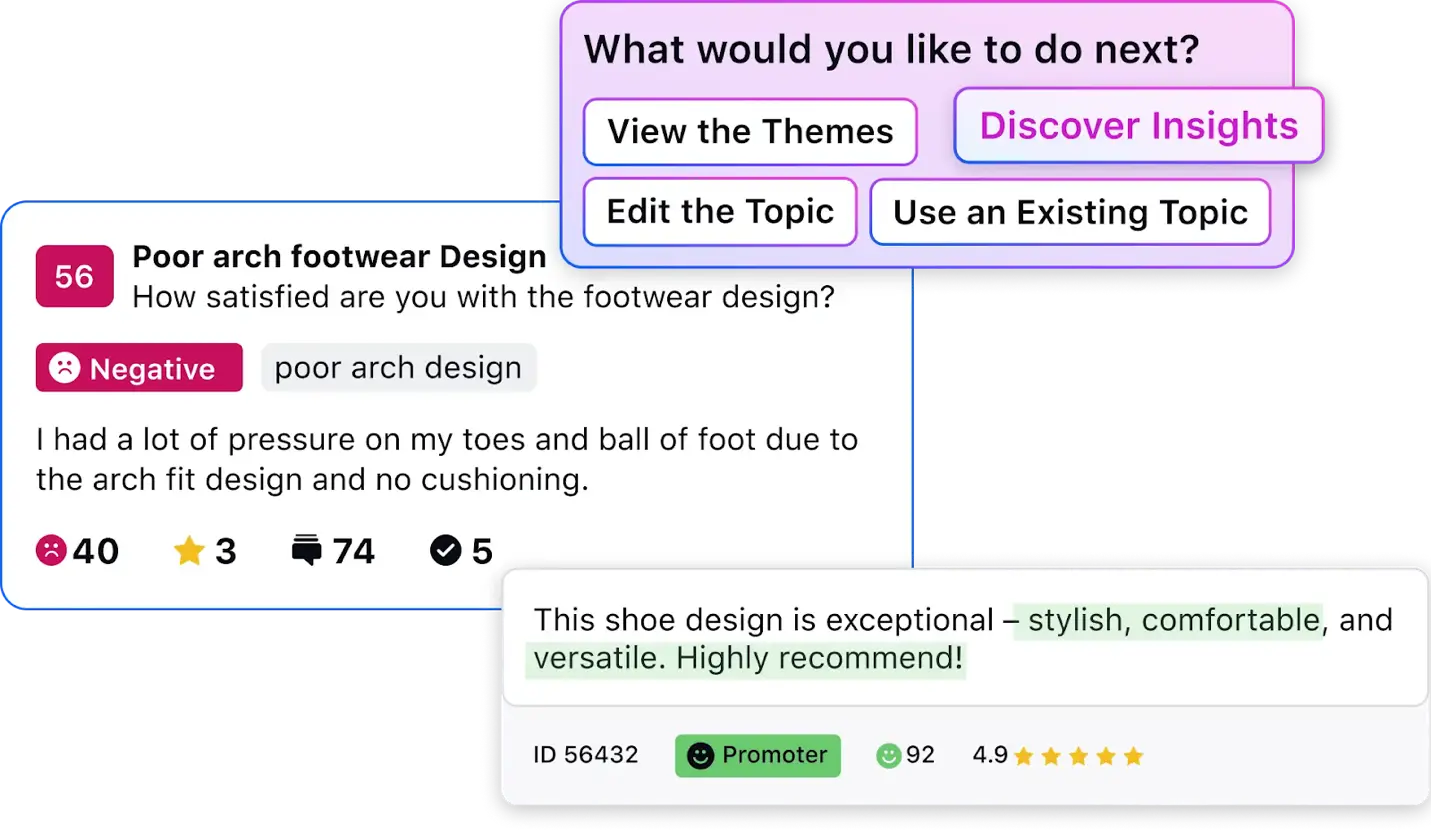
Generative AI powers the end-to-end survey creation process — from distribution to reporting and actions — through sentiment and patterns analysis. AI also gives you relevant suggestions for the next steps powered by the survey data.
2. Social media listening and sentiment analysis
Social listening tracks real-time conversations in public platforms to gauge sentiment, spot trends, and uncover unspoken needs in the conversations. Social listening uses sentiment analysis to decode how your customers feel.
For example, in 2023, Barbie’s marketing team used social listening to spot a viral social media trend — fans were comparing Ken’s outfits in the movie to BTS star Jimin’s 2021 wardrobe.
By monitoring these conversations, team Barbie pivoted quickly, collaborating with actor Ryan Gosling to create a playful video mimicking Jimin’s dance move.
The campaign generated significant tweets (now X post) engagement and millions of Instagram reel impressions.
What you can do with social listening and sentiment analysis
1. Create better content for the future by analyzing sentiments around your existing campaigns
2. Swiftly address complaints during a crisis and rebuild trust using real-time sentiment analysis
3. Uncover unmet needs and product gaps by tracking trending public sentiments around your brand
4. Quantify the emotional impact of campaigns on digital and traditional channels — before and after launch — to measure your campaign performance
5. Integrate sentiment data into CRM for targeted engagement and personalize customer interactions
6. Benchmark against competitors’ share of voice against yours for benchmark, uncovering competitive advantage and strategic opportunities
💡 Pro tip: The real value of social listening in a VoC program is in connecting the dots across languages, regions, and platforms to spot patterns your internal teams would never see manually. If you're running VoC at enterprise scale, look for a platform that goes beyond keyword monitoring to offer AI-driven theme clustering, multilingual sentiment analysis, and trend prediction.
Sprinklr's Social Listening Platform is built specifically for this level of complexity, helping teams move from raw conversation data to prioritized, cross-functional insights without the noise.
3. Customer interviews and focus groups
Customer interviews and focus groups cut through the noise of unstructured data to uncover the “why” behind their behaviors.
These qualitative methods dive deep into your customers’ motivations, frustrations, and unmet needs, offering rich insights that surveys alone can’t capture.
Zoom once hosted virtual focus groups with remote workers to understand post-pandemic challenges. Participants revealed that fragmented workflows between video calls and project management tools drained productivity.
Zoom used these insights to launch Zoom Scheduler, which integrates calendar blocking, task assignments, and Asana/Trello syncs directly into meetings. The feature reduces app-switching fatigue, driving an increase in enterprise subscriptions.
What you can do with customer interviews and focus groups
- Uncover customer pain points and preferences that quantitative data can miss
- Fuel hyper-personalized experiences and inform product roadmaps
- Test proposed strategic directions and product/service innovations before large-scale investment
- Involve customers in the early stages of solution design for inherently customer-centric products and solutions
- Pivot quickly during high-stakes crisis moments, such as adjusting features during beta testing to avoid costly post-launch fixes
4. Customer support data
Customer support data ranges from call logs and chat transcripts to email interactions and other engagement touchpoints.
You can use the support conversations (as voice or text) to identify recurring issues, and pain points that customers face by analyzing these interactions. This data reveals what’s working and pinpoints what requires immediate improvement.
Delta Airlines analyzed support interactions to identify frequent inquiries about flight delays, baggage handling, and reservation changes.
By aggregating these insights, Delta updated its online knowledge base with clear, actionable solutions and launched real-time operations support hub and baggage handling technology.
This initiative significantly reduced repetitive inquiries, improved resolution times, and boosted overall customer satisfaction.
What you can do with customer support data
- Capture the frontline perspectives on recurring customer challenges and product usability issues
- Implement agent suggestions and insights into product development and process optimization cycles
- Optimize staffing, training, and resource allocation to improve response times, reduce costs, and enhance operational efficiency
- Identify frequently asked "how-to" or easily resolved questions and develop robust knowledge bases, FAQs, or self-service tools to deflect common inquiries and empower customers
- Analyze sentiment on support interactions (chat, voice transcripts) to gauge customer emotional responses beyond issue resolution
- Target process improvements or agent training to mitigate negative experiences and enhance customer satisfaction
💡Pro tip : Use Sprinklr’s consumer intelligence platform to gauge the voice of the customer and sentiment from all touchpoints, including your support agent conversations.
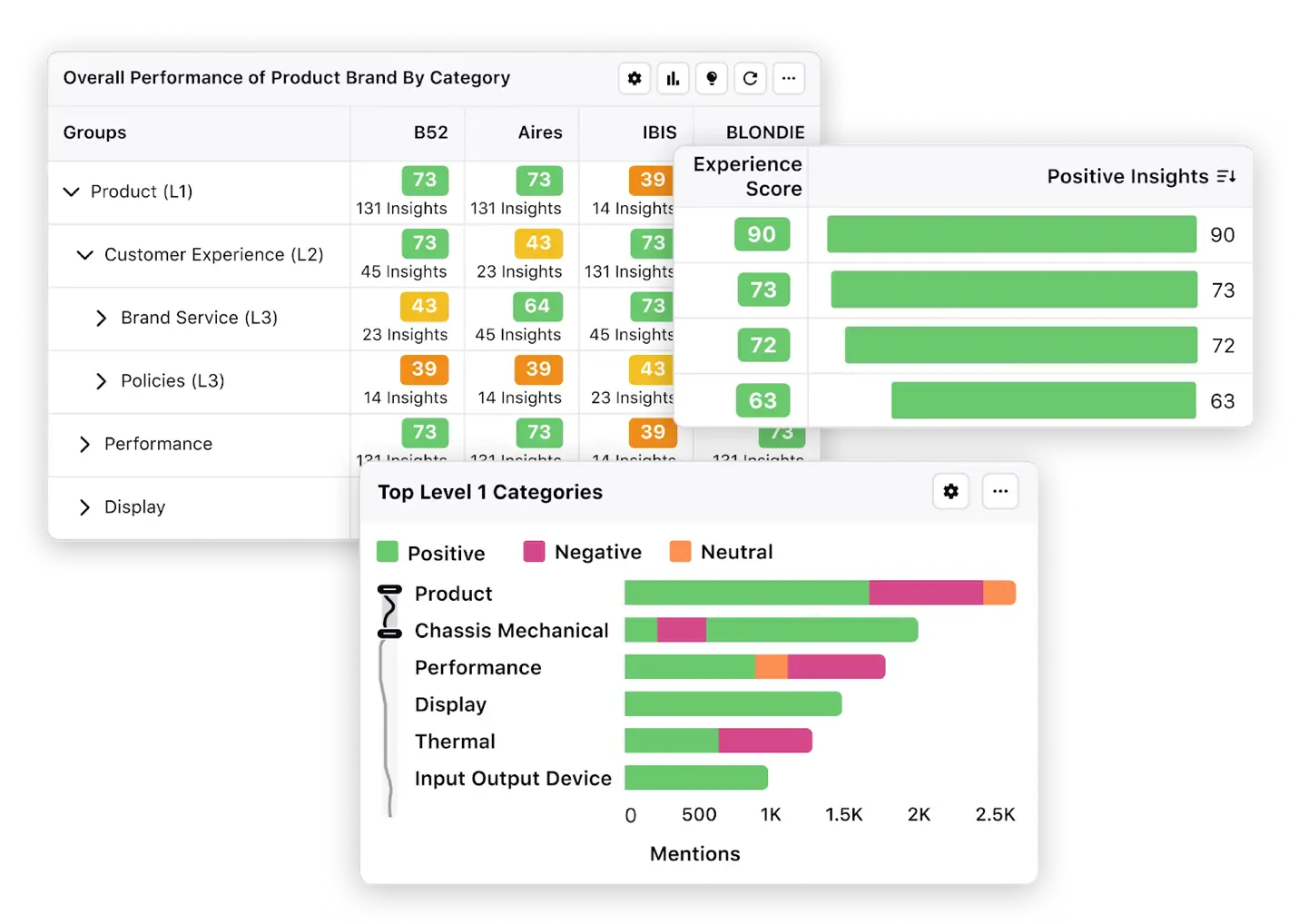
Establish a regular review process with your cross-functional teams to analyze support data and sentiment trends. Use this continuous feedback loop to refine support processes, ensuring your customer service evolves with your customers’ needs.
5. Net promoter score (NPS)
Net promoter score (NPS) measures customer loyalty by asking one simple question: “How likely are you to recommend us?”
Scores range from detractors (0-6) to passives (7-8) and promoters (9–10). It’s a pulse check on customer sentiment, turning abstract loyalty into actionable data.
USAA used its NPS program to identify dissatisfied customers, triggering targeted actions such as personalized follow-ups and process improvements.
USAA achieved an impressive NPS of 75 with this proactive approach, which directly informed customer retention strategies and drove enhancements in customer experience.
NPS insights can help you identify both immediate issues and long-term trends. The real-time feedback minimizes churn and cultivates brand advocates, impacting customer loyalty and revenue growth.
What you can do with net promoters' score
- Turn negative experiences around by immediately contacting detractors and passives post NPS surveys to resolve stated issues
- Identify recurring themes and pain points that drive scores, especially low scores
- Measure and benchmark NPS against industry standards and internal targets
- Enable frontline teams (sales, support, service, success) to analyze customer sentiment in real-time and adapt to interactions
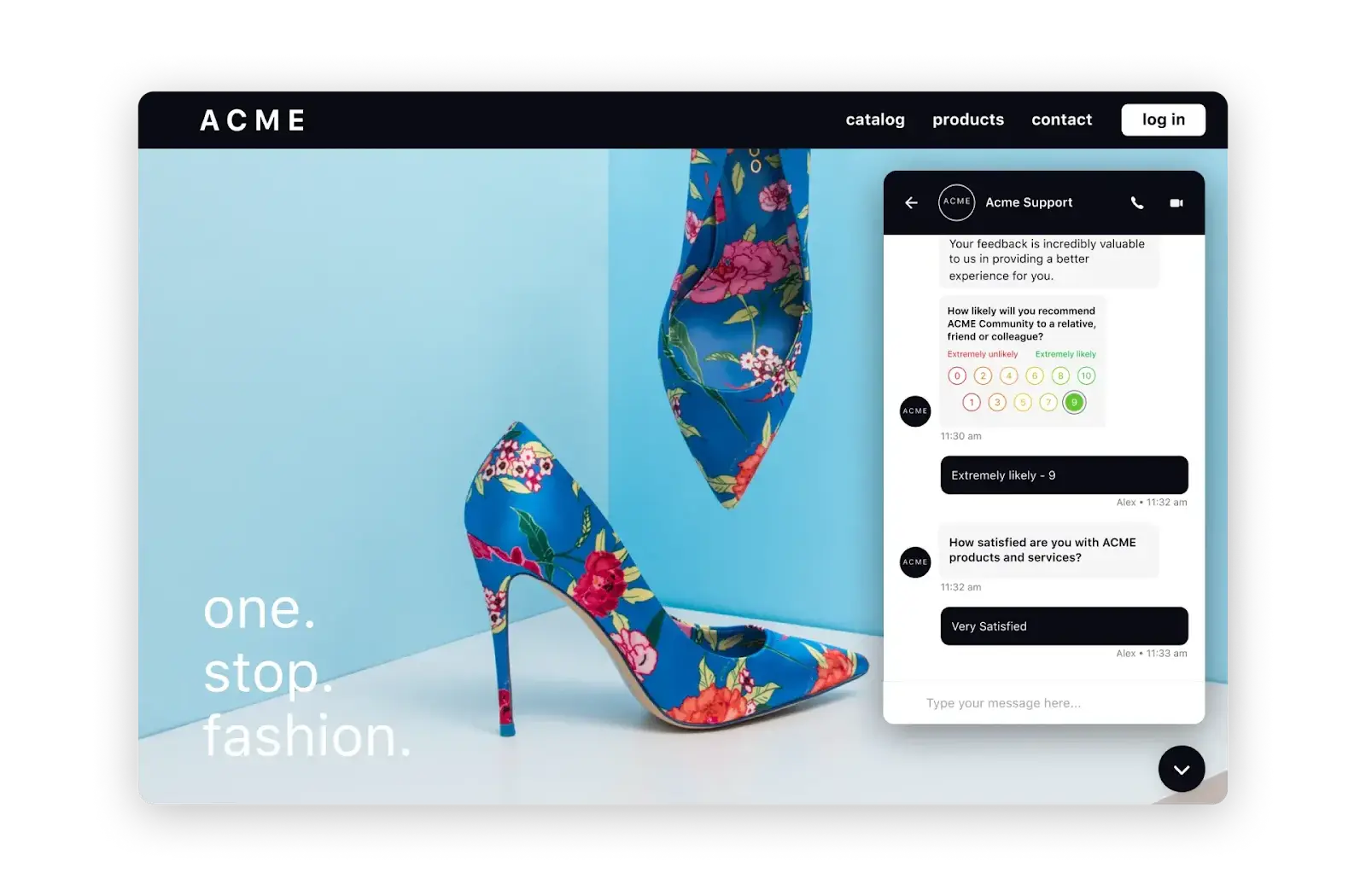
💡 Pro tip: NPS loses much of its value when it's disconnected from the conversation that just happened. The highest-quality NPS responses come when customers are prompted immediately after an interaction, while the experience is still fresh, rather than through a separate email survey sent hours later. Embedding NPS prompts directly into chat or support workflows dramatically improves response rates and reduces survey fatigue.
If you're looking to close that gap, Sprinklr's Omnichannel Survey capability lets you deploy NPS within the same chat thread, so feedback is captured in context, without breaking the customer experience.
🔖 Deep dive: How to improve the net promoter score of your brand
6. Behavioral analytics: website and product usage data
Tracking customer behavior on your website and within your product offers invaluable insights into how users interact with your digital environment.
Monitor clicks, page views, session durations, heatmaps, and feature usage to uncover patterns that reveal what customers value and where they encounter obstacles.
Use the data to identify areas for improvement, refine features, and tailor the user experience to meet customer needs better.
For example, Slack uses product usage analytics to continuously optimize its platform. It identifies friction points and refines its features by monitoring metrics such as channel activity, direct messaging frequency, file-sharing behavior, and integration usage.
This iterative process drives higher engagement and smoother communication and boosts overall user retention.
What you can do with website and product usage data
- Analyze website/product exit pages, drop-off rates in workflows, and error occurrences to directly identify user struggles
- Use browsing history and product feature adoption data to segment users and tailor website content, in-app guidance, or support interactions
- Use website content consumption and feature usage frequency data to make informed decisions on content creation, feature enhancements, and product roadmap prioritization
- Identify declining product usage or website visit frequency trends indicating potential churn
- Use predictive insight to proactively reach customers with tailored support or engagement strategies
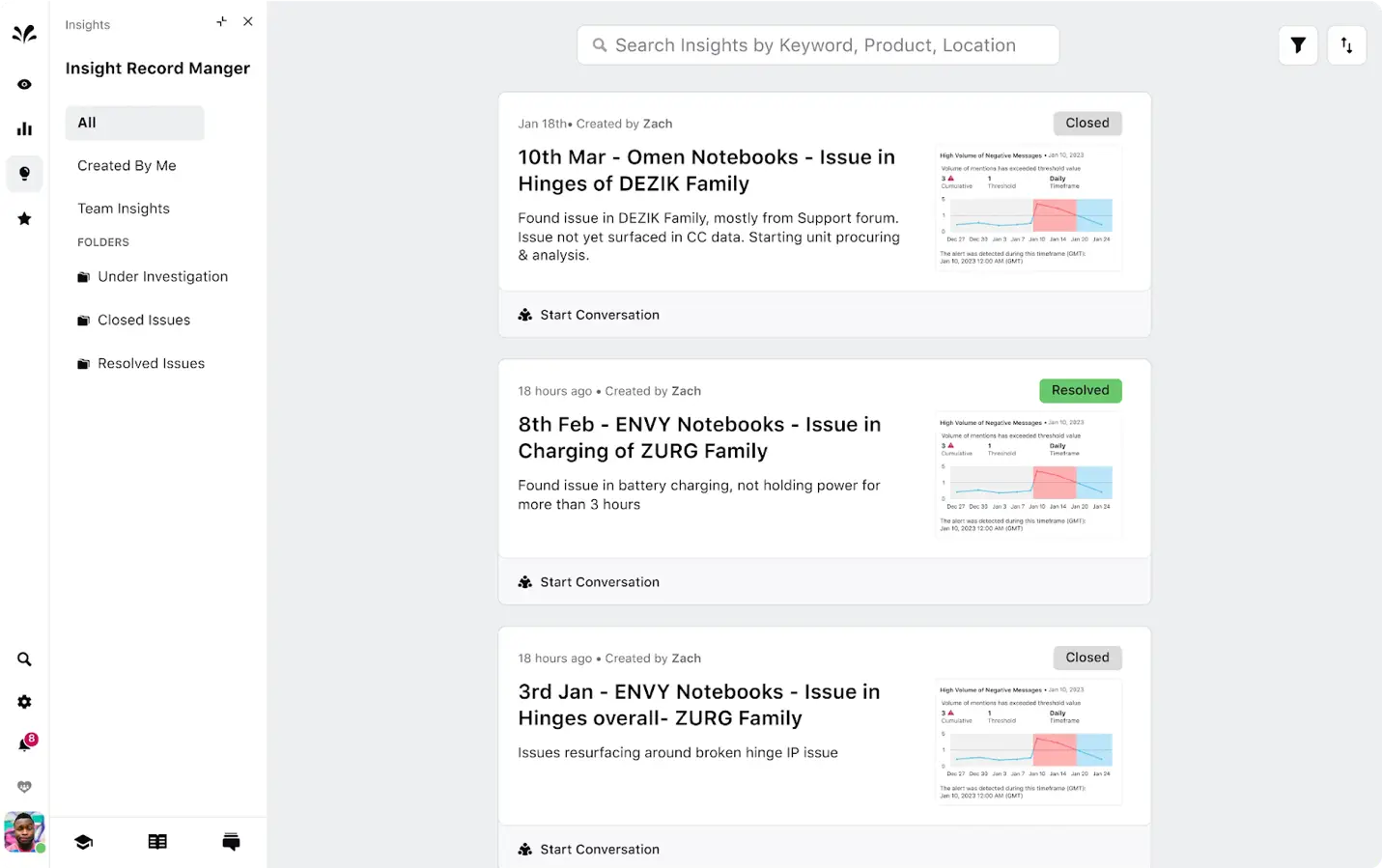
💡 Pro tip : Establish a routine for A/B testing based on website and product usage analytics. To get a 360-degree overview of your customer’s voice across the product life cycle, use Sprinklr's Product Insights.
Listen to conversations where your customers talk about your product with the broadest coverage and get AI to sieve the most relevant conversations to focus on, eliminating competitors' reviews and things you don’t need.
7. Close the feedback loop
Closing the feedback loop means not only gathering customer feedback but also acting on it. This approach creates a culture of continuous improvement and demonstrates to customers that their voices truly matter, boosting satisfaction and loyalty.
For instance, LEGO invites fans to submit ideas for new sets through the LEGO Ideas platform. When an idea reaches a set number of votes, it enters a review process where LEGO collaborates with the creator to refine the concept.
Many of these ideas have led to officially released LEGO sets, proving that customer feedback can directly influence product development and innovation.
What you can do to close the feedback loop
- Personalize acknowledgments where feasible, setting clear expectations on review timelines and next steps in the feedback process
- Deploy a cross-functional feedback analysis team with representatives from relevant departments (e.g., product, service, operations) to review and translate customer insights into actionable recommendations
- Create structured action plans with clearly defined owners, timelines, and measurable objectives to address pain points, driving tangible improvements in products, services, or processes
- Proactively communicate “closed loop” updates to customers about the actions taken in response to their input to demonstrate the value and impact of their contributions
How do you choose the right VoC methodology for your business?
There's no single VoC methodology that works for every business. The right choice depends on three factors: your customer touchpoints, the type of insight you need, and your team's capacity to act on the data. Digital-first businesses get the most from social listening and behavioral analytics. High-touch industries like hospitality or healthcare benefit more from in-person surveys and interviews. Transactional businesses with high ticket volumes should lean on NPS and support data analysis. The strongest VoC programs layer two or three complementary methods — for example, NPS for quantitative pulse, social listening for unsolicited sentiment, and interviews for deeper context.
8. In-person surveys
In-person surveys help businesses capture immediate, high-context feedback during physical interactions such as retail visits, trade shows, conferences, product demos or in-store experiences. Unlike digital surveys, face-to-face conversations allow brands to observe customer reactions, ask follow-up questions in real time and uncover nuanced insights that structured forms often miss.
For example, Starbucks runs its "My Starbucks Experience Survey" across global stores. After an in-store order, randomly selected customers receive a paper invitation to complete a short survey covering service quality, order accuracy, and the overall store experience — while the interaction is still fresh. The feedback is anonymous and used to identify store-level improvement areas and recognize high-performing teams.
What you can do with in-person surveys
- Capture real-time reactions at high-impact physical touchpoints like stores, branches, or events
- Identify location-specific friction points that digital channels would never surface
- Train frontline staff by correlating in-person feedback with individual interaction data
- Test new product placements, store layouts, or service changes before rolling out at scale
- Complement digital VoC data to build a complete omnichannel picture of the customer experience
How you can use the voice of the customer methodologies to drive impact
Here’s how you can start:
Identify pain points and optimize experiences
Pinpoint precise areas where your customers face friction by analyzing VoC data, such as surveys, in-app feedback, and behavioral analytics.
They can refine your customer journey by streamlining processes, simplifying user interfaces, and tailoring messaging to address specific concerns.
Under Armour analyzed its customers’ purchase behaviors and discovered that complicated payment processes were a key friction point.
The sportswear brand simplified the checkout layout and offered financing options (like Klarna) alongside traditional payment methods. This addressed the major pain point giving customers greater flexibility and confidence.
Inform product and service development with VoC insights
VoC methodologies, such as customer interviews, surveys, and usability tests, offer clear signals on user preferences, feature demands, and market gaps.
These insights can help you refine your product or service offerings by aligning them more closely with customer desire, driven by customer feedback and usage data.
For example, OpenAI introduced voice and vision features to its ChatGPT mobile app when users requested more natural, hands-free interaction and image-based queries.
ChatGPT expanded beyond text-only interactions allowing customers to provide audio and visual prompts—a step informed by analyzing customer inputs.
Enhance customer loyalty through personalized engagement
VoC data reveals customer pain points and highlights what truly resonates with your audience. You can tailor your marketing and external communications by analyzing feedback from surveys, purchase histories, and customer interactions. This personalized engagement builds trust and fosters long-term customer loyalty.
Nike’s "Nike By You" platform exemplifies this approach. It empowers consumers to personalize everything — from color to material.
This initiative boosts customer satisfaction and provides invaluable data on consumer preferences. Such insights enable Nike to refine its default product range and strategically control pricing for its mass-market offerings.
Benefits of VoC methodologies for large organizations
Here’s how VoC methodologies help your enterprise:
Personalized experience design
Personalized customer experience drives engagement and loyalty. According to Gartner, 71% of B2C and 86% of B2B customers expect brands to be well-informed about their personal information during an interaction. VoC methodologies help you refine personalization strategies by analyzing customer preferences and behaviors.
Streaming platforms like Netflix and Spotify use VoC insights to track viewing and listening habits and recommend content tailored to individual preferences.
🔖 You may like: An 8-step plan to deliver personalized customer service
Proactive issue resolution
According to Gartner, 38% of Gen Z and Millennial customers abandon a customer service issue if they can’t resolve it through self-service. With VoC methodologies you can anticipate and fix problems before they arise.
AI-driven sentiment analysis can detect dissatisfaction early, helping you:
- Optimize self-service options
- Streamline support
- Prevent potential customer churn
Proactive issue resolution builds trust and enhances customer satisfaction by eliminating friction points.
🔖 Related read: What is proactive customer service?
Competitive differentiation
Customers switch brands when they find better value elsewhere. VoC methodologies will help you track preferences, market gaps, and help you innovate and stay competitive.
Smartphone brands, for example, use VoC insights to prioritize customer-driven upgrades like AI-powered cameras or extended battery life. When brands consistently evolve based on customer expectations, they maintain differentiation, relevance, and a strong market presence.
🔖 Also read: What is competitive benchmarking?
Data-driven decision-making
Gartner predicts that by 2026, 65% of B2B sales organizations will transition from intuition-based to data-driven decision-making. VoC methodologies transform customer feedback into strategic intelligence, reducing reliance on intuition.
You can optimize investments in product development, service enhancements, and experience design by analyzing customer’s voices. With the data, you can ensure your team allocates resources where they matter most, maximizing impact and minimizing waste.
❓ How do you measure VoC program effectiveness?
Track four layers: listening coverage (are you capturing feedback across key journey stages?), experience quality (NPS, CSAT, CES scores at critical moments), closed-loop execution (how fast detractor issues get resolved and improvements ship), and business impact (retention rate, churn reduction, cost-to-serve). The difference between a mature VoC program and a checkbox exercise is whether feedback actually drives measurable outcomes.
Sprinklr: The leading VoC platform built for enterprises
Most enterprises collect customer feedback. The challenge is unifying it — surveys, social conversations, reviews, support interactions, and behavioral signals into a single view that teams can act on.
Sprinklr Insights solves this at scale. As a Leader in the 2026 Gartner® Magic Quadrant™ for Voice of the Customer Platforms, Sprinklr brings together structured and unstructured customer signals from 30+ social and digital channels into one AI-native platform.
Instead of toggling between disconnected survey tools, social listening dashboards, and support analytics, your teams (marketing, research, care, CX) work from a single source of truth. Sprinklr's AI identifies root-cause drivers behind customer sentiment, surfaces prioritized recommendations, and triggers actions across workflows, so feedback doesn't just sit in a report; it drives change.
Whether you're running conversational NPS surveys inside chat threads, analyzing unsolicited social feedback in real time, or tracking sentiment shifts across markets, Sprinklr's unified VoC solution gives enterprises the clarity to listen better and the speed to act faster.
Grab a demo to see why Sprinklr is recognized as a leader. 👇
Frequently Asked Questions
Combine survey data, social listening, and interviews using a unified CXM platform like Sprinklr. Build a central dashboard that merges quantitative and qualitative insights for a full view of customer feedback.
No single method fits all. NPS is popular for its simplicity but pairing it with social media listening offers deeper insights into loyalty drivers.
Yes. VoC methods pinpoint issues and dissatisfaction early. Acting on these insights can improve product experiences and lower churn rates.
Use a diverse mix of feedback channels. Combine randomized surveys, social media monitoring, and targeted focus groups to capture input from all customer segments.
Absolutely. AI automates data collection, identifies patterns, and predicts trends. It turns raw feedback into actionable insights, making VoC data more effective.
Debayan Paul is a content marketing leader specializing in product-led B2B SaaS content, with a background in journalism that still shapes how he writes. During his time at Sprinklr, he created content on Voice of the Customer, customer feedback and intelligence, social media and contact-centre topics, helping enterprises understand how to serve their customers better with unified CXM and AI.
Aishwarya Suresh is an experienced content writer specializing in social media management, social listening, social analytics, Voice of the Customer (VoC) and customer experience. She writes practical, research-backed guides that help brands understand customer conversations, measure social media performance and turn insights into meaningful business decisions.