





Elevate CX with unified, enterprise-grade listening
Sprinklr Insights gives you real-time consumer, competitor and market intelligence from 30+ channels without the noise. Make smarter decisions, strengthen your brand, and stay relentlessly customer-led.



What is Social Listening? All You Need To Know


Key Takeaways
- Social listening tracks conversations about your brand, competitors, and industry. It surfaces insights that direct feedback alone cannot provide.
- AI-powered tools analyze the why behind conversations, detect trends, forecast shifts, and respond to anomalies in real time with AI.
- Acting on insights early drives measurable advantage. Brands like Netflix, Chick-fil-A, McDonald’s, and Spotify that move on signals before competitors improve product decisions, campaign performance, and crisis response.
Customers rarely send feedback directly to brands anymore. They share it publicly across social media, forums, creator communities, and review platforms, where a single complaint or product critique can spread quickly and shape brand perception.
Social listening helps companies capture these conversations, analyze sentiment, and identify patterns in customer feedback. It turns scattered online discussions into insights that inform marketing strategy, product improvements, and reputation management.
To learn everything about social listening, read the entire blog.
- What is social listening?
- Social listening vs. social media monitoring
- Why social listening is important for every brand
- Core social listening techniques
- How social listening improves customer experience
- How social listening improves marketing and brand strategy
- What are the limitations of social listening?
- How to implement social listening in your business
- How AI supercharges social listening
- Future trends in social listening
What is social listening?
Social listening is the process of monitoring and analyzing online conversations related to your brand, competitors, industry, and relevant keywords to extract actionable insights. Unlike basic monitoring, it focuses on identifying sentiment, intent, and emerging patterns that can influence business decisions.
When done correctly, social listening helps:
- Understand customer sentiment and how positively or negatively people perceive your brand how positively or negatively people perceive your brand
- Improve customer engagement strategies by identifying opportunities to respond to customer queries and concerns timely
- Stay on top of PR trends and mitigate potential risks by identifying and addressing negative conversations circulating online before they escalate
- Gain competitive intelligence by observing competitors’ strengths, weaknesses, and successful strategies
The revival of the show Lucifer by Netflix is a great example of social listening in action. Fans worldwide demanded to revive the show using #SaveLucifer on various platforms like X and Reddit.
In this screenshot of a Reddit thread, you can see Lucifer fans discussing collective action to garner the attention of media houses that could bring back the show👇
Here’s another example, this time an X thread, where fans are perpetuating the #SaveLucifer hashtag 👇
Netflix quickly tracked and acknowledged the positive sentiment and made a strategic decision that paid off. The result – Lucifer became one of Netflix’s most-watched series.
Social listening vs. social media monitoring
Social listening and social monitoring are related to some extent as both focus on tracking online conversations. However, they differ in scope and objectives.
Let’s discuss it in detail:
Aspect | Social media monitoring | Social listening |
Primary objectives | Identify and collect specific brand mentions, keywords, or hashtags in real time and manage the brand's online presence by responding to customer queries, addressing complaints, and engaging with positive feedback | Analyze the why behind the conversations than just what. Then interpret the data to understand sentiment, identify emerging trends, and gain a holistic view of the brand's position within the broader industry |
Scope of the data | Narrower dataset, tracking media mentions where the brand is tagged, or a specific keyword is used | Casts a wider net to include direct mentions and untagged conversations about the brand, competitors, and the industry at large |
Depth of the data | Tracks metrics such as the volume of mentions, reach, impressions, and engagement rates. These metrics provide a snapshot of the brand's visibility and interaction levels | Employs sophisticated tech to gauge sentiment, share of voice, identify themes and emotions in conversations, and even forecast future trends. It aims to understand the nuances of public opinion and predict shifts in consumer behavior |
Primary outcome | React swiftly to customer needs, mitigate potential PR crises, and foster community by engaging directly with the target audience | Actionable intelligence that can drive strategic change. This can lead to the development of new products, refinement of marketing messages, and a more profound understanding of the target audience |
Strategic impact | Maintain a positive brand health and provide timely customer service. It is an essential tool to manage day-to-day interactions | Inform long-term business strategy: identifying new market opportunities, understanding competitor strategies, informing product development, and shaping marketing campaigns. |
Why social listening is important for every brand
Social listening is foundational to social media marketing success. It won’t be an overestimation to say you must incorporate it into your social media strategy. Here are the key benefits of social listening:
1. Better understanding of customer needs
Social listening allows you to tap into discussions happening in real time. That helps you uncover pain points, preferences, and emerging demands.
Factoring these into your product roadmap, marketing, support, and sales helps you meet customer expectations better and faster.
2. Strategic crisis management
Real-time monitoring allows you to detect potential crises or spikes in negative sentiment early and respond promptly, preventing reputational damage and maintaining customer trust.
Proactive crisis communication and management reflect your responsiveness and consideration of your audience’s concerns, further strengthening trust.
3. Spotting trends
When used effectively, social media listening spots new trends early, filtering through industry chatter to focus on the right conversations.
This helps you shape your messaging and content strategy, adapting to evolving consumer needs for a strong market position.
4. Evaluate marketing performance
Social listening tools can evaluate your marketing efforts by analyzing campaign performance.
They also enable you to study audience reactions to conferences, events, and promotions, helping you identify what's relevant and what falls flat.
These insights into audience perception and campaign alignment with your goals can help refine your strategy.
Core social listening techniques
Social listening involves incorporating various tools and techniques to monitor, analyze, and respond to conversations on different online platforms.
Take a look at some of the standard social listening techniques inspired by our users:
1. Sentiment analysis
Sentiment analysis analyzes online conversations and classifies them as positive, negative, or neutral with the help of Machine Learning (ML) and Natural Language Processing (NLP).
It involves processes like data collection, preprocessing (tokenization, stop-work removal), keyword analysis, and text scoring.
2. Trend tracking
Social listening works by keeping track of sudden rises in social media mentions, topics, or hashtags that are gaining momentum, indicating emerging trends or revealing new patterns used to describe a particular topic or rising interest.
It also involves real-time analysis of which social media content is going viral.
Additionally, you can detect when special issues, movements, or shifts in attitudes influence consumer behavior.
For example, if consumers’ attitudes shift towards sustainability, and start talking about eco-friendly clothes more, the insights might be useful for brands to shift their long-term strategy or even launch a new line of sustainable clothes.
3. Competitor analysis
Social listening gathers data on which competitor campaigns are performing well or failing.
It uses AI to determine whether customers feel positively or negatively about a competitor's brand, helping identify pain points in competitor products or services that a brand can capitalize on.
It also uncovers gaps in the market by analyzing unmet customer needs. A great example here is Wendy’s which is quick to jump on competitors’ tweets.
4. Keyword monitoring
While keyword monitoring serves raw data on the frequency and reach of terms, social listening adds depth to it by analyzing the emotions of people about those terms and why they're discussing them.
How social listening improves customer experience
Customers may discuss pain points and challenges with your product or dissatisfaction with specific aspects of your service.
To identify these conversations, brands like yours use tools like Sprinklr Social Listening, which, apart from gleaning conversations, also help directly address the issue in the same platform.
Additionally, you can also understand the context of the conversation and avoid misinterpreting slang or sarcasm. This makes it easier to offer more personalized and relevant experience.
Moreover, social listening can be a game changer in customer service:
- It can pick up negative mentions immediately even if the customer hasn't directly tagged the brand, allowing real-time identification of issues before they escalate
- Effective sentiment analysis helps customer service agents tailor their responses for a more empathetic and effective resolution
- Agents can analyze a customer's social media history and gain insights into their past interactions with brands. This gives ideas about preferences and communication style, enabling agents to offer more personalized support
- It helps prioritize customer service requests based on urgency and impact
Spotify introduced ‘Blend’, an AI feature that allows users to create a shared playlist with friends and “DJ” and curates personalized music.
Spotify utilized social listening to develop these features considering users' feedback where they wanted to engage with friends over music, not just listen alone.

How social listening improves marketing and brand strategy
Social listening plays a major role in marketing and brand strategy by helping businesses understand what their target audience is discussing, the language they use, and their pain points.
This helps brands adjust their messaging and content accordingly using audiences’ preferred tone, keywords, and topics.
Additionally, it helps identify authentic and reliable brand advocates by analyzing their real impact and alignment with brand value.
Further, social media listening enhances strategies by optimizing customer support, identifying recurring complaints or questions, and addressing them in real time.
It also enables personalized marketing efforts by segmenting audiences based on their expressed interests and behaviors.
Social listening also impacts your content creation by:
- Understanding your audience and the content they prefer
- Identifying trending topics to create timely and relevant content
- Improving your content strategy by providing insights on what content resonates well with the audience and what doesn't
- Measuring the success of your content by tracking mentions, shares, and comments
Apart from that, social listening plays a huge role in competitive analysis. It can track competitor mentions, giving your ideas about their brand visibility and reach. This allows for easy comparisons, helping you assess your influence. ideas about their brand visibility and reach. This allows for easy comparisons, helping you assess your influence.
Not only that but understanding their sentiment reveals how customers perceive them. Understanding their strengths and weaknesses can help you reflect on potential areas for improvement in your offering.
As a result, you can:
- Address gaps in the market that your competitors are not addressing.
- Adapt the successful campaigns run by your competitors and adapt their strategies to your marketing efforts.
Learn social listening from McDonalds example
McDonald's used social listening during its “Grimace’s Birthday” campaign, when a viral TikTok trend emerged around the Grimace shake. The brand quickly engaged with the trend through a humorous meme, boosting engagement and generating free marketing. This proactive approach contributed to strong Q2 earnings.

What are the limitations of social listening?
While social listening is a crucial aspect of extracting meaningful insights into customer sentiment, it comes with its own set of challenges such as:
- With the sheer volume of social media posts, online reviews, and other digital content, filtering through the noise to find relevant insights can be challenging
- Customers from different parts of the world use different languages to share their thoughts and emotions, which makes it difficult for brands to comprehend feedback
- Social listening tools can misinterpret customer's sarcasm, irony, or other forms of language
- Since data is just information until it's analyzed and turned into actionable insights, organizations must invest time and resources to bring out value
These capabilities help brands sort through large amounts of data, identify relevant conversations, and understand customer sentiment across languages.
To overcome these limitations, Sprinklr’s social listening tool offers powerful filters, multilingual support, and AI-powered sentiment analysis that helps brands sort through large amounts of data, identify relevant conversations, and understand customers' sentiment across languages.
How to implement social listening in your business
Here is a walkthrough on how to implement social listening in your business.
Step1: Outline your objective
The first step is to outline your objective clearly to prevent getting lost in the plethora of data available online. It will allow you to filter the noise.
The objectives could be:
- Brand health: Run a deep analysis of your brand to understand public perception.
- Industry insights: Keep an eye on what's new and what would make good content.
- Competitive analysis: Understand how your products, pricing, marketing strategy, and distribution stack up to competitors.
- Audience insight: Understand your social media audiences and what they care about for a better targeting strategy. Understand your social media audiences and what they care about for a better targeting strategy.
Step2: Choose the right listening tool
Make sure you consider the following factors while selecting the right social listening platform
- The features should complement your objective
- The tool should support all major social media platforms.
- It should have AI capabilities for sentiment analysis.
- It should be easy to navigate and have a customizable dashboard.
- It should integrate seamlessly with your existing systems such as CRM, email marketing tools, and analytics platforms.
- It should be cost-effective while also offering all the necessary features without hidden fees.
For example, let’s understand with two of the best tools for social listening you can get:
Sprinklr
Sprinklr’s social listening platform stand out from other social listening platforms with its deep omnichannel coverage, so you gain a truly 360° view of your brand, customers, and competitors.
Its AI-powered analytics delivers highly accurate sentiment, emotion, and anomaly detection at enterprise scale (over 10billion predictions per day with >80% accuracy), for faster trend spotting and crisis response than most competitors.
Top features:
- Extensive channel coverage
- Industry-leading AI accuracy
- Real-time trend and anomaly detection
- Visual listening capabilities
- Benchmarking and competitor insights
- Customizable themes and topics
- Robust reporting and collaboration
- Real-time alerts
Brandwatch
Trusted by many brands, Brandwatch allows users to perform as many searches as needed to track topics of discussion about brands and products.
Top features:
- Customized searches
- Access historical data
- Tap into millions of data points
- Monitor global conversations
Step 3: Create a list of key terms to monitor
A list of relevant keywords and phrases will help you collect the most valuable insights.
You can create a list based on the following categories and incorporate them into your social listening tool setting:
- Your brand name
- Your brand’s social media handles
- Keywords and hashtags related to your brand
- Key topics your audience is interested in
- Trending industry terms
- Insights and language gathered from your audience
- Your product or service names
Step 4: Take steps to gather your results
Develop a process for addressing typical social listening insights. Identify which comments can be addressed right away and how, and which ones need to be escalated to higher management.
Immediate actions could include liking or sharing positive comments or replying promptly to complaints.
Other comments might be worth tracking for future analysis, such as emerging conversation patterns, potential brand advocates, or suggestions for new products or services.
Then organize your findings into a spreadsheet. This will help identify trends and patterns, allowing you to transform your findings into useful insights.
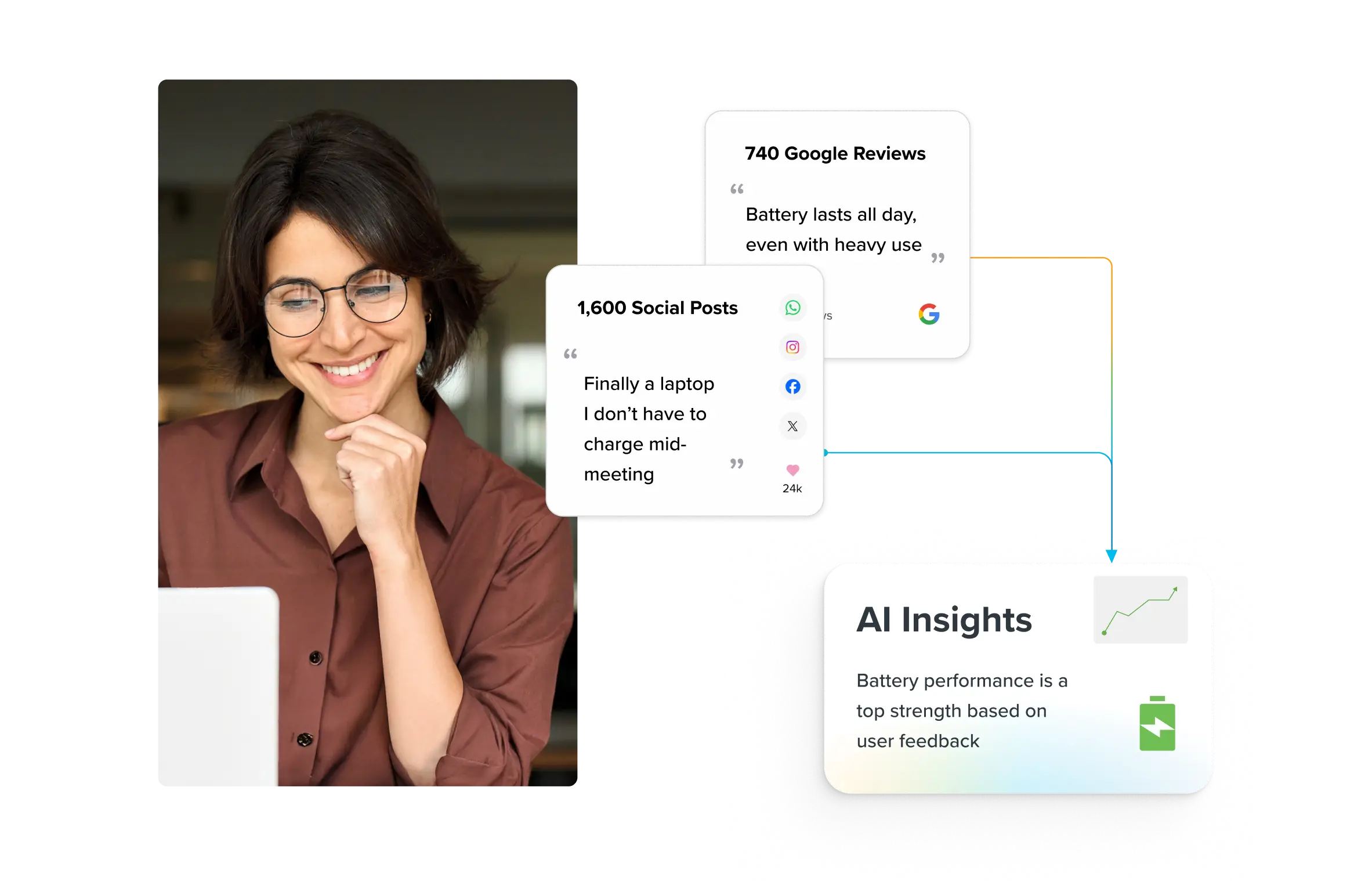
If you want to generate customized reports automatically, Sprinklr’s AI-native social listening captures conversations from 30+ social and digital channels. It then automatically surfaces themes, trends, and anomalies, even from images and videos — that you can analyze, benchmark against rivals, and generate reports, without ever leaving the platform.
Step 5: Leverage the knowledge you've gathered
You can enhance your broader digital strategy by:
- Regularly monitoring brand mentions.
- Gathering insights from your campaigns and social media accounts.
- Observing your brand's sentiment and market presence.
For instance, if you observe that users frequently discuss specific features of your product, it's a good idea to highlight features in your marketing efforts.
How AI supercharges social listening
Social listening used to be a siloed process involving different tools to listen to different channels. Listening would often follow manual data, sentiment, trend, and anomaly analysis before you could finally draw insights and act upon them.
This process looks very different with AI, and for all the good reasons. Now, AI does the data-crunching, leaving you the job you do best: brainstorm, strategize, and act! Here’s how:
- Real‑time sentiment analysis: AI models swiftly gauge positive, negative, or neutral sentiment across millions of posts and surfaces shifting brand mood in seconds
- Advanced topic clustering: Machine learning groups related conversations into Smart Themes, helping you spot emerging trends without manual tagging
- Anomaly detection: AI flags sudden spikes or drops in mentions — crucial for PR crises — letting you notify relevant teams before issues escalate
- Predictive trend forecasting: AI uses deep learning to predict which hashtags or themes will gain traction, enabling proactive campaigns
- Automated response suggestions: Natural language generation crafts draft replies or FAQs, speeding up customer engagement if you use Sprinklr’s Unified Inbox
- Multilingual support: AI translates and analyzes posts in dozens of languages, feeding global insights into Sprinklr Insights dashboards
- Competitor benchmarking: AI compares your share of voice and sentiment against rivals, highlighting where you lead or lag
Future trends in social listening
Here's what we can expect about social listening in 2026:
- As consumer demand for personalization grows, social listening will advance with AI, and big data, allowing brands to analyze the audience in greater detail and understand their unique preferences, behavior, and challenges
- Social listening will expand beyond text and analyze images, and voices, with platforms like Instagram, TikTok, and YouTube, becoming key to capturing consumer sentiment as visual and audio content dominate
- As users shift to niche platforms and private communities, social listening will expand to spaces like Discord, Slack, and specialized forums, uncovering valuable insights from overlooked conversations about consumer and patient experiences
- With advancing technology and ethical challenges, social listening will emphasize transparency and data privacy to ensure compliance with regulations like GDPR and CCPA
Therefore, with these shifts towards deeper insights, multi-format analysis, predictive capabilities, and ethical considerations, brands have to leverage cutting-edge tools to make informed decisions and connect more deeply with their audiences.
And Sprinklr is here to lead your way with advanced AI and big data. Tap into both mainstream and niched platforms to better understand your audience, create personalized engagement, and ensure data privacy and compliance.
Frequently Asked Questions
True. Social listening can indeed help find leads by monitoring industry-relevant keywords, hashtags, or competitor mentions; you can identify potential customers expressing pain points or interest. For example, with Sprinklr Insights, you can set up a Topic to track phrases like “struggling with data security” or mentions of a competitor, then use the Rule Engine to funnel these users into a Profile List — creating a targeted lead segment for outreach or ads! It’s easy and effective.
Start by identifying where your audience actually spends time. To do this, map demographics and past engagement across platforms (e.g., younger users on Instagram/TikTok, pros on LinkedIn). In Sprinklr Insights, you can run a Quick Search on those platforms to see which ones drive the most mentions and sentiment spikes, then expand with Listening Topics on the top 2–3 channels to focus efforts where it matters most.
Social media listening boosts customer advocacy by enabling real-time engagement and data-driven responsiveness, identifying positive mentions to amplify, and detecting issues early to resolve before they escalate. For example, with Sprinklr Insights, you can track an emerging product pain point on X, categorize and prioritize the feedback using AI, then swiftly respond or even launch a proactive fix campaign. That attentiveness transforms satisfied customers into vocal brand advocates.
Chick‑fil‑A used Sprinklr Social Listening to track online reactions when it replaced its Original BBQ sauce. Using Sprinklr, the fast-food chain detected a 923% spike in weekly mentions and 73% negative sentiment, prompting the company to relaunch the sauce with a #BroughtBackTheBBQ campaign. The move led to a 188× surge in mentions and sentiment flipping dramatically to 92% positive.

