




The global leader in enterprise social media management
For over a decade, Sprinklr Social has helped the world’s biggest brands reimagine social media as a growth driver with a unified platform, industry-leading AI and enterprise-grade scale.



Agentic AI in Social Media: Strategy, Impact and Examples
Priyanka Malik is a content marketing professional with over nine years of experience creating content for global B2B SaaS brands. At Sprinklr she writes and strategizes across social media management, social listening, social media analytics and AI-driven social marketing, turning complex topics into clear, practical guidance for marketing and customer experience leaders.
Ankita Srivastava is a Content Editor at Sprinklr who brings four years of experience crafting compelling content across the EdTech, B2B and tech-writing landscapes. She has a real talent for translating complex concepts into clear, engaging prose, the kind that empowers readers with exactly the information they need to succeed.
Agentic AI in Social Media is moving from experimentation to mandate. Unlike traditional AI tools that assist teams, agentic systems operate independently, managing content workflows, optimizing campaigns, and adapting engagement strategies in real time. This shift fundamentally changes how social media is planned, executed, and measured at scale.
For marketing leaders, the value is not speed alone. It is the ability to run social operations that are consistent, adaptive, and measurable without adding complexity or headcount. The challenge lies in making the right strategic choices around adoption, governance, and long-term capability building.
This blog breaks down the agentic AI social media trends worth watching, what they mean for enterprise brands and how practitioners can start using these systems safely and effectively.
What is Agentic AI in social media?
Agentic AI in social media refers to AI systems that work toward defined outcomes by planning and executing multi-step actions across social tools and workflows, with human oversight. Instead of only generating content or answering prompts, agentic systems monitor signals, decide what to do next, act, and validate results against goals.
Agentic AI in social media directly helps with challenges such as:
- Streamlining high-volume tasks that pull teams away from strategy, including scheduling, moderation and routine engagement.
- Reading live audience behavior and adjusting posts or spending without waiting for a human to intervene.
- Consolidating insights from fragmented channels to enable faster, better-context decisions.
- Coordinating multichannel workflows across regions or business units where consistency is hard to maintain.
Most teams start with generative AI to draft captions, rewrite copy, or summarise conversations. Agentic AI builds on that by running the workflow end-to-end: it routes work, applies rules, escalates exceptions, and checks whether actions improved outcomes.
Instead of waiting for prompts, Agentic AI interprets goals, chooses actions, and adapts based on real-time results. That difference matters in enterprise social programs, where success depends on execution at scale, coordination across teams, and consistent performance, not just creative output.
Also read: 5 real-world agentic AI use cases for enterprises
Agentic AI and its impact on social media
Agentic AI systems for social media can interpret goals, coordinate tasks and adapt in real time. They can help your brand optimize its content creation, trend monitoring, social engagement and audience targeting strategies, to name just a few. The following agentic AI social media use cases will showcase the utility of agentic AI in social media:
1. Agentic teamworking
Agentic AI is expected to handle up to 20% of e-commerce-related tasks, from initial discovery to final transaction support. A similar multi-agent execution model is now shaping how social media operations run. Instead of switching between tools or waiting on manual reviews, agents can track performance, adjust schedules and optimize content in the background.
This gives enterprise teams a more reliable workflow that scales without adding operational overhead. Start by identifying where your current process slows down, where approvals are delayed, where repetitive scheduling tasks occur or where analytics insights are delayed. These friction points help you decide which agents should collaborate and where automation will have the greatest impact.
Once you know your friction points, you can start to design coordinated agent roles:
- A listening agent surfaces sentiment shifts and real-time audience analysis.
- A performance agent identifies which formats or posts need adjustment.
- A scheduling agent restructures the calendar as priorities or trends change.
- A governance agent ensures updates stay within brand and compliance rules.
For example, Prada used Sprinklr’s real-time auto-boosting during fashion week to automatically detect high-performing Snapchat posts and boost them instantly. Rather than waiting for manual reviews, Sprinklr’s rules-based system monitored organic engagement, identified spikes and pushed paid support in real time.
This is exactly how Agentic AI works in social media. One agent identifies what is gaining traction, another decides how to respond, and a scheduling or paid agent amplifies it automatically. The result is faster momentum without teams needing to step in at every stage.
2. Agents for everyday social media tasks
Agentic AI proves its value in everyday social media operations. It takes ownership of repeatable work such as scheduling posts, managing queues, identifying early engagement signals, drafting routine responses, and routing low-risk interactions. This frees teams to focus on judgment-driven moments that require human context.
A practical starting point is to identify tasks that consistently consume time, including daily scheduling, story publishing, repetitive replies, and manual trend tracking across platforms. These are clear signals of where task-specific agents can reduce operational load without disrupting existing workflows.
Once identified, you can activate agents to keep day-to-day workflows running smoothly:
- A scheduling agent publishes content across channels at optimal times.
- A curation agent surfaces relevant trends and suggests content ideas.
- An engagement agent handles common questions and routes complex issues to the team.
- A monitoring agent flags spikes in social mentions or sentiment that need attention.
How a global nonprofit organization scaled meaningful social engagement with AI
A global nonprofit organization needed a more unified way to manage high-volume conversations across regions and languages while maintaining a personal touch. Manual workflows made it challenging to maintain consistency and respond quickly to community needs.
With Sprinklr’s Unified-CXM platform, the organization brought all social activity into one system and introduced automation to support everyday engagement. The impact included
- Automated multilingual actions for routine replies and inbox management
- Global calendar visibility that kept publishing consistently across 11 languages
- Real-time oversight of conversations to support coordination during major initiatives
- Prioritized routing for high-need or sensitive messages
- Listening dashboards that improved understanding of audience behavior over time
This shift helped the team maintain meaningful connections at scale while reducing the manual workload behind their social operations.
3. Marketing to AI agents
AI agents are now becoming a new kind of audience themselves. McKinsey estimates that by 2030, AI-driven agentic commerce could influence between $900 billion and $1 trillion in US retail activity and $3-5 trillion worldwide. As more platforms introduce agentic experiences that shape search, recommendations and purchasing, social content needs to be optimized so these systems can parse it, trust it and act on it.
Start by identifying where your content gets surfaced or evaluated by AI systems: recommended posts, social commerce feeds, automated product matches or platform-native assistants. These touchpoints show where better content signals will improve visibility.
Once mapped, you can strengthen your content for AI-driven interpretation:
- Add clear product attributes, specs and price details in captions and alt text.
- Use consistent naming for products and campaigns so AI systems can classify them.
- Include trust markers such as reviews, certifications or verified tags.
- Keep visuals clean and descriptive so vision-based AI can detect items accurately.
- Ensure landing pages and linked assets match the promises made in the post.
For example, Amazon’s agentic systems, such as Rufus, Help Me Decide and Buy for Me, evaluate product signals, descriptions, reviews, visuals and trust markers before recommending or purchasing items on behalf of customers. If information is unclear, incomplete or inconsistent, the agents deprioritize the product. This shift mirrors what social teams must prepare for: posts that are structured so AI systems can confidently interpret value, verify details and surface the right content at the right moment.
4. AI Agents as engagement companions
AI agents are becoming proactive partners in engagement. Instead of waiting for comments or questions, these agents read context, understand intent and deliver guidance or content in a way that feels timely and relevant.
Start by identifying repeatable interaction patterns, common questions, recurring feedback or signals that indicate when a user might need help. These patterns reveal the exact moments where engagement agents can step in proactively.
Once you map those touchpoints, you can deploy agents that elevate day-to-day engagement:
- Agents that detect sentiment and adjust responses accordingly.
- Agents that surface relevant content or recommendations based on user intent.
- Agents that route complex or sensitive messages to the right team instantly.
- Agents that personalize tone and language for different audience segments.
- Agents that learn from historical interactions to improve future responses.
For example, Booking.com used Sprinklr’s AI-powered comment moderation to analyze TikTok conversations in real time, detect sentiment, understand user intent and route messages to the right team for personalized responses. During a single 60-day period, agents identified over 2,000 engageable comments, responded faster to travelers and saved more than 17 hours of manual moderation.
This is precisely how companion-style agents operate: interpreting context, initiating the right action and keeping engagement moving without waiting for a human to intervene.
5. Predictive content optimization agents
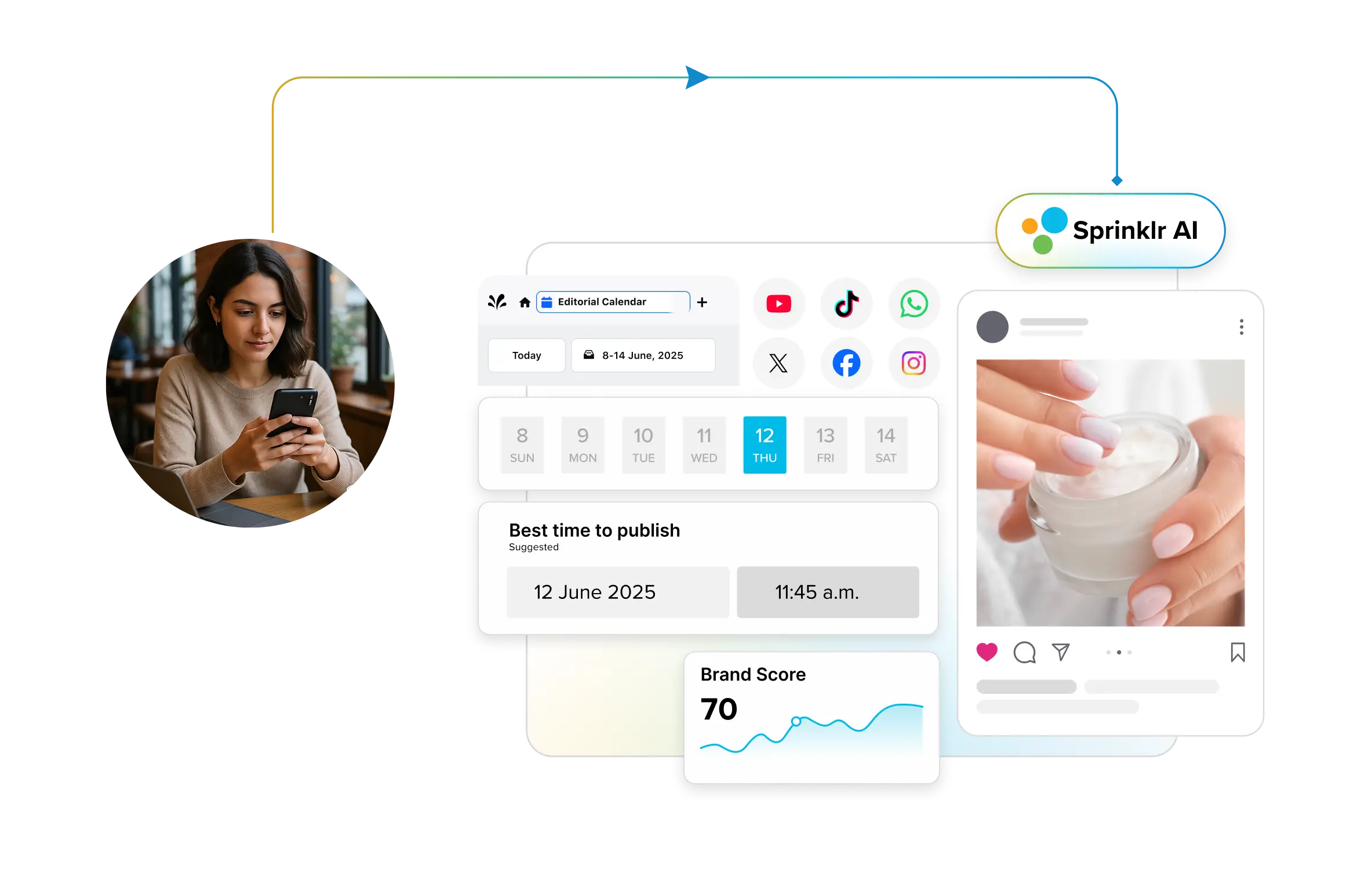
Predictive agents help social teams decide what to publish next by analyzing historic performance, audience behavior, seasonal patterns and real-time signals across platforms. Instead of relying on manual reviews or guesswork, these agents forecast which formats, hooks, posting times or creative angles are most likely to perform and then recommend or auto-adjust campaigns accordingly.
Start by identifying the variables that influence performance on your channels: creative formats, trending conversations, timing windows, influencer inputs or region-specific behaviors. This gives the agent the parameters it needs to predict what will resonate.
Once configured, predictive agents can optimize content decisions end-to-end:
- Recommend formats (e.g., reels vs. carousels) based on real-time shifts in platform preferences.
- Identify underperforming posts and suggest tweaks before publishing.
- Predict the best posting windows using multi-channel behavioral signals.
- Surface long-tail themes that audiences are likely to engage with next week or next month.
- Suggest creators or UGC likely to outperform based on category trends.
How Capital University boosted social performance with unified scheduling and AI-driven insights
Capital University needed a more consistent, data-driven way to manage its multi-channel social presence. With multiple accounts and limited staff, posting natively made it challenging to publish at the right times, keep campaigns aligned and understand what content resonated across platforms.
By moving to Sprinklr Social, the university brought scheduling, publishing and analytics into one system and introduced AI-powered recommendations to guide daily execution. The impact included:
- Unified scheduling across Instagram, TikTok, Facebook and X with optimal-time recommendations
- Real-time dashboards that showed which formats performed best on each platform
- Multi-channel publishing from a single calendar for consistent execution
- Faster decision-making with integrated insights that shaped ongoing content strategy
This AI-guided workflow helped the university accelerate engagement, including a 164% increase on TikTok, while maintaining a coordinated, data-driven social presence.
How to implement agentic AI in your social media workflow
The AI agent market is projected to grow by 45% annually over the next five years, according to a BCG study. Rolling out agentic AI in social media layers intelligent automation into the slowest parts of your workflow, so the system learns your tone, content patterns and processes over time. Here is how to implement it:
Step 1: Pick the right tasks to automate first
Begin by auditing your workflow week by week. Track where work piles up, where approvals stall and which activities your team repeats without variation. Then translate those tasks into clear instructions your agent can follow.
For example, define how you usually schedule posts, what qualifies as a “routine” engagement reply and how your team repurposes content for each platform. This turns inconsistent human habits into predictable rules that the agent can execute.
Step 2: Connect your data sources
Integrate your social channels, listening feeds and analytics tools into a single platform so the agent doesn’t have to work with fragmented signals. Import brand guidelines, tone rules and content templates so the agent knows how to behave when acting on your behalf.
As you connect each source, test how the agent reads that data, run small simulations to confirm its interpreting sentiment, timing patterns and audience segments correctly before expanding its scope.
Step 3: Set goals and guardrails
Translate your brand standards into machine-readable rules.
- For tone, feed the agent examples of approved copy and rejected copy so it learns the boundary.
- For escalation, define precise triggers, such as keywords, emotional cues or account types, that should stop automation and alert a human.
- For governance, map which tasks require approval each time and which the agent can execute once thresholds are met.
Step 4: Start with semi-autonomous mode
Deploy the agent into your workflow but keep it in a recommend-and-review loop. Let it propose scheduling changes, draft replies or surface content ideas, then review its reasoning before you approve or decline the action.
Each approval trains the model on what “good” looks like; each correction shows it where it misunderstood your expectations. This phase is about shaping its decision-making, not testing its creativity.
Step 5: Move to autonomy with monitoring
Shift the agent into controlled autonomy by allowing it to act when certain conditions are met. For example, permit it to optimize timing when predicted engagement crosses a threshold or to respond to low-risk comments that fit strict patterns.
Maintain oversight by conducting weekly audits of what the agent did, why it made those choices and where its logic needs fine-tuning. Use feedback loops to continuously retrain tone, escalation paths and performance definitions so the agent grows more accurate over time.
Examples of Agentic AI in action
Agentic AI is already moving from theory to real-world impact. These Agentic AI social media use cases and examples show how agents can manage operational workflows end to end:
1. DHL: Automating high-volume operational communication with agentic AI
DHL Supply Chain partnered with HappyRobot to deploy agentic AI that autonomously manages appointment scheduling, driver follow-up calls and high-priority warehouse coordination. The agents handle phone and email interactions at scale, processing hundreds of thousands of messages and millions of voice minutes annually.
By offloading these communication workflows, DHL increased responsiveness, improved consistency and freed teams to focus on exceptions and higher-value operational decisions, demonstrating how agentic systems can run complex, time-sensitive tasks reliably in the background.
2. AES: Automating safety audits with synchronized AI agents (verified source)
AES deployed agentic AI using Anthropic’s Claude models on Google Cloud’s Vertex AI to overhaul its safety audit process. Agents now review up to 400 pages of documentation, synchronize tasks and deliver audit results in about one hour instead of 14 days.
By automating document analysis, cross-language reviews and accuracy checks, AES reduced audit costs by 99% and doubled annual audit capacity. Human reviewers now focus only on exception handling, while agents manage the core workflow end to end.
3. Mastercard: Enabling secure, AI-driven agentic payments
Mastercard introduced Mastercard Agent Pay, an infrastructure designed to support secure, scalable, AI-driven agentic transactions. As consumers shift from traditional search to AI-led product discovery, Mastercard’s system authenticates registered agents, verifies intent and processes payments using network tokens and biometric consent.
The framework standardizes how agents interpret data, initiate orders and complete transactions safely. This is a replicable blueprint for social platforms where agentic systems may soon handle product discovery, checkout flows and service interactions autonomously.
The above examples should prompt your enterprise to decide whether to invest in a specialized agentic AI platform or build its own system from the ground up. Let’s look at the pros and cons of both options.
Should you build your own agentic AI system or use a platform?
Deciding whether to build or buy comes down to your operational maturity, internal AI expertise and how quickly you need results. Agentic AI is powerful, but it’s also infrastructure-heavy, meaning your approach should balance speed, risk, customization and long-term sustainability. Here’s how to think about both paths:
1. Building Your Own Agentic AI
Building in-house gives you maximum control, but it’s also the slowest and most resource-intensive option. Teams that choose this route usually have large AI engineering groups, strong data governance and systems already built around proprietary workflows.
Pros | Cons |
Full ownership of how agents reason, act and integrate into internal tools, no platform constraints. | High upfront investment in model training orchestration logic, data pipelines and security layers. |
Ability to fine-tune models based on niche workflows or sensitive, domain-specific logic. | Long development cycles; maintaining production-grade agents requires continuous monitoring and retraining. |
Long-term flexibility if the company plans to build AI as a core competitive differentiator. | Higher operational risk: every guardrail, escalation rule and compliance mechanism must be built manually. |
2. Using Agentic AI platforms (faster and practical for most brands)
Enterprise social teams adopt platform-based Agentic AI to simplify complex operations. Platforms coordinate AI agents across detection, decision-making, and execution, handling tasks such as scheduling, paid campaigns, and moderation while managing governance, safety, integrations, and ongoing monitoring. This allows teams to focus on driving performance and consistency instead of managing systems.
Pros | Cons |
Faster implementation; teams can activate agents in days and scale across channels without custom engineering. | Customization is constrained to platform-supported patterns rather than complete model rewiring. |
Built-in governance, tone controls, security and escalation logic significantly reduce compliance risk. | Dependency on the platform’s roadmap for advanced use cases or edge-case logic. |
Access to continuous improvements, new agent capabilities, better models and integrations roll out automatically. | May require adjusting internal workflows to align with how the platform structures tasks and data. |
Navigating the agentic AI landscape in 2026
Agentic AI is pushing social media into a very different gear, one where teams aren’t scrambling to keep up with volume, trends or channel shifts. The patterns are already clear: agents that collaborate, systems that adjust content in real time, workflows that predict what will perform and engagement tools that respond with context rather than canned lines. Together, these trends signal a 2026 in which social teams can finally focus on strategy rather than firefighting.
If you’re leading a social program, this is the moment to start experimenting. Add agents into low-risk workflows, define your guardrails and measure everything: engagement lifts, response accuracy, workload reduction, and the speed at which campaigns move. Those early wins build confidence, which is exactly what teams need before scaling automation across channels and markets.
Sprinklr Social offers an accelerated path forward by combining unified data, multi-agent orchestration and enterprise-grade governance in a single environment. If you’re planning your 2026 roadmap and want to see how agentic systems can elevate your social strategy, book a demo and explore what these capabilities look like in practice.
Frequently Asked Questions
To identify emerging social media trends, AI agents scan listening feeds, comments, hashtags and competitor channels to catch unusual spikes or shifts. When patterns repeat across multiple sources, they alert you with a short explanation of what changed and why it matters.
Yes. They analyze each segment’s preferred formats, tone and engagement behavior, then generate variations that match those patterns. Over time, they can also refine recommendations based on what each segment consistently interacts with.
Agents route messages to the right teams and attach the relevant context, so no one starts blind. They also share insights and campaign updates across departments, keeping creative, care and analytics aligned without manual coordination for cross-team collaboration.
Brands should keep the following ethical considerations in mind while using AI agents:
· Be clear about how data is collected, stored and used, especially in sensitive contexts.
· Define which situations must escalate to humans and ensure the agent follows that path.
· Maintain transparency so users know when they’re interacting with an AI system.
Agents can help optimize posting schedules by evaluating past performance, audience activity and platform behavior to pinpoint high-impact posting times. They can also automatically adjust schedules when patterns shift, ensuring timing always matches real engagement.
Yes. Agents track competitor social activity, themes and engagement spikes to highlight what’s working for them. They turn those signals into practical takeaways your team can use for timing, content direction and positioning.
Priyanka Malik is a content marketing professional with over nine years of experience creating content for global B2B SaaS brands. At Sprinklr she writes and strategizes across social media management, social listening, social media analytics and AI-driven social marketing, turning complex topics into clear, practical guidance for marketing and customer experience leaders.
Ankita Srivastava is a Content Editor at Sprinklr who brings four years of experience crafting compelling content across the EdTech, B2B and tech-writing landscapes. She has a real talent for translating complex concepts into clear, engaging prose, the kind that empowers readers with exactly the information they need to succeed.