





Transform CX with AI at the core of every interaction
Unify fragmented interactions across 30+ voice, social and digital channels with an AI-native customer experience platform. Deliver consistent, extraordinary brand experiences at scale.




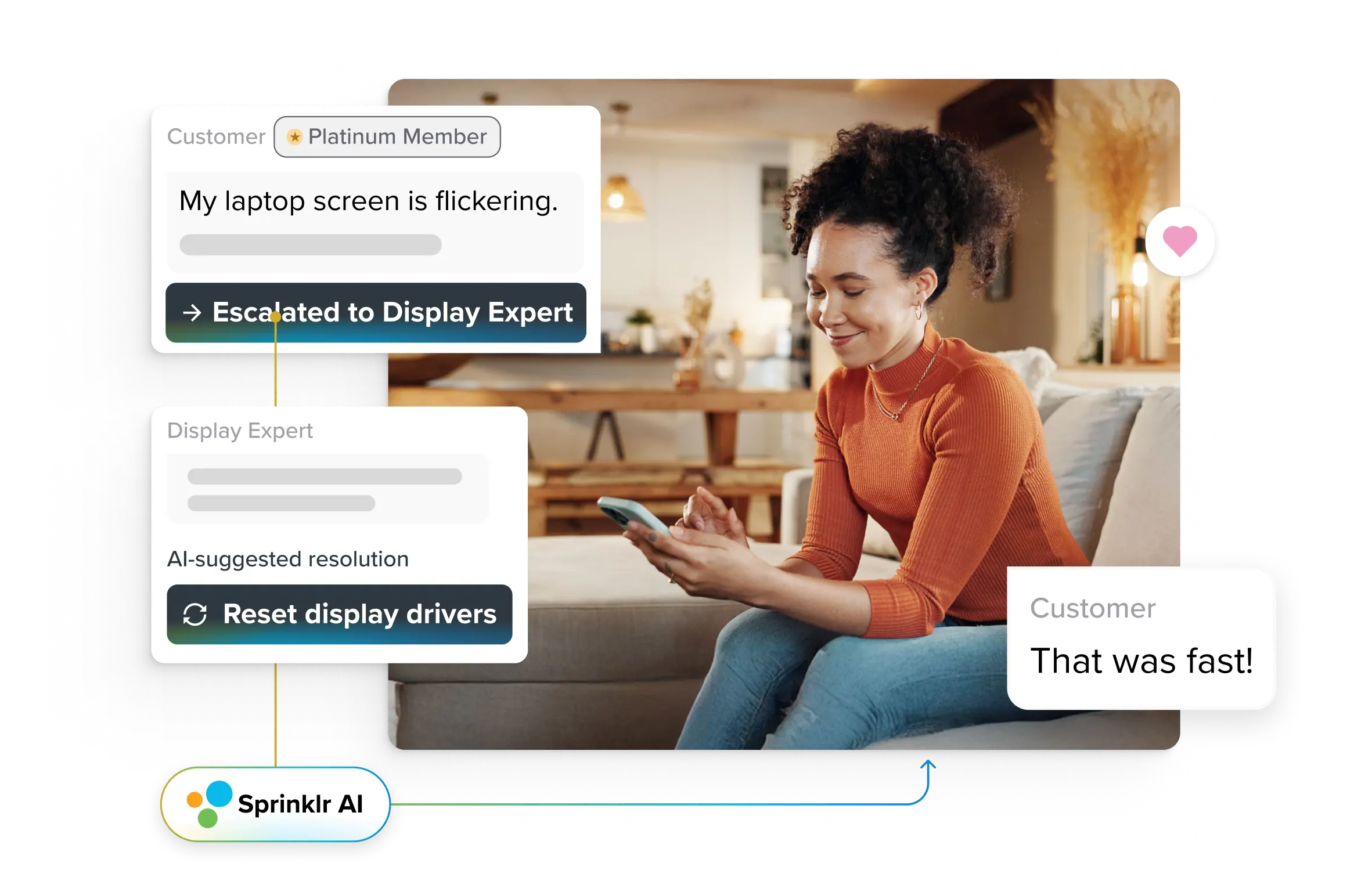
Autonomous AI Agents: The Next Layer of Intelligence

Autonomous AI Agents are emerging as the next evolution of enterprise automation and a practical enabler of scaled customer experience. As service operations grow more complex and customer expectations continue to fragment across channels, traditional automation struggles to keep pace with real-world variability.
Autonomous agents address this gap by combining contextual reasoning, decision-making, and system-level orchestration. For CX, IT, and digital transformation leaders, the implications extend beyond efficiency into how work is designed, governed, and continuously optimized.
This blog examines how autonomous AI agents differ from prior automation approaches, where they deliver measurable value in customer service and CX, and what enterprise leaders must consider across architecture, governance, onboarding, and performance monitoring to deploy them responsibly at scale.
What are autonomous AI agents and how do they work?
Autonomous AI agents are goal-driven systems designed to operate continuously in dynamic, real-world environments. Unlike traditional AI applications that respond to discrete prompts, these agents are built to assess situations, determine next actions, execute tasks, and evaluate outcomes with minimal human intervention.
At a systems level, autonomous agents combine large language models with several critical components: planning and execution logic, persistent memory, policy constraints, access to tools and interfaces, and continuous feedback mechanisms. Together, these elements allow the agent to maintain context over time, reason about trade-offs, and adapt its behavior as conditions change.
In practice, autonomous AI agents operate through a closed-loop process:
- Perception: The agent ingests signals from multiple sources such as CRM platforms, support tickets, social channels, customer communications, and product usage data, and translates them into a structured view of the current state.
- Reasoning and planning: It evaluates this state against defined objectives, constraints, and risk thresholds, generates possible courses of action, and selects an execution plan.
- Action and validation: The agent executes tasks across systems in real-time, responding to customers, routing issues, updating records, or triggering workflows — then verifies whether the outcome aligns with the intended goal.
- Learning and adjustment: Results are fed back into the agent’s memory and evaluation layer, informing future decisions, and reducing repeated errors.
This is where confusion often arises. Many organizations already use generative AI, and some are experimenting with agentic patterns, but both are frequently labeled as “agents.” The practical distinction lies in autonomy: how much independent decision-making, execution, and outcome validation the system is explicitly designed and governed to perform.
🔖 Essential read: Agentic AI vs. AI Agents: Know the Critical Gap
Generative AI vs. Agentic AI vs autonomous AI agents
| |
| |
| |
| |
🔖 Deep dive: How AI Agents Are Ushering in a New Era of Automation
Autonomous AI agent types enterprises must know
Autonomous AI agents are not monolithic. In enterprise environments (particularly in customer service and customer experience), they are deployed in distinct forms, each designed for a specific decision scope and operational risk profile. Understanding these differences is critical for scaling autonomy responsibly.
1. Task-level autonomous agents
These agents operate at the execution layer. They are designed to complete well-defined tasks end-to-end, such as resolving a billing query, updating customer records, or classifying and routing service requests.
They exercise autonomy within a narrow scope, making them easier to govern and ideal entry points for enterprises adopting agent-based systems. In CX operations, task-level agents often replace brittle workflows that fail when inputs vary.
Best suited for: High-volume, repeatable service operations
Risk profile: Low to moderate
2. Workflow-orchestrating agents
Workflow agents coordinate multiple tasks across systems, tools, or teams. Rather than executing a single action, they determine sequencing, dependencies, and escalation paths, adjusting dynamically as conditions change.
In customer service, these agents manage cross-channel journeys: coordinating CRM updates, knowledge retrieval, follow-ups, and handoffs between bots and human agents. Their value lies in reducing friction across fragmented systems.
Best suited for: Complex CX workflows spanning multiple platforms
Risk profile: Moderate
3. Decision-support autonomous agents
These agents focus on analysis, prioritization, and recommendation often operating alongside human teams. They continuously evaluate signals such as customer sentiment, operational load, SLA risk, or churn indicators and propose actions in real-time.
While they may not always execute changes directly, they influence high-impact decisions at speed and scale. In practice, many enterprises deploy these agents with “human-on-the-loop” oversight.
Best suited for: Supervisory, QA, and service leadership functions
Risk profile: Moderate to high
4. Goal-driven autonomous agents
Goal-driven agents operate with the highest degree of autonomy. They are assigned business objectives, such as reducing repeat contacts or improving resolution time, and are empowered to plan, execute, and adjust strategies over extended periods.
These agents often span multiple workflows and systems, making governance, observability, and constraint design essential. When deployed well, they fundamentally change how CX operations are optimized.
Best suited for: Outcome ownership across CX domains
Risk profile: High (requires mature controls)
📌Editor’s Pick: AI Agents in the Enterprise: Types, Use Cases and How to Choose the Right One
Real-world use cases of autonomous AI agents across the enterprise
Across enterprise functions, autonomous AI agents are being deployed to absorb operational complexity scaling execution, reducing friction, and responding to customers and market signals in real-time without linear increases in headcount.
Real-time customer service
Real-time customer service breaks down when interaction volumes spike, channels fragment, and human teams are forced to make rapid decisions with incomplete context. At that point, the challenge is no longer speed alone — it is maintaining accuracy, consistency, and judgment at scale, across every customer interaction.
This shift is changing how enterprises think about trust and control. For example, enterprises now show growing confidence in AI systems operating with bounded autonomy in customer-facing scenarios, particularly where clear constraints, observability, and escalation mechanisms are in place.
Autonomous AI agents enable real-time customer service by:
- Continuously monitoring conversations across customer service channels, maintaining state, classifying intent and urgency, and routing cases without manual intervention.
- Generating context-aware summaries and responses, validating outcomes using resolution and sentiment signals, and adjusting actions dynamically.
- Escalating selectively when confidence thresholds, risk limits, or policy constraints are breached allowing human agents to focus on complex or high-impact interactions.
This approach is already delivering measurable outcomes. A leading Latin American bank modernized its digital customer care operations by moving away from fragmented community management tools toward an AI-driven service model.
Facing limited visibility and manual workflows across seven social and messaging channels, the bank deployed autonomous agents to categorize, route, and manage cases in real time. The result was 100% AI-led categorization across more than 114,000 annual cases, a 50% reduction in first-response time, an NPS of 81.29, and an average resolution time of just over 21 minutes.
The key lesson is not automation alone, but controlled autonomy, where agents own execution within defined boundaries and humans intervene only when judgment truly adds value.
🔖 Don’t miss: Agentic AI in Customer Service: Your Next Advantage
Autonomous social media operations
Traditional social media management tools rely heavily on manual triage and predefined workflows, making it difficult to respond consistently at scale, especially during spikes driven by campaigns, incidents, or breaking events.
Autonomous AI agents are increasingly being deployed to manage social operations as a continuous, real-time system rather than a reactive queue. Their role is not content creation at will, but intelligent orchestration across monitoring, response, and risk management.
In practice, autonomous agents enable social media operations by:
- Continuously monitoring brand mentions, comments, and direct messages across platforms, maintaining state across conversations, and detecting sentiment, urgency, and escalation risk.
- Identifying emerging patterns such as coordinated complaints, reputational threats, or product issues, and escalating them early to CX, PR, or risk teams.
- Validating outcomes based on engagement signals, sentiment shifts, and resolution indicators, and adjusting response strategies in near real-time.
Crucially, effective deployments pair autonomy with explicit governance. Brand tone, regulatory constraints, and escalation thresholds are encoded as policies, while observability layers ensure that actions are traceable and auditable.
Enterprises using autonomous agents in social operations report faster response times, reduced manual moderation effort, and earlier detection of systemic issues without relinquishing control over brand voice or public accountability.
Marketing optimization
Marketing operations tend to break down when speed outpaces coordination. Campaigns span channels, audiences fragment, and performance signals evolve faster than centralized teams can interpret and act on them. The resulting delay between insight, decision, and execution often leads to wasted spend and declining relevance.
This is why marketing has emerged as an early enterprise proving ground for autonomous AI agents.
Autonomous AI agents optimize marketing performance by:
- Continuously analyzing performance signals across channels and maintaining state across campaigns, audiences, and time horizons.
- Dynamically adjusting targeting, bids, and budget allocation within predefined constraints, without waiting for manual reviews.
- Testing and rotating creative variants at scale, learning which messages resonate with specific segments, and retiring underperforming assets.
- Recommending or executing campaign shifts based on ROI trends, saturation signals, and emerging opportunities while escalating only when thresholds are breached
In mature deployments, autonomy is deliberately bounded. Strategic intent, brand constraints, and budget limits remain human-defined, while agents' own execution and optimization occur within those parameters. The result is not faster marketing alone, but marketing systems that adapt continuously rather than episodically.
Voice of customer (VOC) intelligence agents
Most enterprises already collect vast volumes of customer feedback, yet only a small fraction of that input shapes real decisions. Voice calls, live chats, reviews, and social conversations accumulate faster than teams can analyze them, leaving critical signals buried in transcripts, dashboards, and quarterly reports.
The challenge is no longer listening; it is converting unstructured customer voice into continuous, enterprise-wide intelligence that influences action. This is why Voice of Customer (VoC) intelligence is gaining momentum as a strategic capability, not just a CX metric.
Autonomous VoC intelligence agents move beyond analysis by:
- Continuously interpreting voice and text interactions to detect customer sentiment shifts, intent changes, and emerging issues in near real-time.
- Correlating signals across channels, customer journeys, and time horizons to surface systemic friction points or early indicators of operational risk.
- Translating insights directly into downstream actions, triggering workflow adjustments, prioritizing product or policy fixes, or escalating issues before they materialize at scale.
🔥Currently Trending: VoC Templates to Help You Capture, Classify, and Act on Customer Signals
Governance and compliance
In fast-moving, automated environments, issues are often discovered only after policy violations have propagated across systems, data quality has degraded, or compliance gaps have escalated into regulatory exposure.
The challenge is not a lack of rules. Instead, it is the inability to enforce them continuously at scale. As enterprises deploy autonomous systems that act in real-time, governance must shift from retrospective oversight to in-line control. Autonomous AI agents are increasingly being used to enable that shift.
In practice, autonomous agents support governance and compliance by:
- Continuously monitoring operations, data flows, and system interactions against defined policies, regulatory requirements, and risk thresholds.
- Detecting anomalies, drift, or deviations early — before they cascade into service failures, data integrity issues, or compliance breaches.
- Enforcing quality and policy constraints directly, by blocking actions outside permitted boundaries, triggering corrective workflows, or escalating exceptions when limits are crossed.
- Generating continuous, auditable records of decisions and actions, reducing reliance on after-the-fact audits and manual evidence collection.
Sprinklr’s continued commitment to responsible AI: Crafting stellar customer experiences with robust governance.
Should you develop autonomous AI agents in-house?
With these use cases, many enterprises with strong in-house technology teams may assume they can build autonomous AI agents internally.That assumption deserves a closer look, because autonomy at enterprise scale is less about experimentation and more about operational reliability.
Approach | What it involves | What enterprises must be prepared for |
Building agents internally | Designing custom agents tailored to proprietary workflows, data models, and systems. | Requires more than model development. You must build and operate large-scale data pipelines, planning and reasoning engines, tool and UI integrations, continuous testing frameworks, supervision and override mechanisms, auditability, security controls, and governance layers — then maintain them as models, regulations, and business conditions evolve. |
Deploying pre-built autonomous agents designed for insights, workflows, and customer experience at scale. | Shifts effort from infrastructure engineering to configuration: defining objectives, constraints, escalation rules, and success metrics. Enterprises trade deep customization for faster deployment, embedded governance, and lower operational risk. |
In practice, most organizations benefit from a hybrid approach. Core autonomy infrastructure — planning loops, observability, compliance controls — is sourced from platforms, while differentiation is applied at the use-case and policy layer. This allows you to move faster without assuming responsibility for every failure mode introduced by autonomy.
The key question is not whether you can build autonomous agents in-house, but whether you should, given the long-term cost of owning reliability, risk, and accountability at scale.
Embrace autonomy, measure impact and scale into the league of leaders
Beyond a point, adding more AI does not increase productivity. It often does the opposite by layering prompts, tools, and decisions onto already complex workflows, accelerating cognitive overload and burnout.
That reality is precisely what enterprise leaders must confront next. The goal is not more AI. The goal is to achieve the right level of autonomy, applied where it removes friction rather than adds to it.
Sprinklr’s AI agents are built with this balance in mind. They are customizable from the ground up to align with your enterprise workflows, brand tone, and operating standards, ensuring consistency while freeing human teams from repetitive, manual work.
These agents are also designed to cut through the chaos many professionals experience with Generative AI, where productivity stalls as users chase the perfect prompt. With built-in governance and control guardrails, Sprinklr’s autonomous AI agents are engineered for global customer-obsessed enterprises that need to scale confidently from day one.
Get a free demo and let a Sprinklr specialist walk you through a personalized product walkthrough so that you can make a measured, informed decision on your path to autonomy.
Frequently Asked Questions
Autonomous AI agents shift workforce planning from headcount scaling to skill optimization. Routine triage, classification and response handling move to AI, allowing human agents to focus on complex, high-impact interactions. This reduces burnout, improves agent productivity, and helps organizations plan teams around expertise rather than volume.
They are well-suited for global environments when designed with language models, governance controls, and regional policies in mind. Autonomous AI agents can handle multilingual interactions at scale, apply localized rules and escalate region-specific cases appropriately, ensuring consistent service across markets.
Yes. Autonomous AI agents can continuously monitor interactions, workflows, and data usage against defined policies and regulatory rules. They flag anomalies, enforce quality thresholds, and create audit trails in real time, reducing reliance on periodic audits and lowering compliance risk.
Executives should look beyond speed and automation rates. Key metrics include resolution accuracy, escalation quality, customer satisfaction scores, cost per interaction, exception rates, and the frequency of human intervention. Together, these indicators show whether autonomy is improving outcomes or adding complexity.
By responding more quickly, maintaining a consistent tone and resolving issues accurately across all channels, autonomous AI agents reduce friction in customer journeys. Over time, this leads to higher satisfaction, stronger trust, and improved retention, particularly in moments when delays or errors would otherwise erode loyalty.