





Elevate CX with unified, enterprise-grade listening
Sprinklr Insights gives you real-time consumer, competitor and market intelligence from 30+ channels without the noise. Make smarter decisions, strengthen your brand, and stay relentlessly customer-led.



11 Best Sentiment Analysis Tools for 2026
Aishwarya Suresh is an experienced content writer specializing in social media management, social listening, social analytics, Voice of the Customer (VoC) and customer experience. She writes practical, research-backed guides that help brands understand customer conversations, measure social media performance and turn insights into meaningful business decisions.
Karishma Borkakoty is a senior content marketer who lives and breathes long-form content in the form of eBooks, whitepapers and thought-leadership guides people actually bookmark and come back to. She has a knack for taking a big, messy topic and turning it into something genuinely useful and easy to follow.
Sentiment analysis tools act as your brand’s emotional radar, they sense and interpret the feelings behind customer interactions, helping you navigate the social media landscape with clearer insight.
We can’t stress this enough: today’s business world runs on emotions. If you’re not tracking how your customers feel, you’re missing out on valuable customer insights. Whether its customers gushing over your products or venting about a bad experience, there’s a wealth of qualitative data being shared across social media, reviews and forums.
Brands that act on real-time sentiment see up to 15% higher customer retention and cut crisis response time by as much as 60%, which is why 91% of top-performing companies now track sentiment as it happens.
The catch is that these tools are not interchangeable. Some are built for social and brand intelligence, others for survey and VoC feedback, and others for raw text analytics and NLP. This guide sorts the best sentiment analysis tools by what matters most: what you are trying to understand, and which tool is genuinely built for it.
- What are sentiment analysis tools?
- How do sentiment analysis tools work?
- Why is customer sentiment analysis becoming essential for organizations?
- Best sentiment analysis tools for social media and brand intelligence
- Best sentiment analysis tools for customer feedback and VoC
- Best sentiment analysis tools for text analytics and NLP
- Which sentiment analysis tool is best for your business?
- Final thoughts
What are sentiment analysis tools?
Sentiment analysis tools are software that uses artificial intelligence (AI), natural language processing (NLP) and machine learning to identify and interpret the sentiment expressed in text. They typically classify opinions as positive, negative, or neutral on text, like social posts, reviews, survey responses, and support tickets. More advanced tools can pick up on tone, sarcasm, and specific complaints or praise, so you understand not just that someone is unhappy but what they are unhappy about.
In practice, that means turning thousands of scattered, unstructured opinions into something you can actually act on. Instead of manually reading feedback one comment at a time, a sentiment analysis software surfaces patterns across all of it: a spike in frustration after a product update, rising positive sentiment during a campaign, or a recurring gripe about shipping. Most tools also track how sentiment shifts over time and can alert you the moment it moves in the wrong direction, which is what makes them useful for everything from customer care to brand reputation to product decisions.
For example, consider a customer saying, “The new features are great, but the app takes forever to load.” A basic sentiment model might classify the overall comment as negative or mixed. A more sophisticated tool can go further, recognizing positive sentiment toward the features and negative sentiment toward performance. This type of aspect-based sentiment analysis gives teams more actionable context than a single positive or negative label.
How do sentiment analysis tools work?
Most sentiment analysis tools process text using NLP and machine learning models. Depending on the platform, they may analyze individual sentences, entire documents, or sentiment toward specific entities and topics.
The output can range from a simple sentiment label to more detailed analysis, such as:
- Polarity: Positive, negative, or neutral sentiment
- Sentiment intensity: How strongly a sentiment is expressed
- Emotion: Feelings such as anger, joy, sadness, or frustration
- Aspect-based sentiment: Sentiment toward a specific product feature, service attribute, or topic
- Trend analysis: How sentiment changes over time or across customer segments
The right level of analysis depends on the business problem. A brand team monitoring a product launch may care about overall sentiment and emerging issues, while a customer experience team may need to know exactly which part of the customer journey is driving frustration.
Also read: A Complete Guide on Social Media Sentiment Analysis
Modern models reach roughly 85-90% accuracy on clear text, close to a trained human analyst, but accuracy drops on sarcasm, slang, mixed emotions, and non-English content. That's why the strongest tools add context-aware or aspect-based models and let you correct or retrain your own data. Treat sentiment scores as a strong directional signal, not an exact truth, and check accuracy on the languages and channels that matter most to you before committing.
Why is customer sentiment analysis becoming essential for organizations?
For most of the last decade, sentiment analysis was a quarterly report someone skimmed and filed away. That has changed. Customer opinions now form and spread faster than any team can read manually, and the cost of missing them has become concrete. The sentiment analysis market is projected to reach $9.4 billion by 2030, growing at roughly 14% a year, precisely because organizations can no longer afford to guess how customers feel.
Two shifts explain the urgency:
- First, AI made it reliable at scale: modern customer sentiment models now hit 85-90% accuracy, on par with trained human analysts, while processing feedback at 400x the speed of manual review.
- Second, the business impact is now measurable rather than theoretical. The question for most organizations is no longer whether to analyze sentiment, but how quickly they can act on it.
Here is where it earns its keep:
Value area | What it lets you do |
Reputation management | Catch a negative spike while it's 50 angry posts, not 5,000. Teams get early warning on emerging issues before they hit mainstream coverage. |
Customer experience | See the why behind a falling CSAT, pinpointing recurring pain points across reviews, tickets, and social, instead of guessing. |
Product and service feedback | Turn scattered opinions into a priority list, surfacing what customers consistently praise, criticize, or ask for next. |
Campaign and messaging | Know how a launch actually landed within hours, tracking audience reaction to campaigns, offers, and brand messaging in real time. |
Here’s How to Measure Brand Sentiment (With Real-World Insights)
Best sentiment analysis tools for social media and brand intelligence
Social and brand intelligence is where sentiment analysis gets tested hardest. The conversations are messy, fast, sarcastic, multilingual, and spread across platforms you don't control. A single product misstep can turn into a trending complaint. The challenge is not just detecting sentiment, but detecting it accurately, at scale, and early enough to act. It also becomes valuable when you need to understand more than how many people are talking about your brand — what people are saying, how they feel about it, what is driving that sentiment, and whether the conversation is changing.
That requires more than a sentiment score. The strongest platforms combine sentiment analysis with social listening, topic and trend detection, competitive intelligence, visual listening, alerts, and AI-assisted analysis. They pull unstructured mentions across social, news, forums, blogs, and review sites, then classify tone, surface emerging themes, and flag the shifts that actually matter.
These platforms are best suited to organizations that monitor large volumes of conversation across brands, markets, products, and audiences. Here are four worth considering:
Sprinklr Insights
Sprinklr Insights is an AI-powered consumer intelligence platform built for enterprise teams that need to understand not just what customers are saying, but how they feel and why that sentiment is shifting. Rather than treating sentiment as a simple positive-negative-neutral tag, it reads emotion in context across social, news, forums, blogs, and review sites; turning unstructured feedback into signals teams can act on. Its social listening capabilities bring together data from 30+ social and digital channels, 400,000+ media sources, and 1 billion+ websites and review sites, alongside the ability to ingest owned data.
The accuracy advantage comes from how the AI is trained and how far it reaches. Sprinklr's sentiment model reads messages in context to extract opinion and supports sentiment detection across 100+ languages out of 160+ it recognizes, so global brands read regional tone and slang instead of forcing everything through an English-first lens. Through its AI+ layer, built on 1,250+ industry-specific models, it captures the nuances that break basic tools, including sarcasm and mixed emotions, and lets teams build and validate custom sentiment models in AI Studio tuned to their own industry and terminology.
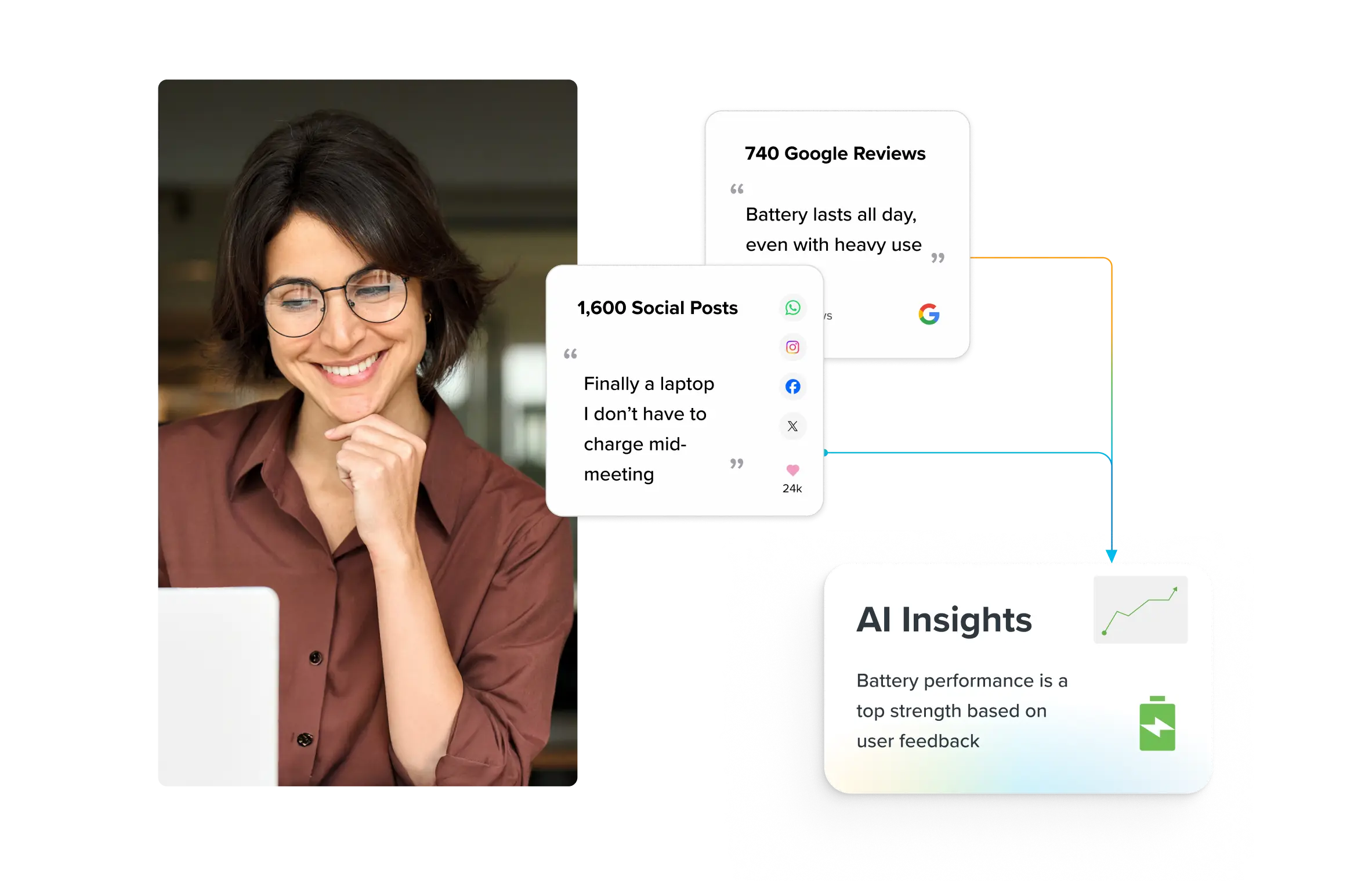
Where it stands apart in 2026 is depth and speed to action. Beyond overall sentiment, Sprinklr runs aspect-based analysis through its Product and Location Insights models, generating phrase-level sentiment so a team learns not just that customers are unhappy, but that they are unhappy about battery life or checkout speed. Its Smart Alerts use AI to watch for negative-sentiment spikes and volume anomalies in real time, distinguishing sudden spikes from longer-term trend shifts so brewing issues surface before they escalate. And with the Copilot Research Assistant, teams can ask questions in plain language, "overall brand sentiment," "recent sentiment changes," "positive discussion themes," and get summaries traced back to the source posts.
Two recent additions push it beyond text-based listening. Following Sprinklr's 2026 acquisition of ViralMoment, its video intelligence now runs frame-by-frame analysis to read sentiment in video and audio, closing a blind spot most listening tools still have as conversation shifts from text to short-form video. And its new LLM Insights tracks how a brand is represented, and how positive or negative that representation is, across AI answer engines like ChatGPT, Gemini, and Perplexity, building its prompts from real customer conversations rather than guessed keywords.
Add configurable governance and the ability to turn any finding into an assigned Action Plan, and the platform works less like a sentiment dashboard and more like a real-time command center for brand and customer intelligence.
Trusted by: Dow, Uber, Microsoft, Wells Fargo, the Prada Group, Heineken Brazil, Boston University, and many more.
Brandwatch (Cision)
Brandwatch, now part of Cision, is a well-known name in customer intelligence, especially for teams that prioritize data scale and research depth. It analyzes conversations across social platforms, news, blogs, forums, and review sites, pulling from a dataset that spans over 100 million sources with historical archives stretching back more than a decade, which makes it a strong fit for tracking long-running brand narratives and sentiment shifts over time.
Its AI layer, Iris, is where the sentiment work happens. Iris enriches every mention with sentiment classification across 44 languages and goes beyond positive-neutral-negative into emotion detection like anger and surprise, useful when triaging whether a spike needs escalation or just awareness. It also layers on entity extraction, demographic inference, and image analysis, so teams see not just the sentiment, but who is expressing it and what themes are driving it.
Iris Conversation Insights lets users click any data point, a sentiment spike, an anomaly, a trend, and get a plain-language summary of the underlying causes, while the newer Iris Post Analysis reads the comments under your own posts to reveal how an audience actually received a message, not just how many engaged. Combined with logo and image recognition and genuinely powerful query building, Brandwatch gives research-heavy teams a structured way to track brand perception at scale, though its depth and enterprise pricing put it out of reach for most small teams.
Talkwalker
Talkwalker, now part of Hootsuite, is an AI-powered social listening and consumer intelligence platform built for teams that need wide visibility and strong sentiment accuracy across global, multilingual conversations. It aggregates data from over 150 million sources, including social networks, news, blogs, forums, and broadcast media, and supports 180+ languages, making it a fit for brands tracking reputation across many markets at once.
On sentiment specifically, Talkwalker's engine goes past tone-tagging to identify the emotional drivers behind a conversation, and can even detect basic sarcasm, one of the hardest problems in the field, so teams catch snarky or negative posts earlier. Its Blue Silk AI clusters conversations, classifies topics, and generates summaries, helping teams understand not just what is happening, but why sentiment is moving.
Multilingual Conversation Clusters group posts across languages into a single theme rather than one cluster per language, a real time-saver for global monitoring, and its LLM Insights tracks how brands appear, and how positively or negatively they are framed, across AI assistants like ChatGPT, Gemini, Claude, and Perplexity. Add image recognition that detects logos in photos and video even without a text mention, and Talkwalker covers the visual-first platforms where a lot of brand conversation now lives. Reviewers praise its real-time crisis monitoring, with the caveat that sentiment accuracy can vary on more nuanced content.
Brand24
Brand24 is an AI social listening and sentiment analysis tool built for small and mid-sized teams that want real-time monitoring without an enterprise budget. It tracks public mentions across 25 million+ sources, including social media, news, blogs, forums, podcasts, video, and review sites, then layers on sentiment analysis, AI summaries, and a conversational AI Brand Assistant.
Its sentiment engine uses deep learning and pretrained language models to classify mentions as positive, negative, or neutral, with the practical touch that you can manually correct any misclassification directly in the dashboard, useful given that even strong models still stumble on sarcasm and slang. The AI Brand Assistant lets teams ask plain-language questions like "what are people complaining about this week?" and get an instant answer, while anomaly detection flags unusual spikes in mention volume so a brewing PR issue surfaces early.
Where it stands out is accessibility. Setup is fast, ratings are strong (G2 4.6, Capterra 4.7), and it delivers genuine value for SMBs and lean agencies. The honest trade-offs: historical data reaches back only about a year, keyword caps are tight, and sentiment accuracy weakens on non-English content, so it fits smaller teams better than global enterprises.
Best sentiment analysis tools for customer feedback and VoC
The tools in this section analyze the feedback customers give you directly, through surveys, support tickets, call and chat transcripts, reviews, and in-app responses. This is the Voice of the Customer (VoC) world, where sentiment analysis runs on feedback you actively collect to explain the why behind a CSAT score or a spike in churn.
The platforms here are built around structured feedback programs rather than social conversation. They pair sentiment analysis with survey engines, contact-center analytics, and closed-loop workflows, so the emotion detected in a comment can be routed to the right team and acted on. That focus is why the VoC and experience management market is growing so fast, from roughly $15 billion in 2024 toward a projected $50 billion by 2030.
Qualtrics
Qualtrics is the experience management category leader, built for teams running formal CX, employee, product, and brand programs that need statistical rigor. It powers research and feedback programs at a large share of the Fortune 500, and its sentiment work happens through Text iQ, its NLP engine for analyzing open-ended responses at scale.
On sentiment specifically, Text iQ assigns a six-level scale, very negative, negative, neutral, positive, very positive, or mixed, along with a numeric sentiment score you can filter and visualize. The model is trained on a large, diverse set of real experience data, which sharpens classification on feedback where the emotion isn't strongly worded. It supports sentiment across roughly 14 core languages, with more available for advanced analyses.
Where it stands out is context and depth. Text iQ factors in the survey question itself, not just the answer, so a one-word reply like "pricing" is scored correctly based on what was asked, and the model now learns from analysts' sentiment edits to improve over time. Combined with Stats iQ for significance testing and driver analysis, Qualtrics gives research teams an unusually high analytical ceiling, though it's sold through enterprise contracts that run into five or six figures and carries a real learning curve.
Medallia
Medallia is an enterprise CX platform built for organizations that need to read sentiment across an unusually wide range of signals, not just surveys, but contact-center calls, chat, and even video and IoT data. Its analytics run on Medallia AI (including its Athena engine), a layer of intelligence embedded throughout the platform.
On sentiment, Medallia's AI-powered Natural Language Understanding analyzes themes, sentiment, empathy, and nuanced emotions across dozens of languages and dialects, without the constant retraining most models demand. Teams get out-of-the-box and customizable KPIs like sentiment, effort, and empathy, so unstructured feedback can be scored consistently across every channel.
Where it stands out is real-time action at scale. Medallia can trigger alerts from any shift in sentiment, categorization, or an AI model, routing emerging trends and missed opportunities to the right person instantly, and it ships hundreds of prebuilt, industry-tuned topic models so teams reach accurate insights without heavy setup. It's a strong fit for large, omnichannel CX programs, with enterprise pricing to match.
Verint
Verint is an enterprise CX and customer engagement platform ranked among the top VoC solutions in 2026, built for large, complex organizations that need to read sentiment across surveys, contact-center calls, chat, email, and social in one place. Rather than treating feedback as a survey exercise, it unifies direct, indirect, and inferred signals through its CX Data Hub, then applies AI to explain the why behind customer behavior.
Its sentiment work runs on two engines. Verint Text Analytics extracts sentiment and automatically discovers themes from unstructured text across chat, email, social, and call notes, separating employee and customer streams so you know exactly who said what, while its Sentiment Bot scores every voice and digital interaction to quantify the factors driving how customers feel. On the voice side, Verint Speech Analytics transcribes and analyzes 100% of calls across 80+ languages, attaching sentiment and emotion to each interaction.
Where it stands out is turning sentiment into real-time action at contact-center scale. Verint connects listening posts across the customer journey and triggers automated actions the moment sentiment shifts, so a plummet in a product or website experience gets flagged and routed within seconds rather than surfacing in next month's report. Powered by its Da Vinci AI layer, trained on billions of real-world interactions annually, it's a strong fit for enterprises with a mature contact-center operation, though its depth and modular portfolio mean it's built for complex environments rather than quick setups.
💡 Where Sprinklr Insights fits in the VoC landscape
Most tools in this category analyze the feedback you actively collect. Sprinklr Insights reads sentiment across both worlds, solicited feedback like surveys, reviews, and care conversations, and the unsolicited opinions people share on social and digital channels, all analyzed by the same AI. That unified view of structured and unstructured signals is what earned Sprinklr recognition as a Leader in the 2026 Gartner® Magic Quadrant™ for Voice of the Customer Platforms, cited for both its Completeness of Vision and Ability to Execute.
Its VoC sentiment analysis pairs proprietary AI with GenAI to identify root-cause drivers and surface prioritized recommendations and adds AI-driven conversational feedback experiences that adapt to each respondent to lift response quality, while pulling in native coverage across 30+ social and digital channels. For teams that don't want survey sentiment and open-web sentiment living in separate tools, that single-platform view is the real draw.
Best sentiment analysis tools for text analytics and NLP
Not every team wants a dashboard. Engineering, data science, and product teams often need sentiment analysis as a building block, an API or library they can drop into their own applications, pipelines, and data warehouses to score text at scale. This is the raw NLP layer: you send it unstructured text, it returns structured sentiment, entities, and themes for you to route, store, or visualize however you like.
The tools in this category trade polished interfaces for flexibility and control. They handle the linguistic heavy lifting, document-level and aspect-level sentiment, entity extraction, and multilingual processing, while leaving the workflow design to your developers. They suit teams building sentiment into a product, enriching a data pipeline, or analyzing high volumes of text where a point-and-click tool would get in the way.
Here are the platforms that do it well:
Lexalytics (InMoment)
Lexalytics, acquired by InMoment in 2021 but still operating its own product line, is one of the longest-standing names in text analytics, with an NLP engine developed over nearly two decades. It transforms unstructured text, reviews, surveys, support tickets, social posts, into structured data, extracting sentiment, named entities, categories, intentions, and document summaries.
Where it stands out is deployment flexibility and control. The product line splits into Salience (an on-premises library for teams needing full technical control or data privacy), Semantria (a cloud REST API with configuration tools), and Spotlight (a document analytics layer), and every part of the sentiment system is tunable to your own vocabulary and rules. The trade-off: it's a technical, API-first tool best suited to teams with the engineering resources to implement and tune it.
Microsoft Azure AI Language
Microsoft Azure AI Language (the evolution of Azure Text Analytics, now part of Azure AI Foundry) offers production-ready sentiment analysis as a cloud API, a strong fit for teams already building on Azure. It classifies text as positive, negative, neutral, or mixed, and returns confidence scores between 0 and 1 at both the sentence and document level, so a review that's positive overall but critical of one feature is scored accurately rather than flattened.
Its aspect-level capability, called Opinion Mining, pinpoints the specific attribute driving a sentiment. Feed it "the battery life is excellent, but the screen is dim" and it tags "battery life" positive and "screen" negative, returning each as a target-and-assessment pair. The service covers 100+ languages through consistent REST APIs and SDKs for Python, C#, Java, and JavaScript, with no model training required to get started.
Where it stands out is enterprise scale and integration, pre-trained models, cloud scalability, and native ties into the wider Azure and Foundry ecosystem. One important caveat for planning: Microsoft has announced that the standalone Sentiment Analysis and Opinion Mining features will retire on March 31, 2029, with new projects directed to its Foundry models, so teams starting fresh should build with that migration path in mind.
Google Cloud Natural Language
Google Cloud Natural Language brings Google's machine learning to sentiment analysis through a clean, developer-friendly API, well suited to teams building on Google Cloud or feeding sentiment into data pipelines. Rather than a simple positive-negative label, it returns two values: a score from -1.0 to 1.0 for polarity, and a magnitude that measures the strength of emotion, which together separate a mildly positive comment from a passionately positive one.
For more granular work, its entity sentiment analysis identifies the specific people, products, or features mentioned in a text and scores the sentiment attached to each, useful for reviews that praise one aspect and criticize another. It handles a broad range of languages, and pairs with Google's Speech-to-Text and Translation APIs to extend sentiment analysis into audio and multilingual content.
Where it stands out is reliability and structure. Analysts consistently rate it highly for confidence-scored sentiment at both document and sentence granularity with stable, predictable JSON output, which makes it a dependable choice for benchmark reporting and production scoring inside Google Cloud workflows.
Can I use ChatGPT or an LLM for sentiment analysis instead of a dedicated tool?
You can — for one-off, small-batch checks: an LLM will label a block of text reasonably well. Where it falls short is scale and consistency: no live data ingestion across social, reviews, or calls, no aspect-level scoring you can trust across thousands of records, no alerting, and outputs that can drift between runs. Dedicated tools add the pipeline, governance, and repeatability that make sentiment usable in production. The practical split: LLMs for quick exploration, purpose-built platforms for ongoing, auditable monitoring.
Amazon Comprehend
Amazon Comprehend is AWS's fully managed natural language processing service, built for teams that want to add sentiment analysis to their applications without training or hosting a model. You call an API, point it at your text, and it returns structured sentiment, entities, key phrases, and language in JSON, no ML expertise required, which makes it a natural fit for teams already building on AWS.
Its core sentiment API classifies a document as positive, negative, neutral, or mixed, returning a confidence score for each so you can set your own accuracy threshold, and it works across supported languages including Spanish, French, German, Japanese, Hindi, and Arabic. For deeper analysis, its Targeted Sentiment feature scores sentiment for each specific entity in a text, so a review like "the tacos were delicious and the staff was friendly" returns positive sentiment attached to both "tacos" and "staff" individually rather than one blended score, though this granular feature currently supports English only.
Where it stands out is customization and AWS-native integration. Beyond the pre-trained models, teams can train custom classification models on their own labeled data to route support tickets or triage feedback by category, without writing ML code, and run it in real time through a managed endpoint. It plugs directly into S3, Lambda, and other AWS services for event-driven pipelines, which is its real advantage for teams already in that ecosystem. One planning note: as of April 30, 2026, a few peripheral features (topic modeling, event detection, prompt safety) closed to new customers, though core sentiment, entity, and custom classification are unaffected.
⚠️ Important Note for Readers:
While this list isn't exhaustive, our team invested significant time in research to curate tools making waves in 2026 — independent picks by Sprinklr’s editorial team, drawn from publicly available review sites and in no particular order of ranking or popularity. These insights empower you to select the software that best fits your sentiment analysis needs. It is crucial to note that software or platforms may evolve over time, and the company may address some of these concerns in newer updates or versions.
Which sentiment analysis tool is best for your business?
The best sentiment analysis tool depends on where your customer data lives and what you need to do with it. If the data is on social and the open web, you need a brand-intelligence platform; if it's in surveys and calls, you need a VoC tool; if you're building sentiment into your own product, you need an NLP API. Top choices span all three: Sprinklr Insights for unified social and customer intelligence, Qualtrics for survey-driven VoC, and Google Cloud Natural Language for developer-built NLP.
Use the shortlist below to narrow your options:
- Sprinklr Insights: Best for enterprises that want social and direct feedback in one place. Choose it when your customer signal is scattered across channels, social, reviews, surveys, and care conversations, and you want it analyzed together rather than in separate tools. It covers sentiment across 30+ social and digital channels, adds aspect-level and multilingual analysis, and ties findings to action, making it a fit for large teams unifying brand and customer intelligence.
- Brandwatch: Best for research-heavy consumer intelligence. Choose it when deep historical data and powerful query building matter more than an all-in-one platform, ideal for insights teams tracking brand narratives at scale.
- Qualtrics: Best for structured VoC and formal research programs. Its Text iQ engine and statistical rigor suit teams running enterprise CX, employee, or market-research programs where survey depth is the priority.
- Verint: Best for contact center-heavy operations. Pick it when most of your sentiment lives in calls and chats, its speech analytics score 100% of voice interactions across 80+ languages.
- Google Cloud Natural Language: Best for developers building sentiment into their own applications. A clean, reliable API with document, sentence, and entity-level scoring, ideal for teams on Google Cloud who want NLP without managing models.
- Brand24: Best for small teams and tight budgets. It delivers real-time monitoring and AI sentiment without an enterprise price tag, the practical choice for SMBs and lean agencies.
The key is to match the tool to the source and scale of your data, the depth of analysis you need, and how your teams will act on the insights. A social listening platform, a VoC solution, and an NLP API can all perform sentiment analysis, but they solve very different business problems.
Are there free sentiment analysis tools?
Yes, but with limits. Open-source libraries like VADER, TextBlob, and Hugging Face models are free to build on if you have engineering resources, and several paid platforms (including cloud NLP APIs) offer free tiers or trials capped by volume. Free options work for testing or low-volume analysis, but they typically lack multilingual depth, aspect-level accuracy, real-time alerting, and support. For business-critical monitoring, the cost usually shifts from licensing to engineering time.
Final thoughts
Picking a sentiment analysis tool is really a decision about what you're trying to hear. A team drowning in social mentions has a different problem than one parsing survey verbatims or wiring sentiment into an app, and the tool that solves one rarely solves all three equally well. Start with the question you actually need answered, then choose the platform built to answer it.
Two shifts are worth planning around. First, sentiment is moving beyond text, video, voice, and even how your brand is described inside AI answer engines are becoming signals worth tracking, so a tool that only reads written posts will show you less of the picture each year. Second, detection is no longer the hard part; nearly every tool here can tell you something turned negative. The advantage now belongs to platforms that connect that signal to an owner and an action fast enough to matter.
That gap, between knowing and acting, is where a unified approach earns its place. Sprinklr Insights reads sentiment across multiple channels alongside surveys, reviews, and care conversations, then uses AI to surface the root cause and route it to the right team, so a shift in how customers feel becomes something you can respond to, not just observe. If that unified view fits how your teams work, book a demo to see it against your own data.
Aishwarya Suresh is an experienced content writer specializing in social media management, social listening, social analytics, Voice of the Customer (VoC) and customer experience. She writes practical, research-backed guides that help brands understand customer conversations, measure social media performance and turn insights into meaningful business decisions.
Karishma Borkakoty is a senior content marketer who lives and breathes long-form content in the form of eBooks, whitepapers and thought-leadership guides people actually bookmark and come back to. She has a knack for taking a big, messy topic and turning it into something genuinely useful and easy to follow.