



The global leader in enterprise social media management
For over a decade, Sprinklr Social has helped the world’s biggest brands reimagine social media as a growth driver with a unified platform, industry-leading AI and enterprise-grade scale.



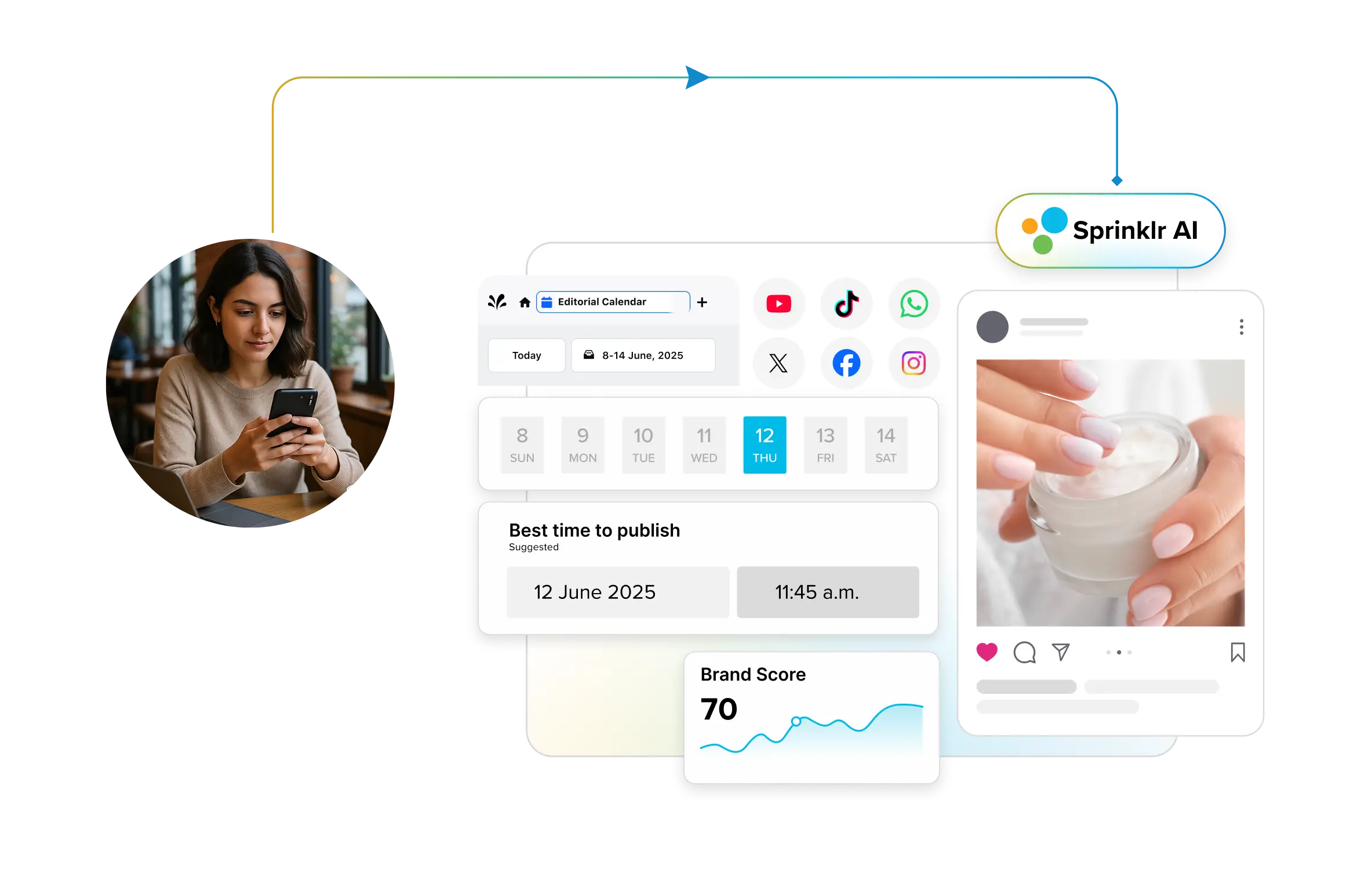
Social Media Marketing Funnel: AI-Driven Roadmap to Conversions

A social media marketing funnel is a structured framework that maps how audiences move from awareness to conversion across social platforms. It defines how impressions turn into engagement, engagement turns into intent, and intent turns into revenue so enterprises can measure performance, optimize spend, and connect social activity directly to business outcomes.
At enterprise scale, this structure begins to break. Social signals move instantly across markets, but reporting cycles, data silos, and budget decisions lag behind. Traditional funnels were designed for linear journeys and cannot process fragmented cross-platform behavior in real time, leading to delayed optimization and unclear attribution.
AI closes this gap by unifying campaign data, behavioral signals, and conversion activity into a single decision layer. Instead of relying on post-campaign analysis, enterprises can detect drop-offs early, prioritize high-intent audiences, and reallocate budgets based on projected conversion impact. This blog explains how to rebuild your social media marketing funnel with AI, step by step, from identifying performance leaks to predicting conversion outcomes.
- Stages of social media marketing funnel
- AI-driven social media marketing funnel roadmap
- How to build (and continuously improve) your social media funnel
- Proving business value: The ROI of an AI-driven social media funnel
- Future trends in AI-powered social media funnels
- Redefining the social media funnel for the AI age with Sprinklr
Stages of social media marketing funnel
A social media marketing funnel maps the journey from discovering your brand to becoming a loyal customer.
A traditional social media marketing funnel assumes users progress predictably. It is typically divided into four linear stages:
- Awareness: The audience first encounters your brand through social content, ads or mentions.
- Consideration: Prospects engage with your content, compare options and evaluate whether your brand meets their needs.
- Conversion: Users take the desired action, such as making a purchase, signing up or downloading content.
- Loyalty: Post-purchase engagement fosters repeat business, referrals and brand advocacy.
However, the old funnel worked when audiences moved predictably. But enterprise marketers now manage audiences who jump from a TikTok trend to a YouTube review and back to Instagram before ever clicking “buy.” These journeys don’t move forward in order; they evolve through feedback loops powered by data.
In modern social media funnels, every interaction is both a signal and a trigger. Campaigns can’t wait for intent; they must anticipate it.
The result is not exactly a literal “funnel,” but an ecosystem that learns from every scroll, share and sentiment shift. When Heinz asked AI to visualize “what ketchup looks like,” it wasn’t just running a creative experiment; it built a responsive funnel. The campaign fed user interactions back into its data model, sharpening future content recommendations and re-engaging audiences with context-aware messaging.
Also read: How to Build a Successful X, formerly Twitter Ad Funnel
What role do cross-channel touchpoints play in a social media funnel?
Cross-channel touchpoints ensure a consistent and cohesive customer journey across various social platforms. Engaging with prospects through multiple channels reinforces brand messaging and increases the likelihood of conversion.
AI-driven social media marketing funnel roadmap
Follow along for a roadmap of how AI strengthens each stage of your social media marketing funnel.
Awareness stage: Predictive targeting and trend detection
AI makes the top of the funnel more precise by identifying emerging conversations and audience clusters before they peak, so brands enter when attention is building, not fading.
How to apply:
- Data inputs: Combine social listening, CRM, first-party web data and open-source forums like Reddit or X to detect early shifts in interest.
- Models: Use topic clustering, burst detection and predictive reach models to forecast what audiences will care about next.
- Activation: Feed signals into an AI-powered campaign management platform to auto-adjust content themes, timing and influencer collaborations.
- Feedback loops: Track trend velocity and share of voice via unified dashboards to refine future targeting.
KPI | What it measures | Who owns it |
Reach and Impressions | Total audience exposure across channels | Social Strategy/Paid Media |
Share of Voice (SOV) | Visibility vs. competitors on trending topics | Brand Marketing/Insights |
Emerging Topic Engagement Rate | Growth in engagement on AI-identified trends | Demand Gen/Social Media |
Example:
Unilever is using AI to scale faster and more effective marketing across its global brands. AI-powered tools have reduced content production time by up to 30 percent while more than doubling video completion rate and click-through rate, supported by brand-safe systems like Digital Product Twins and Brand DNAi.
Closeup produced over 100 campaign assets in three days across four Asian markets, while Home Care brands increased TikTok visibility by 22.5 percent by responding to cultural trends in real time. Beauty and Wellbeing teams streamlined end-to-end content creation through the Beauty AI Studio, and Food Solutions tripled engagement while achieving a 96 percent satisfaction rate with its chef-powered Recipe Intelligence platform.
How can social media data improve the accuracy of my marketing funnel?
Social media data offers real-time insights into audience behavior, engagement patterns and content performance. By analyzing metrics such as click-through rates, conversion rates and engagement levels, marketers can identify which content resonates most with their audience. This enables precise targeting and personalized messaging, leading to improved conversion rates.
Consideration stage: Intelligent segmentation and engagement scoring
At this stage, audiences are evaluating the product fit. AI turns fragmented engagement data into actionable segments, allowing marketers to personalize experiences and prioritize high-intent prospects.
How to apply:
- Centralize data: Integrate social, CRM and web analytics into a single layer to detect behavioral clusters, such as users engaging with tutorials versus product demos.
- Cluster intelligently: Replace rule-based lists with unsupervised learning (e.g., K-Means, hierarchical clustering) to uncover hidden patterns.
- Personalize engagement: Pair segmentation data with GenAI creative tools to test tones, formats, and influencer voices, reallocating spend based on performance.
- Feed scores into CRM/ad systems: Use engagement scores within analytics tools to trigger retargeting or lookalike audiences.
How to track:
KPI | What it measures | Owned by |
Engagement Quality Score (EQS) | Weighted score of meaningful interactions (comments, shares, saves vs. likes). | Social Analytics/Marketing Ops |
Segment Conversion Rate (SCR) | % of AI-defined audience segments that progress to the lead or purchase stage. | Growth/Demand Generation |
Lead Qualification Speed (LQS) | Time from engagement spike to CRM qualification or retargeting trigger. | Marketing Automation/CRM Team |
Example:
Crescendo Lab, a marketing technology provider for e-commerce brands, leverages BigQuery to analyze terabytes of daily data from LINE user interactions. This allows clients to generate detailed consumer segmentation reports in just five minutes, a process that used to take up to five hours.
With these insights, brands can adjust marketing strategies instantly, ensuring campaigns are more targeted and effective.
Suggested read: 7 Social Media Lead Generation Strategies for 2026
Decision stage: Conversion optimization with dynamic personalization
Here, the challenge shifts from awareness to relevance. AI personalizes offers and experiences in real time, removing friction and improving conversion efficiency.
How to apply:
- Personalize content: Use reinforcement learning or predictive recommendation engines to tailor landing pages and CTAs based on past engagement.
- Optimize conversion paths: Tools like Sprinklr Smart Rules test and deploy the best-performing layouts, copy, or offer sequences automatically.
- Integrate AI chatbots: Use GenAI-powered chat or voice assistants to resolve objections, share discounts, or simplify checkout.
- Predict purchase timing: Analyze historical data to identify when users are most likely to convert and trigger personalized outreach within that window.
How to track:
KPI | What it measures | Owned by |
Conversion Rate Lift (CRL) | % increase in conversions after AI-driven personalization vs. baseline campaigns. | Performance Marketing/Growth |
Offer Response Rate (ORR) | Ratio of users responding to AI-personalized offers or CTAs. | Digital Marketing/CRM Team |
Abandonment Recovery Rate (ARR) | % of users re-engaged or converted after an AI-led recovery attempt (chatbot, remarketing). | Marketing Automation/CX Team |
Example:
Gossby, a print-on-demand retailer in Vietnam, combined its Search campaigns with existing Performance Max campaigns to optimize conversions.
This approach led to a 22% increase in orders and a 33x boost in conversion rate, all while maintaining its return on ad spend. The integration allowed the brand to target high-intent customers more effectively and maximize campaign efficiency.
Read more: Social Media Personalization: Examples and Tips
Retention and advocacy: Predictive loyalty and upsell campaigns
Retention fuels sustainable growth. AI predicts churn, identifies upsell opportunities and automates loyalty actions across channels to deepen customer relationships.
How to apply:
- Predict churn: Use classification models trained on interaction frequency, sentiment, and purchase intervals to flag at-risk customers and trigger win-back offers.
- Automate loyalty journeys: Platforms like Sprinklr orchestrate micro-journeys, automatically inviting happy customers to referral or advocacy programs.
- Personalize retention content and offers: Recommender systems surface complementary products, premium upgrades or community invites to reinforce value.
- Enable predictive upsell and cross-sell: Use lookalike modeling to target customers resembling top LTV profiles with tailored upgrade offers.
How to track:
KPI | What it measures | Owned by |
Customer Retention Rate (CRR) | % of customers retained over a defined period. | Customer Success/CRM Team |
Churn Prediction Accuracy (CPA) | Precision of AI models in correctly identifying at-risk customers. | Data Science/Marketing Analytics |
Advocacy Activation Rate (AAR) | % of loyal customers transitioning into advocates (e.g., referrals, reviews, UGC). | Community/Advocacy Marketing |
Example:
Albertsons simplified its loyalty program using AI in 2024, making it easier for customers to earn and redeem points.
This streamlined approach increased membership by 15%, reaching 44.3 million members by early 2025. By optimizing loyalty touchpoints and tailoring rewards, Albertsons strengthened customer engagement, boosted repeat purchases and improved long-term retention.
How enterprise brands boost full-funnel impact with LinkedIn
Enterprise marketers struggle to build strong brands while proving ROI. A survey of 613 professionals from $250M+ companies found that only 20% reported significant ROAS growth in the past year.
By integrating Sprinklr with LinkedIn, teams achieved measurable results:
- 2.7x higher likelihood of ROAS improvement for full-funnel campaigns
- 72% prioritized building a trustworthy brand; 43% focused on long-term loyalty
- 91% value LinkedIn for brand-building, but only 18% use it for full-funnel marketing
Sprinklr’s analytics and tracking tools helped marketers measure and report ROI, turning brand initiatives into actionable growth strategies and stronger customer connections.
How to build (and continuously improve) your social media funnel
Building a social media funnel isn’t a one-time setup. Audiences shift fast, and your funnel needs to evolve just as quickly.
Here’s a simple, repeatable roadmap enterprises can use to turn insight into performance.
Step 1: Audit and map your current funnel
Before optimizing your processes, start by diagnosing where your funnel is leaking. Your goal here is to understand how audiences move (or don’t move) from awareness to conversion.
With advanced insights, visualize each stage and spot friction points early. AI models can even flag declining engagement segments in real time, alerting Marketing Ops to refresh creative or validate data sources for compliance.
Pro Tip: Let AI do the heavy lifting. AI-powered platforms like Sprinklr AI can track customer behavior, score engagement and predict who’s likely to disengage so you can retarget them instantly with tailored content or offers.

Book a demo to see how Sprinklr AI can help you predict and prevent funnel drop-offs before they affect conversions.
Also read: The Expert’s Guide to Social Media Audit
Step 2: Align funnel goals to business KPIs
Each funnel stage should directly tie to business outcomes. Aligning metrics ensures marketing performance is measurable and relevant to enterprise goals.
Set up an automated dashboard that unifies social, CRM and commerce data so everyone—from Marketing Ops to Finance—sees the same source of truth and measurable KPIs. Update multi-touch attribution models regularly to reflect changing channel impact and budget efficiency.
How do I know if my social media funnel is leaking conversions?
Watch for sudden drops in engagement or click-throughs between the funnel stages. If CTR falls sharply after a specific touchpoint, the content or offer there likely needs refining.
Step 3: Use data (and light AI) to identify opportunities
Once your KPIs are set, look for the hidden wins. Integrate behavioral data from social, CRM, and web platforms to get a 360-degree customer view, then apply AI for pattern detection, identifying churn risk, high-LTV clusters or segments ready for upsell.
Leverage data integration and AI to uncover hidden growth opportunities and pre-empt performance drops.
- Consolidate behavioral data from social, CRM and web platforms to get a unified customer view.
- Apply AI for pattern detection, such as spotting churn risk or identifying high-LTV audience clusters.
Also read: AI In Marketing Automation: 7 Business Cases
Step 4: Test, measure, iterate
The best-performing brands treat every campaign as a test, learning from real-time data and adapting quickly to optimize conversion velocity.
Treat every campaign as a continuous experiment to improve funnel efficiency and conversion velocity.
- Run A/B or multivariate tests on ad copy, CTAs or landing page design and track results in a centralized analytics hub.
- Automate insights-to-action loops using tools like Sprinklr Insights for weekly optimization.
For example, Marketing Ops maintains a versioned test registry, while Data Science validates lift through control groups. Underperforming creatives trigger automated refreshes, and models undergo quarterly validation to ensure stability and accuracy.
How should budgets be allocated across different funnel stages?
Start with a flexible split. For example: 40% awareness, 30% consideration, 20% decision, 10% retention. Then you can adjust dynamically. Like:
- If CPL rises > 10%, move the budget from awareness to mid-funnel nurturing.
- If conversion rate drops > 8%, shift funds toward retargeting or personalization.
- If retention falls > 5 points, reinvest in loyalty programs or churn-prediction models.
This rolling allocation keeps spending tied to real-time performance instead of static annual plans.
Step 5: Collaborate across teams
Building a high-performing funnel needs cross-functional collaboration. A high-performing funnel requires alignment between marketing, sales, product and CX teams.
- Create shared dashboards displaying funnel performance, engagement, lead velocity and conversion by stage.
- Schedule monthly reviews to identify leaks and reallocate budgets collaboratively.
Paid and organic teams can align audience strategies, amplifying top-performing organic posts through paid boosts. Role-based access controls and audit trails ensure that all funnel insights rely only on consented, vetted data, maintaining enterprise compliance and transparency.
What’s the best way to connect organic and paid efforts within the funnel?
Use organic content to build credibility, then amplify what performs best with paid reach. This synergy creates a smoother journey from discovery to conversion and a stronger ROI overall.
Proving business value: The ROI of an AI-driven social media funnel
Once your teams are aligned and your funnel is running smoothly, the final challenge isn’t execution; it’s proving that every stage drives business value.
1. Track performance by stage
Each stage of the funnel has its own success indicators. Rather than relying on static benchmarks, compare current performance against your organization’s past results or industry medians.
Funnel Stage | Core Metric | What to Measure | Business Outcome |
Awareness | CTR/Reach Efficiency | How effectively campaigns translate reach into attention | Lower acquisition cost through better audience targeting |
Consideration | Engagement-to-Lead Ratio | How well engagement turns into qualified leads | Faster funnel progression with predictive scoring |
Decision | Conversion Rate (CVR) | Percentage of prospects taking the desired action | Higher incremental conversions from hyper personalization |
Retention | Repeat Purchase/ Loyalty Metrics | How many customers advocate for the brand | Stronger customer lifetime value and referral growth |
2. Calculate ROI
A simple formula keeps analysis consistent:
ROI = (Incremental Conversions × Average Order Value) − Campaign Cost
So if AI optimization drives 500 incremental conversions at 2,000 AOV on a 400K campaign, ROI = (500 × 2,000) − 400,000 = 600,000 net gain.
Use these outcome metrics to connect funnel performance directly to business value, from reduced CAC to faster revenue realization.
For example:
- A 10 to 20% lift in funnel velocity can compress the sales cycle by a week in enterprise contexts.
- AI-driven targeting typically reduces CAC by 10 to 25% through budget efficiency.
- Predictive engagement can improve LTV by 15 to 20% as customer retention strengthens.
3. Validate over a 90-day cycle
- Baseline (Weeks 1 to 2): Audit existing funnel metrics, AOV and CAC using Sprinklr Insights.
- Experiment (Weeks 3 to 8): Deploy AI-driven segmentation, dynamic creatives and retargeting automation in two funnel stages.
- Measure (Weeks 9 to 12): Compare uplift in CTR, CVR and LTV against control campaigns to calculate net ROI using the above formula.
This approach gives quantifiable proof of value, demonstrating smarter engagement and measurable business acceleration across the funnel.
How do I measure the ROI of a social media funnel beyond conversions?
Go beyond immediate sales metrics. Track customer lifetime value, time to repeat purchase, NPS and sentiment shifts and operational efficiencies from automation or reduced manual triage.
You can also measure referral traffic growth and retention uplift to see how sustained engagement drives long-term brand advocacy and revenue expansion.
Future trends in AI-powered social media funnels
Social media funnels are becoming faster, smarter, and more adaptive. AI sits at the core of this shift — helping brands predict intent, personalize at scale, and orchestrate journeys seamlessly across platforms.
Here’s how the next generation of social funnels is taking shape.
1. Predictive customer journeys
AI now predicts what they’ll do next. By modeling individual behavior across platforms and channels, brands gain clearer visibility into audience intent and conversion probability. Recent research shows that AI-driven journey analytics reduces insight-to-action time significantly.
2. Hyper-personalization at scale
Mass messaging is no longer enough. The future funnel delivers individualized experiences while maintaining a consistent brand voice. AI combines behavioral, transactional and contextual data to tailor messages and offers dynamically. A Deloitte study found that 80% of consumers are more likely to purchase from brands offering personalized experiences.
Read more: Personalized Customer Experience: Top 4 Ideas + Examples
3. Cross-platform orchestration
Modern social journeys rarely unfold on a single platform. AI enables marketers to connect every interaction, from social post to ad click to customer service chat, into one unified funnel.
Unified attribution models and automated optimization tools help teams identify where to invest, what to scale and which experiences deliver the highest ROI.
With AI managing decisions in real time, enterprises can shift from channel-first execution to audience-first orchestration, ensuring every touchpoint contributes to consistent growth.
Redefining the social media funnel for the AI age with Sprinklr
The social media funnel has evolved into a responsive, data-aware system. What once guided audiences in a straight line now adapts continuously, learning from every interaction and predicting what comes next.
For enterprise marketers, this shift isn’t just about adopting AI tools but building a culture that connects data, creativity and accountability with AI. When every touchpoint feeds intelligence back into the system, marketing becomes a cycle of insight and improvement instead of reaction and guesswork.
Sprinklr Social makes this possible by unifying publishing, engagement, specialized AI and analytics under one AI-driven platform. It connects audience insights, automates campaign optimization and gives teams real-time visibility into performance and ROI. With it, every stage of the funnel becomes compliant and growth focused.
Book a demo today to understand how Sprinklr can help you operationalize your social media funnel!
Frequently Asked Questions
Adopt governed data pipelines with consent logging, anonymization and automated audits. Platforms like Sprinklr ensure GDPR and CCPA compliance while maintaining data integrity across teams.
Fragmented data and disconnected teams often slow execution. Unified platforms solve this by integrating analytics, publishing and engagement into one governed workflow.
Retraining every 30 to 60 days keeps AI models aligned with new audience behaviors, seasonality and creative performance trends. Regular updates sustain predictive accuracy.
Track LTV uplift, conversion velocity and cost-per-engagement efficiency. These show how AI-driven funnels reduce operational costs while improving long-term revenue impact.
