




The AI-native platform for global campaign management
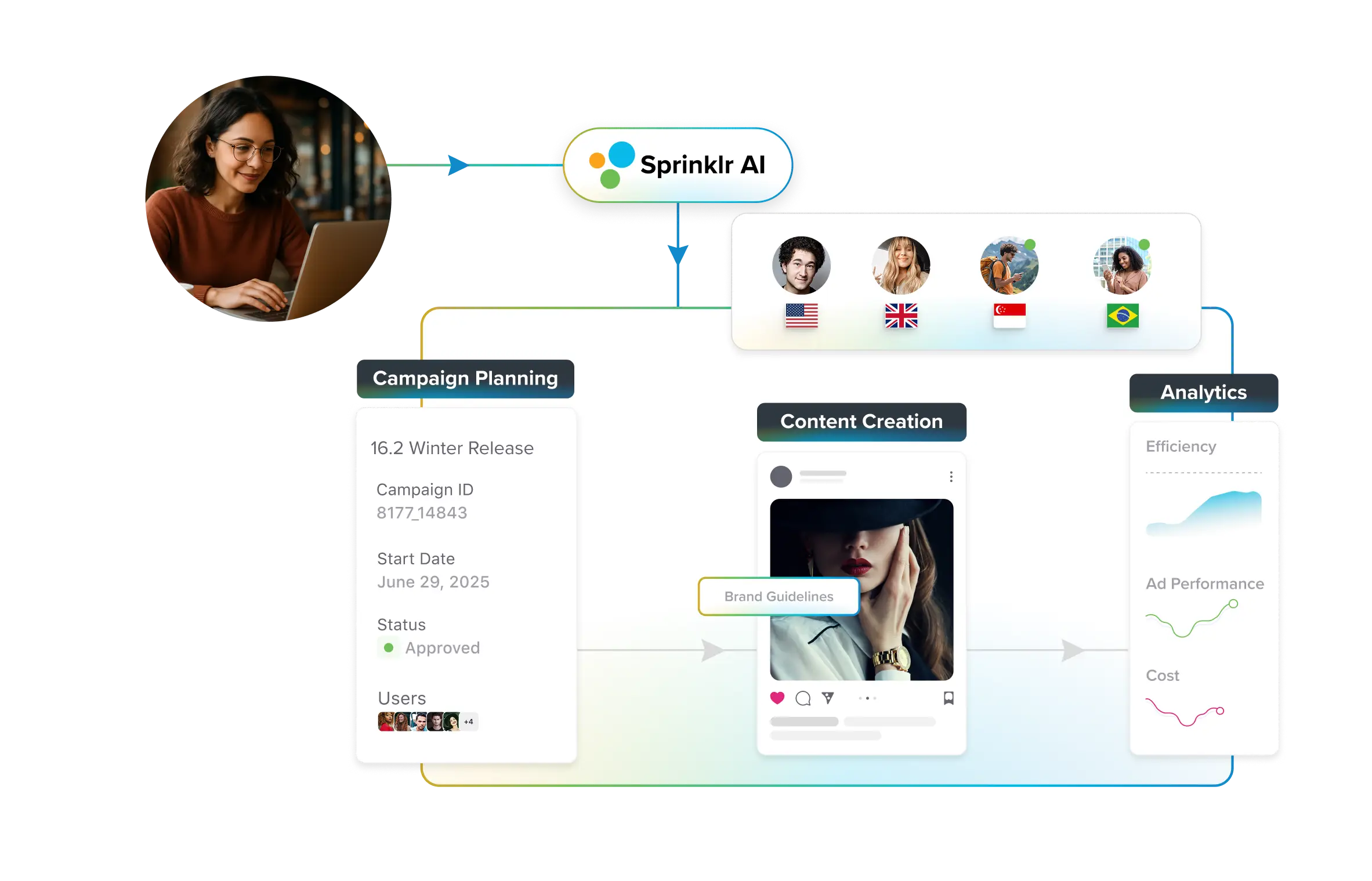
Sprinklr Marketing unifies campaign planning, content creation, publishing and analytics across global teams — all elevated by AI. Accelerate go-to-market, boost performance and enforce brand governance at scale.




Agentic AI in Marketing: The New Competitive Edge

Modern marketing runs on shrinking decision windows. Auctions, ranking systems, and customer intent can shift in minutes. Yet many teams still operate on weekly reviews, manual QA loops, and post-hoc optimizations, so performance improvements arrive after the opportunity has already moved on.
Agentic AI changes the operating cadence. Instead of generating insights for humans to act on later, it can plan and execute actions in the workflow, within guardrails marketing leaders define for spend, brand, and risk.
Nearly 70% of marketing leaders believe Agentic AI will be transformative, but far fewer have operationalized it at enterprise scale. This guide explains why Agentic AI has become a leadership priority, how it delivers measurable business impact, and where enterprises are applying it today.
- What is agentic AI
- Why agentic AI matters in marketing
- Actionable use cases of agentic AI in marketing
- Agentic AI tools in marketing
- Benefits of implementing agentic AI in marketing
- KPIs directly influenced by Agentic AI
- What’s next for agentic AI in marketing
- Turning agentic AI into a repeatable marketing operating model
What is agentic AI
Agentic AI is an AI architecture that uses autonomous agents to pursue specific goals with minimal supervision. Each agent can interpret data, plan actions, execute tasks across connected tools, and learn from outcomes — enabling software systems to operate with adaptive, goal-driven intelligence under human-defined governance.
How it differs from the AI most marketing teams already use:
- Automation executes predefined rules (“if X, then Y”).
- Predictive AI forecasts outcomes (“this audience is likely to convert”).
- Prompt-based genAI responds when asked (“write me an email”).
- Agentic AI acts — it can trigger workflows, shift budgets, rotate creative, or route issues when conditions change, while logging decisions for review.
Instead of waiting for instructions, agentic AI behaves like a proactive operator; monitoring performance, executing tasks, and reporting results against targets.
What you should remember:
- Autonomy must be bounded (guardrails, approvals, escalation paths).
- Agent performance requires observability (traces, audit logs, evaluation).
- The ROI comes from closing the loop: signal → decision → action → measurement.
Suggested Read: Agentic AI vs. Traditional AI: Use Cases + Gap Analysis
Why agentic AI matters in marketing
The below forces are pushing agentic AI from experimentation to necessity:
- Decision lag is now a measurable cost: Auction-based media, dynamic search rankings, and social algorithms update continuously. Human review cycles, even daily ones, are too slow. Agentic AI brings decision-making into the execution layer, preventing value leakage in real time. This directly protects marketing ROI in volatile environments.
- Customers expect real-time relevance: Customers now expect interactions shaped by their immediate context, not last month's segment profile. Agentic AI dynamically orchestrates content, channel, and timing for individuals at scale, turning personalization from a batch process into a live dialogue.
- Governance is becoming the gating factor: Enterprises aren’t pausing because agents can’t act; they’re pausing because they need to govern, validate, and monitor autonomous systems safely. In one 2026 study of senior leaders implementing agentic AI, the top barriers included security/privacy/compliance concerns and challenges managing and monitoring agents at scale.
- Cost pressure is amplifying inefficiency: As CPCs and CPMs rise, even short delays compound into material waste. Agentic systems correct inefficiencies immediately, reducing overspend before it impacts CAC or ROI.
For leadership, the value proposition is clear: resilience. Agentic AI builds marketing operations that are adaptive, efficient, and scalable in a landscape that no longer pauses for human intervention.
Learn More on Agentic AI Workflows: What to Expect, Benefits, and Challenges
Actionable use cases of agentic AI in marketing
Agentic AI delivers value where conditions shift constantly, and delays are costly. Here are the top applications:
1. Cross-channel budget optimization
Weekly or daily budget reallocation is reactive. Agentic AI treats the marketing budget as a dynamic portfolio, continuously shifting funds across channels and campaigns based on live performance signals (e.g., conversion probability, cost trends, audience intent). It captures rising demand instantly and reduces exposure to softening segments, ensuring peak efficiency.
How this works:
- Ingest performance signals (conversion quality, CPA/ROAS movement, audience saturation, frequency, incrementality proxies).
- Apply constraints (channel caps, brand safety rules, geo priorities, pacing targets).
- Execute reallocations (shift budget weights, pause underperformers, expand winning segments).
- Log actions and outcomes for auditability.
For example, by bringing programmatic decisioning in-house, Bayer gained direct control over how spend shifted across channels in real time. This reduced reliance on delayed platform optimizations and delivered a 6% sales lift among new customers for Claritin, demonstrating how agent-led budget control can capture demand while it is active.
Good to know: Sprinklr’s Smart Budget Allocation applies the same agentic logic at scale — continuously redistributing ad spend across campaigns and channels based on real-time performance. Using reinforcement learning, it predicts outcomes, reallocates budgets toward top-performing entities, and minimizes CPA automatically.
Your team can set custom optimization goals, including metrics from third-party analytics like Google DV360 or Adobe Analytics, and manage cross-channel campaigns in one unified view. The system not only automates budget decisions but also records every action for full auditability, giving marketing leaders confidence that each dollar is optimized transparently.

Curious to learn more?
2. Real-time trend detection and adaptive marketing execution
Cultural and demand trends can emerge and fade within days. Agentic AI scans social conversations, search data, and engagement patterns to identify emerging signals. It then automatically aligns relevant content, messaging, and even paid media spend to capitalize on these moments while they are still gaining momentum.
How it works
- Detect emerging themes via social listening + search interest + engagement anomalies.
- Validate with internal context (historical performance, inventory constraints, audience overlap, brand fit).
- Trigger actions (spin up creative briefs, adjust messaging priorities, deploy responsive content across channels).
For example, Estée Lauder Companies uses AI agents to analyze live cultural and consumer signals alongside decades of internal data, enabling faster identification of emerging demand. This allows their leadership teams to shorten the distance between trend detection and go-to-market decisions, reducing missed opportunities in fast-moving categories.
Another Read: The Best AI Marketing Trends & Strategies
3. Continuous creative experimentation
Creative fatigue sets in quickly. Agentic AI transforms A/B testing from a manual, episodic task into a persistent, scaled operation. Agents generate or select multiple creative variants, deploy them across audiences, analyze engagement signals, and automatically scale the winning combinations, all within a single campaign flight.
How this works:
- Generate or ingest variants (copy/visual/format), respecting brand and compliance constraints.
- Deploy controlled tests (audience splits, geo splits, holdouts).
- Promote winners automatically within defined thresholds (lift confidence, spend ceilings).
- Retire fatigued creative before performance cliffs hit.
For example, Havas Media Group used Sprinklr Marketing to scale creative experimentation across more than 560 clients and 11 geographies. With AI-driven capabilities such as Smart Budget Allocation and Smart Rules, Havas teams test and optimize creative and media performance in real time while maintaining strong governance and brand safety across markets. Using Sprinklr, Havas Media Group was able to onboard 560 clients.
Suggested read: Agentic AI vs AI agents: What’s the Difference
4. Adaptive lifecycle and journey orchestration
Static journey maps break when customer behavior deviates. Agentic AI manages journeys as fluid systems. Based on real-time engagement data, it dynamically adjusts the next-best action, message timing, and channel sequence; accelerating outreach when interest peaks and pausing to prevent fatigue.
How it works:
- Use real-time signals (site behavior, in-product events, support interactions, propensity scores).
- Adjust send-time, cadence, and channel mix automatically.
- Suppress outreach when risk signals appear (fatigue, negative sentiment, high complaint probability).
For example, Hobbycraft implemented agent-based AI across email, chat, and social channels to unify customer communications. The AI autonomously handled a significant share of routine inquiries and supported personalized follow-ups, contributing to faster response times, higher customer satisfaction and measurable uplift in guided sales outcomes.
Read more: Agentic AI Workflows: What to Expect, Benefits and Challenges
5. Real-time anomaly detection and automated response
Performance issues often surface silently. Agentic AI monitors live campaign metrics, identifies anomalies (e.g., a sudden CPC spike or engagement drop), diagnoses likely causes, and executes pre-approved mitigation steps such as pausing an ad set or reallocating budget often before human teams are alerted.
How this works:
- Baseline normal ranges by channel/campaign/segment.
- Detect deviations (CPC spikes, conversion drop-offs, bot traffic surges).
- Trigger automated responses (pause, reroute spend, switch creatives, escalate to humans).
- Preserve an audit trail and escalation history.
Uber applies agent-driven monitoring across global service and social channels to detect high-risk issues as they emerge. By routing and responding automatically, the organization reduced first response time by 33% and improved SLA compliance by 8%, proving how autonomous detection protects operational resilience at scale.
Also Read: 5 Real-World Agentic AI Use Cases for Enterprises
Agentic AI tools in marketing
Agentic AI does not replace the marketing stack. It changes how decisions flow across it.
In practice, enterprises run a two-layer pattern:
- Execution agents embedded in channels and platforms (media, email, social, service).
- A governance/orchestration layer that defines guardrails, manages access, and provides monitoring, evaluation, and auditability.
Below are six commonly used Agentic AI tools, positioned by capability and organizational fit.
1. Sprinklr AI+ Studio
Sprinklr positions AI+ Studio as a centralized place to manage models, prompts, workflows, and guardrails, including PII masking and safety controls.
Autonomous tasks: Deploy and manage AI agents/workflows across channels, apply guardrails, and operationalize governed AI use cases.
Best for: Large enterprises prioritizing governance, scale, and compliance controls across regions.
Keen to learn more? Talk to an expert to explore how AI+ Studio helps you scale enterprise-ready GenAI.
2. HubSpot Breeze Agents
HubSpot introduced Breeze Agents (e.g., Customer, Knowledge Base, Prospecting) to automate parts of go-to-market workflows inside HubSpot.
HubSpot also supports AI-based optimization like email send-time optimization in its marketing email tooling.
Autonomous tasks: Agent-driven prospect research/outreach and support automation (varies by agent), plus AI-assisted email timing and content workflows.
Best for: SMB/mid-market and scale-ups standardizing on HubSpot for marketing + sales + service.
3. OpenAI Agents
OpenAI provides an Agents platform and tooling (e.g., AgentKit, Agent Builder) for building, deploying, and optimizing agent workflows with tools, guardrails, and evals.
Autonomous tasks: Multi-step workflows across tools via connectors/APIs, plus evaluation and optimization pipelines.
Best for: Enterprises with engineering capacity that want customizable agents across their martech ecosystem.
4. Adobe Journey optimizer
Adobe Journey Optimizer offers AI-driven decisioning (next-best content/offer) and “Journey Agent” capabilities inside its optimization features.
Autonomous tasks: Next-best action selection, offer ranking, journey analysis and recommendations, and journey creation assistance.
Best for: Enterprises already invested in Adobe Experience Platform and omnichannel journey orchestration.
5. Google Vertex AI Agent Builder
Vertex AI Agent Builder is designed to help teams build, scale, and govern AI agents in production, including a full-stack lifecycle approach.
Autonomous tasks: Agent deployment and runtime management, tooling integration, evaluation, and production scaling.
Best for: Data-mature enterprises building agentic systems on Google Cloud with strong governance needs.
6. Meta Advantage+
Meta’s engineering coverage describes how its Advantage+ automation increases eligible ads through automation of audience creation, budget allocation, dynamic placements, and creative generation; indicating deep, platform-native automation.
Autonomous tasks: Automate major parts of paid social optimization inside Meta’s ecosystem (targeting/placements/budget decisions are heavily automated in Advantage+).
Best for: Performance marketing teams seeking high automation inside Meta’s ad stack (with reduced manual controls).
💡 Pro Tip: Success hinges on governance before scale. Begin by establishing clear parameters for spend, brand voice, and risk tolerance. A centralized GenAI management layer (like Sprinklr AI+ Studio) is becoming essential, providing a single plane to audit decisions, enforce policies, and ensure transparency as autonomous operations expand.
Benefits of implementing agentic AI in marketing
Scaled agent deployments could deliver productivity improvements of 3-5% annually and potentially lift growth by 10% or more. It can reshape your organization’s entire performance by shortening the distance between signal and action.
In enterprise marketing terms, that translates to:
- Faster decision velocity: Less lag between signal and action.
- Lower waste: Quicker suppression of underperforming spend.
- Higher throughput: More experiments with fewer manual steps.
- More consistent performance: Fewer “surprise cliffs” mid-flight.
- Better use of human expertise: Teams move from tuning knobs to setting objectives, constraints, and quality standards.
KPIs directly influenced by Agentic AI
Here’s how agentic AI connects to core marketing performance metrics:
1. Conversion rate
How agentic AI influences: Dynamically serves top-performing creative and adjusts bids the moment high-intent audience signals are detected.
How to calculate:
2. Customer acquisition cost (CAC)
How agentic AI influences: Continuously redirects spend away from spiking costs or underperforming placements in real time.
How to calculate:
3. Customer lifetime value (CLV)
How agentic AI influences: Personalizes interactions at an individual level based on live behavior, driving retention and repeat engagement.
How to calculate:
Enterprises often use more advanced, margin-adjusted or predictive CLV models.
4. Marketing ROI
How agentic AI influences: Accelerates the test-learn-scale cycle, ensuring budget is efficiently deployed against the highest-yielding tactics.
How to calculate:
5. Engagement metrics
How agentic AI influences: Optimizes send times, message sequencing, and creative elements based on real-time engagement feedback.
How to calculate:
What’s next for agentic AI in marketing
Agentic AI is still early in its adoption curve, but several trends already point to how it will reshape marketing performance over the next few years. 43% of CMOs already invest $10–15 million annually in scaling AI adoption. The shift is less about replacing teams and more about building marketing systems that learn, adapt, and optimize continuously.
Trend 1: Marketing shifts from campaigns to continuous decision systems
The traditional cadence of launch, review and optimize is becoming misaligned with customer behavior that changes by the hour. Agentic AI will enable marketing to function as a living system, where decisions around spend, creative and targeting update continuously rather than at fixed checkpoints.
Impact: Campaign efficiency rises as agents adjust everything in real time, from creative rotation to budget weights. Teams will likely operate with fewer manual checkpoints and see steadier performance across channels.
Trend 2: Personalization evolves from segmentation to individual decisioning
Segment-based personalization cannot keep pace with real-time intent. Agentic AI will allow marketing systems to respond to each customer’s current behavior, context, and momentum, rather than historical averages.
Impact: Engagement metrics such as CTR, open rates and scroll depth strengthen because every touchpoint is shaped by what a specific user is doing right now, not what they did weeks ago.
Trend 3: Experimentation becomes a core revenue lever
Most enterprises limit experimentation due to setup complexity and slow analysis. Agentic AI will remove those constraints by running tests continuously and scaling winners automatically.
Impact: Faster experiments mean faster identification of winning tactics, which can support higher revenue potential and more efficient scaling of successful creatives and audiences.
Also read: How to Evaluate Enterprise Grade RAG for AI Agents
Trend 4: Cross-channel coordination moves from manual planning to autonomous orchestration
As channels proliferate, coordinating timing, sequencing and messaging becomes increasingly brittle. Agentic systems will manage orchestration across touchpoints based on live signals rather than static plans.
Impact: Consistency improves, and customers experience smoother journeys. This strengthens conversion paths and reduces friction-driven drop-offs.
Trend 5: Human roles shift from execution to stewardship and governance
As agents take on real-time execution, human value will revolve around defining objectives, setting boundaries, and ensuring ethical, brand-safe outcomes.
Impact: Organizations scale personalization and speed without scaling headcount, while maintaining accountability and trust.
Turning agentic AI into a repeatable marketing operating model
The transition to Agentic AI represents a fundamental upgrade to marketing’s core competency: the speed and intelligence of decision-making. The early advantage is decisive. Organizations that build the data infrastructure, governance frameworks, and operational muscle for autonomous marketing today will create a performance gap that competitors cannot quickly close.
The journey begins with a single, high-impact workflow — whether it's autonomous budget orchestration or real-time creative testing. The goal is to demonstrate value, learn responsibly, and scale confidence alongside capability.
If you're looking to implement AI agents safely, responsibly and at an enterprise scale, Sprinklr Marketing built exactly for this. With real-time optimization, cross-channel orchestration and governed experimentation, teams can prove value quickly and scale with confidence.
Ready to see this in action?
Frequently Asked Questions
Agentic AI most directly impacts KPIs tied to decision speed and relevance, where faster experimentation and in-flight optimization matter. In enterprise deployments, the biggest movement typically shows up in conversion rate, cost efficiency (e.g., CAC/CPA), engagement metrics, and overall marketing ROI, when agents can act on live performance signals within defined guardrails.
Autonomous systems reduce the lag between insight and action by continuously testing, reallocating effort toward what’s working, and throttling waste when performance shifts.
When deployed at scale with governance and workflow redesign, agents can accelerate execution cycles and improve efficiency without requiring proportional increases in manual effort.
Yes — smaller teams can often benefit quickly when agents take over repetitive monitoring, reporting, and routine optimization loops that would otherwise consume analysts or ops bandwidth. This leverage matters because many marketing organizations still report limited automation of low-value work, which constrains time for higher-impact strategy and experimentation.
Timelines vary by channel, traffic volume, and data maturity. Many teams see early gains in execution speed and efficiency first; attributable revenue impact typically follows once optimized campaigns run long enough to validate lift and scale winning treatments through controlled tests.
Agentic systems perform best with clean performance data, consistent campaign metadata, and access to unified customer profiles or real-time behavioral signals. The clearer and more current the inputs, the better agents can optimize timing, targeting, and next-best actions in a measurable, auditable way.