






The strategic AI-native platform for customer experience management
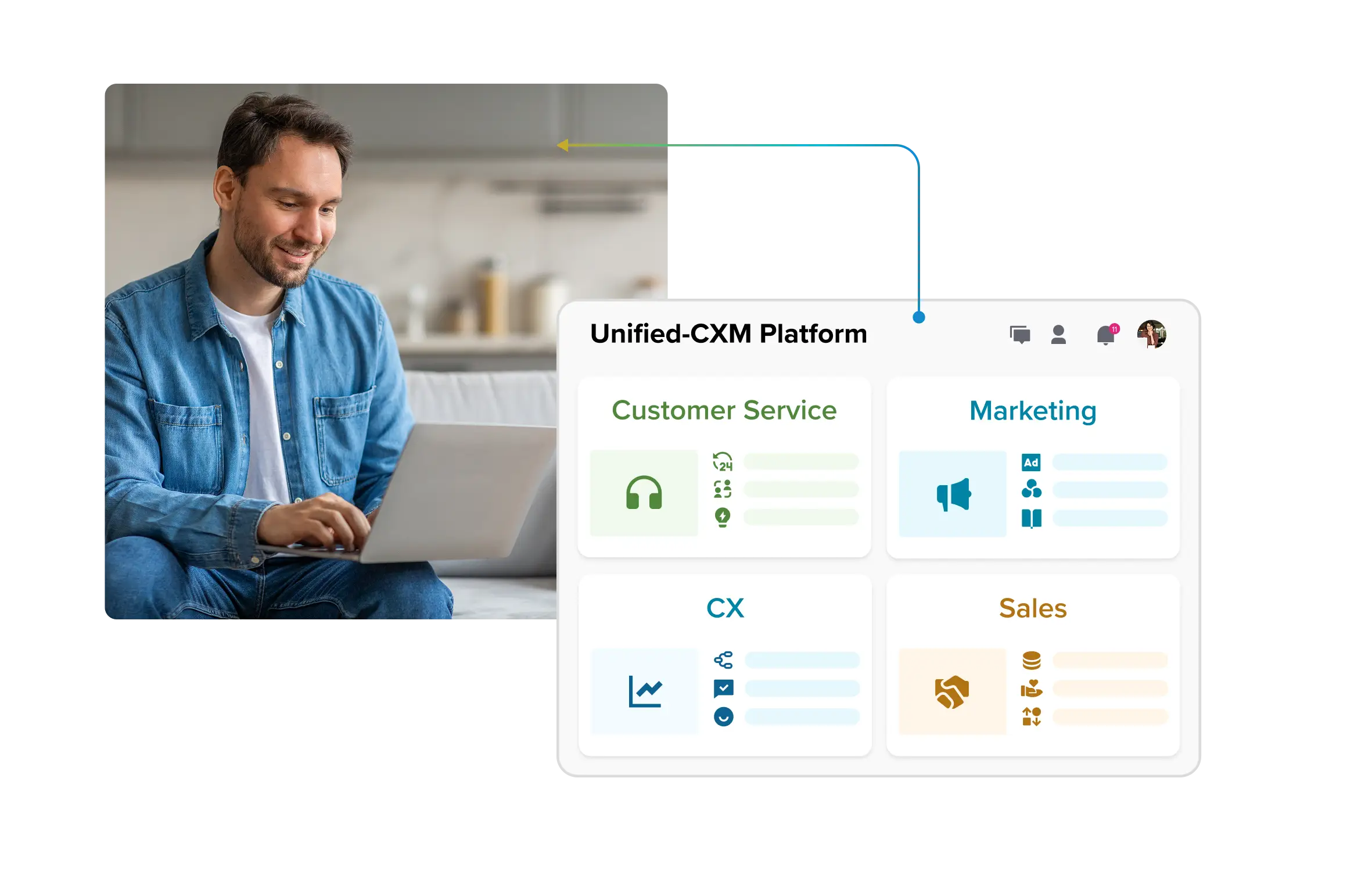
Unify your customer-facing functions — from marketing and sales to customer experience and service — on a customizable, scalable, and fully extensible AI-native platform.




Customer Experience Transformation: 5 Trends Leading the Way
Aishwarya Suresh is an experienced content writer specializing in social media management, social listening, social analytics, Voice of the Customer (VoC) and customer experience. She writes practical, research-backed guides that help brands understand customer conversations, measure social media performance and turn insights into meaningful business decisions.
Jayadeep Subhashis is a senior B2B content specialist and editor with over a decade of experience creating content across blogs, whitepapers, eBooks, case studies, sales enablement assets and account-based marketing campaigns. During his time at Sprinklr, he led editorial strategy for Sprinklr Service, shaping content around customer experience, contact centres, Voice of the Customer and enterprise AI.
Key Takeaways:
- Customer experience transformation is a company-wide redesign of the customer journey, going well beyond patching individual interactions.
- A transformation that lasts rests on four foundations: integrated customer data, a scalable tech stack, aligned teams, and continuous feedback loops.
- Five forces are reshaping CX in 2026: AI and machine learning, customer data and insights, omnichannel integration, immersive AR and VR, and voice and conversational AI.
- AI has moved from generative assistance toward agentic systems that resolve issues on their own, but human judgment and trust still decide where automation belongs.
- The brands pulling ahead are the ones that unify their data and give every team the same view of the customer.
Customer experience transformation is what happens when a brand stops patching customer problems one ticket at a time and starts rebuilding the entire journey around the people living it.
Think about the last brand you recommended to someone. Chances are it wasn't the product that won you over, but how effortless, fast, and human the experience felt. That feeling now moves money. 32% of consumers will walk away from a brand they love after just one bad experience and 52% have stopped buying from a brand altogether because of a poor experience.
Loyalty in 2026 tends to follow the brands that keep earning the next interaction, even when a competitor's product looks similar on paper. This blog breaks down what CX transformation really means, why it's a survival strategy now, and the five trends shaping it in 2026.
- What is customer experience transformation and why is it important?
- How to build a customer experience transformation framework?
- Top 5 trends shaping CX transformation in 2026
- 1. Agentic AI takes the wheel
- 2. Hyper-personalization at scale
- 3. Experience orchestration over channel-stitching
- 4. Proactive and predictive service
- 5. Voice AI and the trust imperative
- Leveraging tools to power consumer experience transformation
- Consumer experience transformation: The journey ahead
What is customer experience transformation and why is it important?
Customer experience transformation is a company-wide shift that aligns your people, processes, and technology to consistently deliver seamless, personalized, and memorable interactions at every touchpoint. It moves the organization from reacting to problems as they surface toward proactively designing the whole journey from the customer's point of view, connecting marketing, sales, and support so a customer deals with one coordinated brand across every touchpoint.
Let’s take Google as an example. With the launch of Gemini (formerly known as BARD), Google redefined how customers interact online. By integrating this advanced AI assistant into Pixel smartphones, Gemini transformed traditional search into a smart, voice-powered assistant experience. Beyond browsing, it enables users to generate text and images through prompts, book tickets, schedule meetings, make calls and more—all in one cohesive interface. This innovation enhanced functionality, set a new standard for customer experience and reshaped what users expect from technology.
But why is customer experience transformation important?
Today, the ability to deliver personalized and seamless interactions has evolved from a nice-to-have to a critical survival strategy. Here’s why.
CX statistics reveal that companies offering highly personalized experiences enjoy stronger loyalty, and in 2026, 71% of consumers now prefer brands that personalize while 76% are frustrated by impersonal interactions.
Customers now reward the brands that deliver and quietly leave the ones that fall short. To stay relevant, brands must treat CX transformation as a strategic priority.
🔖Fuel your foundations: Customer Experience Journey: An Ultimate Guide
Is customer experience transformation the same as digital transformation?
No. Digital transformation modernizes technology and operations across the business. Customer experience transformation is narrower: it puts those tools to work redesigning how customers feel at every touchpoint. A new CRM or mobile app comes from digital transformation, while the decision about how that CRM removes friction for the customer is where CX transformation lives. The strongest programs treat them as partners, using digital investment to fund real experience outcomes.
How to build a customer experience transformation framework?
A strong customer experience transformation framework brings together people, processes and technology to deliver seamless, personalized and impactful customer interactions that result in memorable experiences. Organizations need to focus on a few key components to build such a framework.
1. Data integration: To truly understand your customers and provide meaningful experiences, it’s essential to combine data from multiple customer touchpoints — such as website interactions, social media engagement, customer service inquiries and purchase histories. This unified view of the customer enables precise personalization and more informed decision-making. Modern platforms like customer data platforms (CDPs) and AI-driven CRM systems can consolidate this data into actionable insights while adhering to data privacy regulations like GDPR and CCPA.
2. Technology stack: You must invest in tools that enhance workflows and the customer experience to drive transformation. This includes chatbots or conversational AI for routine query handling, analytics tools for tracking real-time performance metrics and AI-powered systems for sentiment analysis or hyper-personalization. Adopting scalable, cloud-based solutions ensures your technology stack can evolve with future trends and demands.
3. Team alignment: Customers expect consistency across all touchpoints, which means marketing, sales, and customer service teams need to work in harmony. Aligning teams requires cross-functional training to ensure everyone shares a common understanding of the CX vision. Collaboration tools and Unified-CXM platforms can help break down silos, enabling teams to work cohesively and create a seamless customer journey without gaps or miscommunications.
4. Customer feedback loops: Regularly collecting feedback through customer surveys, focus groups and online reviews provides valuable insights into customer pain points, emerging trends and areas for improvement. Organizations should also leverage sentiment analysis tools to extract insights from unstructured data, such as social media comments, customer emails, or call center transcripts. This helps uncover blind spots and ensures the feedback process evolves alongside customer expectations.
How long does a customer experience transformation take?
There's no fixed finish line, and that's the point. Most brands see early wins, like faster response times or a smoother onboarding flow, within a few months of unifying data and fixing high-friction moments. But full transformation is ongoing, because customer expectations keep moving. A useful way to frame it: treat the first 90 days as proving value on one or two journeys, the first year as scaling what worked across channels, and everything after as continuous refinement. The brands that treat CX transformation as a permanent operating model tend to stay ahead, because they keep refining as customer expectations move.
Top 5 trends shaping CX transformation in 2026
Both offline and digital customer experiences have evolved far beyond what they once were. Emerging technologies are revolutionizing how businesses interact with customers, setting new benchmarks yearly. In 2026, the landscape of CX transformation is being driven by these five key trends:
1. Agentic AI takes the wheel
The chatbot era has given way to something more capable. In 2026, the defining shift is agentic AI: systems that interpret intent, pull context, complete multi-step tasks, and resolve issues end to end, escalating to a human only when judgment is genuinely needed. Gartner predicts agentic AI will autonomously resolve 80% of common customer service issues by 2029, and the pressure to get there is already here, with 91% of customer service leaders reporting executive pressure to implement AI in 2026.
What this looks like in practice:
- Autonomous resolution: Agents handle whole requests, from a billing dispute to a rebooking, without bouncing the customer between menus or departments.
- Context that carries: These systems draw on customer history and real-time signals, so people stop repeating themselves at every step.
- Human judgment where it counts: Routine volume goes to AI, freeing agents for the emotionally charged or high-stakes moments that need empathy.
Comcast's Ask Me Anything (AMA) feature was an early sign of where this was heading. Powered by AI, AMA gives agents accurate, context-aware suggestions during live conversations, cutting average handling time by 10% per interaction and saving millions annually while improving customer satisfaction. What was assistive in that case is now becoming autonomous.
What is the difference between generative AI and agentic AI in customer service?
Generative AI produces content: it drafts a reply, summarizes a conversation, or suggests a next step for a human to approve. Agentic AI goes a stage further and takes action on its own, completing a refund, updating an order, or working through a multi-step request without waiting for a person to execute each move. Most brands adopted generative AI between 2023 and 2025. The 2026 story is the move toward agentic systems, and with it a bigger governance question, because the risk shifts from AI saying the wrong thing to AI doing the wrong thing.
2. Hyper-personalization at scale
Personalization stopped being a differentiator and became an expectation. With over 70% of consumers expecting brands to deliver personalized interactions; the brands winning have moved past segment-level messaging toward experiences shaped in real time for each individual, and the payoff is measurable: companies with mature personalization drive roughly 40% more revenue from those efforts than average performers.
- Memory-rich experiences: AI retains context across interactions, so a customer's history informs every touchpoint instead of resetting to zero each time.
- Predictive anticipation: Behavioral signals let brands surface the right offer or solution before a customer asks, reducing churn and lifting retention.
- Personalization built on trust: As data use deepens, transparency and consent become part of the experience, not an afterthought.
L'Oréal shows the upside. Its skin-age diagnostic tool uses advanced analytics to assess skin health and recommend tailored products, tapping into demand for beauty solutions built around individual needs rather than broad demographics.
Build personalization on a foundation of clean, well-governed data. Reliable data improves the experience and protects your brand from compliance and reputational risk at the same time.
🔖Also read: 5 questions to answer about customer insights
3. Experience orchestration over channel-stitching
Connecting channels used to be the goal. In 2026, omnichannel is the floor, and the real work is experience orchestration: designing and managing an end-to-end journey the way you would design a product. Customers move fluidly between app, web, social, and store and expect the thread to hold, which means the priority has shifted from adding channels to coordinating the journey across them.
Omnichannel customer experiences ensure that interactions across platforms — in-store, online, mobile apps or social media — are consistent, cohesive and personalized. The benefits are clear:
- Seamless journeys: A customer might browse on an app, ask a question over social, and finish in-store without losing context along the way.
- A single source of truth: Orchestration unifies customer data across touchpoints so every team acts on the same view.
- Proactive intervention: With the full journey visible, brands can step in at moments of friction rather than waiting for a complaint.
Hugo Boss illustrates the operational payoff. By integrating digital and physical touchpoints and using 3D modeling to compress its creation-to-shelf timeline from a year to six to eight weeks while cutting physical samples by over 30%, the brand delivers faster, more responsive experiences. Consistent 360-degree product views across hugoboss.com, flagship stores, and social channels helped drive a double-digit increase in sales.
Who should own customer experience transformation in an organization?
CX transformation rarely succeeds when it belongs to one department. Because the journey cuts across marketing, sales, service, product, and IT, ownership works best as shared accountability anchored by a senior sponsor, often a Chief Customer Officer or an equivalent CX leader with a cross-functional mandate. That person's job is to align every function around one view of the customer and one set of experience goals. Without that connective role, teams optimize their own slice, and the customer feels the seams between them.
4. Proactive and predictive service
The most valuable service interaction in 2026 is increasingly the one that never has to happen. Instead of waiting for customers to report problems, brands are using behavioral and operational signals to anticipate issues and resolve them before they surface. The business case is concrete, with proactive service strategies shown to cut inbound contact volume by 20 to 30%.
- Fewer avoidable contacts: Anticipating a delayed shipment or a failed payment and reaching out first removes a whole category of frustration.
- Earlier intervention: Silent-churn signals often appear months before a customer leaves, giving proactive teams a window most reactive operations miss.
- Lower cost to serve: Resolving issues before they escalate reduces both ticket volume and the effort each case demands.
This trend moves support from the back end of the journey to the front, turning service from a cost center into a retention engine.
How is proactive customer service different from reactive service?
Reactive service responds after a customer reaches out with a problem. Proactive service uses data to spot the problem first and address it before the customer has to ask. A reactive team learns about a service outage when tickets flood in. A proactive team detects the outage, notifies affected customers with a workaround, and updates them on the fix.
5. Voice AI and the trust imperative
Voice is having a resurgence, reinvented by AI. The rigid, menu-driven IVR is being replaced by Voice AI agents that hold natural, two-way conversations, read sentiment and intent, draw on full customer history, and hand off to a human when needed. The market reflects the momentum: conversational AI is projected to grow from $14.3 billion in 2025 to $17.7 billion in 2026, and on to $78.9 billion by 2033 at a 23.8% CAGR.
- 24/7 natural conversations: Voice agents resolve routine phone queries instantly, without hold times or menu trees.
- Cost efficiency at scale: Automating high-volume calls lowers operating costs while keeping quality consistent.
- The trust layer: As AI takes on more, customers expect transparency about when they are talking to a machine and a clear route to a human. Responsible AI governance has become a differentiator, since roughly only 30% of organizations are mature enough to properly govern autonomous systems.
HotelPlanner.com shows the scale on offer. Its AI travel agents conduct natural, multilingual conversations and, within the first month, processed over 40,000 holiday inquiries and generated £150,000 in room bookings while operating around the clock.
Modern conversational AI platforms make building and managing these agents straightforward. With drag-and-drop design and auto-suggestions, you can deploy bots tailored to your needs, no coding required, that handle interruptions, resume conversations dynamically, and deliver human-like experiences.

Leveraging tools to power consumer experience transformation
The effectiveness of your tech stack can make or break your customer experience (CX) strategy. You must invest in the right tools to deliver seamless, memorable experiences that keep customers returning. Here are five essential technologies that can drive CX transformation and help you stay ahead of the competition:
Customer data platforms (CDPs): CDPs unify customer data from every touchpoint —whether it’s a website, mobile app, email, or social media interaction — to create a single, actionable profile for each customer. By offering a 360-degree view, CDPs empower you to deliver hyper-personalized experiences, anticipate customer needs and use predictive insights to craft more meaningful interactions.
AI-powered analytics tools: AI-led analytics tools analyze large volumes of data to uncover patterns, predict customer behavior, and identify emerging trends. These tools help enterprises stay proactive, tailoring CX strategies to meet evolving customer expectations. For example, real-time sentiment analysis can detect potential customer dissatisfaction during a customer interaction, enabling you to make on-the-spot improvements and optimize the customer journey in real time.
️Feedback management systems: Customer feedback management systems collect and analyze customer input through surveys, reviews and ratings. AI also captures underlying customer sentiments in every feedback. By turning customer opinions into actionable insights, these tools enable brands to refine their offerings and resolve issues quickly, demonstrating that customer voices truly shape the experience.
Sprinklr Surveys go beyond traditional feedback tools. It allows you to track customer feedback across conversations on 30+ digital and social channels — including voice. But that’s just the beginning.
With AI-powered conversational surveys, you can automatically convert survey questions into dynamic conversations by chatbots. This innovative approach combats low response rates and uncovers deeper insights, enabling you to understand better and respond to your customers’ needs.

Unified CXM platform: Sprinklr’s Unified-CXM brings all the above tools under one roof. The platform integrates advanced AI capabilities with a single user interface, allowing you to deliver consistent, personalized experiences across every channel. Collaborative features ensure teams work seamlessly, aligning efforts to create cohesive and satisfying interactions.
Consumer experience transformation: The journey ahead
To stay ahead, you must adopt transformation and align your strategies with the future of CX. Getting there means moving past reactive fixes and building experiences that make customers feel valued at every touchpoint, so your brand sets the pace instead of chasing it.
The key to future-proofing your business lies in choosing the right partners. Sprinklr’s Unified-CXM platform is built on an AI-native architecture that unifies all your channels, tools and data into a single, comprehensive platform. This unified approach provides a 360-degree view of your customers, empowering your teams to deliver seamless, personalized, proactive experiences.
With AI-driven insights at your fingertips and intelligent automation ensuring every interaction is timely and meaningful, you’ll emerge as a customer-first brand that not only meets but exceeds customer expectations.
Schedule a demo today and take your first step toward transforming the customer experience.
Frequently Asked Questions
CX transformation reimagines every customer interaction using advanced technologies, personalization, and a unified approach. Where traditional customer service tends to react to issues as they arise, CX transformation works proactively and holistically to create seamless, consistent, and memorable experiences across all touchpoints.
Key metrics include net promoter score (NPS) to track loyalty, customer satisfaction score (CSAT) for immediate feedback, customer effort score (CES) to measure ease of interaction and customer lifetime value (CLV) to understand long-term revenue impact. Analyzing these metrics provides actionable insights into CX improvements.
Absolutely. Companies prioritizing CX transformation see increased customer retention, higher spending, and stronger loyalty. Brands that lead in customer experience grow revenue up to 80% faster than laggards, making CX a direct driver of enterprise success rather than a support function.
Yes, social media is a powerful tool for CX transformation. It lets brands engage directly with customers, resolve issues in real time, and build authentic connections. Platforms like X and Instagram allow businesses to showcase transparency, earn customer trust, and even crowdsource feedback to refine services.
Enterprises struggle with data silos, which prevent a unified view of the customer. Other challenges include integrating legacy systems, aligning cross-departmental teams, and managing the cost of adopting new technologies. Overcoming these barriers requires robust data strategies, cohesive leadership, and scalable CX platforms.
Aishwarya Suresh is an experienced content writer specializing in social media management, social listening, social analytics, Voice of the Customer (VoC) and customer experience. She writes practical, research-backed guides that help brands understand customer conversations, measure social media performance and turn insights into meaningful business decisions.
Jayadeep Subhashis is a senior B2B content specialist and editor with over a decade of experience creating content across blogs, whitepapers, eBooks, case studies, sales enablement assets and account-based marketing campaigns. During his time at Sprinklr, he led editorial strategy for Sprinklr Service, shaping content around customer experience, contact centres, Voice of the Customer and enterprise AI.