






The strategic AI-native platform for customer experience management
Unify your customer-facing functions — from marketing and sales to customer experience and service — on a customizable, scalable, and fully extensible AI-native platform.




7 Examples That Show Why Hyper Personalization is the New CX Standard
Bhavya Aggarwal is a freelance tech and marketing content writer with over five years of experience, and a favoured guest contributor to the Sprinklr blog. He specialises in emerging technology and CX, with deep coverage of agentic AI across insurance, finance, manufacturing and healthcare, alongside social listening, VoC dashboards and customer service. His work has been featured by publications including Gartner, YourStory and Capterra.
Jayadeep Subhashis is a senior B2B content specialist and editor with over a decade of experience creating content across blogs, whitepapers, eBooks, case studies, sales enablement assets and account-based marketing campaigns. During his time at Sprinklr, he led editorial strategy for Sprinklr Service, shaping content around customer experience, contact centres, Voice of the Customer and enterprise AI.
When products, pricing, and features converge (as they increasingly do), customer experience becomes the only durable differentiator. And in moments of choice, customers don’t remember who had the longest feature list. They remember who understood them.
That shift has pushed enterprises beyond surface-level personalization into the era of hyper-personalized customer experience, where every customer interaction is shaped by real-time context, behavioral signals, intent, and history. Hyper-personalization is about recognizing who the customer is, what they are trying to accomplish right now, and how the brand should respond in that moment.
The business could not be clearer. Research consistently shows that personalized experiences can reduce customer churn by nearly 15%, while 58% of U.S. consumers are willing to pay more for brands that deliver relevant, tailored interactions. Yet despite widespread investment, many organizations plateau because their personalization efforts remain fragmented across channels, teams, and tools.
In this article, we examine eight real-world examples of hyper-personalization in CX, breaking down how leading enterprises operationalize data, AI-driven decisioning, and journey orchestration to deliver truly hyper-personalized experiences at scale. More importantly, we reverse-engineer what’s happening behind the scenes so you can understand not just what worked, but also how to apply similar strategies within your own customer experience ecosystems.
What “hyper-personalized customer experience” really means
A hyper-personalized customer experience goes far beyond segment-based marketing or rules-driven personalization. Traditional approaches group customers into static cohorts and rely on scheduled touchpoints such as monthly newsletters, quarterly promotions, or tier-based offers. While efficient, these models assume customer intent is predictable and stable. It rarely is.
Hyper-personalization replaces static assumptions with real-time understanding. Every interaction is shaped by a continuously updated view of the individual, drawing on behavioral signals (browsing paths, search queries, dwell time, service history), expressed preferences (channel affinity, price sensitivity, product usage), and situational context (device, location, time of day, stage in the journey).
The difference is not subtle. Traditional personalization might send the same discount to every customer in a loyalty tier. Customer experience hyper-personalization, on the other hand, determines whether a message should be sent at all, and if so, what, when, and through which channel, based on what the customer is trying to accomplish in that exact moment.
At scale, a hyper-personalized experience depends on systems that can infer intent dynamically rather than just react to predefined triggers. These systems continuously evaluate signals across channels and decide the next-best action: a proactive recommendation, a contextual in-app nudge, a knowledge base article surfaced to an agent, or a service intervention that prevents friction before the customer asks.
📌Executive takeaway
It’s important to understand that hyper-personalization is ultimately a decisioning problem, not a content problem. Delivering it well requires more than data. It requires orchestration across channels, real-time analytics, AI-driven decision logic, and clear governance to ensure relevance without crossing trust boundaries. Understanding these elements is essential before examining how you put hyper-personalization in CX into practice.
Core elements of hyper-personalized customer experience
No single capability creates hyper-personalization. The outcome emerges when several elements work together in a single flow.
- A unified, real-time customer intelligence layer
Hyper-personalization begins with first-party data unified in real-time, not batch-synced profiles updated hours or days later. Behavioral events, transactional data, and service interactions must be stitched together through identity resolution and event streaming so the organization operates from a single, continuously evolving customer truth.
If a customer browses a product, abandons a cart, contacts support, and returns via a mobile app, the system must recognize this as a single customer journey — not four disconnected interactions. Without this foundation, personalization collapses into guesswork.
- Intent inference and next-best-action decisioning
What differentiates hyper-personalization from advanced personalization is decisioning. Systems must infer intent from live signals such as navigation patterns, search behavior, friction points, sentiment shifts, and journey stage, and determine the next-best action in the moment.
That action might be a recommendation, a proactive service message, a change in routing logic, or no action at all. Knowing when not to intervene is just as critical as knowing when to engage.
- Contextual signal orchestration
Hyper-personalized experiences are shaped by context, not just preference. Device type, location, time of day, connectivity, and recency of interaction all influence how an experience should be delivered.
- Dynamic experience and content assembly
At scale, hyper-personalization cannot rely on pre-built journeys or static content variants. AI-driven systems dynamically assemble experiences — copy, layouts, offers, recommendations, and service guidance — based on inferred intent and real-time constraints.
In service environments, this often shows up as agent-assist recommendations, dynamically surfaced knowledge, or adaptive scripts that evolve as the conversation unfolds. The experience adjusts continuously, not just at predefined checkpoints.
Governance, consent, and trust by design
Hyper-personalization only works when customers trust it. That trust is maintained through clear governance frameworks that cover data use, consent, model behavior, and explainability.
Leading enterprises embed consent management, data minimization, and transparency directly into their personalization systems. This prevents “creepy” experiences, reduces regulatory risk, and ensures personalization enhances the brand rather than undermining it.
7 real-world examples of hyper-personalization in customer experience
Hyper-personalization varies by problem and context. The examples below illustrate distinct strategies where data, models, and real-time signals combine to deliver personalized experiences tailored to each individual.
1. Netflix: Real-time homepages built around viewing intent
Netflix delivers one of the clearest real-world demonstrations of a hyper-personalized customer experience — because for them, personalization is not a feature; it is the product.
The signal
Netflix continuously captures real-time behavioral signals: viewing history, watch duration, completion rates, pause/rewind behavior, time of day, device type, and even how quickly a user abandons a title. Importantly, these signals are interpreted as intent rather than static preference.
A customer who binge-watches crime documentaries late at night signals something very different from one who samples a comedy during a weekday lunch break — even if both fall into the same demographic segment.
The decision
Instead of relying on predefined segments, Netflix uses real-time decisioning models to determine:
- Which rows appear on the homepage
- The order in which those rows are displayed
- Which titles surface first within each row
- Which artwork variant represents the same title for a specific user
This means two users searching for the same show may see entirely different visuals and positioning, based on what Netflix believes will trigger engagement in that moment.
The experience
What the customer experiences feels intuitive, not engineered:
- Homepages are dynamically reordered every session.
- “Continue Watching,” and recommendation rows evolve in near real-time.
- Artwork changes to emphasize characters, moods, or genres that the user historically responds to.
This is customer experience hyper-personalization in its purest form: the interface itself adapts continuously, without ever asking the customer to configure preferences.
The CX impact
Netflix’s approach reduces decision fatigue, shortens time-to-content, and increases completion rates — all critical drivers of customer retention in subscription businesses. More importantly, personalization never feels intrusive because it’s rooted in behavioral relevance, not inferred personal data.
2. Amazon: Contextual commerce driven by real-time intent
Amazon’s strength in hyper-personalized customer experience lies in how deeply personalization is embedded across the entire commerce journey, not just discovery.
The signal
Amazon captures a dense stream of real-time and historical signals: browsing depth, search refinements, dwell time, cart edits, past purchases, reorder cadence, delivery preferences, device type, and even hesitation signals such as repeated comparison or cart abandonment.
Crucially, these signals are interpreted as purchase intent and readiness, not just interest.
The decision
Using real-time decisioning, Amazon continuously determines:
- Which products to recommend (“Inspired by your browsing”)
- What bundles to assemble (“Frequently bought together”)
- When to prompt replenishment or reorders
- Whether to emphasize speed, price, or availability in that moment
Two customers viewing the same product can receive entirely different recommendations, bundles, or follow-up prompts based on where they are in their decision journey.
The experience
From the customer’s perspective, personalization feels seamlessly woven in:
- Product pages dynamically adapt recommendations.
- Cart experiences surface complementary items contextually.
- Post-purchase journeys trigger timely reorder nudges or accessories.
- The homepage reshapes itself every visit based on recent activity.
This is customer experience hyper-personalization applied not as messaging, but as real-time merchandising and journey orchestration.
The CX impact
Amazon reduces friction at every step — shortening decision cycles, increasing average order value, and reinforcing habit-driven loyalty. Importantly, personalization rarely feels promotional. It feels helpful because it is grounded in the immediate context.
3. Spotify: Moment-based personalization that adapts in real-time
Spotify shows that hyper-personalization can go beyond mere utility to create emotional connections, all without feeling intrusive.
The signal
Spotify captures continuous behavioral signals: listening history, skips, replays, playlist additions, time of day, device used, location patterns, and even session length. These signals aren’t treated as static music preferences; they’re interpreted as moment-based intent.
What a user listens to during a morning commute signals something very different from late-night listening or weekend background play.
The decision
Spotify’s models infer what kind of moment the listener is in and dynamically decide:
- Which playlists to surface (focus, commute, workout, unwind)
- How to reorder the home screen in real time
- When to introduce new artists versus familiar tracks
- How frequently should recommendations be refreshed without overwhelming the user
Daylist is a strong example: the same user sees playlists that change multiple times a day based on evolving listening context.
To the listener, the experience feels uncannily in sync:
- Weekly updates based on evolving taste, not fixed genres.
- Home screens shift over time, based on behavior and momentum.
- Playlist names, descriptions, and sequencing are automatically adjusted.
The CX impact
Spotify reduces discovery fatigue while strengthening emotional attachment to the brand. Users don’t feel “targeted”; they feel understood. That emotional resonance is a major reason Spotify maintains high customer engagement in an otherwise commoditized streaming market.
4. Duolingo: Adaptive journeys that personalize for learning momentum
Duolingo applies hyper-personalized customer experience principles to a domain where personalization must do more than engage; it must change behavior. Learning outcomes depend on relevance, pacing, and motivation, all of which vary widely by individual.
The signal
Duolingo captures granular learning signals in real time: error patterns, response speed, repetition frequency, skipped exercises, streak consistency, time of day, and device usage. These signals indicate not just proficiency, but cognitive load and motivation.
A learner struggling with verb conjugation signals a different need than one rushing through exercises to maintain a streak — even if both are at the same nominal level.
The decision
Rather than enforcing a fixed curriculum, Duolingo’s systems continuously decide:
- Which skill to reinforce next
- When to introduce new concepts versus reinforce fundamentals
- How difficult should the next exercise be
- When to deploy motivational nudges versus instructional support
These decisions are recalculated after nearly every interaction, allowing the learning path to adapt in-session.
The experience
The experience feels responsive rather than corrective:
- Lesson paths shift based on mistakes and mastery signals.
- Exercise difficulty adjusts dynamically.
- Streak reminders and nudges align with individual engagement patterns.
- Feedback feels encouraging, not punitive.
This is customer experience hyper-personalization applied to progression design where the product adapts to the learner, not the other way around.
The CX impact
Duolingo increases retention by aligning the experience with each learner’s capacity and motivation in the moment. Instead of overwhelming users or letting them stagnate, the platform sustains momentum, one of the hardest challenges in self-directed learning.
5. Starbucks: Hyper-personalization that bridges digital and physical CX
Long before personalization became a technology arms race, Starbucks understood a simple truth: people respond to being recognized.
Writing a customer’s name on a coffee cup may seem trivial. But at Starbucks’ scale — tens of thousands of stores, millions of daily transactions — it represents one of the earliest and most disciplined forms of hyper-personalized customer experience in physical retail.
The signal
The signal here isn’t digital. It’s human. A spoken name, a repeat order, a familiar face, a time-of-day routine. When a barista asks for your name, Starbucks captures a lightweight identity marker that anchors the interaction. Over time, that identity becomes richer, linked to ordering habits, visit frequency, preferred locations, and increasingly, app-based behavior.
The decision
The decision Starbucks makes is subtle but powerful: recognition over anonymity.
Instead of treating customers as transaction numbers, the system — human and digital — decides to acknowledge individuality in every interaction. In the app era, this decision scales further:
- Names and favorite orders surface automatically
- Personalized offers are tied to habitual behavior.
- Order-ahead ensures the name follows the customer from the mobile screen to the pick-up counter.
The handwritten name becomes the physical-world equivalent of a persistent customer profile.
The experience
For customers, the experience feels personal without being invasive:
- Your usual order is remembered; sometimes without asking.
- The app reflects familiarity without demanding attention.
- In-store and digital experiences reinforce each other seamlessly.
The CX impact
Starbucks increases repeat visits by fitting naturally into customers’ daily routines. Personalization doesn’t demand attention; it quietly removes friction and saves time. That consistency builds customer trust and habit, which are far more durable than one-time promotional lift.
6. Grammarly: Personalized performance intelligence
Grammarly’s Weekly Premium update is a powerful example of a hyper-personalized customer experience delivered through email without relying on offers, promotions, or behavioral nudging.
Instead of asking users to do more, Grammarly shows them what they already did, how it compares, and where they can improve next.
What makes this hyper-personalization
At first glance, Grammarly’s weekly email looks simple. In reality, it is built on continuous behavioral analysis across millions of writing moments.
Each update is generated from:
- Writing volume and frequency
- Accuracy and error categories
- Vocabulary diversity and tone shifts
- Productivity trends over time
- Tool usage across apps, browsers, and documents
These signals are aggregated into individual performance narratives rather than generic benchmarks.
The decision
Rather than sending a static summary, Grammarly’s system decides:
- Which metrics matter most to that user
- How to frame progress (improvement vs opportunity)
- What is the next area of focus?
- Whether to emphasize productivity, clarity, correctness, or tone
The experience
The result feels reflective, not intrusive:
- Personalized stats replace generic tips.
- Progress is framed visually and contextually.
- Recommendations feel earned, not pushed.
- The email reinforces value without demanding action.
This is customer experience hyper-personalization that respects attention and reinforces trust. Grammarly doesn’t interrupt workflows; it interprets them.
The CX impact
Grammarly demonstrates a critical principle: hyper-personalization doesn’t always need to be real-time or in-session. When done well, periodic, insight-rich personalization can be just as powerful, especially for professional and productivity-focused audiences.
7. Sephora: Hyper-personalized discovery meets assisted selling
Sephora delivers a hyper-personalized customer experience in a category where choice overload is the norm and confidence is fragile. With thousands of SKUs, personalization here is about helping customers find what works for them.
The signal
Sephora captures a blend of explicit and implicit signals: beauty profile attributes (skin type, tone, concerns), browsing and purchase history, product reviews, shade matching interactions, virtual try-on behavior, and in-store consultation data. These signals, more than preferences, reveal confidence gaps and decision-readiness.
The decision
Sephora’s systems use this intelligence to decide:
- Which products and shades to recommend
- How to rank search results and category listings
- When to introduce virtual try-on or tutorials
- How in-store advisors should tailor consultations
Personalization decisions evolve as customers experiment, compare, and learn across both digital and physical channels.
The experience
The experience feels consultative, not promotional:
- Product recommendations align with individual skin profiles.
- Virtual try-on reduces trial anxiety and returns.
- Routines and collections are tailored to personal goals.
- In-store associates can pick up where digital exploration left off.
This is hyper-personalization in CX that supports decision confidence, not just convenience.
The CX impact
Sephora reduces friction in a high-consideration journey by making customers feel understood rather than sold to. Personalization bridges self-serve discovery and human expertise, creating continuity instead of repetition.
Mass personalization had its moment. Then, customers moved on.
Personalization was once a differentiator, but now it’s a basic expectation. CX expert and bestselling author Dan Gingiss discusses why traditional mass personalization, such as segments, templates, and generic journeys, no longer builds customer loyalty. In this short video, he reveals how creating lasting customer experiences now hinges on real-time relevance, not just broad reach.
Scaling hyper-personalized customer experience with Sprinklr
Hyper-personalization breaks down when customer experience is treated as a collection of channels, tools, and teams — each optimizing its own slice of the journey. What the examples in this article make clear is that hyper-personalized customer experience requires a single system of intelligence, not fragmented execution.
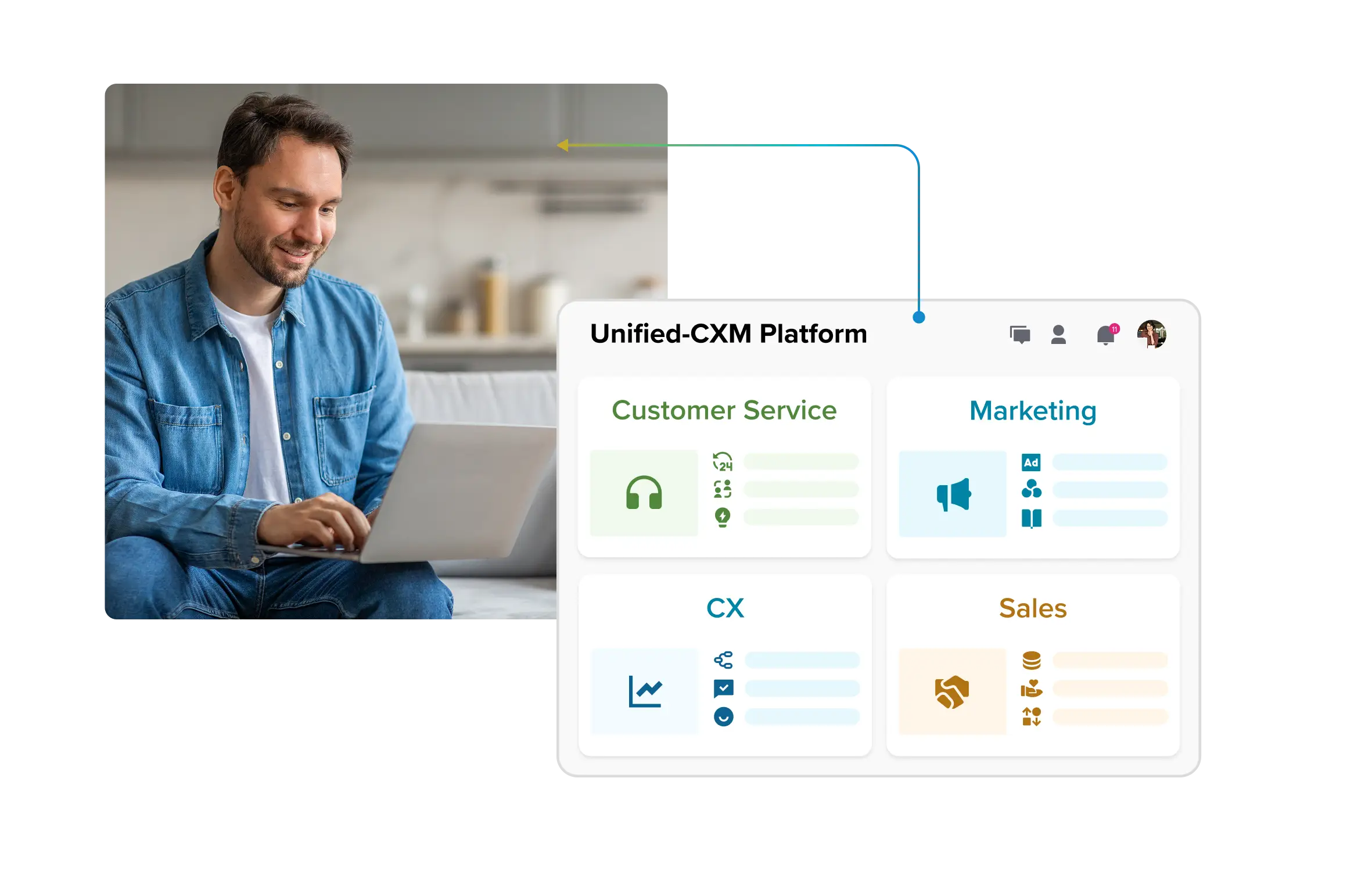
Sprinklr approaches hyper-personalization through its Unified-CXM platform, which brings together customer conversations, real-time signals, AI decisioning, agent experiences, analytics, and governance on a shared intelligence layer. Whether the interaction happens on chat, social, messaging, voice, or in-app, every signal informs the next decision, ensuring personalization is consistent, contextual, and scalable.
When CX operates as one system, hyper-personalization stops being an exception and becomes the default. See how leading enterprises operationalize hyper-personalized customer experience with Sprinklr Unified-CXM.
Frequently Asked Questions
Traditional personalization groups customers into segments and tailors content for each group. Hyper-personalization uses real-time data, AI and behavioral analysis to tailor experiences at the individual level. It dynamically adjusts recommendations, tone and timing, ensuring every interaction feels unique and fresh.
Hyper-personalization relies on technologies like artificial intelligence, machine learning, customer data platforms and predictive analytics. These systems process real-time signals from multiple channels to personalize messages, offers and service journeys instantly.
Yes. Real-time events are essential for hyper-personalization because they enable brands to respond to changing customer intent. By capturing live signals, like clicks, location or sentiment, AI systems deliver the right message or action at the exact moment it matters.
Hyper-personalization improves loyalty and satisfaction by making customers feel recognized and understood. When experiences align with their intent, frustration decreases and trust increases. Studies show that customers are more likely to repurchase and recommend brands that personalize meaningfully.
Personalization tactics decay as customer behavior and market conditions shift. Most enterprises refresh models every 30 to 90 days, depending on data volume and velocity. Continuous monitoring ensures AI systems stay accurate, responsive and aligned with evolving customer expectations.
Bhavya Aggarwal is a freelance tech and marketing content writer with over five years of experience, and a favoured guest contributor to the Sprinklr blog. He specialises in emerging technology and CX, with deep coverage of agentic AI across insurance, finance, manufacturing and healthcare, alongside social listening, VoC dashboards and customer service. His work has been featured by publications including Gartner, YourStory and Capterra.
Jayadeep Subhashis is a senior B2B content specialist and editor with over a decade of experience creating content across blogs, whitepapers, eBooks, case studies, sales enablement assets and account-based marketing campaigns. During his time at Sprinklr, he led editorial strategy for Sprinklr Service, shaping content around customer experience, contact centres, Voice of the Customer and enterprise AI.

