



Elevate CX with unified, enterprise-grade listening
Sprinklr Insights gives you real-time consumer, competitor and market intelligence from 30+ channels without the noise. Make smarter decisions, strengthen your brand, and stay relentlessly customer-led.




VoC Templates to Help You Capture, Classify, and Act on Customer Signals

Ask any Chief Customer Officer what keeps them up at night, and the answer rarely changes: We have more customer data than ever. So why is it still so hard to make confident, customer-led decisions?
The truth is, most organizations aren’t suffering from a feedback deficit. They’re suffering from a feedback clarity problem. Insights live in silos, scorecards lack context, and customer narratives get reduced to trend lines. When data is fragmented, decisions become fragmented, and so does the customer experience.
A well-designed Voice of the Customer (VoC) template is one of the most underrated executive tools to fix this. Not a basic survey outline, but a structured, enterprise-grade model that standardizes how feedback is captured, organized, synthesized, and elevated to the C-suite.
In this guide, we’ll unpack how modern VoC templates are built, what they unlock for CCOs and CX leaders, and share enterprise-ready examples you can adapt to your own strategy. Whether you’re aligning product and CX around the same customer truth, tightening your quarterly business reviews, or driving organization-wide customer obsession, the right template gives you something invaluable: decision-quality insight delivered consistently, across every touchpoint.
Because when your VoC template is strong, your strategy is strong.
What is a Voice of the Customer (VoC) template?
A voice of the customer (VoC) template is a structured framework that helps you collect, categorize, and interpret customer feedback in a consistent, repeatable way. At an enterprise level, it serves as the vital link between raw customer signals and the business decisions those signals need to shape. It defines what feedback you capture, how you capture it, and how teams are expected to use it.
When built right, it forces clarity around customer expectations, standardizes feedback across communication channels, and ensures every stakeholder — from product to CX to marketing — speaks the same “customer language.”
Unfortunately, this is where most organizations fall short.
Why do most teams get it wrong?
1. They confuse templates with forms.
Most VoC templates floating around are glorified questionnaires — tactically useful, strategically empty. They capture responses, not insights. An actual VoC template should plug directly into analysis workflows, not just data collection.
2. They only capture symptoms, not drivers.
Teams often focus on scores (NPS, CSAT, CES) without collecting contextual data: effort points, friction drivers, emotional signals, or root causes. Without structured metadata, your VoC template becomes a mere scoreboard, not a diagnostic tool.
3. They fail to unify multi-channel feedback.
Enterprises capture feedback across customer surveys, support tickets, community forums, social channels, product usage data, and frontline conversations. Most templates aren’t designed to normalize these inputs, so every function ends up interpreting “customer truth” differently.
4. They don’t evolve with the customer journey.
Static templates quickly become obsolete. Customer expectations shift, products change, digital customer experiences evolve, and templates must reflect that. High-performing CX teams treat VoC templates as living artifacts.
Survey Templates vs. insight templates vs. VoC dashboards
Criteria | Survey template | Insight template | VoC dashboard |
What it is | A structured set of standardized questions sent at specific touchpoints through channels like email, in-product prompts, SMS, live chat, or IVR. | A framework for organizing, tagging, and synthesizing qualitative feedback from any channel such as support tickets, interviews, social, reviews, transcripts, usage signals and more. | A live customer analytics view that consolidates multichannel feedback into role-based dashboards for CX, product, and executive teams. |
Primary purpose | To collect customer feedback consistently at the moment of experience. | To transform raw feedback into structured, comparable insights. | To monitor KPIs, diagnose issues, and inform executive-level decisions |
What it captures | NPS/CES/CSAT scores, sentiment indicators, transactional feedback, and limited context metadata. | Pain points, themes, root causes, drivers, emotion markers, verbatims coded with consistent taxonomy. | Aggregated KPIs, trends, segmentation, journey-level friction, sentiment shifts, alerts, and drill-down views. |
X Voice of the customer templates every CX team needs
When most leaders hear the term “voice of the customer (VoC) template,” they imagine a one-page survey or a feedback form. But in real enterprise environments, where experiences span channels, journeys, and teams, a single template is never enough. Mature VoC programs rely on a family of templates, each designed to capture a different signal and convert it into a different layer of customer intelligence.
Let’s explore how these templates naturally emerge in high-performing organizations.
1. Survey templates: Capturing the moment of experience
In most enterprises, the first VoC template that takes shape is the survey template. It usually starts innocently: a CSAT survey here, an NPS pulse there, a post-support survey sent out of a helpdesk platform. Over time, these fragments multiply. Every team starts crafting its own version because there’s no standard.
You’ve likely seen this in your own organization — five versions of a “quick feedback survey” floating around, each with different questions, different scales, and no consistent metadata. As a result, you collect plenty of feedback, but none of it aligns well enough to tell a clean story.
A standardized survey template fixes this by creating a common measurement language. It ensures every transactional or relational pulse is built the same way, so comparisons make sense and trends become meaningful. When the first 30 days of onboarding suddenly show a dip in satisfaction, you know it’s a real signal, and not a byproduct of inconsistent templates.
2. Insight-capture templates: Turning raw feedback into structured intelligence
Quantitative scores are useful, but they rarely explain why something is happening. This is where insight-capture templates become indispensable.
Most enterprises reach a point where the volume of qualitative feedback, such as support notes, interview transcripts, call logs, community posts, and internal escalations, becomes overwhelming. The intelligence is there, but frontline teams capture it differently. One agent might write “login issue,” another “access blocked,” another “can’t sign in.” All three mean the same thing, but without structure, they never roll up into a meaningful trend.
An insight-capture template brings order to this chaos. It introduces a standard set of categories, tags, emotional markers, and root-cause fields. Patterns become visible. Operational improvements become obvious. And leadership finally gets to see the why behind every score movement.
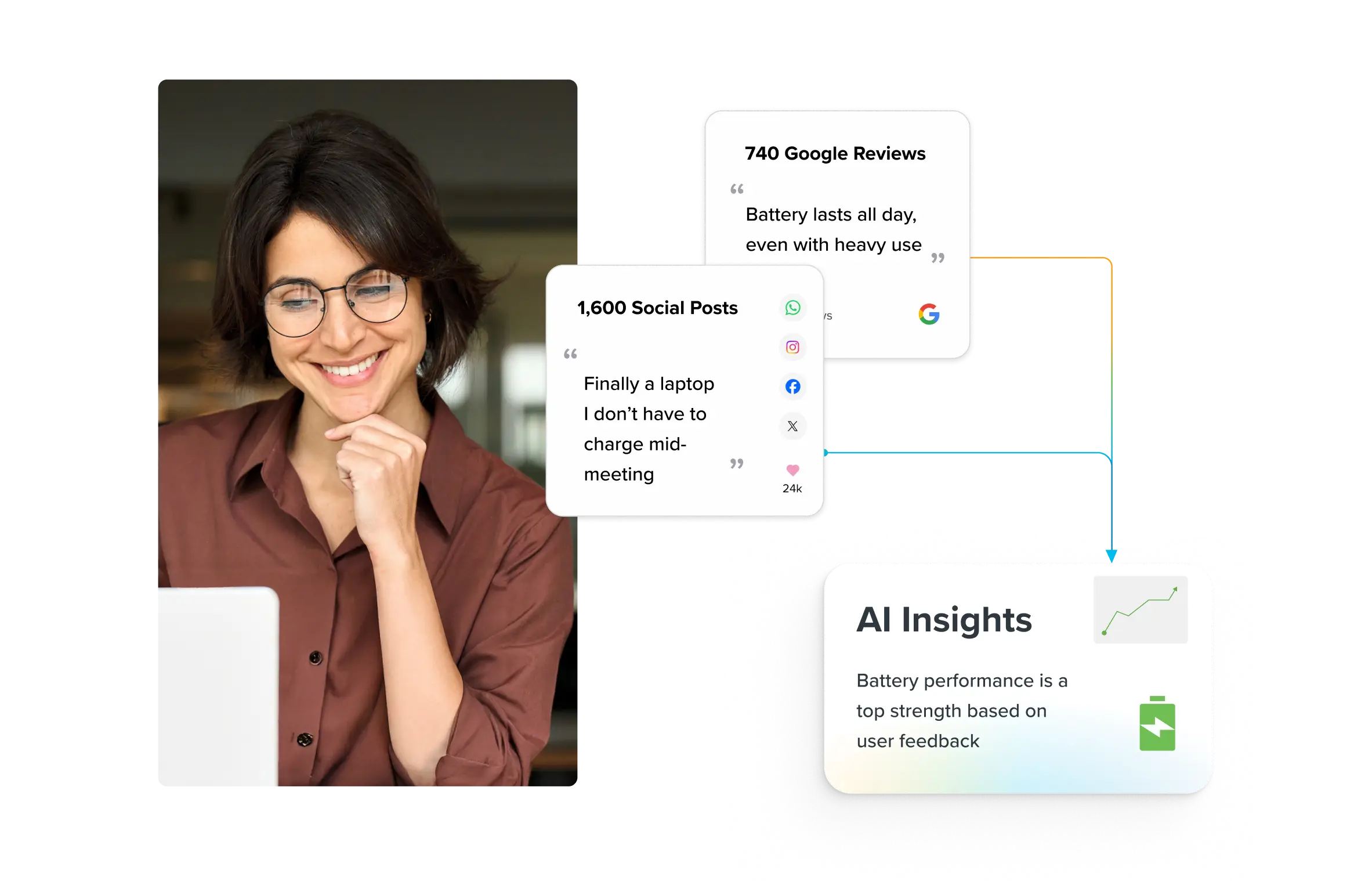
If you're looking to go even further, Sprinklr's customer feedback management software, "Sprinklr Surveys," helps automate everything this template aims to achieve. Powered by Sprinklr AI, the platform can detect root causes, classify themes, and surface emerging experience drivers, often without any manual setup or configuration. It's the same discipline behind insight-capture templates, but scaled across channels, teams, and millions of customer interactions.

3. Journey-specific templates: Making feedback make sense in context
As VoC programs mature, another realization hits: customers don’t experience your company through isolated moments. They experience it as a journey. Yet most feedback comes through channels such as surveys, chat, support, email, and journey stages.
This creates blind spots. You might know your CSAT is dropping, but not where in the journey the friction begins. Is it onboarding? Adoption? Billing? Support? Renewal?
Journey-specific VoC templates fill this gap by mapping feedback to the customer’s progression rather than the channel they used. They ask questions tailored to each stage: clarity during onboarding, usability during adoption, transparency during billing, and responsiveness during support.
Once you start capturing feedback in the journey context, it becomes much easier to isolate the “moments that matter” and to fix them before they become structural weaknesses.
4. Closed-loop actioning templates: Making feedback actually matter
Every enterprise eventually confronts the uncomfortable truth: collecting feedback is easy. Acting on it consistently is hard.
What typically happens is this: detractors sometimes get follow-ups, depending on who notices the feedback. Product insights occasionally make it into the roadmap. Some issues get escalated; others get lost. Nothing is malicious, but the system is unstructured.
Closed-loop actioning templates solve this by defining a consistent process for acknowledgment, diagnosis, ownership, follow-through, and closure. They make it clear how teams should respond, what information should be documented, who is accountable, and what “resolution” actually means.
When actioning is templatized, customers feel heard, teams stay aligned, and VoC begins to influence operational behavior rather than being reported on.
Platforms like Sprinklr Insights take this discipline even further by introducing real-time intelligence into the loop. Instead of waiting for someone to notice a dip in experience scores or a spike in negative sentiment, smart alerts surface these shifts automatically, the moment they occur.
As a result, you can consolidate review feedback from hundreds of domains, unify signals, and route insights to the right teams with recommended next actions. That means sales see emerging objections earlier, product learns about friction faster, customer service gets ahead of crises, and R&D has clearer visibility into recurring pain points.

5. Executive VoC reporting templates: Elevating signals into strategy
Eventually, all roads in a VoC program lead to the executive team. This is where you realize you need a different kind of template altogether — one built not to collect insight, but to distill it.
Executives don’t need dashboards with a hundred metrics. They need a narrative that clearly answers:
- What changed in customer perception?
- Why is it happening?
- Which segments are most impacted?
- What are the emerging friction drivers?
- What decisions or investments are recommended next?
An executive VoC reporting template ensures that, every quarter, your organization rallies around a clear, shared understanding of customer reality and the decisions needed to improve it.
6. Product and innovation templates: Translating feedback into better products
Product teams often receive more feedback than any other function — but without structure, it becomes impossible to prioritize. One customer wants Feature A, another pushes for Feature B, and internal teams champion C or D.
A product feedback template introduces a consistent rubric: customer impact, frequency, segment importance, revenue implication, and engineering effort. When every idea is evaluated through the same lens, roadmap planning shifts from opinion-driven debates to insight-driven decisions.
Must Read: Voice of Customer: 5 Examples to Learn From (+ How to Start Yours)
How to customize voice of the customer templates for different channels
One of the biggest misunderstandings in VoC design is the belief that a single template can “scale across every channel.” It can’t, and it shouldn’t. Customers express themselves differently depending on where they are and how they’re engaging with your brand. A great VoC template respects these channel behaviors instead of fighting them.
The best CX teams don’t reinvent the template for every medium; they keep the spine consistent while tailoring the outer shell to the channel’s natural strengths. Here’s what that looks like in practice.
1. Email: The channel for reflection, not reaction
Email gives customers a moment to pause, think, and articulate their experience with more context. This is why email templates usually perform best for:
- Relational NPS
- Post-purchase reflection
- Post-onboarding check-ins
- “Tell us more” open-ended questions
When customizing email templates, the goal is to invite narrative rather than rush it. That means fewer scale-only questions and more prompts that encourage reflection.
How the template adapts:
- A slightly longer form is acceptable
- Clear framing for why their feedback matters
- Open-ended questions worded to encourage depth (“What nearly stopped you from finishing…?”)
The spine stays consistent — still structured, still tagged — but the tone shifts to something warmer and more expansive.
2. In-product: The channel for precision and speed
In-product feedback is about catching the moment of truth while the experience is still fresh, often seconds after the action. You’re not looking for paragraphs; you’re looking for signals.
The best in-product templates are short, sharp, and context-aware. A CES question after a task. A quick CSAT after using a new feature. A binary “Did this help?” after a knowledge article.
How the template adapts:
- Two to three core questions max
- Pre-populated metadata (feature ID, user role, device, path)
- A single optional open text field
This is feedback as telemetry — low friction, high signal, real-time.
3. Chat and messaging: The channel for conversational insight
Chat environments create a unique psychological effect: customers are already typing, already engaged, already in “micro-conversation” mode. This makes chat ideal for capturing spontaneous insights.
Instead of dropping a rigid survey in chat, advanced teams use conversational templates that adapt dynamically:
- “Was this conversation helpful?”
- “What could we have done differently?”
- “Is your issue fully resolved?”
The key here is emotional relevance. Customers often express sentiment more openly in chat because it feels personal.
How the template adapts:
- Questions feel conversational, not questionnaire-like
- Templates include micro-prompts to draw out context
- Automated tagging enhances insight without burdening the user
📌 Good Read: Conversational Surveys: The Modern Approach to Understanding Customers
4. SMS: The channel for brevity and clarity
SMS is unforgiving. You get one shot, one question, maybe two — and that’s it. The experience must be minimal, immediate, and mobile-native.
Enterprises use SMS templates when:
- Response windows are tight
- The action is simple (like a delivery or service visit)
- Customers are on the move
How the template adapts:
- One primary question (usually CSAT or CES)
- One optional free-text field
- Absolutely no long URLs or multi-step flows
The art of SMS feedback is mastering the “micro moment.”
5. Social and community: The channels you don’t control
Unlike email or in-product channels, social platforms and communities give you no control over structure. Here, the template doesn’t shape what customers say; it shapes how your teams interpret what they say.
This is where social listening templates and coding templates become crucial:
- Identifying themes
- Tagging customer sentiment consistently
- Distinguishing noise from patterns
- Mapping signals back to journey stages
How the template adapts:
- Framework is built for internal use
- Template emphasizes classification, context, and escalation path
- Standardizes how user-generated content becomes insight
6. Contact center and voice: The channel of unscripted emotion
Voice interactions carry more emotional weight than any other channel. If your template here looks like your email or in-app template, you’re missing the richest signal in your ecosystem.
For phone and voice AI channels, the best VoC templates focus on:
- Emotional tone
- Frustration markers
- Escalation triggers
- Time to resolution
- “What the customer said” vs. “what the agent captured”
How the template adapts:
- Insights captured post-call follow a structured rubric
- Emotion and root-cause fields are mandatory
- Transcription tools auto-populate verbatims, leaving agents to interpret meaning
Sprinklr’s conversational analytics software enables you to understand true customer sentiment by analyzing both speech and text conversations in real time using Sprinklr AI. You can identify sentiment trends linked to specific contact drivers and agent performance, helping you uncover hidden root causes.
Additionally, you can categorize customer conversations by key topics, enabling you to monitor contact center performance across these areas. This data-driven approach empowers you to enhance every interaction and improve the overall customer experience.

The future of VoC templates: From static forms to AI signals
For decades, VoC templates were built around a single assumption: customers will pause what they’re doing, fill out a form, and articulate their experience in neatly structured answers. That world is disappearing. Customers today speak through behaviors, not just surveys. Through signals, not just scales. Through micro-moments, not macro responses.
This shift is forcing VoC templates to evolve from static, human-filled forms into dynamic, AI-interpreted signal models.
Modern customer leaders are no longer asking, “What questions should we include?”
They’re asking something far more strategic: “Which signals across the journey can AI interpret on our behalf?”
AI is quietly dissolving the old template paradigm. Instead of asking a customer, “Was this easy?” a good system can infer effort by analyzing clicks, time-to-task, or conversational sentiment. Instead of waiting for NPS comments, AI can extract themes from thousands of support conversations in minutes. Instead of manually tagging feedback, AI can classify root causes, emotional tone, and friction drivers with more consistency than any human team.
The future of VoC templates isn’t about more forms. It’s about fewer questions, richer signals, and deeper context — captured passively, interpreted instantly, and delivered directly to decision-makers. And that changes everything.
Where AI takes VoC templates next
Tomorrow’s templates will be:
🔧Adaptive, not static
They will resize themselves based on customer behavior. If a customer looks frustrated in a chat session, the follow-up template shifts to diagnostic mode. If sentiment is already clear, the system won’t ask unnecessary questions.
📲 Omnichannel by design
Templates will no longer be built “per channel”—they’ll be built on top of unified taxonomies that AI applies consistently across surveys, conversations, social media, and product signals.
🧠 Predictive rather than reactive
Instead of telling you what happened, AI-enhanced dashboards will surface what is likely to happen next—churn risk, sentiment dips, adoption friction, support surges.
Why Sprinklr Insights is built for this future
Most platforms can collect feedback. Very few can interpret it with the level of context, scale, and intelligence that modern enterprises require. Sprinklr Insights stands at this intersection — where structured VoC templates meet AI-driven customer understanding.
Sprinklr gives you:
- A unified taxonomy that standardizes how insights are captured across surveys, support, social, product usage, and conversational data.
- AI-led classification and sentiment models trained on billions of customer interactions — not generic language models that struggle with industry nuance.
- Channel-agnostic VoC templates that adapt automatically based on the signal source.
- Executive-ready dashboards that translate customer signals into decision-quality narratives.
- Predictive intelligence that identifies emerging friction drivers before they show up in surveys or KPIs.
- Closed-loop workflows that ensure insights turn into action across CX, Product, Marketing, and Support.
In a world where customers express their opinions through every click, call, chat, post, and pause, Sprinklr not only helps you gather the voice of the customer but also enables you to understand it, operationalize it, and lead with it. This represents the new frontier of Voice of the Customer (VoC): templates that listen, signals that think, and insights that drive decisions.
With Sprinklr, you are not only prepared for this future; you are already operating within it. If you want to explore the topic further, a guide on designing a VoC dashboard is the next ideal read for you. Additionally, if you’d like to see how Sprinklr captures VoC using AI, simply book a Sprinklr Insights demo.
Frequently Asked Questions
VoC templates typically include survey templates for structured feedback, insight-capture templates for qualitative signals, journey-specific templates tied to lifecycle stages, closed-loop actioning templates for follow-through, and executive reporting templates for decision-making. Together, they create a unified system that captures signals, organizes insights, and translates customer feedback into operational and strategic action.
Absolutely. AI can identify which questions yield the strongest predictive signals, auto-tag open-ended feedback, infer sentiment from conversations, and surface emerging themes without manual coding. Modern systems even recommend template edits based on actual customer behavior. AI shifts templates from static forms into adaptive, data-driven instruments that capture richer insights with less effort.
B2B VoC templates focus on account-level health, multi-stakeholder input, and long, complex journeys. They emphasize relationship strength, value realization, and executive alignment. B2C templates prioritize high-volume feedback, behavioral signals, emotion tracking, and rapid friction detection. While B2B hinges on depth and context, B2C hinges on scale and speed — requiring different structures and metadata.
Closed-loop actioning templates typically produce the fastest visible improvements. By standardizing who follows up, how issues are diagnosed, and what actions are taken, they close the gap between insight and resolution. Companies often see immediate gains in detractor recovery, service consistency, and frontline alignment because these templates directly influence daily customer interactions.
