



The global leader in enterprise social media management
For over a decade, Sprinklr Social has helped the world’s biggest brands reimagine social media as a growth driver with a unified platform, industry-leading AI and enterprise-grade scale.




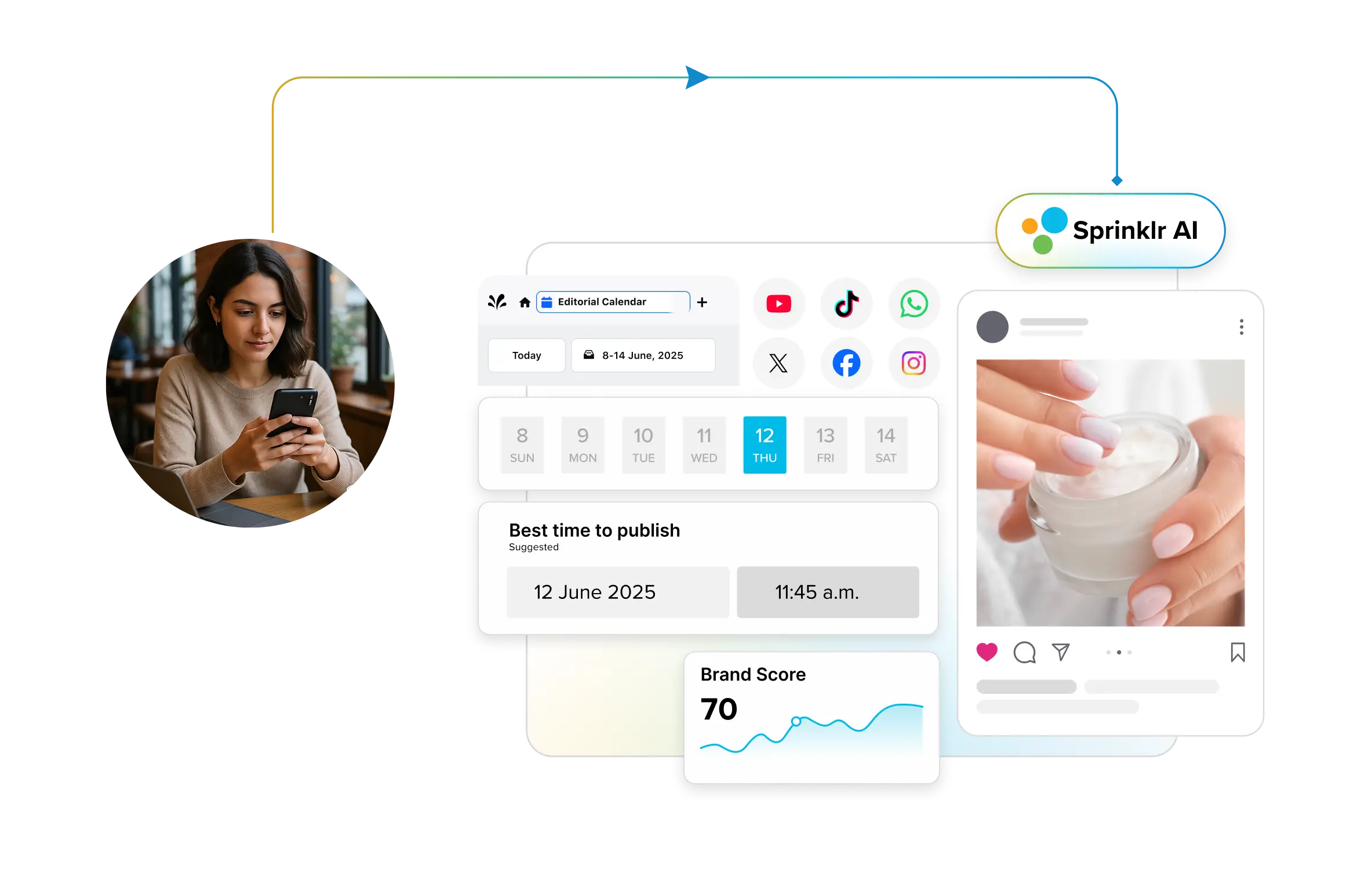
Beyond Engagement: Turning Social Media Conversations into Revenue

Across enterprise social teams, a pattern is hard to miss. The comments that arrive at odd hours, the DM asking a product question, the frustrated post after delivery — these are now sales moments. Customers don’t wait to visit a brand’s website. They learn, evaluate, and sometimes buy without ever leaving the platform.
Social is no longer an acquisition channel limited to awareness or engagement; it’s a direct contributor to purchase behavior. Globally, social commerce sales have exceeded $1.17 trillion, and mobile buying, tightly woven with social touchpoints, now accounts for nearly 59% of total online retail sales.
But most enterprises still can’t prove how social contributes to revenue. Engagement metrics are tracked in dashboards, but linking conversation to commercial results like conversions, repeat purchases, or cross-sell lift remains elusive. This article breaks down how enterprises operationalize social insights into measurable business growth.
- Conversation to conversion: social media’s evolution into a revenue channel
- Why most brands struggle to turn engagement into revenue
- How you can convert social conversations into revenue
- The social revenue loop: A simple framework to operationalize conversion
- The revenue outcomes you can unlock with a unified social strategy
- Make social your next growth channel with Sprinklr
Conversation to conversion: social media’s evolution into a revenue channel
Social media’s role has matured through three distinct phases. Initially, it was an Awareness Channel, measured by impressions, reach and follower growth. It then evolved into an Engagement Channel, where sentiment and conversation volume defined success.
Today, it is a Revenue Ecosystem (driven by intent, assisted conversions, and retention). Two shifts accelerated this phase:
- Messaging‑led commerce: Meta reports 1B+ daily active business message threads and click‑to‑WhatsApp ad revenue up ~60% YoY (Q3 2025) — evidence that discovery-to-decision increasingly happens in private threads.
- Social commerce infrastructure: Even as Meta phases out native in‑app checkout in 2025 in favor of website checkout, social platforms are doubling down on DM-first journeys and creator‑led shopping (e.g., TikTok Shop’s rapid GMV growth, especially in the U.S.).
Implication: optimizing for intent in conversations and speed-to-lead matters more than chasing feed‑level vanity metrics.
Read more: Advanced Social Media for Business: 9 Growth Strategies
Why most brands struggle to turn engagement into revenue
Despite advanced tooling, many organizations remain stalled in the engagement phase, prioritizing vanity metrics over value. This disconnect stems from four structural barriers:
- Fragmented systems: Marketing, care, and sales track interactions in different systems; context is lost, and customers repeat themselves. Without a unified view of the customer, it gets difficult to understand how one interaction influences a sale.
- Slow, manual workflows: High-intent moments have a short shelf life. Siloed teams and manual processes cause fatal delays in response. Firms that contact leads within 5 minutes are dramatically more likely to qualify them than those that wait 30 minutes or more; HBR’s classic analysis remains directionally valid in today’s messaging‑first world.
- Missed intent signals: Pre‑purchase questions like “Is this available in blue?” or “Does this integrate with X?” are buying signals that drown in volume without AI-driven classification and routing.
- Attribution blind spots (dark social): A large share of influence happens in private channels (WhatsApp, DMs, email) that don’t pass referrers; obscuring social’s true contribution and causing over‑attribution to “Direct.” Industry research consistently flags the gap and offers ways to close it (better UTMs, server‑side capture, survey lift, and modeling).
Bottom line: Generating social engagement is straightforward; converting it at scale requires intelligence, speed, and connected systems.
Also read: Measuring Social Media ROI at Enterprise Scale
How you can convert social conversations into revenue
Real impact starts when teams stop treating social listening, engagement, and measurement as separate tasks and start building a connective system between them. The transition is defined by a shift in core capabilities:
Capability | Traditional approach | Revenue-mature approach |
Listening | Volume/sentiment tracking | AI detects intent, objections, buying signals |
Response | Bandwidth-driven | Urgency-tiered, <5-min SLAs |
Cross-team alignment | Siloed teams | Shared customer view across functions |
Data flow | Manual exports | Automated CRM routing |
Metrics | Engagement rate and impressions | Assisted revenue, conversion lift, customer lifetime value (CLV) |
Implementing this model requires a strategic focus on these pillars:
1. Aligning social KPIs with revenue goals
Before you invest in tooling or workflows, set clear objectives that map to business outcomes.
Replace “engagement rate” targets with outcome-led social media KPIs like assisted conversions, revenue per campaign and average order value influenced by social. This shared accountability aligns social strategy with enterprise growth goals.
How to act:
- Define 2–3 revenue KPIs for social and map them to funnel stages.
- Create SLAs for response times on high-intent tags.
- Report assisted revenue alongside ad spend each quarter.
Read more: 9 Customer Experience KPIs to Track in 2025 (+Tips)
2. Identifying purchase intent with AI listening
Advanced Natural Language Processing (NLP) scans millions of unstructured comments and messages in real-time to surface commercial intent. It identifies patterns: questions about pricing, comparisons to competitors, logistical queries that signal a prospect entering the buying window.
What this helps you do:
- Prioritize high-value conversations instead of reacting to volume
- Spot early demand for products before launches
- Identify customers by comparing with alternatives
- Understand objections that influence drop-off
Example: A consumer electronics brand surfaces intent spikes whenever customers ask about stock availability or performance differences. Marketing activates targeted clarification posts while sales teams contact high-intent DMs, resulting in faster conversions during high-demand cycles.
Pro Tip: Strengthen your revenue pipeline by tracking intent-rich queries across all channels in one place. An AI-powered listening solution can enrich every interaction with customer history and behavior.
For example, Sprinklr’s Social Listening identifies hidden signals, uncovers patterns and builds universal profiles that help your teams respond with context. This gives you a clearer view of high-intent conversations, so you can convert them before competitors do.

Keen to explore how unified profiles support revenue impact?
3. Categorizing multi-layer intent
Intent is not one-dimensional. Enterprises that win break intent into actionable categories, tagging conversations by intent type. This lets teams apply the right playbook.
Signals to track with examples:
- Interest: “This looks cool” — nurture with education.
- Need/pain point: “I’m struggling with X” — empathize and offer solutions.
- Comparison: “Is this feature better than Y’s?” — provide side-by-side value.
- Purchase signal: “Is this available on X?” — remove friction immediately.
- Support: “I need help” — escalate to care with priority handling.
Emotional cues matter too. Urgency, frustration, excitement, and hesitation change how you respond. Tagging both intent and emotion gives your routing logic the nuance it needs to prioritize high-reward interactions.
💡 Pro Tip: Categorizing multi-layer intent is powerful but doing it manually at enterprise scale is slow, inconsistent, and hard to sustain. Sprinklr’s Generative AI-powered Zero-Shot Intent Detection, built within AI+ Studio, makes it faster and smarter.
It uses large language models to classify conversations into predefined intent categories without any training data. Teams can instantly generate new intents, refine prompts, and manage configurations, all from one unified interface.
The result: faster scaling, higher accuracy, and a consistent understanding of customer intent across every channel.
4. Responding at the right moment
Intent without action produces no revenue. Timing defines outcomes. Codify SLA tiers: e.g., respond to high‑intent DMs within 5 minutes, public high‑stakes comments within 15, and standard inquiries within 1 hour. HBR/MIT research shows qualification odds fall off a cliff beyond 5–30 minutes, and modern messaging expectations are even tighter.
How this helps:
- Reduced abandoned carts when social care resolves friction
- Higher conversion on campaign posts when teams respond in real time
- Lower negative sentiment when complaints are addressed early
- More reviews and UGC from customers who feel supported
Example: A beauty retailer notices customers often ask shade-matching questions. Fast, personalized replies increase click-through rates on product pages, boosting assisted conversions during seasonal spikes.
Read more: From Social Insights to Marketing Action: Closing the Execution Gap
Pro Tip: To hit aggressive response SLAs without adding headcount, automate the first mile: use Sprinklr Service to auto-classify incoming messages by intent/urgency/sentiment, prioritize and route them to the best‑fit agent, and arm agents with AI Copilot that summarizes the thread and suggests on‑brand replies, so high‑intent DMs move from detection to response in minutes, not queues.

5. Routing conversations to sales systems automatically
When a conversation meets intent criteria, auto‑enrich and route it into CRM or case management with full context (handle, history, last touch). This reduces manual exports and broken handoffs and gives reps “warm” opportunities already in buying mode.
Practical outcomes:
- Sales reps engage with prospects already in an active buying mindset
- Lead quality improves because social intent data enriches profiles
- Marketing, CX and sales work with the same single source of truth
- Governance improves with structured, trackable workflows
Example: A financial services provider routes all loan-related social queries into CRM workflows. Qualified leads receive callbacks within minutes, improving inquiry-to-application rates.
6. Measuring revenue impact with unified attribution
Finally, close the loop by measuring impact. Use UTM parameters, promo codes, and CRM integration to track how social interactions influence downstream conversions. Advanced attribution models can quantify how a support conversation on Twitter prevented a cancellation or how an instructional video on LinkedIn accelerated a deal cycle. This data justifies investment and guides optimization.
What you gain:
- Clear view of which social campaigns drive the strongest commercial response
- Ability to justify budget and headcount with measurable ROI
- Insight into which products generate the most social-led conversions
- Understanding of how conversation quality influences loyalty
Example: A D2C home goods brand finds that resolving delivery concerns on social increases repeat purchase rates. Unified attribution helps quantify the financial impact, which leads to increased investment in social care staffing.
When you combine these capabilities, your social shifts from a reactive channel to a system that actively drives acquisition, improves conversions, and influences long-term loyalty. Enterprises that operationalize this loop will see that the more aligned their teams, the more predictable their revenue impact becomes.
The social revenue loop: A simple framework to operationalize conversion
These pillars form a continuous, scalable cycle — the Social Revenue Loop:
- LISTEN: Capture conversations across channels with AI filters.
- INTERPRET: Tag intent and emotion, enrich with profile data.
- ENGAGE: Respond quickly with personalized, channel-appropriate messages.
- ROUTE: Push qualified leads and service issues into CRM and case workflows.
- ATTRIBUTE: Tie conversions and retention back to conversation-level signals (with dark‑social proxies).
- OPTIMIZE: Refine listening rules, response scripts, content, and staffing mix.
How Acer turned global social conversations into coordinated revenue impact
Acer manages 250 social accounts across 160+ countries, yet its most significant challenge was not volume. It was fragmentation.
After unifying its global marketing and customer care workflows using Sprinklr’s Unified-CXM platform that integrates Sprinklr Social, Sprinklr Insights and Sprinklr Service, the impact was immediate:
- 30K+ marketing posts published in 6 months
- 18% increase in customer care responses
- 50% increase in marketing asset reuse
- Faster decisions during launches, trade shows and events
- Consistent brand experience across every market
- Stronger, more personalized customer engagement
A unified platform enabled Acer to compare performance across regions, reuse high-performing assets and act on real-time insights rather than rely on scattered reports. Marketing and care teams finally operated with the same visibility, metrics, and customer context.
Learn how you can too by booking a demo now.
Also Read: 10 Impacts of Social Media on Business You Must Know
The revenue outcomes you can unlock with a unified social strategy
You’ve seen how unified listening, engagement and attribution change the way enterprises respond to customers. But what does this shift deliver in concrete business terms?
Here are some impacts you can expect when your social is connected end-to-end:
1. Reduced acquisition costs with high-intent targeting
Acting on intent-rich conversations reduces wasted spend and sharpens audience targeting. Instead of broad campaigns, social teams focus on people who are already comparing, evaluating or signaling a need. This lowers cost per acquisition and improves the quality of leads entering your sales funnel.
2. Increased conversions by engaging in the decisive moment
Real-time replies to product questions, comparisons or concerns push customers closer to a final decision. Brands that engage quickly see higher add-to-cart rates and stronger assisted conversions because they eliminate friction at the exact point of interest.
3. Strengthened retention through proactive issue resolution
Your unhappy or uncertain customers often express their concerns on social media before escalating elsewhere. Responding early prevents customer churn and builds trust. Resolving service issues in public spaces also improves perceptions for future buyers who read those threads.
4. Predicted demand with insights from real customer conversations
High-volume conversation patterns help you forecast interest, identify product gaps, and adjust messaging before a campaign goes live. This reduces waste, boosts social media ROI, and ensures that your teams act with clarity rather than assumptions.
When these outcomes compound, social becomes one of the most efficient drivers of revenue. The shift is operational, measurable, and directly tied to customer value.
Pro Tip: Tighten your social media governance model by giving every team the same rules to work with. When intent tags, urgency tiers and routing paths live in a single shared playbook, high-value conversations move faster, and handoffs feel seamless rather than siloed.
Use a workflow orchestration solution that centralizes these rules in one place. Sprinklr Service helps you automate escalations and assignments, while Sprinklr Social ensures content governance stays consistent across global markets.
Keen to see how playbooks scale across enterprise teams? Request a demo.
Interesting watch: Uncover the Hidden Strategies of Social Commerce with Jay Baer
Make social your next growth channel with Sprinklr
The evidence is clear: social media is a primary channel for commercial intent. The constraint for most enterprises is no longer creativity, but infrastructure — the lack of a unified system to convert insight into revenue.
Move beyond engagement metrics and start measuring social's direct contribution to revenue. Request a demo today to see how Sprinklr Social can transform your social conversations into a predictable growth channel. ⬇️
Frequently Asked Questions
By detecting purchase intent, responding in real time, and routing high-value interactions into CRM or sales systems. This connects social engagement directly to business outcomes like conversions, upsells, or retention gains.
Questions about pricing, availability, product comparisons, or delivery timelines often signal readiness to buy. AI tools detect these patterns at scale, helping teams act before competitors do.
Focus on conversion rate, assisted revenue, lead quality, sentiment improvement, and retention impact. Unified attribution maps these results back to the exact conversations that influenced them.
When data sits in silos, customer signals get lost between teams. A unified view combines intent, history, and context, so every department works from the same insight and can convert engagement into measurable revenue.
AI uncovers hidden buying signals, prioritizes high-intent interactions, and enriches customer profiles. This allows enterprises to respond faster, personalize outreach, and close the loop between conversation and conversion.