






Transform CX with AI at the core of every interaction
Unify fragmented interactions across 30+ voice, social and digital channels with an AI-native customer experience platform. Deliver consistent, extraordinary brand experiences at scale.




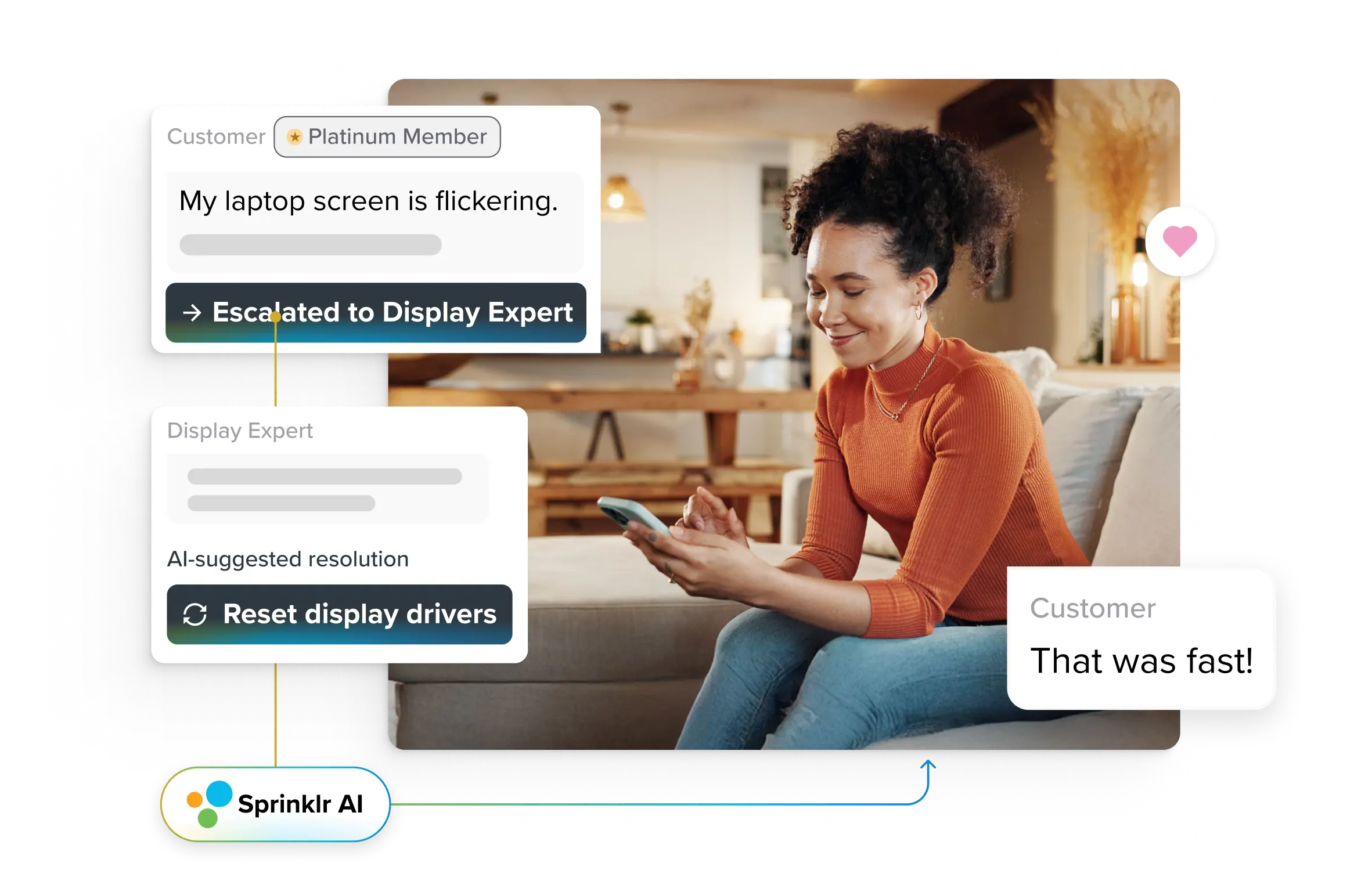
Contact Center Automation in 2026: An Actionable Guide for Modern Enterprises

The contact center has evolved from a cost center to a strategic battleground where customer loyalty is won or lost in minutes. In 2026, customers expect immediate, personalized resolutions across every channel, while economic pressures demand operational efficiency at scale. Both expectations are impossible to meet without meaningful contact center automation.
A Gartner survey has revealed that 77 percent of customer support leaders feel pressure from executives to deploy AI. While AI is the engine behind modern contact center automation, for C-suite leaders this push represents both an existential challenge and a transformative opportunity.
Strategic contact center automation directly impacts three contact center metrics that matter most:
· Revenue growth, by improving retention and recovery moments
· Operational cost reduction, through intelligent deflection and agent productivity gains
· Enterprise resilience, through a scalable, always-on customer engagement infrastructure
The window for competitive advantage is narrowing as well. As contact center automation capabilities become democratized and customer expectations continue their relentless climb, organizations that move decisively today will establish market positions that become increasingly difficult to challenge.
In this article, let's take a clear framework for understanding contact center automation in 2026, what it truly means, how to assess your organization's maturity, and how to ensure automation enhances rather than erodes the human experiences that drive lasting customer relationships.
- What does contact center automation really mean?
- Three fundamental layers of contact center automation
- A practical automation maturity model for enterprise contact centers
- Contact center automation: The implementation roadmap
- Ensuring human-centric experiences in an automated contact center
- Why Sprinklr’s AI-native platform is the best choice for contact center automation
What does contact center automation really mean?
Despite how often the term is used, contact center automation is widely misunderstood. It’s not a chatbot. It’s not a handful of AI shortcuts. And it’s definitely not a linear “replace humans with machines” exercise.
Contact center automation is the end-to-end use of AI, analytics, and automated workflows to handle customer interactions, augment agent performance, and streamline contact center operations, at scale.
Here, you must also note that contact center automation is not about eliminating human contact center agents but about intelligently distributing work between machines and people based on capability, context, and customer preference.
Three fundamental layers of contact center automation
At its foundation, contact center automation operates across three fundamental layers that work in concert to transform customer engagement:
1. The interaction layer
This is where automation becomes visible to the customer. It includes every touchpoint such as voice, live chat, messaging, email where a conversation begins, and where expectations for speed and personalization are set.
Modern interaction layers go far beyond traditional IVRs or static scripts. They include:
- Conversational AI capable of understanding natural language across voice and digital channels.
- Intelligent virtual agents that authenticate customers, resolve routine inquiries, and hand off gracefully when human expertise is required.
- Omnichannel routing engines that match customers to the right resource — automated or human — based on intent, history, emotion, and real-time context.
The sophistication here lies not in replacing human interaction, but in creating fluid, context-rich journeys where customers can move between self-service and live assistance without repeating themselves, revalidating information, or feeling abandoned by automation. In 2026, the interaction layer is defined by continuity, not containment.
2. The intelligence layer
If the interaction layer is the “front door,” the intelligence layer is the cognitive engine that makes sense of every signal, every data point, and every customer cue.
This layer synthesizes inputs from:
- CRM and ticketing systems
- Interaction history and behavioral patterns
- Knowledge bases and product documentation
- External data sources such as logistics, billing, or device telemetry
Using this data, machine learning models:
- Interpret intent and customer sentiment
- Predict customer needs and potential failure points
- Recommend next-best actions to agents or automated systems
- Continuously learn from successful and failed resolutions
Natural language processing translates unstructured customer expression into structured signals that trigger workflows. And increasingly, predictive intelligence enables proactive customer service, surfacing information before the customer even articulates a need. In a mature operation, the intelligence layer anticipates, guides, and accelerates customer journeys.
3. The orchestration layer
The orchestration layer is the part that ensures automation doesn’t operate in silos but instead moves tasks fluidly across systems, contact center channels, and teams. Key capabilities include:
- Workflow automation engines that trigger processes based on customer behavior or system events.
- Integration frameworks and APIs that connect telephony, contact center CRM, knowledge management, billing, WFM, and back-end systems.
- Context propagation to ensure information collected by automation carries through to human agents.
- Real-time resource management, including queue prioritization, callback scheduling, and load balancing across channels.
- Policy and compliance enforcement to ensure guardrails remain intact even as automation scales.
When orchestration is strong, customers experience one coherent journey, even though dozens of systems and decision points may be working behind the scenes.
A practical automation maturity model for enterprise contact centers
Below is a maturity model that helps leaders understand what to implement first, why it matters, and how each stage strengthens the next.
Stage 1: Manual operations with basic tooling
At this foundational stage, the contact center operates predominantly through human effort supported by disconnected legacy systems. Basic IVR provides keypad-based routing with no intent recognition. Agents toggle between multiple applications without unified authentication, context persistence, or workflow automation. Documentation is captured manually in CRM systems after each engagement, and knowledge remains distributed across tribal memory, email threads, and outdated documentation repositories.
The customer experience is inconsistent because outcomes rely heavily on individual agent skill, memory, and system navigation speed. Average handle times (AHT) increase due to manual effort and context switching. First-contact resolution suffers because agents lack unified context and guidance, resulting in unnecessary transfers or repeat contacts.
Organizations at this stage face compounding challenges: growing contact volume, rising customer expectations, and cost structures that scale linearly with demand. The business case for automation becomes increasingly compelling, but leaders often lack clarity about prerequisites.
The first critical step is to establish strong data hygiene, integrate systems, and move away from outdated infrastructure that cannot support advanced automation.
Stage 2: Structured self-service and agent assistance
The second stage introduces deliberate automation for high-volume, routine interactions while improving agent effectiveness for complex cases. Organizations deploy conversational IVR with basic natural language understanding (NLU), web-based self-service portals, and FAQ chatbot for interactions across digital channels.
Agent productivity receives its first major lift. Desktop integrations create consolidated workspaces, reducing the need to toggle between systems. Knowledge base platforms provide consistent, searchable content. Screen pops surface contextual customer data upon call arrival. Early forms of automated after-call work generate templated summaries or trigger system updates.
💡Key takeaway
The maturity shift from Stage 1 is meaningful, but automation remains rule-based, isolated, and channel-specific. Chatbots and IVRs operate independently, leading to context discontinuity when customers move across channels. Intelligence is limited to pattern matching and predefined scripts with no learning loop or closed-loop optimization.
Organizations typically see measurable cost relief and improved capacity at this stage, but customer satisfaction improvements are modest. Automation handles volume but doesn’t yet create personalized, predictive, or entirely seamless experiences. The next stage requires adopting advanced AI capabilities and unifying cross-channel data.
Stage 3: Intelligent automation with limited orchestration
Stage 3 represents a major capability leap. Organizations deploy AI systems that understand intent, maintain conversation state, and manage multi-turn interactions with higher accuracy. Conversational AI now clarifies ambiguous requests, recognizes sentiment, and dynamically adapts responses. Virtual agents can execute moderately complex workflows, such as billing inquiries, appointment scheduling, or basic troubleshooting.
Machine learning models begin to predict customer needs using historical behavior, product telemetry, and interaction outcomes. Intelligent routing incorporates real-time signals such as customer value, emotional state, and agent expertise. Agent assist capabilities provide real-time recommended actions, summarize conversations, and generate contextual responses.
📌Enterprise challenge
In this stage, orchestration, however, remains partial and brittle. While systems can share limited context across channels, authentication, data integrity, and workflow continuity often break down during transitions. Automation handles a broader scope of inquiries but still relies on deterministic boundaries — novel situations, multi-system transactions, and exception handling require human intervention.
Organizations at Stage 3 achieve significant efficiency gains and measurable improvements in CX. But experiences remain transactional rather than deeply personalized, and operational seams become more visible as complexity grows.
Stage 4: Adaptive intelligence with seamless orchestration
The fourth stage represents operational excellence. You achieve true omnichannel continuity, where experience, intent, and sentiment persist across every interaction and transition. The system not only remembers what your customer said but also interprets why they reached out and what outcome they are trying to achieve.
Basically, automation becomes adaptive. AI-driven decision engines dynamically adjust workflows based on behavior, historical patterns, and real-time signals. Virtual agents know when to escalate and execute warm handoffs with full context propagation. Human agents receive the recommended following actions, risk indicators, and personalized coaching cues powered by AI.
It is also at this stage that quality assurance undergoes a complete transformation. AI evaluates 100% of interactions, extracting compliance issues, coaching opportunities, sentiment trends, and emerging product signals. Organizations at Stage 4 maximize the strategic value of contact center automation. Operational costs fall sharply while CX, loyalty, and digital containment rise. The contact center becomes a proactive, insight-generating function rather than a reactive cost center.
Stage 5: Predictive and prescriptive experience orchestration
Automation now orchestrates entire customer journeys. Instead of waiting for inbound demand, the system sends personalized notifications, proactively issues fixes, initiates outreach, or coordinates human follow-up. Virtual agents evolve into persistent digital companions that maintain long-term context, preferences, and history across sessions.
The intelligence layer incorporates deep behavioral modeling, dynamic preference learning, and real-time simulation of likely outcomes. Prescriptive analytics determine optimal interventions, what message to send, via which channel, at what time to maximize resolution, retention, or revenue expansion.
💡Do you know
Only a small subset of enterprises operate at this level today due to the demanding technical, operational, and governance requirements. Achieving Stage 5 requires mature data ecosystems, unified conversation architectures, multi-model AI governance, and cross-functional alignment across marketing, product, engineering, and CX.
This is also where platform choice becomes decisive. Most legacy stacks weren’t designed to support continuous learning loops, omnichannel context persistence, or AI-driven orchestration at enterprise scale. Platforms with a unified data foundation and integrated AI capabilities—such as Sprinklr Service, which brings routing, conversational AI, knowledge, case management, and analytics onto a single architecture- give you the structural advantage needed to progress toward predictive and prescriptive service.
Rather than stitching disparate tools together, you can focus on redesigning customer journeys, strengthening governance, and accelerating automation maturity with a platform built for end-to-end, AI-driven service delivery.

It includes every touchpoint and interaction that a customer has with your company, including marketing, sales, finance, logistics, customer service, product or service delivery, and ongoing engagement. It even includes touchpoints your customers have with each other.
Contact center automation: The implementation roadmap
Strategic vision without tactical execution remains theoretical. Enterprise contact center automation requires disciplined implementation that balances ambition with pragmatism, delivers measurable value incrementally, and builds organizational capability systematically. The roadmap below provides a structured approach for translating contact center automation strategy into operational reality.
Phase 1: Foundation and assessment (Weeks 1–8)
- Assess current capabilities: Map your customer journeys across communication channels, analyze interaction volumes and contact drivers, evaluate agent workflows, and identify repetitive tasks or handoff failures. This reveals both quick wins and structural constraints that may slow automation.
- Define measurable objectives: Set clear targets for AHT, FCR, CSAT, containment, and cost per interaction. Align 12–24-month goals with enterprise priorities — cost reduction, digital scale, customer experience, or operational resilience.
- Secure cross-functional alignment: Transformation requires sustained support from IT, operations, CX, and business teams. Establish governance early, communicate expected benefits and timelines, and proactively address workforce impact with clear role-evolution plans.
- Prioritize high-value use cases: Rank opportunities by business impact and implementation feasibility. Start with a small set of automation-ready interactions to build momentum and organizational confidence.
Phase 2: Infrastructure and integration (Weeks 6–16)
- Unify customer data: Implement an integration layer that aggregates CRM, billing, product, and support data into a reliable, governed source. Poor data quality guarantees poor automation performance.
- Modernize integration architecture: Deploy API frameworks and reusable connectors to link telephony, CRM, knowledge, WFM, and automation systems. Standardizing integrations accelerates future automation.
- Strengthen knowledge management: Consolidate knowledge into a structured, searchable platform designed for both human agents and machine consumption. Good knowledge is the fuel of consistent automation.
- Establish analytics and monitoring: Build contact center dashboards that track operational performance, customer experience signals, and automation accuracy. Real-time alerting helps detect issues early and maintain trust.
Phase 3: Pilot and optimization (Weeks 12–24)
- Launch automation for selected use cases: Deploy virtual agents, intelligent routing, or agent assist for a limited audience. Keep scope tight to maximize learning.
- Test thoroughly: Validate accuracy across common, edge, and failure scenarios. Test load capacity and confirm seamless escalation to human agents when automation is insufficient.
- Roll out gradually: Release to a subset of customers or interactions and monitor closely. Track containment, CSAT, sentiment, and escalation patterns. Reinforce human-in-the-loop safeguards.
- Refine continuously: Use interaction logs to improve NLU models, knowledge content, and routing logic. A/B test enhancements to objectively measure impact. Pilots should behave like “learning loops,” not launches.
Phase 4: Scale and enhance (Months 6–18)
Once early wins are validated, expand automation with discipline.
- Expand automation coverage: Add new use cases and channels, ensuring consistent cross-channel capabilities and unified context as customers move between bot and agent.
- Increase intelligence and personalization: Introduce predictive routing, sentiment-driven interventions, and tailored responses based on customer history and preferences.
- Strengthen agent augmentation: Scale real-time guidance, automated summaries, and quality automation. Augment (not replace) human capability for complex or emotionally sensitive interactions.
- Measure and communicate results: Track improvements against objectives, quantify contact center ROI, share wins, and keep contact center transformation visible across the organization. Momentum is a strategic asset.
Phase 5: Continuous evolution (Months 12+)
Automation maturity is a sustained operating model, not a finish line.
- Institutionalize continuous improvement: Review performance regularly, feed insights into enhancement cycles, and create closed-loop learning processes between customer interactions, agents, and AI models.
- Advance capabilities incrementally: Progress toward predictive and proactive service. Strengthen orchestration for end-to-end journeys and explore generative AI for dynamic guidance and resolution.
- Evolve people and processes: Upskill agents for higher-value work, build internal automation expertise, and foster a culture of experimentation.
- Stay aligned to business strategy: Revisit priorities as market conditions and customer expectations shift. Keep automation human-centric. Technology should amplify empathy and effectiveness, not replace it.
💬 Customers often ask
“We’re mapping where contact center automation can actually take work off agents. Which tasks are realistic to automate end-to-end?”
A good rule of thumb: if a task is repetitive, predictable, and doesn’t require empathy, it’s probably automatable. AI can now handle tasks such as identifying intent, pulling up customer details, answering routine questions, generating call summaries, updating cases, and handling most after-call work. It can even resolve common requests, such as order status or password resets, on its own. The goal isn’t to replace agents, but to clear their plate so they can focus on the conversations that really need a human.
Ensuring human-centric experiences in an automated contact center
Human-centric service doesn’t happen by accident in an AI-driven contact center. It requires designing automation, so it amplifies human capability, preserves empathy, and adapts to the emotional reality of customer conversations. A helpful way to frame this balance is through a modern interpretation of the Technology–Customer–Agent Triangle, where each interaction may activate two or all three vertices depending on context.
When AI handles the routine, humans can focus on what matters most
In Heineken Brazil’s transformation with Sprinklr Service, contact center automation now resolves a large percentage of high-volume, repetitive interactions across digital channels. Routine inquiries, such as order status, product questions, and basic troubleshooting, are handled instantly by AI-powered virtual assistants. This shift reduced agent workload by 69% and accelerated SLA performance by 75%.
But the real story isn’t the automation numbers. It’s what they enabled. Because automation absorbed the repetitive workload, agents gained the bandwidth to focus on complex, sensitive, and high-value conversations — moments when judgment, reassurance, and empathy create far more customer value than task execution ever could.
This is the “customer ↔ technology” vertex working efficiently, so the “customer ↔ employee” vertex can operate at its highest level.
Human agents should remain at the emotional center of service
Automation is most effective when it becomes a quiet exoskeleton for human agents, not a replacement for them. Platforms like Sprinklr Service exemplify this by supporting the “three-vertex” mode of the triangle:
- Customers may begin with self-service powered by AI.
- When human intervention is needed, context, history, and sentiment carry forward.
- Agents receive real-time insights, suggestions, and knowledge from AI in the background without customers ever seeing the complexity beneath.
This model ensures that automation never isolates the customer. It enriches the human conversation with better information, faster access, and more tailored decision-making.
💬 Customers often ask
“I want contact center automation to feel helpful, not like deflection. What design choices keep the experience human?”
Make automation feel like support, not a barrier. Start by being transparent — tell customers what the bot can do and how to reach a human at any time. Use intent and sentiment signals to recognize when frustration appears and hand off immediately with full context. Keep the experience conversational, not scripted, and design journeys where automation adds value (faster answers, fewer steps) instead of blocking access. When customers feel in control, automation feels helpful rather than dismissive.
Why Sprinklr’s AI-native platform is the best choice for contact center automation
As contact centers race toward AI-driven operations, the biggest differentiator won’t be who deploys automation first — but who deploys it right. The leaders will be the organizations that choose platforms built for end-to-end, human-centric, omnichannel service at enterprise scale. And this is where Sprinklr’s AI-native omnichannel contact center platform stands apart.
Most contact centers today are held back by fragmented technology — one tool for voice, another for chat, another for bots, another for case management, and even more duct tape holding the data together. Automation often fails not because AI isn’t powerful enough, but because the underlying architecture can’t support consistent context, continuity, and intelligence.
With Sprinklr Service, built on the Unified-CXM platform, every channel, every conversation, every signal, and every AI model runs on one unified platform. That means:
- One place to orchestrate customer journeys
- One knowledge layer powering both agents and automation
- One data foundation that preserves context across every touchpoint
- One AI engine that learns from every interaction and improves continuously
Executives no longer need to integrate five vendors just to automate one journey. Sprinklr eliminates complexity so you can focus on outcomes, not plumbing.
Sprinklr’s customers — from global telcos and banks to retailers and public-sector organizations are already achieving:
- Dramatically higher containment
- Lower handle times and operational costs
- Stronger customer satisfaction
- More empowered, less overwhelmed agents
- Faster time to value and easier scaling
You can explore real-world transformations under Sprinklr customer stories. But the most meaningful first step is a conversation. An expert-led demo will show exactly how Sprinklr can help you automate your contact center with speed, intelligence, and confidence.
Frequently Asked Questions
Start with a unified framework that standardizes workflows and data models across regions. Then, introduce AI tools that support multilingual models and local compliance requirements. Centralized governance with region-specific customization helps maintain consistency while adapting to regional nuances.
No, and it shouldn’t. Automation is best suited for repetitive, rules-based tasks, while humans handle high-stakes interactions. The most effective contact centers use a hybrid model where AI assists agents, ensuring both speed and empathy.
Costs vary depending on scale, channels, and existing systems. Many enterprises start with targeted use cases to prove ROI before expanding. Platforms like Sprinklr Service allow modular deployment, helping organizations scale automation investments gradually and efficiently.
Rushing deployment without clear use cases or training is the biggest mistake. On top of it, poor data quality and limited change management often derail results. Start small, monitor closely, and continuously refine models based on feedback.
Treat automation like a new team member: it should only access the data it truly needs. Sensitive fields such as payment information, full card numbers, passwords, government IDs, health details, or internal notes not intended for customers should stay off-limits unless tightly controlled and encrypted. Use role-based access and mask anything the bot doesn’t need to resolve an issue. Just as important, every automated action should be logged the same way a human action is: who (or what) did it, when, why, and what system was touched. Clear audit trails protect customers, agents, and your automation program as it scales.
